
California unemployment benefits are weekly EDD payments for workers who lost a job through no fault of their own and meet wage and availability rules. Amounts come from past earnings, not current need.
That wage-based formula explains why a one-week unpaid waiting period applies before any payment, no matter how high your highest-earning quarter was.
That $450 cap hasn’t risen since January 2005, so it rarely covers a full paycheck’s gap.
California Unemployment Benefits in 2026: Quick Answers
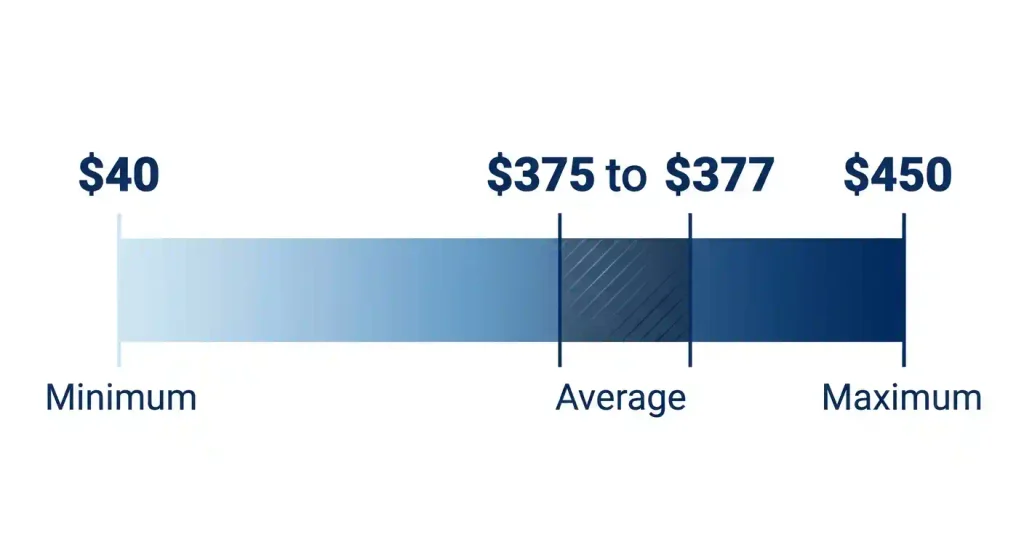
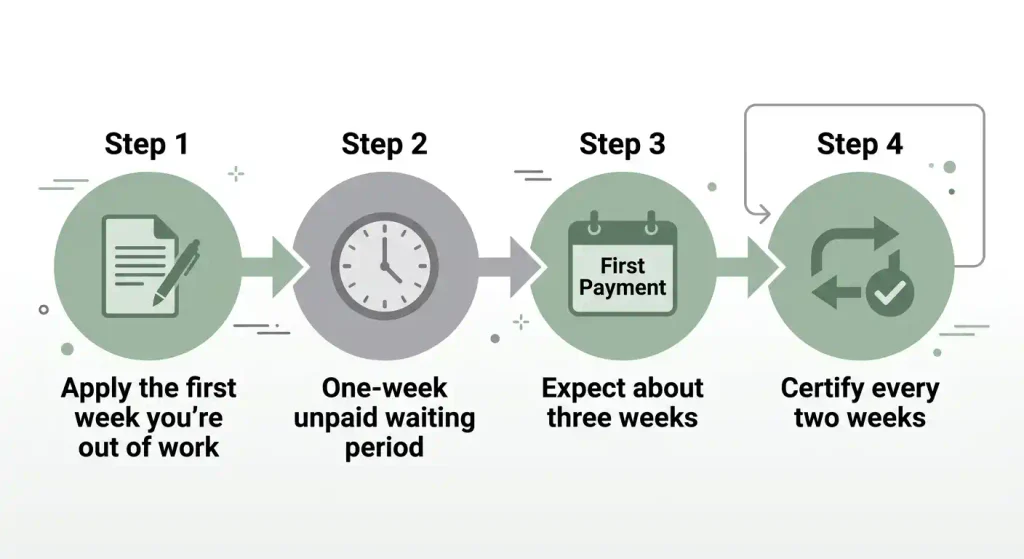
Your weekly check runs $40 to $450, lasts up to 26 weeks, and your first payment takes about three weeks. Apply the week you lose work.
How Much Can You Get in California Unemployment Benefits?
The 2026 range is $40 to $450 a week; EDD’s average check was about $375 to $377. You hit the $450 maximum only if your highest-paid quarter was $11,674.01 or more. Your amount comes from past wages, so coworkers laid off together can get different checks.
How Long Can You Receive Unemployment Benefits?
Regular benefits last up to 26 weeks within a 52-week benefit year. Your total claim balance is the lower of 26 times your weekly amount or half your base-period wages, so at $450 a week the most you can collect is $11,700. Once it runs out, payments stop.
When Will You Receive Your First Unemployment Payment?
Expect about three weeks, if nothing needs review. Your first eligible week is an unpaid waiting week and does not pay. EDD processes your application, decides eligibility, then pays after you certify, and a hold at any step slows the money.
Who Qualifies for California Unemployment Benefits?
You qualify if you lost work through no fault of your own, earned enough in your base period, and can work right now. EDD checks all three.
Basic Eligibility Requirements
These are the California unemployment eligibility requirements EDD checks for every claim: monetary eligibility requirements, proving you paid into the system through wages, and non-monetary eligibility requirements, proving you lost work through no fault of your own and are able, available, and ready to accept a suitable job, the suitable work requirement. Employers fund the system via the Federal Unemployment Tax, or FUTA, and California’s State Unemployment Tax Act, or SUTA, never your paycheck. Turning down a suitable offer without good reason can end benefits. Every two weeks you certify you are still looking; acceptable work search activities include applications, job fairs, or a resume on CalJOBS, with no fixed number required, but keep a list of employers contacted in case EDD asks.
Can You Get Unemployment If You Were Laid Off?
Usually, yes. A layoff, downsizing, or closure meets the no-fault test, as do temporary layoffs when there’s simply no work. You still need enough base-period wages and must stay available.
Can You Collect Unemployment If You Were Fired?
Sometimes. Being fired alone does not block benefits. EDD asks whether you were fired for misconduct, a willful act against your employer’s interest under California Unemployment Insurance Code Section 1256. Poor performance or an honest mistake usually does not count; repeated unexcused absences or serious violations can. EDD hears both sides and decides.
Can You Get Unemployment If You Quit Your Job?
Only with good cause, a reason so serious a reasonable person would quit too, like unsafe conditions or a big change in pay or hours. Boredom or wanting a change usually does not qualify. EDD reviews your reason and any proof you have.
Can You Qualify If Your Working Hours Were Reduced?
Yes, this is called partial unemployment. If your employer cuts your schedule, closes briefly, or gives fewer shifts, you can still file. Your benefit shrinks as earnings rise (see the part-time section below), and you must report what you earn each week.
How Much Unemployment Will You Receive in California?
Expect $40 to $450 a week, set from your highest-paid base-period quarter, not your last paycheck. Your award notice has the final figure.
California Unemployment Weekly Benefit Amounts for 2026
The 2026 minimum is $40 and the maximum is $450, unchanged since January 2005; California adds nothing for dependents. EDD sets your amount from an unemployment insurance benefit table based on your highest quarter of wages, and its online benefit calculator gives a quick estimate on the California EDD official website. Your notice of award is official.
How EDD Calculates Your Unemployment Benefits
EDD looks up your highest base-period quarter in its table to set your Weekly Benefit Amount (WBA), roughly that quarter’s wages divided by 26, capping at $450 once that quarter hits $11,674.01 or more. Your total claim, the Maximum Benefit Amount (MBA), is the lower of 26 times your WBA or half your base-period wages. EDD’s benefit determination guide shows the full math.
California Unemployment Base Period Explained
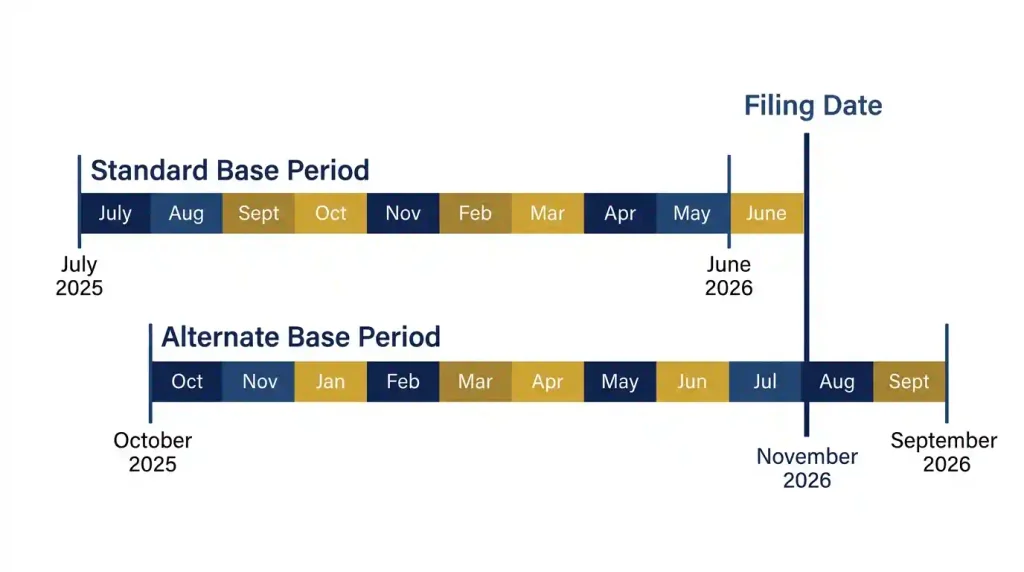
The base period is a 12-month window of wages EDD checks. The standard base period is the first four of the last five completed quarters (filing in November 2026 means July 2025 through June 2026). If too low, EDD uses an alternate base period, the last four completed quarters (October 2025 through September 2026). Your filing date decides which wages count.
Minimum Earnings Required to Qualify
You need one of two things in your base period:
- Earn at least $1,300 in your highest quarter
- Earn at least $900 in your highest quarter, with total base-period wages at least 1.25 times that quarter
Example: a $1,000 best quarter plus $400 elsewhere totals $1,400, above $1,250, so you qualify; $1,100 would not. EDD mails the result in a monetary determination notice.
California Unemployment Benefit Calculation Examples
These estimates show how the highest quarter drives the check.
| Situation | Highest quarter | Estimated weekly benefit |
|---|---|---|
| Steady $4,000 a month | $12,000 | $450 (maximum) |
| Steady $2,800 a month | $8,400 | About $320 |
| Quarters of $5,000, $5,500, $14,000 (big commission), $5,000 | $14,000 | $450 (maximum) |
The third row shows one strong quarter can lift your check to the cap even with low other quarters. Use EDD’s calculator with your own wages, then check your award notice for the real number.
What Is the Maximum Unemployment Benefit You Can Receive?
The most is $450 a week, $11,700 total (26 weeks x $450), but a $450 check doesn’t guarantee 26 weeks. Example: $12,000 in one quarter plus $3,000 elsewhere totals $15,000, so half ($7,500) at $450 a week lasts about 16 weeks. Steady high wages all year gets the full 26.
How to Apply for California Unemployment Benefits
Apply online through myEDD and UI Online. Have your Social Security number, ID, and work history ready. Register with CalJOBS if told to, and watch for your award notice.
When Should You Apply After Losing Your Job?
Apply the first week you’re out of work or your hours drop, not your last paycheck. Your claim starts the week you file, so skipped weeks are usually lost. Your filing date also sets your base period, so waiting can change which wages count.
Information and Documents Needed to Apply
Gather these before applying:
- Social Security number and a government ID
- Work authorization details, if not a U.S. citizen
- Employer names, addresses, dates worked, and pay for roughly the past 18 months
- SF-8 (federal workers) or DD-214 (veterans), if relevant
Worked in multiple states? File an interstate claim to combine wages. Moved out of California? File with California EDD, since the state where you earned the wages decides your claim, but also register for job search services with your new state’s local employment office within 21 days of applying, a separate deadline from CalJOBS registration, or you could be denied.
How to Apply Through myEDD and UI Online
Create a myEDD account, open UI Online, and start your initial claim. Check your answers before submitting and save the confirmation. UI Online then shows your claim status and messages.
Registering for CalJOBS After Applying
Some claimants must register with CalJOBS, California’s job-matching site. If your Notice of Requirement to Register for Work (DE 8405) says so, you have 21 days (the CalJOBS registration deadline) to register and post a resume, or your payments can delay or stop.
What Happens After You Submit Your Application?
EDD checks your wages against employer reports and reviews eligibility, then sends a benefit award notice, the Notice of Unemployment Insurance Award (DE 429Z), showing your weekly amount and claim balance. It may schedule a phone eligibility interview, sometimes after a Request for Eligibility Information (DE 4365FF); answer any request by its deadline. If denied, EDD sends a Notice of Determination (DE 1080CZ); you can appeal within 30 days using an Appeal Form (DE 1000M) to the California Unemployment Insurance Appeals Board (CUIAB), where an Administrative Law Judge (ALJ) hears both sides. EDD may pay conditional unemployment payments during an appeal, repayable if you lose.
How to Certify for California Unemployment Benefits
Certifying means telling EDD every two weeks you’re still out of work and able to work. No certification, no payment; approval alone doesn’t pay you.
What Is Unemployment Certification and Why Is It Required?
Every two weeks you answer questions proving you still qualify: were you able and available, did you look for work, did you earn or turn down anything? EDD pays only certified weeks; approval once doesn’t keep payments flowing.
How to Certify for Benefits Through UI Online
Log in to UI Online when due and answer honestly on your Continued Claim Form (DE 4581CTO), reporting gross pay via EDD’s Weekly Wage Reporting Tool. Submit and save the confirmation, or certify by phone through Tele-Cert. UI Online also shows your EDD claim status.
What Happens If You Miss an Unemployment Certification?
Payments stop until you certify. Certify as soon as possible and be ready to explain the delay. An inactive claim may need reopening in UI Online; otherwise, contact EDD by phone or UI Online.
Can You Work Part-Time While Receiving Unemployment?
Yes, you can work part-time and still collect if you report your pay. No work, no earnings that week means your full unemployment benefits for it. California ignores part of your earnings, then subtracts the rest.
California Partial Unemployment Benefits Explained
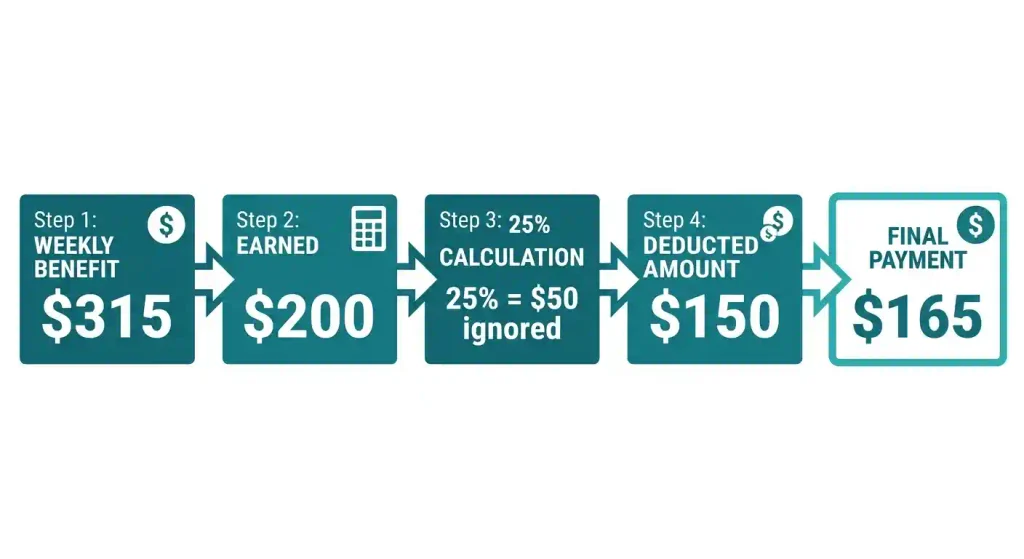
EDD ignores the first $25 of weekly earnings or 25%, whichever is more, and subtracts the rest. EDD’s example: a $315 benefit with $200 earned (25% = $50 ignored) deducts $150, paying $165.
Which Earnings Must You Report to EDD?
Report all gross pay for work done that week, before taxes: hourly wages, overtime, tips, commissions, bonuses, holiday pay, vacation pay, and self-employment income. Report when earned, not when paid; small gig income counts too.
What Happens If You Earn More Than Your Weekly Benefit?
That week’s payment can drop to zero, often with extra shifts or a short temp job. Still report earnings and keep certifying; your claim stays open and that week’s balance isn’t reduced. Unreported earnings can bring a Notice of Overpayment (DE 1444CT) and recovery of the money, and false information under California Unemployment Insurance Code Section 1257 brings fraud penalties too.
How and When Will You Receive Unemployment Payments?
EDD pays by direct deposit, debit card, or check after each two-week certification. UI Online shows what’s paid and pending.
California Unemployment Payment Methods
EDD offers direct deposit, a Money Network prepaid debit card, or checks by mail, chosen and changeable in UI Online. Direct deposit is simplest, and UI Online keeps your full payment history.
How to Check Your EDD Unemployment Claim Status
Log in to UI Online to see your claim status, payment history, and notices. Pending means EDD is still reviewing something, so check messages for requests or an interview and respond fast.
Why Is Your California Unemployment Payment Delayed?
Usual causes: identity checks (often via ID.me), an open eligibility question, a missed certification, mismatched wages, or incomplete answers. Check UI Online, fix what’s flagged, certify on time, and call EDD if nothing changes.
Special Situations That Can Affect Your Unemployment Eligibility
Your work type, pay arrangement, school, health, or immigration status can change the answer. EDD decides case by case, so file and let it review.
Can Independent Contractors and 1099 Workers Get Unemployment?
Usually not, since unemployment insurance covers W-2 employees, and self-employed people generally don’t qualify because they haven’t paid in. But your tax form label isn’t final: California’s ABC test for worker classification makes many contractors, including gig economy workers, legally employees. If misclassified, apply anyway and let EDD decide.
Can Seasonal and Temporary Workers Collect Unemployment?
Yes, with enough base-period wages and readiness to work, like a farm worker after harvest or a holiday retail hire. School employees and substitute teachers face extra rules during breaks: EDD generally won’t pay if you have reasonable assurance of returning next term. Otherwise, keep certifying and looking for work.
Can You Collect Unemployment If You Receive Severance Pay?
Often yes, but details matter. EDD looks at what the payment is for and which weeks it covers; a lump sum differs from notice-period or vacation pay, and can sometimes delay or reduce benefits. Report it and answer EDD’s questions.
Can You Receive Unemployment While Attending College or Job Training?
Yes, if you stay able and available for work. School alone doesn’t disqualify you. California Training Benefits (CTB) can extend benefits for EDD-approved training and change work-search rules, so ask EDD before enrolling.
Can You Collect Unemployment If You Are Sick or Injured?
Not while unable to work; unemployment needs you able and available. If illness or injury stops you, California State Disability Insurance (SDI) pays up to $1,765 a week in 2026, and you can estimate your payout with the SDI calculator. Hurt on the job? Workers’ compensation applies instead, usually not both at once. The right program depends on why you can’t work.
Can Non-US Citizens Receive California Unemployment Benefits?
Yes, if authorized to work in the U.S. and meeting wage rules. EDD verifies your authorization and requires qualifying wages earned while authorized. Have documents ready; work authorization and wage history decide it, not citizenship.
California Unemployment Benefits vs. Other Financial Assistance
Unemployment pays when you lost work. Disability and paid leave programs pay when you can’t work or need to care for someone, different programs with different tests.
| Program | Who It’s For | 2026 Weekly Max |
|---|---|---|
| Unemployment Insurance (UI) | Lost a job, able to work | $450 |
| State Disability Insurance (SDI) | Can’t work due to illness, injury, or pregnancy | $1,765 |
| Paid Family Leave (PFL) | Caring for a seriously ill family member or bonding with a new child | $1,765 |
Unemployment Insurance vs. California Disability Insurance
Unemployment is for people who can work but have no job; SDI is for people who can’t work due to illness, injury, or pregnancy. Apply for unemployment if laid off and healthy, SDI if a medical issue stops you. Eligibility decides, not which pays more.
Unemployment Benefits vs. Paid Family Leave
Paid Family Leave (PFL) pays to care for a seriously ill family member or bond with a new child; unemployment pays when you lost work. You can’t collect both for the same week, since PFL assumes a job to return to. PFL’s 2026 weekly maximum is $1,765.
Can You Receive Unemployment and Social Security Benefits Together?
You may receive both unemployment and Social Security retirement benefits, but must report the retirement income under California’s Social Security earnings limit rules. California can reduce unemployment for pension or retirement payments tied to a base-period employer, and you must stay able and available for work. Tell EDD about retirement income when you apply.
What Happens When Your California Unemployment Benefits Run Out?
Regular benefits stop when your balance runs out or after 26 weeks, whichever comes first. Extensions aren’t guaranteed; next steps are a new claim, if you qualify, or other aid.
Can You Extend Unemployment Benefits After 26 Weeks?
Not automatically. Extensions depend on federal programs from the U.S. Department of Labor or state unemployment-rate triggers; Extended Benefits has not been active in California through late 2026. Check EDD’s Extended Benefits page for current status. California Training Benefits can also extend benefits for approved training.
Can You Reopen or File a New Unemployment Claim?
Lose a new job in the same benefit year? Reopen your claim and use your remaining balance, which simply stays on file if you return to work before it runs out. After the benefit year ends, file a new claim; you need new qualifying wages in the new base period.
Financial Assistance Options After Unemployment Benefits End
CalFresh covers food; Medi-Cal and Covered California cover health (losing job-based coverage opens a special enrollment window). Your county or 211 can point to rent and utility help. Most programs are income based, so check each site for current rules.
California Unemployment Benefits: Myths and Misconceptions
Most wrong ideas come from assuming every case is the same. EDD reviews each claim by its facts and your wages.
You Automatically Qualify If Your Employer Fires You
Not true. EDD decides whether the firing was for misconduct, weighing both sides. Many fired for poor fit or honest mistakes still qualify, if they have enough base-period wages.
You Cannot Receive Unemployment If You Work Part-Time
Wrong. Part-time work only reduces your check. EDD ignores the first $25 or 25% of earnings, whichever is more, then subtracts the rest. Report pay and keep certifying.
You Must Receive the Maximum $450 Every Week
Not so. $450 is a cap; your check depends on your highest base-period quarter, and the 2026 average was about $375. You need $11,674.01 in one quarter to reach the cap.
Your First Payment Arrives Immediately After Approval
It does not. The first eligible week is an unpaid waiting week, and EDD pays only after you certify, roughly three weeks from application, longer with review.
Independent Contractors Can Never Qualify
Not always true. If EDD finds you were really an employee under California’s ABC test, your pay counts as wages. EDD can review your classification when you apply.
Unemployment Benefits Are Tax-Free
Wrong. Federal income tax applies, reported to the Internal Revenue Service (IRS); California does not tax it, confirmed by the California Franchise Tax Board (FTB). EDD provides Form 1099-G each January, and you can ask it to withhold 10% for federal tax.
Frequently Asked Questions About California Unemployment Benefits
Short answers are below. Your award notice from EDD is always the final word on your own claim.
How Much Is the Maximum Unemployment Benefit in California in 2026?
It’s $450 a week, $40 minimum, based on your highest-paid base-period quarter.
How Long Does It Take to Get Approved for California Unemployment?
EDD estimates about three weeks. Identity checks, wage mismatches, or an eligibility review can add time.
Can I Collect Unemployment If I Quit My Job?
Only with good cause, such as unsafe conditions or a major change in your job. EDD reviews your reason and your evidence.
Can I Receive Unemployment If I Was Fired?
Yes, unless EDD finds misconduct caused the firing. A termination by itself does not disqualify you.
Do I Have to Pay Taxes on California Unemployment Benefits?
You owe federal income tax on them. California does not tax these benefits. Expect a Form 1099-G from EDD.
How Often Do I Need to Certify for Unemployment?
Every two weeks. You confirm that you were able, available, and looking for work.
Can I Receive Unemployment While Working Part-Time?
Yes. Report your gross pay. EDD ignores the first $25 or 25% of earnings, whichever is more, and subtracts the rest from your benefit.
What Should I Do If My EDD Payment Says Pending?
Check UI Online for notices; pending often means an identity check or eligibility question. Respond by the notice’s deadline.
What Happens If My Unemployment Benefits Run Out?
Regular payments stop. Check for active extensions, a new claim, or food, health, or housing help.
Final Checklist Before Applying for California Unemployment Benefits
Gather your work history and wages, apply right away, and plan to certify every two weeks; a few checks now save weeks of delay.
Steps to Avoid Delays and Application Mistakes
Double-check your name, Social Security number, employer names, and dates before submitting; list wages accurately, since EDD compares them to employer reports. Certify every two weeks, keep a job-search record, and check UI Online often, replying to requests by deadline. Save confirmation numbers and payment history for tax time, and bookmark California.gov for forms or deadlines.

Yeasin Sorker is the founder of Paycheck Calculator California. He built this tool in 2018 after noticing that most free paycheck calculators missed California-specific rules like daily overtime and the uncapped SDI rate.
He researches California payroll tax updates regularly and keeps this calculator aligned with the latest IRS, FTB, and EDD published rates. All calculations on this site are estimates based on official 2026 government sources. For personalized tax advice, consult a qualified tax professional.