
California PTO Payout Calculator (2026)
See exactly what you’re owed for unused PTO — plus any late-payment penalty.
Your Numbers
Based on a 2,080-hr work year.
Sick-leave-only balances don’t count — only vacation/PTO.
Leave blank to just check the deadline.
Enter your rate and unused PTO hours to see your gross payout, taxes, net amount, deadline, and any penalty owed.
What You’re Owed
| Gross payout | $0.00 |
| Federal withholding (22%) | -$0.00 |
| Social Security (6.2%) | -$0.00 |
| Medicare (1.45%) | -$0.00 |
| Additional Medicare (0.9%) | -$0.00 |
| California SDI (1.3%) | -$0.00 |
| California state withholding (6.6%) | -$0.00 |
| Estimated net payout | $0.00 |
This is withholding, not your final tax bill — reconciled when you file.
Payment Deadline
Waiting-Time Penalty (Labor Code §203)
California PTO Payout Rules, Plain and Simple
Do I really get paid for unused vacation or PTO?
Yes. Under Labor Code §227.3, accrued vacation/PTO is earned wages the moment it accrues. “Use it or lose it” is illegal — you’re paid for every banked hour when you leave.
What rate do they use — my old rate or my final rate?
Your final rate of pay, even on hours earned before a raise.
When does my employer have to pay it?
Fired/laid off: immediately, on your last day. Quit with 72+ hrs notice: your last day. Quit with less notice: within 72 hours.
What happens if they pay me late?
You may get a waiting-time penalty (Labor Code §203): one day’s pay for each day late, up to 30 days.
Does this include my sick leave balance too?
No — unless sick time is blended into one general PTO bank, in which case the whole balance is payable.
Can my employer cap how much PTO I can accrue?
Yes, typically 1.5–1.75× your annual accrual rate. They just can’t take back what you’ve already earned.
Estimates only — not legal or tax advice. Rates are 2026 IRS/CA EDD supplemental wage rates. For unpaid final wages, contact the CA Labor Commissioner’s Office or an employment attorney.
Figure out exactly what your employer owes you for unused vacation or PTO in California, before you leave the job or chase down a late paycheck. Built for employees who quit, got laid off, or got fired and need a real number, not a guess. Enter your rate and hours, and it calculates gross payout, estimated taxes, your legal payment deadline, and any penalty you’re owed if they’re late.
Calculated using 2026 federal supplemental wage withholding (22%), FICA (7.65%), California SDI (1.3%), and California supplemental withholding (6.6%).
How to Use the California PTO Payout Calculator
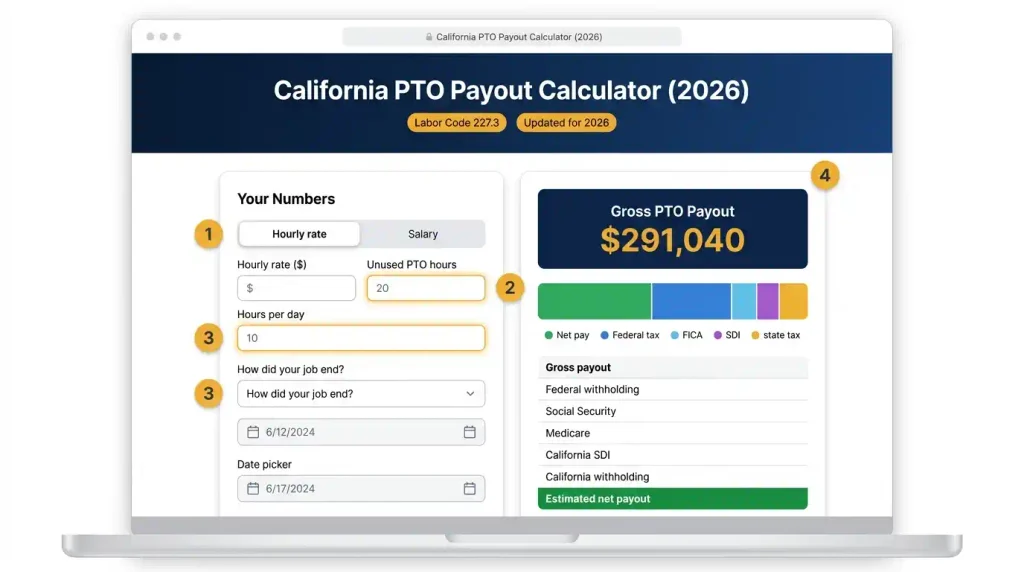
Step 1: Choose how you’re paid, hourly rate or salary.
Step 2: Enter your hourly rate, or your salary amount and pay period.
Step 3: Enter your unused, accrued PTO or vacation hours.
Step 4: Enter your typical hours per workday (defaults to 8).
Step 5: Select how your job ended, fired/laid off, quit with 72+ hours’ notice, or quit with less notice.
Step 6: Enter your last day worked to see your legal payment deadline.
Step 7: Enter the date your final paycheck actually arrived, if you want to check for a late-payment penalty.
Step 8: Check the applicable box if your 2026 supplemental wages exceed $1,000,000, or your total 2026 wages exceed $200,000.
Pro Tips
Use your final rate of pay, not an older rate. California law requires payout at your most recent hourly rate, even for hours earned before a raise, as covered in our California PTO law guide.
Don’t include sick-leave-only balances. Only vacation/PTO is payable, unless your employer blends both into one bank.
Check the deadline first. The date you were legally owed payment, not your normal payday, is what starts the waiting-time penalty clock under California’s final paycheck law.
How California PTO Payout Is Calculated
Formula: Gross Payout = Unused PTO Hours × Final Hourly Rate
Withholding is estimated separately: Federal (22% or 37%) + Social Security (6.2%) + Medicare (1.45%, plus 0.9% if applicable) + California SDI (1.3%) + California (6.6%). PTO payouts are treated as supplemental wages, the same category as bonuses. Check our California bonus tax rate breakdown for how that flat rate works, or run your SDI deduction separately with the California SDI calculator. Federal supplemental rates come from IRS Publication 15, and SDI is set annually by the California EDD.
| Item | Amount |
|---|---|
| Unused PTO hours | 80 |
| Hourly rate | $30.00 |
| Gross payout | $2,400.00 |
| Federal withholding (22%) | -$528.00 |
| Social Security (6.2%) | -$148.80 |
| Medicare (1.45%) | -$34.80 |
| California SDI (1.3%) | -$31.20 |
| California withholding (6.6%) | -$158.40 |
| Estimated net payout | $1,498.80 |
California PTO Payout Rules for 2026
- Accrued vacation/PTO is earned wages under Labor Code §227.3. “Use it or lose it” policies are illegal.
- Payout uses your final rate of pay, not the rate when the hours were earned.
- Fired, laid off, or discharged: payout due immediately, on your last day.
- Quit with 72+ hours’ notice: payout due on your last day.
- Quit with less than 72 hours’ notice: payout due within 72 hours of quitting.
- Late final wages trigger a waiting-time penalty under Labor Code §203: one day’s wages per day late, capped at 30 days.
- Employers can cap PTO accrual, typically 1.5–1.75x your annual accrual rate. They cannot cap or forfeit hours already earned.
- Federal supplemental withholding: 22% (37% if your 2026 supplemental wages exceed $1,000,000), unchanged from 2025.
- FICA: 6.2% Social Security + 1.45% Medicare, plus 0.9% Additional Medicare above $200,000 in wages, unchanged from 2025.
- California supplemental withholding: 6.6%, unchanged from 2025.
- California SDI: 1.3% for 2026, up from 1.2% in 2025 as detailed in our CA SDI rate 2026 guide. No wage cap, applies to all wages including PTO payouts.
For the full legal picture on deductions, notice periods, and worker rights, see our California labor laws hub, sourced from the California Department of Industrial Relations.
California PTO Payout Calculator: Full Feature List
Input fields:
- Pay type toggle: hourly or salary
- Hourly rate
- Salary amount with pay period (annual, monthly, biweekly, weekly)
- Unused PTO/vacation hours
- Typical hours per workday
- Separation type (fired/laid off, quit with 72+ hours’ notice, quit with less notice)
- Last day worked (date)
- Date final paycheck arrived (optional)
- Supplemental wages over $1,000,000 checkbox
- Total 2026 wages over $200,000 checkbox
Modes:
- Hourly-rate mode
- Salary-conversion mode (auto-converts to hourly using a 2,080-hour work year)
Outputs:
- Gross PTO payout
- Visual withholding breakdown bar
- Line-item table: federal, Social Security, Medicare, Additional Medicare (conditional), California SDI, California withholding, estimated net payout
- Legal payment deadline based on separation type
- Days-late calculation if a payment date is entered
- Estimated waiting-time penalty under Labor Code §203
Every Feature, Explained
Hourly or salary toggle
Switch instantly between an hourly rate and a salary. No manual math on your end.
Auto salary-to-hourly conversion
Enter your annual, monthly, biweekly, or weekly salary. It converts to an hourly rate using a standard 2,080-hour year, the same method used in our annual salary calculator.
Unused PTO hours input
The core number. Multiplied by your rate to get your gross payout.
Hours-per-day field
Sets your daily wage, which drives the waiting-time penalty math. Defaults to 8, editable if you work a different schedule.
Separation type selector
Fired, laid off, quit with notice, or quit without. This single choice determines your exact legal payment deadline.
Last day worked + date paid
Plug in both dates and it tells you, in plain terms, if your check was late and by how many days.
$1,000,000 supplemental wage checkbox
Switches federal withholding from 22% to the mandatory 37% for high earners over the IRS threshold.
$200,000 wage checkbox
Adds the 0.9% Additional Medicare tax automatically, so high earners aren’t underestimating their withholding.
Live withholding breakdown bar
See gross vs. federal vs. FICA vs. California SDI vs. California withholding at a glance, visually. Want just the gross number on its own? Try the gross pay calculator.
Waiting-time penalty estimator
The feature most competitors skip. Calculates what you’re owed if your employer paid late, day by day, capped at 30 days.
Auto-calculate
No button to click. Every number updates the moment you type.
What Makes This Calculator Different
Most PTO calculators stop at gross pay. This one goes further, telling you your legal deadline, checking if you were paid late, and estimating the penalty you’re owed if you were.
It’s built only for California, using California-specific law (Labor Code §227.3 and §203), not a generic multi-state formula that gets the rules wrong.
It handles both hourly and salaried employees natively, instead of forcing salaried workers to do their own conversion first.
It runs on 2026 IRS and California EDD supplemental wage withholding rates, not outdated figures.
Why People Use It
You’re about to leave a job and want to know your real payout before you sign anything.
You already left and want to check if your final paycheck matches what you’re actually owed.
You got paid late and want to know if you’re entitled to a penalty, and roughly how much.
What Is a PTO Payout in California?
A PTO payout is the cash value of unused vacation or PTO hours your employer owes you when you leave a job. California treats accrued vacation as earned wages the moment you accrue it, so it can never be forfeited or capped by a “use it or lose it” policy. This applies to anyone who quits, is laid off, or is fired, regardless of reason. The payout is calculated at your most recent hourly rate and must be included in your final paycheck, the same gross pay versus net pay rules that apply to any paycheck. When it’s paid depends on how your employment ended, immediately if you’re let go, or within a set window if you quit.
PTO/Vacation vs. Sick Leave: What Gets Paid Out
Vacation and sick leave follow different rules under California law. See our full California sick leave laws guide, or browse all paid leave and benefits topics for related rules like paid family leave.
| Vacation / PTO | Sick Leave | |
|---|---|---|
| Payable when you leave? | Yes, always | No, unless blended with PTO |
| Can it be “use it or lose it”? | No | Not applicable |
| Governing law | Labor Code §227.3 | Healthy Workplaces, Healthy Families Act |
| Accrual cap allowed? | Yes, typically 1.5–1.75x annual rate | Yes, separate rules apply |
Frequently Asked Questions
Do I get paid for unused PTO if I get fired in California?
Yes. Accrued vacation/PTO is earned wages, and firing you doesn’t erase it. It’s due immediately, on your last day.
Does my employer have to pay unused vacation when I quit?
Yes. The deadline depends on your notice, your last day if you gave 72+ hours’ notice, or within 72 hours if you didn’t.
What rate is used to calculate my PTO payout?
Your final, most recent hourly rate, not an earlier rate, even if most of the hours were earned before a raise.
Is unused sick leave paid out in California?
No, not unless your employer combines sick leave and vacation into a single, undifferentiated PTO bank.
What happens if my employer pays my final check late?
You may be owed a waiting-time penalty: one day of wages for every day late, up to 30 days, under Labor Code §203.
Can my employer cap how much PTO I accrue?
Yes. A reasonable cap, often 1.5–1.75x your annual accrual, is legal. They just can’t take back hours you’ve already earned.
Is my PTO payout taxed differently than regular wages?
It’s usually taxed as supplemental income, often withheld at a flat 22% federal rate instead of your normal payroll rate. If your regular paychecks also look smaller than expected, see why your paycheck might be low.
Related Tools
California Paycheck Calculator: see your regular take-home pay after taxes.
Annual Salary Calculator: convert your salary to hourly, weekly, or monthly pay.
California SDI Calculator: estimate your California State Disability Insurance deduction.
California Self-Employment Tax Rate: estimate taxes if you’re a 1099 worker.
California Tax Refund Status: track your California state tax refund.