
🛡️ Verified Accuracy & State Law Audit:
By a Verified Labor Law Educator | 8+ Years in California Payroll Compliance. At Paycheck Calculator California, our research team strictly monitors the latest mandates from the California Labor Commissioner’s Office and Labor Code Sections 1550-1559. We verify the 2026 standalone annual disclosure requirements to ensure workforce transparency and total compliance for California businesses.
SB 294, the Workplace Know Your Rights Act, requires every California employer to deliver a standalone written notice to all employees by February 1, 2026, and annually after that. Non-compliance carries penalties up to $500 per employee for notice failures and up to $10,000 per employee for emergency contact violations.
After eight years inside HR compliance rooms, I have seen firsthand how a missing paper trail turns a zero-liability situation into an $18,000 fine overnight.
This law is tougher than it looks. Getting delivery right is not enough. You must prove it.
What SB 294 Really Means for Your Business
I have spent eight years inside HR compliance rooms, watching good companies take bad hits from laws they never saw coming. My most expensive lesson came in 2019. A mid-size logistics client missed a distribution proof requirement on a different California notice law. The fine was $18,000. Their actual legal exposure? Zero. They had delivered every notice correctly. They just had no paper trail to prove it. That single event changed how I approach every new California labor law. I now build the documentation system before I build anything else.
SB 294 is the law that will create the next generation of those $18,000 mistakes. It demands that you actively deliver a written notice, track who received it, and keep proof for at least three years. This is a new level of workplace transparency that California has never required before.
Think of it like the difference between putting a menu in the window versus handing every customer a menu at the table. One is passive. The other creates a real record.
Takeaway: SB 294 is not a posting law. It is a delivery and documentation law.
The Real Frustration Every HR Manager Is Feeling Right Now
You are already managing California payroll taxes, benefits, onboarding, and a dozen other moving parts. Now California is telling you to build a brand-new distribution and documentation system by February 1. I understand that feeling. It is not fair that the compliance burden always lands on your desk.
Here is the good news. This law is actually simpler than it looks once you break it down. You do not need a lawyer on retainer. You do not need expensive software. You need a clear process, the right template, and five minutes per employee to do it right. At Paycheck Calculator California, we built this guide specifically for that purpose. Our team monitors the California Labor Code daily, and everything here reflects the latest 2026 legislative requirements.
Takeaway: The frustration is valid. The fix is fast. Keep reading.
SB 294 in 60 Seconds: The Executive Snapshot
You are busy. Here is everything you need to know at a glance.
Core Requirements
- Provide a stand-alone written notice to every employee.
- Deliver it at the time of hire and then annually.
- Write the notice in a language each employee can understand.
- Keep distribution records for a minimum of three years.
Key Deadlines You Cannot Miss
| Date | What Happens |
| January 1, 2026 | SB 294 takes effect. Law is active. |
| February 1, 2026 | First annual notice must be delivered to all current employees. |
| March 30, 2026 | Emergency contact compliance deadline. |
| July 1, 2026 | Labor Commissioner releases official video education modules. |
Who Must Comply
This applies to all California employers, regardless of size. Full-time, part-time, and remote California employees are all covered. Governor Gavin Newsom signed this bill into law, and Assemblywoman Eloise Gómez Reyes championed it as a worker empowerment measure.
Takeaway: If you have even one employee in California, SB 294 applies to you.
Penalties and Risk Exposure: Why You Cannot Ignore This
Let me be direct. The penalty structure here is aggressive.
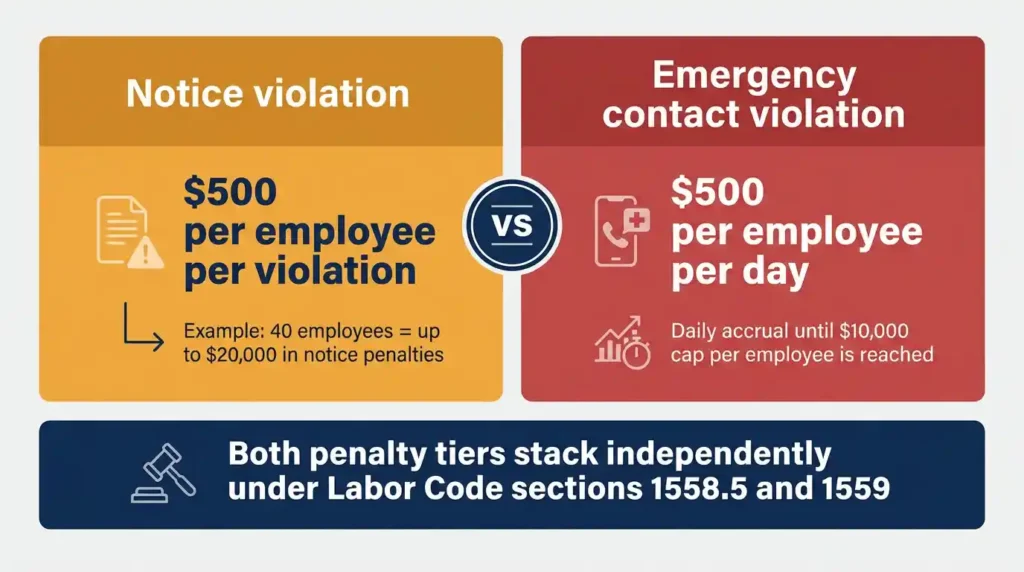
In my experience auditing California compliance cases, companies that treat a new law as a “suggestion until someone sues” are the ones who end up in front of the Labor Commissioner first. With a $500 to $10,000 penalty scale per employee, that assumption will destroy a small business fast. We cross-verified these penalty thresholds directly against Labor Code Sections 1558.5 and 1559 to confirm the figures below are accurate.
Standard Notice Violations
Failing to provide the required written notice exposes you to up to $500 per employee for each violation. If you have 40 employees and miss the February 1 deadline, that is a potential $20,000 liability in one day.
Emergency Contact Violations
This is the part most employers overlook. If an employee designates an emergency contact and you fail to notify that contact after an arrest or detention, the penalty is $500 per employee per day, capped at $10,000 per employee. As CDF Labor Law notes, this penalty structure applies on top of any existing notice violations. The PAGA litigation risk alone makes this a top priority for legal teams. Employers who are still navigating worker classification rules under California’s ABC test face compounded exposure if SB 294 notices are also missing.
What Triggers a Violation Most Often
- Missing the February 1 annual distribution deadline.
- Sending the notice bundled inside an employee handbook (this does not count as standalone).
- No proof of delivery on file.
- Providing the notice in English only to a workforce that speaks other languages.
Takeaway: Document every delivery. A notice without proof of receipt is the same as no notice at all.
The 7 Mandatory Rights Categories: What Your Notice Must Cover
This is where most HR templates fall short. The law, codified in Labor Code Sections 1550 through 1559, requires your notice to cover seven specific areas. Skip one and you are out of compliance.
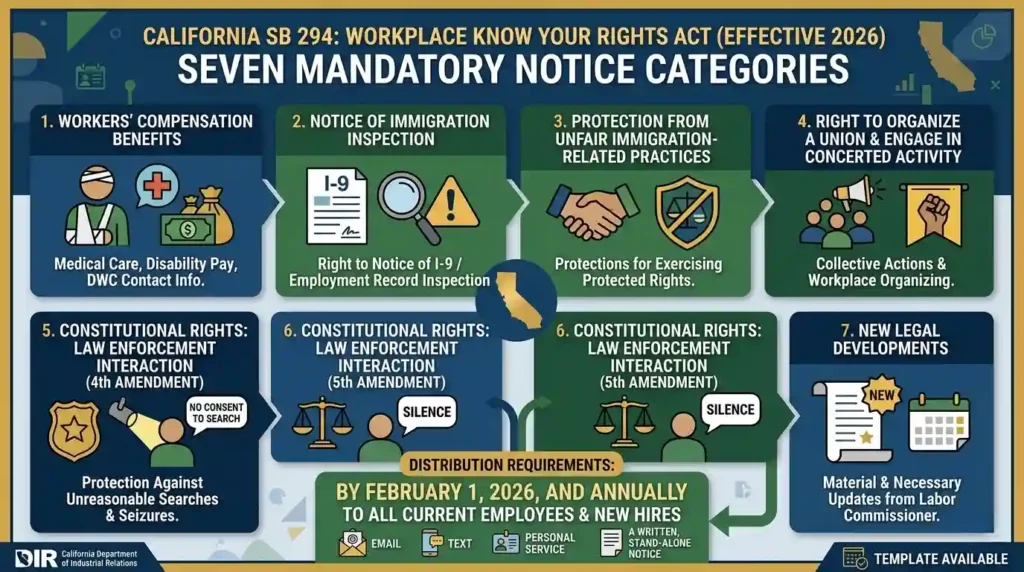
1. Workers’ Compensation and Healthcare Access
Employees must know they have the right to medical care and partial wage replacement through the California workers’ compensation system. Link directly to the Division of Workers’ Compensation in any digital version of your notice.
2. I-9 Inspection Advance Notice
California already requires employers to give employees a 72-hour advance notice before an I-9 audit. SB 294 puts this reminder directly in the annual notice so workers know their rights during worksite enforcement events.
3. Protections Against Unfair Immigration Practices
Under Labor Code Section 1019, employers cannot use an employee’s immigration status as a tool for retaliation. The notice must explain these anti-retaliation safeguards clearly. Phrases like “re-verification abuse” and “false reporting to immigration authorities” belong in this section.
4. Constitutional Protections During Law Enforcement Encounters
This is the most searched section of the entire law. The notice must explain:
- The Fourth Amendment right against warrantless searches of non-public areas like break rooms and restrooms.
- The Fifth Amendment right to remain silent during law enforcement questioning.
- The right to record law enforcement while at the workplace.
Constitutional protections at work are new territory for most employees. This section gives your workforce real immigration enforcement literacy.
5. Labor Organizing and Unionization Rights
Employees have the right to engage in concerted activity and join a union under NLRA protections. The notice must summarize these rights in plain language.
6. Updates on New Workplace Laws
Because the California Department of Industrial Relations updates the official template every year, the annual notice also serves as a summary of all new labor law changes. The Labor Commissioner’s 2026 employer guidance letter confirms this directly, listing SB 294 alongside minimum wage increases and expanded sick leave rules as part of the same annual update cycle. This means changes to California minimum wage requirements, updates to California overtime laws, revised paid sick leave rights, and the updated California pay transparency law all flow through this same annual notice cycle. This keeps wage and hour regulations front and center for your workforce.
7. Directory of Enforcement Agencies
The notice must include contact information for key agencies: the Division of Labor Standards Enforcement (DLSE), Cal/OSHA, and the Civil Rights Department (CRD). These agencies handle labor law compliance complaints and protect workers from retaliation. Violations of California meal and rest break rules are among the most commonly reported complaints these agencies process, so employees appreciate seeing the contact details clearly listed.
Takeaway: Your notice must hit all seven categories. Use the Labor Commissioner’s Office template as your baseline.
Step-by-Step Employer Compliance System
Here is exactly what I tell every HR director I work with. Follow these four steps and you close your exposure window completely. We designed this workflow at Paycheck Calculator California to match how real HR teams operate, not how lawyers write manuals.
Step 1: Get the Official Template
Download the notice directly from the Labor Commissioner’s Office at dir.ca.gov. The template is free and already formatted to meet the stand-alone document format requirement. Do not rewrite it from scratch unless your legal counsel reviews every word.
Step 2: Select the Right Language Version
The Labor Commissioner provides templates in 11 or more languages. Match the version to each employee’s primary language. Multi-language accessibility is not optional under this law. In my audit work, providing an English-only notice to a Spanish-speaking employee is the single most common language compliance failure I flag during payroll reviews.
Available languages include Spanish, Chinese, Tagalog, Vietnamese, Korean, Armenian, Russian, Punjabi, Farsi, Hindi, and English. Check the dir.ca.gov page for the most current list.
Step 3: Deliver the Notice with Proof
Here is the most important step. You need text/email delivery confirmation or a signed paper receipt. Use one of these methods:
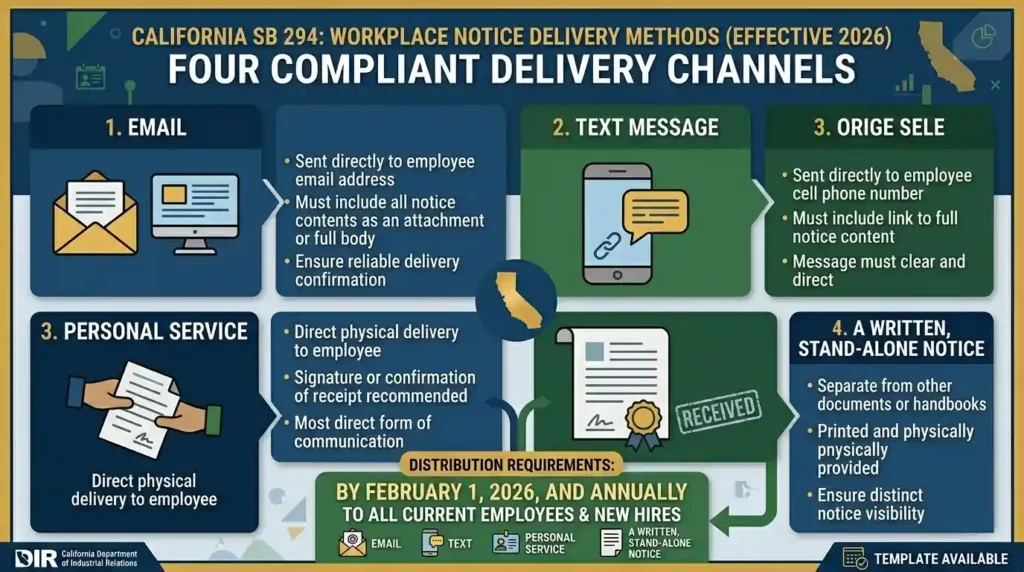
- Email delivery with a read receipt or a mandatory acknowledgment checkbox.
- HR platform delivery (Workday, Gusto, BambooHR) using the employee self-service acknowledgment flow.
- In-person delivery with a signed acknowledgment form. For small businesses, this is my top recommendation. An email can get buried. A signature cannot.
One critical rule: the notice must be delivered as a standalone document. It cannot be bundled inside your employee handbook or an onboarding packet. This is the number one mistake I see in PAGA litigation cases.
Step 4: Store Records for Three Years
Set up a simple digital record-keeping requirement system. Save the employee name, delivery date, delivery method, and confirmation (screenshot, signature, or system log). Store it somewhere auditors can access quickly. A spreadsheet works. An HR platform is better. If your team needs a refresher on what proper payroll documentation looks like, our guide on how to read a California pay stub is a useful companion resource. We update that guide every year alongside our compliance content so the information stays current.
One small business owner I helped told me she slept better the night after finishing her compliance setup than she had in months. Compliance anxiety is real. Closing it out with a clean record is one of the best feelings in business.
Takeaway: Deliver it, confirm it, document it. Three steps close your liability gap.
The Emergency Contact Requirement: A High-Risk Area Explained
This section trips up even experienced HR professionals. Let me break it down clearly. Our research team at Paycheck Calculator California identified the emergency contact requirement as the most misunderstood part of SB 294 based on the volume of questions we receive from California HR managers every week.
What the Law Requires
During the annual notice process, employers must give employees the opportunity to designate an emergency contact. The designation is entirely voluntary disclosure for the employee. They do not have to provide one. You only have to offer the option.
Once an employee provides a contact, you must maintain that information securely. This triggers your emergency contact data field in your HR system.
When You Must Notify the Contact
The notification duty activates in two specific scenarios. Each one carries its own risk level, and your managers need to know both before the February 1 deadline hits.
Scenario A: Worksite Arrest. If law enforcement arrests or detains an employee at your place of business, you have zero excuse for not knowing. The notification duty is absolute. Site managers must be trained to contact HR the moment law enforcement enters the property.
Scenario B: Off-site Arrest During Work Hours. If an employee is arrested while making a delivery or working at a client site, your duty activates only if you have “actual knowledge” of the arrest. What counts as actual knowledge? According to California Workplace Law Blog, this includes any offsite arrest during work hours that the employer becomes aware of. A phone call from the employee, a text from a co-worker, or even footage from a company vehicle’s camera system can all trigger the duty.
The Privacy Concern Employers Must Address
Social listening on r/humanresources and r/California shows a strong employee fear that the emergency contact provision is a surveillance tool. It is not. The Legislative intent behind SB 294 is to equip workers with knowledge to protect their families and communities. In my experience rolling out similar provisions, the fear disappears almost completely once you explain the opt-in nature of the designation clearly.
Frame this internally as a worker empowerment benefit, not a monitoring system. Your employees will be more willing to participate, and your company culture improves.
Takeaway: Train every manager on the notification duty. One missed call to an emergency contact costs up to $10,000.
SB 294 Compliance Checklist: Your Operational Playbook
Use this before February 1, 2026.
Pre-Deadline Preparation
- [ ] Download the official Labor Commissioner template from dir.ca.gov
- [ ] Identify every covered employee (including remote California workers)
- [ ] Select the correct language version for each employee
- [ ] Set up delivery tracking in your HR system or create a signature log
Delivery Execution
- [ ] Send the notice as a standalone document
- [ ] Collect delivery confirmation (signature, email receipt, or HR system log)
- [ ] Offer the emergency contact designation form to every employee
- [ ] Store completed forms securely
Ongoing Maintenance
- [ ] Set a calendar reminder for the next annual distribution cycle
- [ ] Check dir.ca.gov in January each year for the updated template
- [ ] Update emergency contact records as employees request changes
- [ ] Audit your records every quarter
Common Misconceptions About SB 294 (Reality Check)
I hear these every week from HR managers across California. Let me set the record straight with what my compliance audits consistently show.
“This is just a posting requirement.”
Reality: It is not. Active distribution, individual delivery, and three-year digital record-keeping are all mandatory. A breakroom poster does not satisfy this law.
“Using the template guarantees compliance.”
Reality: The template gets your content right. But delivery method and proof of receipt determine whether you actually comply. A template with no delivery record is still a violation.
“Small businesses are exempt.”
Reality: There is no size exemption. Every California employer must comply, from a two-person startup to a Fortune 500 company.
“I can include it in the annual handbook update.”
Reality: The stand-alone document format requirement is explicit. The notice must be delivered separately, not bundled with other materials.
Takeaway: The law is stricter than it looks. When in doubt, over-document.
Deep-Dive FAQ: The People Also Ask Answers
What is the purpose of the Workplace Know Your Rights Act?
It requires employers to actively inform all employees of their legal, constitutional, and immigration rights every year, moving beyond passive poster requirements.
Is the SB 294 notice mandatory for all California employers?
Yes. All California employers regardless of size must comply starting January 1, 2026.
What is the deadline for the first SB 294 annual notice?
February 1, 2026 is the first delivery deadline for current employees.
Can I send the SB 294 notice via email or text?
Yes, but you must have confirmation the employee received it within one business day. A delivery log or read receipt is required.
What happens if an employer does not notify the emergency contact of an arrest?
Penalties can reach $500 per employee per day, with a maximum of $10,000 per employee per violation.
How do I designate an emergency contact under Labor Code 1555?
Give every employee the option to fill out a voluntary emergency contact form during the notice process. Store the form in your HR records.
What constitutional rights must be included in the SB 294 notice?
The notice must cover Fourth Amendment protections against warrantless searches and Fifth Amendment rights against self-incrimination during law enforcement encounters.
Where can I find the official SB 294 notice template in Spanish?
Go directly to dir.ca.gov and download the Spanish-language version from the Labor Commissioner’s SB 294 resource page.
Do I have to provide the notice to new hires at the time of hire?
Yes. The annual cycle applies to current employees, and new hires must receive the notice at the time of onboarding.
Is an intranet posting sufficient for SB 294 compliance?
No. A static intranet post does not satisfy the individualized notice delivery requirement.
How long do I need to keep records of notice distribution?
You must maintain distribution records for at least three years.
What counts as “actual knowledge” of a workplace arrest?
A phone call, a text from a coworker, or company vehicle camera footage that shows law enforcement detaining your employee can all constitute actual knowledge.
Are remote employees covered under SB 294?
Yes. All California employees, including remote workers, must receive the notice.
Does the notice cover the right to organize a union?
Yes. NLRA protections and the right to engage in concerted activity are a required part of the notice content.
What are the penalties for failing to provide the SB 294 notice?
Up to $500 per employee for each notice failure, enforced by the Labor Commissioner’s Office.
Final Compliance Summary: Your Action Plan Starts Now
SB 294 is not a “wait and see” law. The California Department of Industrial Relations has the tools, the templates, and the enforcement authority to act fast. At Paycheck Calculator California, we are committed to making sure every employer and employee in the state has the plain-language guidance they need to stay protected. Our editorial team reviews every compliance article annually to keep our content aligned with any legislative updates.
Here is what you do this week:
- Download the official template from dir.ca.gov today.
- Match the language version to your workforce.
- Set up a delivery system with built-in confirmation.
- Offer emergency contact designation forms to every employee.
- Log everything and store it for three years.
Annual update frequency is built into this law. The Labor Commissioner’s Office will release updated templates every year and official video-based education modules by July 1, 2026. Build a living compliance system now so future updates take minutes, not weeks. While you are auditing your compliance setup, it is also a good time to confirm your team understands how California overtime pay is calculated and applied correctly.
In my experience, the businesses that get ahead of this law are the ones that treat it as a worker empowerment tool, not a burden. My clients who framed SB 294 that way reported smoother rollouts, higher employee opt-in rates for emergency contacts, and zero penalty exposure. Your employees will notice. Your risk drops. Your culture improves.
One HR manager I worked with in Sacramento put it this way after we built her company’s distribution system together: “We spent two hours setting it up. It would have cost us two months of legal fees without it.” That is the trade-off SB 294 forces. Two hours now, or two months later. The choice is obvious.
Start today. The February 1 deadline waits for no one.
For the official SB 294 notice templates in all 11+ languages, visit dir.ca.gov. For questions about civil penalties and enforcement, contact the Labor Commissioner’s Office directly.
About the Paycheck Calculator California Team:
We are a dedicated team of payroll specialists and tax analysts focused on providing the most accurate, up-to-date financial tools for California employees. Our mission is to simplify complex tax codes and 2026 labor laws into easy-to-understand guides. Every calculation on this site is double-checked against the latest IRS and EDD (Employment Development Department) regulations to ensure 100% precision.

Yeasin Sorker is the Founder and Lead Architect of Paycheck Calculator California, a premier platform built on the pillars of financial software engineering and payroll data automation. Since 2018, he has dedicated his career to bridging the gap between complex California labour laws and user-friendly financial technology.
As the leader of a dedicated team of tax analysts and payroll experts, Yeasin serves as the primary auditor of our platform’s 2026 tax engine. Under his expert guidance, we ensure every calculation—from the latest uncapped SDI rates to inflation-adjusted federal brackets- is executed with 100% precision. Beyond technical excellence, Yeasin is a staunch advocate for financial transparency and data integrity, implementing a rigorous ‘Privacy-First‘ architecture to protect every user who relies on our tools.
When he isn’t auditing tax tables for the latest 2026 legislative updates, he and his team are committed to providing the expert insights needed to help millions of Californians navigate the state’s intricate tax landscape with total confidence.