
California itemized deductions let you subtract qualifying 2026 expenses, medical costs, mortgage interest, property taxes, and charitable gifts, from taxable income instead of the state standard deduction. It only helps once your total exceeds $5,706 single or $11,412 joint.
Because California never adopted several federal 2017 tax law changes, its itemizing rules diverge sharply from what your federal return assumes.
High earners face an added 80% and 6% limitation, so the full deduction isn’t guaranteed.
California Itemized Deductions 2026: The Quick Answer
California lets you deduct many of the same expenses as the IRS, but not all, and not always in the same amount. If your qualifying California expenses beat the state standard deduction, itemize. If not, take the standard deduction. For more ways to lower your state tax bill, browse our California tax savings planning category.
What counts as a California itemized deduction
California never adopted the Tax Cuts and Jobs Act changes, so some deductions killed federally are still alive here, and some federal deductions never applied. That gap traces to how the California Revenue and Taxation Code selectively follows the Internal Revenue Code. Add up what you qualify for, compare it to the standard deduction.
Itemized deductions vs. California standard deduction
The comparison itself is simple, whichever number is bigger wins. What trips people up is that this choice is made independently on each return. Itemizing federally does not lock you into itemizing on your California return, these are separate decisions with separate math.
The fastest way to estimate your 2026 California deduction
Start with your federal Schedule A totals. Add back what California disallows, subtract what federal law disallows but California permits. Apply any income-based limitation. Compare that final number to the California standard deduction and pick the larger. Our annual salary calculator can help you confirm your AGI before running these numbers.
California Standard Deduction vs. Itemized Deductions
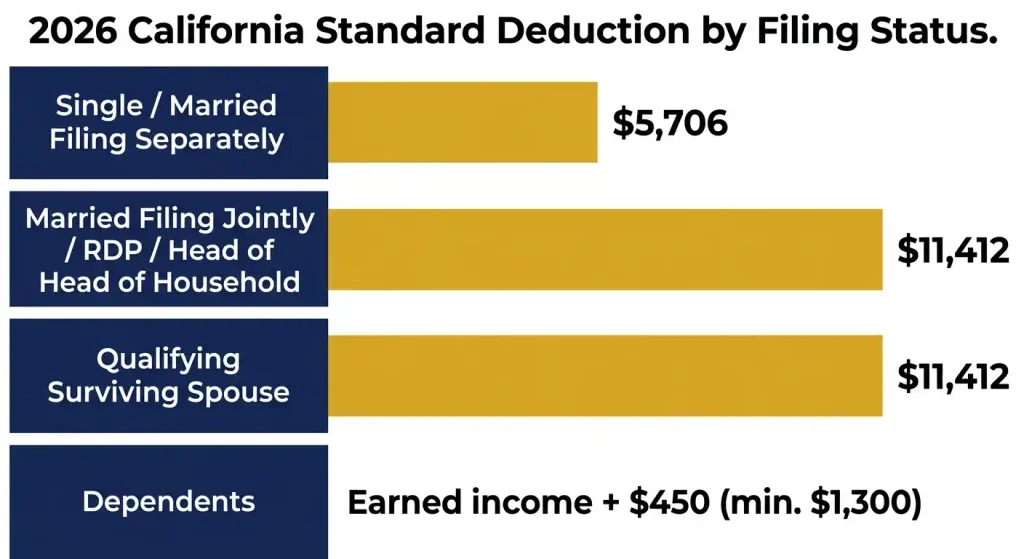
2026 California standard deduction by filing status
For the 2025 tax year, filed in 2026:
| Filing status | Standard deduction |
|---|---|
| Single / Married filing separately | $5,706 |
| Married filing jointly / RDP filing jointly / Head of household | $11,412 |
| Qualifying surviving spouse | $11,412 |
Dependents work differently, their standard deduction is limited to earned income plus $450, with a $1,300 minimum, capped at the regular single filer amount. The FTB publishes a California standard deduction chart and a California standard deduction worksheet each year for these cases.
When itemizing produces a larger deduction
Itemizing tends to win with a real mortgage, a heavy medical year, or significant charitable giving. The threshold is $5,706 single, $11,412 joint. Mortgage interest alone often clears that bar for single filers, but joint filers usually need it paired with another category. Charitable donations alone rarely clear it. “Qualifying expenses” means what California allows, not raw spending.
Why the federal standard deduction does not answer the California question
California’s standard deduction is far smaller than the federal one, which runs into the tens of thousands. A taxpayer who takes the federal standard deduction might still beat California’s much lower $11,412 bar by itemizing on the state return. Schedule CA reconciles the two. For a full breakdown of the current amounts, see our California standard deduction guide.
What Counts as a California Itemized Deduction in 2026?
Medical and dental expenses
Deduct qualifying medical and dental costs above 7.5% of federal AGI, the same threshold the IRS uses. On $80,000 income, the first $6,000 doesn’t count, only the amount above it does. Keep receipts and insurance statements. If you’re contributing to an HSA, those dollars are already pretax and don’t factor into this threshold, our HSA contribution limits 2026 guide covers how much you can set aside.
Home mortgage interest
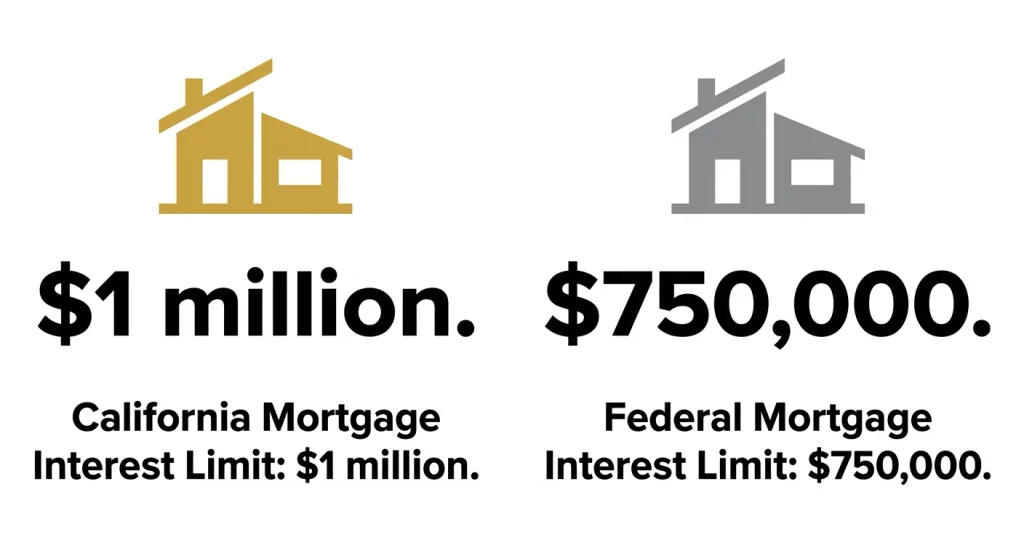
California is more generous than federal law here. The $1 million mortgage limit California applies to acquisition debt is the standing rule for all qualifying loans, while the federal limit is $750,000. Qualifying home equity debt counts too, if the funds went into the home itself. If your mortgage is unusually large or you refinanced mid-year, check the Schedule CA instructions rather than assuming your federal number transfers.
State and local taxes and property taxes
Property taxes are deductible and often the biggest line item for homeowners. State income tax withheld is treated differently, you can’t deduct California income tax on your California return the way you can federally. Vehicle license fees do qualify, but only the value-based portion of your DMV bill, not flat registration, weight, or smog fees. Don’t copy your federal SALT number onto your state form, run California’s version separately. For a wider look at how these amounts are calculated from your paycheck, see our California payroll taxes category.
Charitable contributions
Cash and noncash gifts to qualifying organizations are deductible, generally capped at 50% of federal AGI. Starting in 2026, a new 0.5% floor applies, so on $100,000 income the first $500 in donations doesn’t count. Keep receipts for cash gifts, written acknowledgment above $250, and fair market value documentation for property.
Certain miscellaneous itemized deductions
A real California advantage: federal law suspended miscellaneous itemized deductions subject to the 2% AGI threshold, but California never conformed. Unreimbursed employee expenses (the kind that used to run through Form 2106), investment-related costs, and tax preparation fees are still deductible above 2% of federal AGI.
Gambling losses and wagering expenses
California allows gambling losses up to the amount of winnings, no net loss beyond that. Starting tax year 2026, California itself limits the deduction to 90% of wagering losses, matching the same cap now in federal law. Keep a log of sessions, wins, losses, and W-2G forms.
Other California-specific deductible expenses
A few smaller items exist, including interest on loans from certain utility companies for energy-efficient home improvements. These require California-specific Schedule CA adjustments, not a straight federal transfer. Check current FTB instructions for unusual situations.
California vs. Federal Itemized Deductions: What Changes?
Why federal Schedule A is only the starting point
Your federal Schedule A total feeds into Schedule CA, where amounts get added back or subtracted under state law. The federal and California totals can end up meaningfully different.
Deductions California allows differently
Mortgage interest, miscellaneous deductions, and gambling losses are the three biggest divergence points. State tax withholding, certain federal-only limitations, and a few timing rules don’t match either.
Deductions that may be allowed in California but not federally
The clearest example is the miscellaneous deduction category federal law suspended but California kept. Federal software often misses this unless you dig into state-specific worksheets. Adjustments show up on Schedule CA, Part II.
What happens when you itemize federally but not in California
Nothing forces these to match. Run the California comparison independently, apply Schedule CA adjustments, compare to the standard deduction. The standard deduction can still win on the state side even after itemizing federally.
What happens when you do not itemize federally but want to itemize in California
Complete federal Schedule A anyway, it feeds Schedule CA, Part II. Check the required box on Schedule CA and attach the federal Schedule A to your state filing.
How to Calculate California Itemized Deductions for 2026
Step 1: Start with your federal Schedule A
Gather totals for medical expenses, taxes paid, mortgage interest, charitable gifts, and other applicable categories. Complete this even if you take the federal standard deduction. Keep supporting receipts and statements.
Step 2: Make California Schedule CA adjustments
Transfer federal amounts onto Schedule CA, subtract what California disallows (like state tax withholding), add back what California permits (like the miscellaneous 2% deductions). The result is your California-allowed total.
Step 3: Apply California itemized-deduction limitations
If California AGI exceeds the applicable threshold, run the 80% itemized deduction limitation against the 6% AGI limitation and use whichever produces the smaller reduction. This only applies to higher earners.
Step 4: Compare the result with the California standard deduction
Compare your final adjusted total to $5,706 or $11,412, accounting for dependent rules if they apply. Use the larger number.
Step 5: Enter the deduction on the California return
Enter the final amount on Form 540, pulled from Schedule CA. Part-year residents and nonresidents use Form 540NR. Attach every required schedule, including federal Schedule A if itemizing in California without itemizing federally.
California Itemized Deduction Limits for Higher-Income Taxpayers
Who may be subject to the California limitation
This kicks in once California AGI crosses $252,203 for single or married filing separately, $504,411 for married filing jointly, or $378,310 for head of household. It’s separate from the standard deduction comparison. Check current Schedule CA instructions to confirm these thresholds haven’t been adjusted for inflation.
How the 80% limitation calculation works
Take your preliminary itemized deduction total, excluding medical expenses, investment interest, and disaster casualty losses. Multiply by 80%. This is the 80% itemized deduction limitation.
How the 6% AGI limitation works
Subtract the applicable threshold from California AGI, multiply the excess by 6%. This is the 6% AGI limitation. Compare it to the 80% figure and use whichever is smaller as the actual limitation.
What high-income taxpayers should check before filing
Confirm California AGI and filing status, verify the correct threshold for the year, and run the limitation worksheet carefully rather than estimating. If the limitation shrinks your deduction more than expected, revisit your California estimated tax payments so you don’t get caught by an underpayment penalty.
Real-World California Itemized Deduction Examples
Single homeowner with mortgage interest and property taxes
A single filer earning $95,000 pays $9,200 in mortgage interest and $4,800 in property taxes, totaling $14,000. That clears the $5,706 single filer standard deduction easily, itemizing wins.
Married couple with charitable gifts and medical expenses
A married couple filing jointly with $130,000 combined AGI has $11,800 in medical expenses. The 7.5% threshold on their AGI is $9,750, so only $2,050 counts. Add $3,500 in charitable donations and a few smaller items, their itemized total lands around $6,200, below the $11,412 joint standard deduction. Standard deduction wins.
High-income California taxpayer
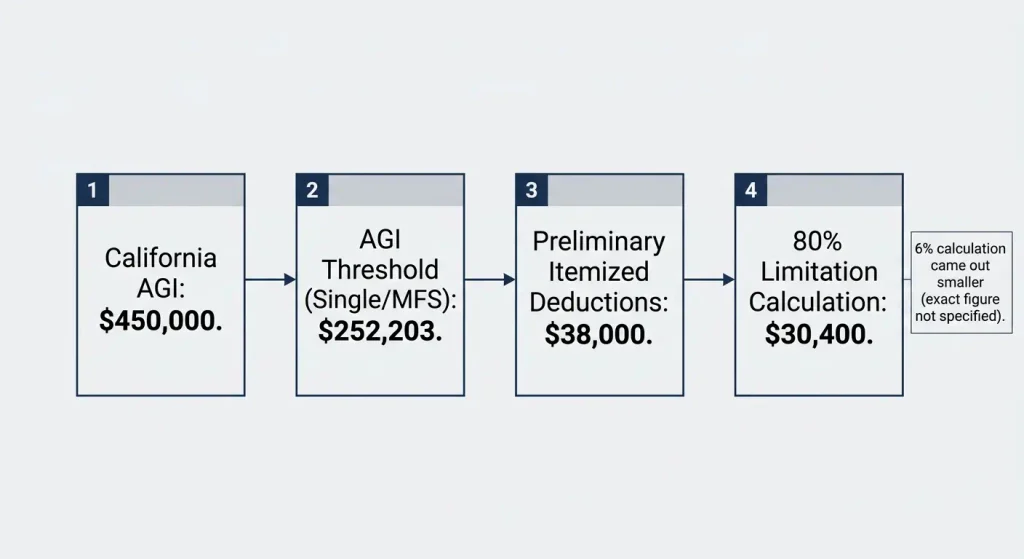
Consider a single filer with $450,000 California AGI and $38,000 preliminary itemized deductions. Their 80% calculation comes to $30,400. Their 6% AGI calculation comes out smaller, so that becomes the limitation. Their final allowed deduction still beats the standard deduction. Taxpayers at this income level often have investment income too, so it’s worth checking how California’s capital gains tax rate interacts with the same return.
Federal standard deduction but California itemization
A taxpayer takes the federal standard deduction, but still completes Schedule A for California, runs it through Schedule CA, Part II, and reaches $8,400, above the $5,706 threshold. They check the box and itemize for California only.
Taxpayer with California-only deductible expenses
An employee with $2,200 in unreimbursed job expenses gets no federal benefit, since federal law suspended that deduction. After subtracting 2% of AGI, a meaningful chunk still counts in California, pushing their itemized total above the standard deduction.
Special California Situations That Change the Calculation
Married filing separately
Spouses or RDPs filing separately must use the same deduction method. If one itemizes, both must. Allocate expenses according to who actually paid.
Dependents
A dependent’s standard deduction is limited to earned income plus $450, with a $1,300 minimum, capped at the regular single filer amount. Their itemizing decision compares against this lower figure, not the flat $5,706.
California part-year residents and nonresidents
Part-year residents and nonresidents file Form 540NR, with deductions calculated on California-source income using Schedule CA (540NR). Every figure is adjusted to reflect the portion connected to California. Our California part-year resident tax guide walks through the full Form 540NR calculation.
Registered domestic partners
RDPs generally follow the same joint or separate filing rules as married couples, sometimes requiring a recalculated federal AGI figure since RDPs aren’t recognized federally the same way.
Disaster losses
California allows deductions for qualifying disaster losses, sometimes more generous than current federal rules. A significant casualty loss tied to a declared disaster can push your total well past the standard deduction. Keep insurance records, repair estimates, and disaster declaration documentation.
Common Mistakes and Myths About California Itemized Deductions
“If I itemize federally, I automatically itemize in California”
Not true. California runs its own comparison after Schedule CA adjustments, using a completely different standard deduction number.
“If I take the federal standard deduction, I cannot itemize in California”
False. Complete federal Schedule A for California purposes, run it through Schedule CA, Part II, and itemize on your state return if it beats the standard deduction.
“Every federal Schedule A deduction is deductible in California”
California’s nonconformity means several categories need adjustment, from state tax withholding to the miscellaneous deduction suspension.
“A deduction reduces my California tax dollar-for-dollar”
Deductions lower taxable income, not the tax bill directly. A $1,000 deduction saves someone in a 9.3% bracket about $93, not $1,000, see our California tax brackets breakdown to find your own marginal rate. Itemizing doesn’t guarantee a bigger refund either, that depends on withholding versus what you owe, a gap you can track through our California tax refund status guide.
“The federal SALT limit tells me my California deduction”
The federal SALT cap and California’s treatment of property and state taxes follow entirely different rules. California doesn’t allow a state income tax deduction the way the federal SALT deduction does.
California Itemized Deductions Checklist Before Filing
Records to gather
- Mortgage interest statements
- Property tax bills
- Medical and dental expense records
- Charitable contribution receipts
Numbers to verify
- Federal AGI
- California AGI
- Federal Schedule A total
- California Schedule CA adjustments
If tax software produces a figure that doesn’t match your own math, trace it through the Schedule CA adjustments line by line.
Forms and schedules to review
- Form 540
- Form 540NR (if applicable)
- Schedule CA (540)
- Federal Schedule A from Form 1040
Final comparison before submitting the return
Calculate your final itemized total and applicable standard deduction, select the larger, and confirm filing status and any limitation rules first.
California Itemized Deductions 2026 FAQ
What are the California itemized deductions for 2026?
Medical and dental expenses above 7.5% of AGI, home mortgage interest, property taxes, charitable contributions, certain miscellaneous expenses above a 2% threshold, and gambling losses up to winnings.
Is it better to itemize or take the standard deduction in California?
Depends on whether your qualifying California expenses exceed $5,706 single or $11,412 joint. Run both numbers, don’t guess from your federal outcome.
Can I itemize on my California return if I take the federal standard deduction?
Yes. Complete federal Schedule A, apply Schedule CA adjustments, itemize on your state return if the result beats the standard deduction, and check the required box.
What medical expenses can I deduct in California?
Qualifying costs above 7.5% of federal AGI. On $80,000 income, the first $6,000 doesn’t count.
Does California allow mortgage interest as an itemized deduction?
Yes, with a $1 million acquisition-debt limit, higher than the federal $750,000 limit.
Does California allow charitable contributions as an itemized deduction?
Yes, cash and noncash gifts capped at 50% of federal AGI, with a new 0.5% AGI floor starting in 2026.
Does California allow miscellaneous itemized deductions?
Yes, above a 2% of AGI threshold, even though federal law suspended this category entirely.
Are California itemized deductions limited for high-income taxpayers?
Yes, once California AGI crosses the applicable threshold, an 80% calculation and a 6% AGI-based calculation are compared, and the smaller result becomes the limitation.
Do California and federal itemized deductions use the same rules?
No. California didn’t conform to several Tax Cuts and Jobs Act changes, creating real differences in mortgage interest, miscellaneous deductions, and gambling losses.
Which California form reports itemized deductions?
Form 540 for full-year residents, Form 540NR for part-year residents and nonresidents, supported by Schedule CA (540) or Schedule CA (540NR).
Official California Sources for 2026 Deduction Rules
California Franchise Tax Board deduction guidance
Verify current standard deduction amounts and allowable categories directly with the FTB’s deductions page. Their published deduction tables break out each threshold by filing status.
Schedule CA instructions
Review the federal itemized deduction adjustments, state-specific additions and subtractions, and limitation calculations in the official Schedule CA instructions.
Form 540 and Form 540NR instructions
Check the deduction entry for your specific form, the standard deduction rules for your situation, and required supporting schedules.
Key Takeaways: Choosing Your California Deduction
The four numbers to know before choosing
California AGI, federal Schedule A total, California-adjusted itemized deduction total, and California standard deduction.
The safest final decision process
Reconcile federal deductions against California’s rules, apply any applicable limitation, compare the final itemized total against the standard deduction, and use the larger number. For a full picture of your take-home pay after this deduction, try our California paycheck calculator.

Yeasin Sorker is the founder of Paycheck Calculator California. He built this tool in 2018 after noticing that most free paycheck calculators missed California-specific rules like daily overtime and the uncapped SDI rate.
He researches California payroll tax updates regularly and keeps this calculator aligned with the latest IRS, FTB, and EDD published rates. All calculations on this site are estimates based on official 2026 government sources. For personalized tax advice, consult a qualified tax professional.