
California firefighters earn $52,000 to $145,000 a year in 2026, with pay set by each department’s own salary schedule rather than a single statewide rate.
In my eight years tracking California fire department pay schedules, I’ve seen that department, not title, drives this range most.
Six-figure pay is common eventually, but most new hires start well below the top of that range.
How Much Do Firefighters Make in California in 2026?
That $52,000 to $145,000 span breaks down by career stage: new hires in smaller departments land near the bottom, while experienced firefighters at big-city departments with heavy overtime land near the top.
California firefighter salary at a glance
Three tiers: new hires typically start at $52,000 to $75,000. Firefighters with five-plus years often sit at $80,000 to $110,000 in base pay. Senior firefighters, captains, and heavy-overtime earners can clear $130,000 to $145,000 in total compensation. Every department sets its own scale, so identical jobs pay very differently by city.
What is the average firefighter salary in California?
Third-party estimates on the Bureau of Labor Statistics’ May 2024 survey put California’s mean near $98,200; the same dataset’s median, a better “typical” figure, is $83,400. Glassdoor shows near $80,000; ZipRecruiter shows near $58,800, pulled down by part-time and seasonal listings. These differ because they measure different slices of the workforce with data of different ages. Go to the specific department’s official salary schedule for a number that reflects today’s pay, not a 2024 survey.
What is the starting firefighter salary in California?
Starting pay runs about $52,000 in smaller departments up to $78,000 at big-city departments like Los Angeles. Chico’s most recent posted recruitment ran $73,615 to $98,658 a year, full range from hire to top step, though recruitment cycles reopen periodically so it is worth confirming the figure is still live before applying. LAFD recruits earn $78,070 during the academy, unusually high for training pay. Recruit or academy pay is always lower than sworn, line-firefighter pay.
California firefighter salary by department
San Francisco Fire Department reportedly pays entry-level firefighters in the low $90,000s, though that figure needs confirming against the department’s current agreement (check your own San Francisco paycheck numbers for a real comparison). San Diego Fire-Rescue Department starts at $73,000 to $80,000. Bay Area pay runs high: San Jose Fire Department starts Firefighter Recruits at $47.75 to $50.16 an hour, jumping to $114,192 to $119,955 at Step 1 after graduation and about $141,772 at top step. Oakland Fire Department pays about $45,652 during the academy, then $108,381 at sworn Step 1, rising to roughly $142,033 at top step. Sacramento Metropolitan Fire District’s pay lands in a similar range, but check its current published schedule directly, and run the number through a Sacramento paycheck calculator once you have it. CAL FIRE, officially the California Department of Forestry and Fire Protection, is a state agency that pays base salary plus Extended Duty Week Compensation, and its own Fire Fighter I classification page lists the current pay items directly. Orange County and other county fire authorities use a 56-hour average duty week instead. None of these systems compare directly, so always check the actual schedule before comparing departments.
California firefighter salary comparison
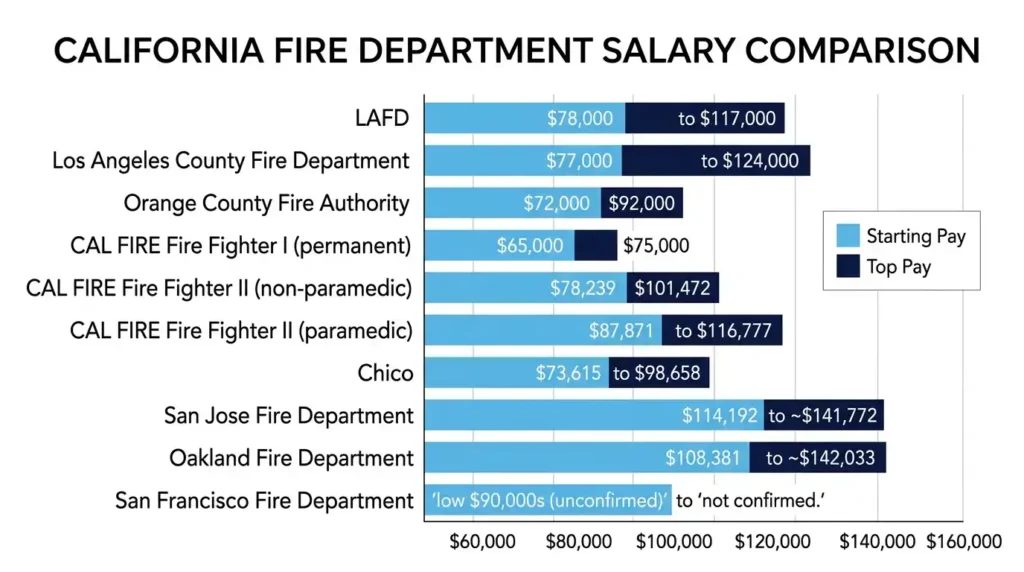
| Department | Starting/Base Pay | Top Pay |
|---|---|---|
| LAFD | ~$78,000 | ~$117,000 base (before overtime) |
| Los Angeles County Fire Department | $77,000 | $124,000 (across classifications) |
| Orange County Fire Authority | $72,000 (paramedics higher) | $92,000 base |
| CAL FIRE Fire Fighter I (permanent) | $65,000 | $75,000 |
| CAL FIRE Fire Fighter II (non-paramedic) | $78,239 | $101,472 |
| CAL FIRE Fire Fighter II (paramedic) | $87,871 | $116,777 |
| Chico | $73,615 | $98,658 |
| San Jose Fire Department | $114,192 (Step 1) | ~$141,772 |
| Oakland Fire Department | $108,381 (Step 1) | ~$142,033 |
| San Francisco Fire Department | low $90,000s (reported, unconfirmed) | not independently confirmed |
San Jose and Oakland post the highest confirmed base pay in this comparison, both starting above $108,000 at Step 1 and topping $140,000, ahead of San Francisco’s reported but unconfirmed entry range.
What Does a California Firefighter Salary Actually Include?
A salary schedule shows a range, not one number. What lands in your account depends on your step, certifications, and overtime that year.
What does firefighter base salary mean?
Base salary is the published minimum and maximum for your classification, reached through defined steps, not a smooth line. CAL FIRE’s $66,889 top for Fire Fighter I is what someone earns after years of step increases, not a new-hire number. Base salary excludes overtime, bonuses, and specialty pay.
Base salary vs. total firefighter compensation
Total compensation adds overtime, specialty pay, and benefits value to base salary, and is the more honest number for comparing offers, once you also factor in California payroll taxes on the cash portion. CAL FIRE’s Extended Duty Week Compensation is planned overtime built into many jobs because the workweek exceeds 40 hours. Paramedic, hazmat, and bilingual incentives add more. Employer-paid health insurance and retirement can be worth tens of thousands a year, even though they never show on a pay stub.
How firefighter work schedules affect pay
Firefighters do not work a standard 40-hour week, so hourly comparisons to office jobs mislead. Many departments run 24-hour shifts with 48 or 72 hours off; Orange County Fire Authority uses a 56-hour average duty week. CAL FIRE runs extended duty weeks, currently 66 hours after a 2024 cut from 72, which is why Extended Duty Week Compensation exists as its own pay item. Always check the duty-week length behind a posted salary before comparing departments.
Firefighter Salary by Department in California
Every department negotiates its own pay scale, reflecting local cost of living, staffing needs, and union agreements.
Los Angeles firefighter salary
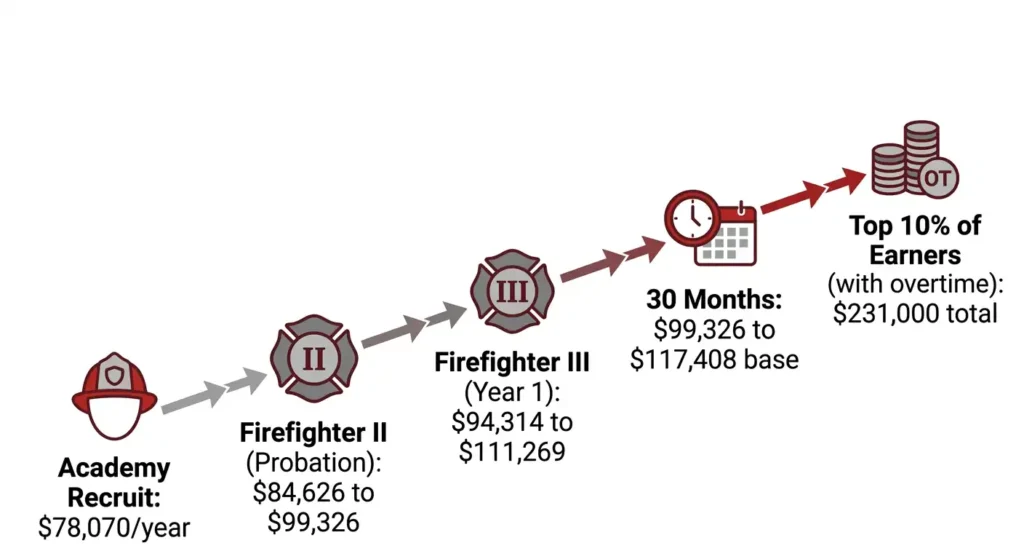
The Los Angeles Fire Department (LAFD) pays academy recruits $78,070 a year. Firefighter II on probation: $84,626 to $99,326. Firefighter III after year one: $94,314 to $111,269. At 30 months: $99,326 to $117,408 base (a Los Angeles paycheck calculator shows what any of these figures nets after tax). Add 1 to 3 percent education bonuses and a language incentive, and LAFD’s top 10 percent of earners, mostly from overtime, can clear $231,000 total. Applicants must be at least 21 with a high school diploma or equivalent and pass physical and written exams.
Los Angeles County firefighter salary
Los Angeles County Fire Department covers a larger, more varied area than the city. Pay across classifications runs $77,000 to $124,000, senior and specialized roles past $150,000. Requirements mirror the city’s Fire Fighter I certification and EMT credential. The county runs its own labor agreement, separate from the City of Los Angeles.
Chico firefighter salary
Chico’s most recently posted recruitment: $25.28 to $33.88 an hour, or $73,615 to $98,658 a year, hire to top step. Academy starts each January using the statewide Firefighter Candidate Testing Center list, and since recruitment cycles reopen periodically, confirm the current listing on the city’s careers page before relying on these figures. Chico shows solid pay exists outside LA and the Bay Area, at a lower ceiling.
Orange County firefighter salary
Orange County Fire Authority runs salary against a 56-hour average duty week, more scheduled hours than a typical office job. Firefighters earn $72,000 to $92,000 base, up to $114,000 for experienced staff. Firefighter/paramedics can reach about $84,000 a year (roughly $7,000/month) before overtime. OCFA rewards paramedic certification heavily.
CAL FIRE firefighter salary
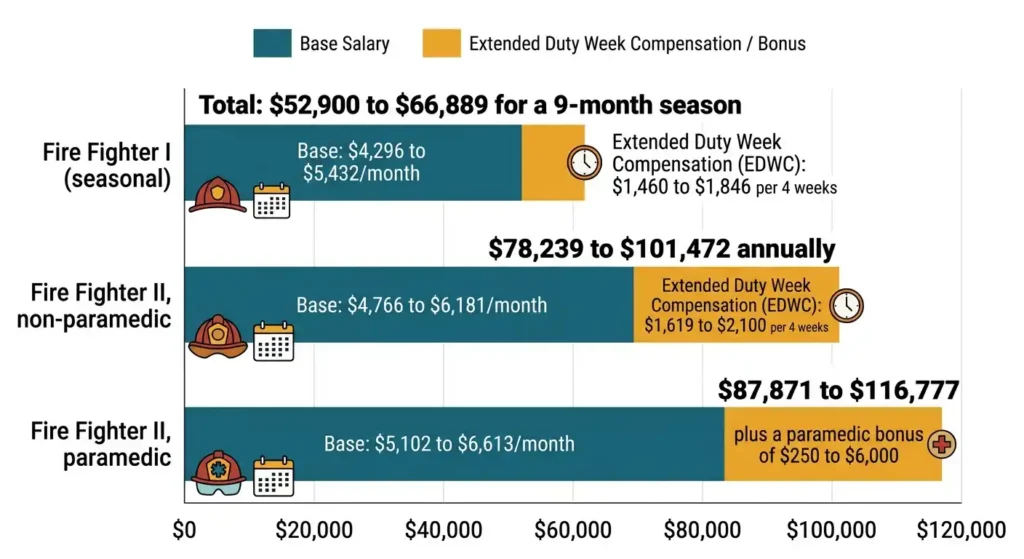
CAL FIRE is a state, not city or county, agency, so its structure differs. Permanent Fire Fighter I roles run $65,000 to $75,000 total. Seasonal Fire Fighter I posts a base of $4,296 to $5,432 a month plus $1,460 to $1,846 Extended Duty Week Compensation every four weeks, totaling $52,900 to $66,889 for up to a nine-month season. Fire Fighter II runs $78,239 to $101,472 for non-paramedics, $87,871 to $116,777 for paramedics with a $250 to $6,000 paramedic bonus. CAL FIRE includes a defined-benefit CalPERS pension. Its wildland mission also means a different pay and staffing model than a structural, municipal department.
How Firefighter Pay Changes With Experience and Promotion
Pay climbs through automatic steps as you gain seniority, and jumps again with each promotion.
Recruit and academy firefighter pay
Compensation usually starts the day the academy starts, at a lower rate than full firefighter pay. LAFD’s $78,070 academy pay is high for the state. Recruit status is legally and financially different from a sworn Firefighter II or III. Check each department’s specific academy pay and start date.
Fire Fighter I salary
Fire Fighter I is the entry classification statewide, city or CAL FIRE. CAL FIRE Fire Fighter I pays a base of $4,296 to $5,432 a month plus Extended Duty Week Compensation, totaling near $52,900 to $66,889 seasonally. Local departments often start permanent Fire Fighter I roles at $60,000 to $75,000. Both use step increases toward the top of the range, timeline varying by employer.
Fire Fighter II salary
Fire Fighter II follows completion of Fire Fighter I requirements and often more certification. CAL FIRE Fire Fighter II pays $4,766 to $6,181 a month base plus $1,619 to $2,100 Extended Duty Week Compensation for non-paramedics, totaling $78,239 to $101,472 annually. Paramedics earn $5,102 to $6,613 a month base plus higher Extended Duty Week Compensation and a paramedic bonus, totaling $87,871 to $116,777. That bonus alone can add close to $30,000 a year.
Fire Captain salary
Captain promotion brings a real pay jump for the added responsibility of supervising a crew and an incident scene. California’s Fire Captain average is $94,218, range $70,287 to $120,915. CAL FIRE captains, per Glassdoor’s Jan 2026 data, can reach $150,229 at the high end. Reaching captain takes years of experience, a promotional exam, and often fire officer certifications.
Battalion chief and fire chief salary
Command pay differs sharply from line pay. California’s Battalion Chief average through official salary surveys is $94,300, range $70,228 to $120,855; job-board estimates including large urban departments show $104,000 to $136,000, with top earners reaching roughly $153,000 to $154,000. Reaching this level takes years past captain, advanced certifications, and often a degree in fire science or public administration. These are not typical firefighter earnings.
How Overtime and Specialty Pay Increase Firefighter Earnings
Base salary is the floor. Overtime and specialty pay push many California firefighters into six figures.
How much can overtime add?
Overtime is planned, like CAL FIRE’s Extended Duty Week Compensation built into every pay period, or unplanned, from short staffing or major incidents like wildfires, on top of the baseline set by California overtime laws. LAFD’s top 10 percent of earners, driven by overtime, top $231,000 total, well above base pay. Overtime is never guaranteed; it depends on staffing and call volume that year.
Can a California firefighter make over $100,000?
Yes, commonly at large departments. LAFD firefighters at 30 months reach $99,326 to $117,408 base alone. CAL FIRE paramedics in Fire Fighter II can reach $116,777 total. San Francisco’s reported top-step pay is high as well, though that figure needs confirming against the department’s current schedule. Six figures is realistic with a few years in and in-demand certifications, but it is not a starting salary.
What specialty pay can firefighters receive?
Paramedic certification is the biggest specialty boost, worth thousands a year at CAL FIRE and Orange County Fire Authority. Hazmat and technical rescue training add smaller bumps. Some departments pay for a degree, bilingual ability, or longevity, and a few add holiday pay or a shift differential for holiday or overnight rotations. Amounts vary by department, so check the current schedule.
Why two firefighters can earn very different amounts
Same title, very different pay: one department’s base scale may be higher, one firefighter may be further along in steps, one may hold a paramedic certification, one may work a busier, higher-overtime station. Stack those factors and a $30,000 to $50,000 gap between two firefighters in the same state is normal.
How Much Is a California Firefighter Salary per Month, Hour, and Paycheck?
Annual numbers compare job offers; monthly and per-paycheck numbers are what people actually budget with.
Annual salary to monthly firefighter pay
$60,000 a year is about $5,000 a month before taxes; $80,000 is about $6,667; $100,000 is about $8,333. CAL FIRE’s Fire Fighter II range of $78,239 to $101,472 works out to roughly $6,520 to $8,456 monthly gross, before taxes and deductions.
Annual salary to hourly firefighter pay
Dividing salary by 2,080 (the standard 40-hour-week assumption) misleads, since most California firefighters do not work 40-hour weeks. OCFA uses a 56-hour average duty week; CAL FIRE’s Extended Duty Week Compensation exists because its firefighters exceed a standard week. LAFD’s published rates, like $40.53 to $47.57 for Firefighter II, already reflect real shift structure. Treat any simple 2,080-hour hourly estimate online as rough at best.
What does a firefighter take home after taxes?
Paychecks shrink from federal and California state income tax and Social Security and Medicare taxes, plus a mandatory pension contribution like CalPERS, the same gross pay vs net pay math that applies to any California paycheck. An $80,000 salary might net $58,000 to $64,000 in the bank, depending on filing status and benefit elections.
Example firefighter paychecks
A CAL FIRE Fire Fighter II earning $90,000 gross (base plus Extended Duty Week Compensation) sees roughly $3,462 gross per biweekly check, close to the numbers in a $90,000 after taxes in California breakdown. After federal tax, California tax, FICA, and a CalPERS contribution, net lands around $2,500 to $2,700. Unplanned overtime during wildfire season can push a check or two higher, and learning how to read your California pay stub makes it easier to spot exactly where that extra money shows up. These are estimates; run your own numbers through a California paycheck calculator for an accurate figure, or browse more salary after-tax scenarios for a range of income levels.
Firefighter Benefits and Total Compensation in California
Salary is only part of the picture. California fire departments generally add substantial benefits value on top of the pay stub.
Health and insurance benefits
Medical, dental, and vision are standard, with employers covering a significant premium share for the firefighter and family. LAFD provides full family and domestic partner coverage including dental and vision. Exact employer contribution varies by department, so ask during hiring.
Retirement and pension benefits
Most California firefighters retire through a defined-benefit pension, with the CalPERS retirement system most common at CAL FIRE and many city and county departments. Employees contribute a percentage; the employer contributes a separate, usually larger, share. Rules vary by employer and pension tier, so confirm directly with your department.
Paid leave and other benefits
Vacation, sick leave, and paid holidays vary by department and tenure. LAFD provides 12 fully paid sick days a year plus partial-pay days, accumulating up to 100 days, on top of the baseline set by California’s sick leave laws. Many departments also structure vacation accrual similar to the caps described in California’s PTO law, and cover uniforms and equipment at no cost. For the fuller picture of what counts as paid leave and benefits in California, the rules that apply to firefighters largely mirror what applies to any other state employee.
Why total compensation matters
Comparing offers by base salary alone can mislead. A $75,000 offer with a strong pension and fully paid family health coverage can beat an $85,000 offer with weaker retirement and higher employee premiums. Ask for the full compensation picture, not just the headline salary.
What Determines a California Firefighter’s Salary?
A handful of factors decide where you land in your department’s pay range.
Experience and salary steps
Nearly every department uses a step system: base pay rises automatically at set intervals, usually annually, separate from promotions. A Fire Fighter I moving step one to step five sees real growth without a title change. Each department sets its own step count and increase size.
Firefighter and paramedic qualifications
Paramedic certification is one of the clearest pay boosts. At CAL FIRE, the paramedic track in Fire Fighter II adds a higher base range plus a bonus up to $6,000 a year. Basic EMT certification is usually a baseline hiring requirement; paramedic status is an optional, incentivized step beyond it, amount set by each department’s labor agreement. Most departments also require a valid Class A or B commercial driver license for driving apparatus. Chico places certified lateral candidates at a higher starting salary than a brand-new hire, and several departments do the same for experienced applicants from other agencies. Military experience does not usually raise starting pay directly, though many departments weigh it favorably during hiring.
Specialized assignments and certifications
Hazmat, technical rescue, and specialty-unit assignments like urban search and rescue can add pay, but many departments require an active assignment, not just the certification, before the incentive kicks in.
Department and collective bargaining agreements
Every department negotiates its own salary schedule through a collective bargaining agreement with the local union, which is why pay varies city to city. The California Department of Human Resources, or CalHR, found in its 2025 survey that state firefighter classifications lagged local department maximum base pay by 76.7 percent on average, narrowing to a 26.9 percent lag once total compensation, including benefits, is counted. Always check the current, official schedule for your target department.
California Firefighter Salary Compared With Other Careers
Firefighting sits alongside other public safety and public-sector careers people weigh against it, including teaching; firefighter base pay and overtime potential typically run well above California teacher salary levels once step progression kicks in. For a broader look at how firefighter pay stacks up against other fields, see the full set of California salary guides by industry.
Firefighter vs. police officer salary
Firefighter pay runs fairly close to California police officer salary levels in most jurisdictions, both step-based plus overtime, both typically with CalPERS or similar pensions. The real gap usually comes down to specific department and city, not a fixed statewide difference.
Firefighter vs. paramedic salary
A standalone paramedic at a private ambulance company or hospital typically earns less than a fire department firefighter/paramedic, since departments build the certification into a higher-paying classification with an incentive on top. Firefighter/paramedics also carry firefighting duties beyond medical response.
Firefighter vs. EMT salary
Emergency Medical Technician, or EMT, certification is usually a minimum hiring requirement, not a separate career track. Standalone EMT jobs, often at private ambulance companies, pay less since they lack firefighting duties and a fire department’s benefits. EMT experience is often a stepping stone toward a firefighter job.
Is firefighter pay enough to live in California?
It depends on location. $75,000 goes further in Chico or Sacramento than San Francisco or Los Angeles, which is why expensive-region departments post higher entry pay. San Francisco’s reported low-$90,000s starting pay looks generous until Bay Area housing costs enter the picture, which is why many SFFD firefighters commute from cheaper areas. Pension and health benefits add real long-term security beyond the raw salary number.
Real California Firefighter Salary Scenarios
A new applicant comparing two departments
A smaller department starting at $65,000 with modest benefits versus a bigger one at $78,000 with fully paid family coverage and a stronger pension: comparing starting salary alone favors the bigger department, but total compensation can widen or, in some cases, narrow that gap.
A firefighter deciding whether to become a paramedic
Paramedic certification can add $10,000 to $30,000 a year in total compensation at CAL FIRE alone, against training time, cost, and added medical responsibility. Verify the exact incentive with the current department schedule.
An experienced firefighter considering promotion
Moving from a typical $80,000 to $110,000 firefighter range to a captain range averaging $94,218, with upside past $120,000, adds crew supervision and incident command responsibility, and requires years of experience plus a promotional exam.
A firefighter deciding whether to rely on overtime
Overtime availability shifts year to year with staffing, call volume, and fire season, so it is never certain. Overtime dollars are taxed and may factor into retirement differently than base pay. Budget around guaranteed base pay and treat overtime as extra.
How to Estimate and Compare Your Potential Firefighter Earnings
How to estimate first-year firefighter earnings
Start with the actual entry-step salary from the department’s current posting, not a statewide average, and plug it into an annual salary calculator to see the real yearly picture. Add only compensation you will realistically get in year one; leave out unearned overtime and specialty pay. Account for the actual work schedule, since a 56-hour duty week posting already reflects more scheduled hours than a 40-hour job.
How to estimate long-term firefighter earnings
Build in the department’s step schedule, a realistic promotion timeline if pursuing captain or beyond, and specialty qualifications like paramedic certification using the department’s published incentive. Keep overtime as a separate, optional line.
How to compare two firefighter job offers
Compare starting base salary, then maximum salary at top step and the years to reach it. Compare overtime availability and specialty incentives. Weigh retirement, health benefits, schedule, and cost of living together, since the higher salary on paper is not always the better decision.
Common Myths About California Firefighter Salaries
Myth: Every California firefighter makes over $100,000
False for a large share of the workforce early on. CAL FIRE’s seasonal Fire Fighter I pays as little as $52,900 a year, and many smaller departments start in the low $60,000s. Six figures is common at large, senior departments once overtime and specialty pay are included, but not universal.
Myth: The top of the salary range is starting pay
CAL FIRE’s $52,900 to $66,889 Fire Fighter I range spans new hire to top step after years, not the starting number. New hires start at the bottom and move up through automatic steps.
Myth: Overtime is part of guaranteed salary
Overtime, planned like CAL FIRE’s Extended Duty Week Compensation or unplanned, sits separately from base pay and is never contractually guaranteed. Availability shifts with staffing, call volume, and fire season, so treat it as variable income.
Myth: Every California fire department uses the same pay scale
State (CAL FIRE) and local employment run entirely separate pay systems. Even two municipal departments, like Los Angeles and Chico, differ sharply. CalHR’s 2025 survey found state maximum base pay lagging local departments by 76.7 percent, narrowing to a 26.9 percent lag on total compensation. Check each department’s own current schedule.
How to Verify a California Firefighter Salary Before Applying
Where to find the official salary range
Every legitimate posting includes an official range, usually on the city, county, or CAL FIRE careers site. CAL FIRE and other state agencies post openings and pay through CalCareers; many cities and counties list California government jobs, including firefighter openings, through GovernmentJobs.com. Cross-check against the official salary schedule and class specification, and check the posting’s effective date. Once you have a real monthly figure, a gross pay calculator turns it into a per-paycheck estimate fast.
What to look for in a salary posting
Confirm whether a figure is annual, monthly, or hourly. Confirm whether it is base salary alone or includes planned overtime like Extended Duty Week Compensation. Check the assumed work schedule, standard 40-hour or something like OCFA’s 56-hour average duty week. Look for paramedic or hazmat incentives listed separately. Most posted ranges cover cash pay only, not the dollar value of health insurance or pension contributions.
How to avoid outdated firefighter salary data
Check the publication and revision date on any figure. Government and department sources beat third-party aggregator sites for accuracy. Compare multiple current official sources, and treat anything more than a year or two old as historical, not current 2026 compensation.
Questions to Ask Before Accepting a Firefighter Job
What should I ask about salary?
Ask for first-step base pay in writing, how the step schedule works, the maximum base pay at top step and realistic years to reach it, and whether scheduled general increases are already built into the current agreement.
What should I ask about overtime and specialty pay?
Ask whether overtime is regularly available at that station, how planned overtime like Extended Duty Week Compensation is calculated, what paramedic or hazmat incentives exist and their current dollar amounts, and which payments are guaranteed versus variable.
What should I ask about benefits and retirement?
Ask the pension contribution split and which tier applies to new hires, your monthly health insurance cost, how vacation and sick days accrue with tenure, and whether uniforms, equipment, and training costs are covered.
Frequently Asked Questions About Firefighter Salary in California
What is the average firefighter salary in California in 2026?
Estimates range from $58,800 to $98,200, depending on source, workforce mix, and how recent the data is; the higher figures trace to a 2024 federal survey, not a fresh 2026 count. Official department schedules beat any blended average.
How much does a firefighter make starting out in California?
About $52,000 in smaller or seasonal roles up to $78,000 at large departments like LAFD. Recruit or academy pay is lower than full firefighter pay; step increases begin after probation.
Can California firefighters make $100,000 a year?
Yes, commonly at large departments with a few years in. LAFD reaches $99,326 to $117,408 base at 30 months; CAL FIRE paramedics in Fire Fighter II can reach $116,777 total. It is generally not a first-year reality.
Which California fire department pays the most?
Rankings shift with labor contracts. San Jose Fire Department’s Step 1 starts above $114,000, reaching about $141,772 at top step; Oakland Fire Department runs $108,381 at Step 1 to about $142,033 at top step. LAFD and CAL FIRE’s paramedic Fire Fighter II track also rank near the top with total compensation included.
How much does a firefighter make after 5 years in California?
Often near or approaching top step. At LAFD, that means base pay in the $99,000 to $117,000 range. At CAL FIRE, a paramedic Fire Fighter II at five years could near the $116,777 top of that range. Some have also promoted to a higher classification by then.
Do California firefighters get paid overtime?
Yes, through planned overtime like CAL FIRE’s Extended Duty Week Compensation and unplanned overtime from staffing shortages or emergencies. It sits separately from base salary and varies significantly year to year.
Does being a paramedic increase firefighter pay in California?
Yes, significantly at most departments. CAL FIRE’s Fire Fighter II paramedic track adds a higher base range plus a bonus up to $6,000 a year on top of the non-paramedic rate. Check the current department’s exact incentive.
Is CAL FIRE firefighter pay different from city firefighter pay?
Yes. CAL FIRE, a state agency, uses monthly base salary plus Extended Duty Week Compensation; city departments like LAFD negotiate separate local scales. Comparing the two requires matching duty-week lengths, not just job titles.
What is the highest firefighter position salary in California?
Command roles top line firefighter pay. California’s Fire Captain average is $94,218, up to about $120,915, though Glassdoor’s CAL FIRE-specific data shows captain pay reaching $150,229. Battalion chief averages run $94,300 up to roughly $153,000 to $154,000 at large departments. These roles take years of experience and certifications beyond a standard firefighter position.
Final Takeaway: What Can You Really Earn as a California Firefighter?
The salary range to remember
Realistic starting pay runs $52,000 to $78,000; experienced firefighters commonly earn $90,000 to $130,000 with step progression, specialty pay, and overtime. Department choice is the single biggest factor. Trust the official salary schedule over a blended online average.
What matters most before choosing a department
Starting pay matters, but so does time to top step, overtime and specialty pay opportunities, and benefits, retirement, schedule, and local cost of living together.
The next step for a prospective firefighter
Identify two or three target departments, verify current hiring requirements on their official careers page, pull their current official salary schedule, and compare realistic first-year and long-term compensation using real numbers, starting with the California paycheck calculator to see exactly what any of these salaries turns into after tax.

Yeasin Sorker is the founder of Paycheck Calculator California. He built this tool in 2018 after noticing that most free paycheck calculators missed California-specific rules like daily overtime and the uncapped SDI rate.
He researches California payroll tax updates regularly and keeps this calculator aligned with the latest IRS, FTB, and EDD published rates. All calculations on this site are estimates based on official 2026 government sources. For personalized tax advice, consult a qualified tax professional.