
The Social Security earnings limit 2027 caps how much you can earn before full retirement age without losing part of your benefit. Go over it, and the Social Security Administration withholds part of your check.
This guide breaks down the exact 2027 thresholds, withholding math, and exceptions SSA applies before and during your retirement year.
The one catch: withheld benefits aren’t lost, but you won’t see that money again immediately.
Social Security Earnings Limit 2027: The Amount You Can Earn
Two numbers matter in 2027, shown below: one for anyone under FRA all year, one for anyone reaching FRA during the year. SSA calls these thresholds the earnings test exempt amount: a lower exempt amount and a higher exempt amount, depending on which group applies to you. Older SSA materials also call full retirement age Normal Retirement Age (NRA), the same thing under an earlier name.
2027 Social Security Earnings Limits at a Glance
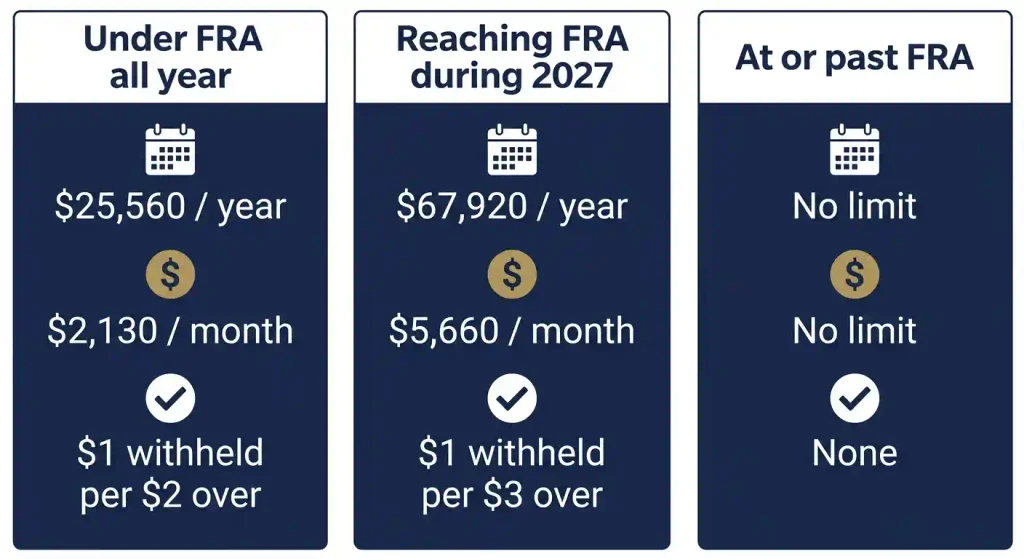
| Status in 2027 | Annual limit | Monthly limit | Withholding rate |
|---|---|---|---|
| Under FRA all year | $25,560 | $2,130 | $1 per $2 over |
| Reaching FRA during 2027 | $67,920 | $5,660 | $1 per $3 over |
| At or past FRA | No limit | No limit | None |
These are the official 2027 SSA figures, released with the 3.6% cost of living adjustment. They’re up from 2026’s $24,480 and $65,160, since SSA adjusts them most years for wage growth.
2027 Earnings Limit for People Under Full Retirement Age
If you claimed early and won’t hit FRA in 2027, your ceiling is $25,560 for the year. This covers anyone collecting retirement, spousal, or survivor benefits before FRA, at 62 or 65. Cross it, and SSA withholds $1 for every $2 earned above it. It’s not a cliff, just a small, proportional reduction.
2027 Earnings Limit for People Reaching FRA During the Year
If your FRA falls in 2027, your limit is $67,920, but only earnings from January through the month before FRA count. Reach FRA in September, and SSA only counts January through August. Earnings from September on don’t count at all. The higher limit assumes you’re easing into retirement, not working a full career year.
Who Must Follow the Social Security Earnings Limit?
Only people collecting benefits before full retirement age. At FRA, the rule disappears. This falls under Social Security Administration retirement benefits, under the Social Security Act, and differs from Social Security disability insurance (SSDI) or Supplemental Security Income (SSI). SSDI uses its own Trial Work Period and Ticket to Work Program, and SSI reduces payments based on nearly any income, earned or not, rather than this limit.
People Collecting Social Security Before FRA
Claim early, say at 62 or 64, and you’re subject to the earnings test once you earn above the threshold. Working doesn’t cancel eligibility, but it can reduce your monthly payment, sometimes to nothing. Married couples each have their own earnings limit based on individual income, not combined household earnings, so one spouse going over never touches the other’s check.
People Reaching Full Retirement Age in 2027
Your birth year sets your FRA. Born 1960 or later, FRA is 67. Earlier birth years fall somewhere between 66 and 67, in two month increments. As a recap, that’s the $67,920 limit for your months before FRA, then the test stops for good. Age 62 always falls under the lower $25,560 limit. Ages 65 and 66 usually do too, unless one is your exact FRA.
People Already at Full Retirement Age
At FRA, earn any amount, $50,000 or $200,000, and SSA withholds nothing. The earnings test targets early claimants, not people already at full retirement age. Income may still be taxed under regular rules, but that’s separate from the earnings test.
How the Social Security Earnings Test Reduces Your Benefits
SSA withholds only a fraction of what you earn above the threshold, not your whole check. SSA’s own name for this is the SSA Retirement Earnings Test, and it works the same way every year, only the dollar thresholds change.
The $1-for-$2 Withholding Rule
For anyone under FRA all year: $1 withheld for every $2 earned above $25,560. Earn $5,000 over, lose $2,500 for the year. A small overage barely dents your check; a big one can wipe it out for months. Earn exactly $25,560, and nothing is withheld.
The $1-for-$3 Rule in the Year You Reach FRA
In your FRA year, SSA withholds $1 for every $3 earned above $67,920, counting only pre-FRA earnings. That’s gentler than the $1-for-$2 rule, since SSA treats this as a transition year, not a full working year.
Does Social Security Stop Your Entire Monthly Check?
Sometimes, yes, temporarily. SSA withholds by skipping whole months rather than shaving a little off each check, until the owed amount is covered. Owe $6,000 with a $2,000 monthly check, and SSA likely withholds three full months. Nothing is lost forever, but the gap is real. The next section shows how your own benefit amount changes that math.
2027 Social Security Earnings Limit Examples and Calculations
Numbers make this clearer than explanation. Here’s what happens at common income levels.
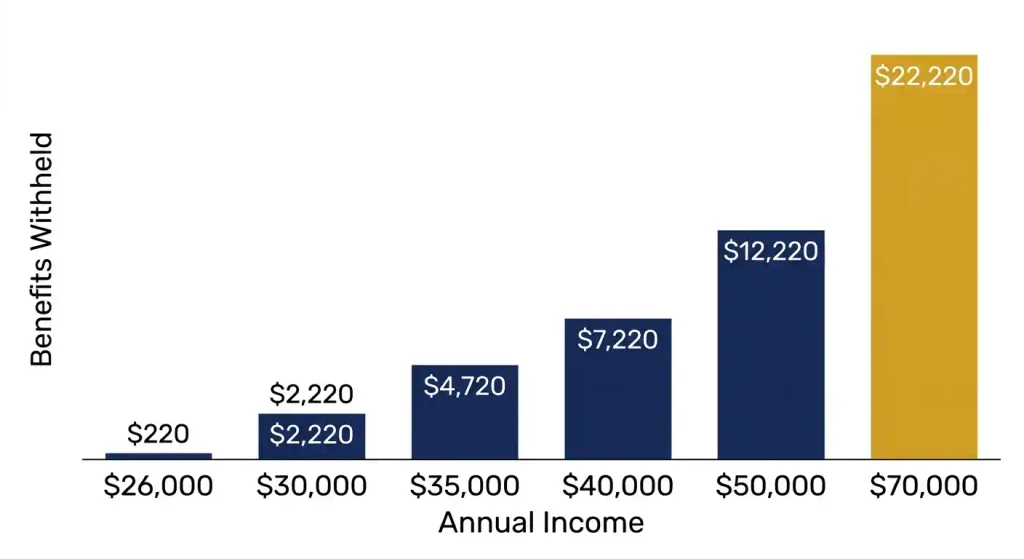
| Annual Income (under FRA all year) | Amount Over the $25,560 Limit | Benefits Withheld |
|---|---|---|
| $26,000 | $440 | $220 |
| $30,000 | $4,440 | $2,220 |
| $35,000 | $9,440 | $4,720 |
| $40,000 | $14,440 | $7,220 |
| $50,000 | $24,440 | $12,220 |
| $70,000 | $44,440 | $22,220 |
How Much Social Security Will Be Withheld on $30,000?
Using the table above, $30,000 withholds $2,220 for the year. On a $1,800 monthly benefit, that’s about a month and a bit withheld, not your whole year.
What Happens If You Earn $40,000 or $50,000?
Withholding grows faster than the extra income at both levels, since the excess itself keeps climbing. More work income doesn’t always mean more total income once benefits start disappearing to cover the gap.
What If You Earn $70,000 in 2027?
Under FRA all year, $70,000 means $22,220 withheld, enough to zero out most of the year. Reaching FRA in 2027 instead, your limit is $67,920, so you’re only $2,080 over, and SSA withholds just $693 under the $1-for-$3 rule. Same income, different outcome, depending on FRA timing.
How Your Monthly Social Security Benefit Affects Withholding
Your benefit size decides how many months get skipped. A $12,220 withholding against a $3,000 monthly benefit holds back about four months. Against $900 monthly, it could mean over a year of reduced checks. The earnings test only touches your Social Security benefit, not your wages. Example: someone getting $1,500 a month, $4,000 over the limit from part-time work, has $2,000 withheld, about one full check plus part of another. Someone getting $2,500 a month, $1,000 over, has just $500 withheld.
What Income Counts Toward the Social Security Earnings Limit?
Only earned income from active work counts, not savings, investments, or other benefits.
Employment Income That Counts
Gross wages count, not take-home pay: salary, overtime, bonuses, commissions, accrued vacation pay, and tips. If you want to run your own numbers first, a gross pay calculator can help, and our paycheck basics guide covers how wages are counted more broadly. SSA counts wages when earned, not when paid, which matters around a calendar year or retirement date.
Self-Employment Income and the Earnings Test
SSA counts net earnings, not gross revenue. A business bringing in $100,000 with $30,000 profit counts only the $30,000. This protects high-revenue, thin-margin businesses from unfair penalties. If you’re self-employed in California, it also helps to know your self-employment tax rate, since that’s calculated separately from the earnings test.
Income That Does Not Count Toward the Earnings Limit
Pensions, annuities, IRA and 401(k) withdrawals, investment income, interest, dividends, capital gains, and rental income from property you don’t actively manage sit outside the earnings test. Pull $80,000 from a traditional IRA in 2027, and it has zero effect on the earnings test, though it may still be taxable. Wages and self-employment profit are earned income; everything in this list is unearned income. Only earned income triggers withholding.
Does Social Security Count Gross Pay or Take-Home Pay?
Gross pay, always. 401(k) contributions, insurance premiums, and tax withholding don’t reduce what counts. Self-employment is the exception, where net profit is what matters. If your own check feels smaller than expected for unrelated reasons, our guide on why your paycheck is so low walks through the common causes.
2026 vs. 2027 Social Security Earnings Limits
Comparing the years shows how closely these numbers track wage growth.
Annual Earnings Limit Comparison
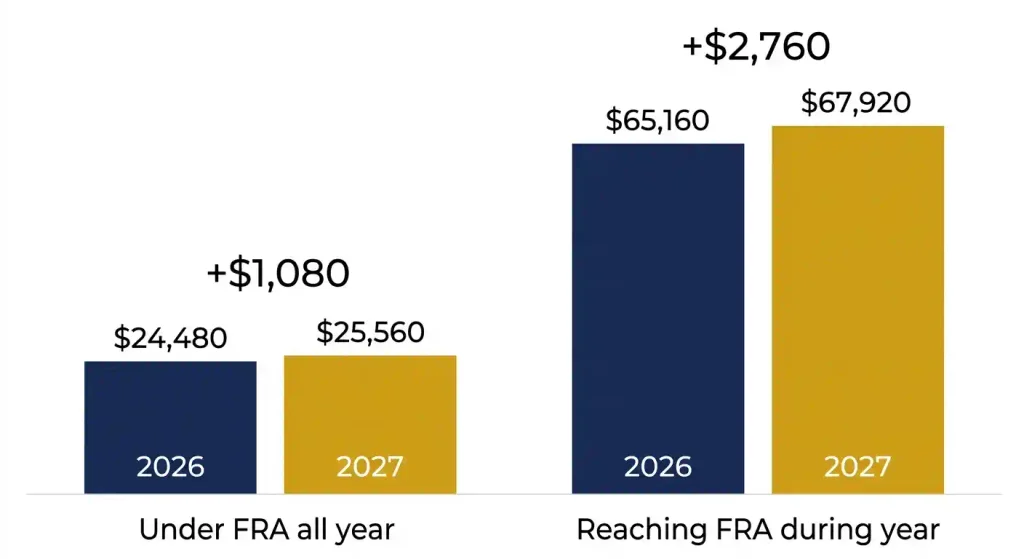
| Category | 2026 | 2027 | Increase |
|---|---|---|---|
| Under FRA all year | $24,480 | $25,560 | $1,080 |
| Reaching FRA during year | $65,160 | $67,920 | $2,760 |
Both limits rose for 2027, as expected, since SSA adjusts them almost every year with national wages.
Social Security Earnings Limit vs. Taxable Maximum
Two different numbers people mix up. The earnings limit affects benefits for early claimants who still work. The Social Security taxable maximum is the cap on income taxed for Social Security, $192,300 for 2027, up from $184,500 in 2026. One decides if your check shrinks; the other decides your payroll tax. This cap funds Old-Age, Survivors, and Disability Insurance (OASDI). Contributions flow in under the Federal Insurance Contributions Act (FICA) and pass through the U.S. Department of the Treasury into the trust funds. The SSA Office of the Chief Actuary calculates the wage growth behind each increase, published in the Federal Register every fall.
Does the 2027 COLA Change the Earnings Limit?
The 3.6% cost of living adjustment raises your monthly benefit, separate from the earnings limit increase. Both rose for 2027, but one adjusts your check size, the other what you can earn. Officially this is the Cost-of-Living Adjustment (COLA), and the 2027 Social Security COLA came in at 3.6 percent, tied to inflation rather than wage growth, which is why it uses a separate formula.
The Special Monthly Earnings Rule for Your First Year of Retirement
A lesser known rule for people retiring partway through the year, and it can save real money.
How the First-Year Monthly Earnings Test Works
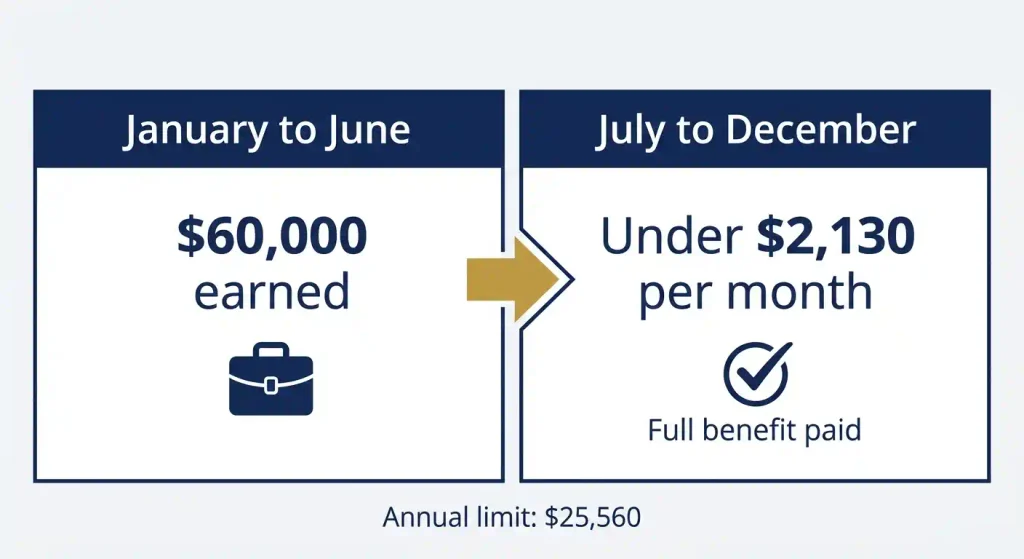
In your first year claiming, SSA offers a monthly test instead of the annual one. Earn under $2,130 in a month in 2027, without substantial self-employment work, and you get your full benefit for that month regardless of earlier earnings. SSA sometimes calls this the special earnings limit rule, for your first calendar year only.
Retiring Midyear After Already Earning Above the Annual Limit
Earn $60,000 through June, then retire and claim in July. The annual rule alone would put you way over $25,560. But if your earnings from July through December stay under $2,130 a month, you still get your full benefit those months.
Special Rules for Self-Employed Retirees
For business owners, the monthly test also depends on hours worked. More than 45 hours a month in your business counts as substantial services in self-employment, which can disqualify that month even with low net earnings. SSA uses this to stop high earners from retiring on paper while still running the business.
What Happens to Social Security Benefits Withheld Because You Worked?
Withheld benefits aren’t gone. They come back.
Are Withheld Social Security Benefits Permanently Lost?
No. Every dollar withheld gets factored back into your benefit once you reach full retirement age. It’s a delay, not a penalty.
How SSA Recalculates Your Retirement Benefit at FRA
At FRA, SSA recalculates your monthly benefit as if you’d claimed later for the withheld months. This usually means a modest ongoing increase, spread over your expected lifetime rather than paid back in one lump sum.
Can Working Longer Increase Your Future Social Security Benefit?
Working can raise your benefit if current earnings beat one of the 35 years used in your calculation. SSA swaps in the higher year automatically. Those 35 years feed your Average Indexed Monthly Earnings (AIME), which becomes your Primary Insurance Amount (PIA), the base of your benefit. The permanent reduction from claiming early is locked in for life, unlike earnings-test withholding, which is temporary and gets added back at FRA. Anyone planning to work a full schedule usually comes out ahead delaying benefits until the earnings test no longer applies, which is worth weighing as part of broader retirement planning.
Common Social Security Earnings Limit Myths and Mistakes
A few myths cause more confusion than the actual rules.
Myth: You Cannot Work While Collecting Social Security
False. Nothing stops you from working before FRA. The earnings test only reduces your check above the threshold, it doesn’t cancel eligibility.
Myth: All Income Counts Toward the Earnings Limit
Only earned income counts: wages and net self-employment profit. Pensions, 401(k) withdrawals, investment gains, and passive rental income stay outside it entirely.
Myth: Withheld Benefits Are Lost Forever
They’re not. SSA raises your benefit at FRA to account for withheld months. It comes back as higher ongoing payments, not a lump sum.
Myth: The Monthly Earnings Limit Applies to Everyone
The monthly test only applies in your first year of claiming. After that, SSA uses the standard annual test; $2,130 and $5,660 are just reference points, not a permanent monthly cap.
What to Do If Your 2027 Earnings Exceed the Social Security Limit
Concrete steps to take before a surprise reduced deposit.
- Estimate your annual earnings against the $25,560 or $67,920 limit.
- Report any significant change in expected earnings to SSA right away.
- Check your my Social Security account for current earnings-test adjustments.
How to Estimate Your Annual Earnings
Add up expected wages, overtime, bonuses, and commissions; self-employed, use net profit. Compare the total to $25,560 or $67,920, whichever applies. Do this before accepting a raise, promotion, or extra overtime, since a pay jump can push you over fast. An annual salary calculator can do the math for you.
How to Report Changes in Your Expected Earnings
Report your expected earnings when you claim, and update the estimate if income changes significantly. SSA doesn’t automatically know your real-time earnings, it relies on your estimate and on W-2 and tax filings that arrive months later, so reporting changes yourself avoids a messy correction. The same earnings test applies working for a U.S. employer abroad, since that’s covered work. A foreign employer’s wages may fall under a totalization agreement between the U.S. and that country, which decides if the work counts, so confirm your situation with SSA.
How to Check Your Social Security Benefit and Earnings Record
Log into your my Social Security account at ssa.gov to see your benefit amount, earnings history, and any earnings-test adjustments. Your Social Security Statement there breaks your earnings record down year by year. SSA explains how the earnings test rule works in SSA Publication 05-10069, free at ssa.gov, though always check the current year’s thresholds on SSA’s own site rather than an older printing of that publication.
Frequently Asked Questions About the Social Security Earnings Limit 2027
How much can I earn while collecting Social Security in 2027?
$25,560 if you won’t reach FRA in 2027. $67,920 if you will, counting only earnings before that month.
Can I earn $30,000 and still collect Social Security?
Yes. $2,220 withheld for the year if under FRA the whole time, but benefits continue.
Does Social Security count my gross income or net income?
Gross wages for employees, net profit for the self-employed. Payroll deductions don’t reduce what counts.
What happens if I reach full retirement age in 2027?
You get the $67,920 limit for months before your FRA birthday, then no limit after.
Will Social Security give back the benefits withheld because I worked?
Yes, through a recalculation at FRA that raises your ongoing monthly benefit. Not a lump sum, but not lost.
Does the earnings limit apply to pensions and 401(k) withdrawals?
No. Those are unearned retirement income and don’t count, though they may still be taxable.
Can I work full-time and collect Social Security after FRA?
Yes, no limit. Earn any amount at FRA without losing a dollar of benefit.
Does the Social Security earnings limit change every year?
Almost every year. SSA adjusts it with national wage growth, which is why 2027 is higher than 2026. Check ssa.gov each fall for the new COLA and earnings limits.

Yeasin Sorker is the founder of Paycheck Calculator California. He built this tool in 2018 after noticing that most free paycheck calculators missed California-specific rules like daily overtime and the uncapped SDI rate.
He researches California payroll tax updates regularly and keeps this calculator aligned with the latest IRS, FTB, and EDD published rates. All calculations on this site are estimates based on official 2026 government sources. For personalized tax advice, consult a qualified tax professional.