
California sick leave laws in 2026 require employers to give eligible workers paid time off for illness or family care, with eligibility starting after 30 days worked and usable after 90 days of employment.
That 30 and 90-day timeline is what I check first when auditing a client’s payroll setup, matched against the 2026 poster update.
The real minimum depends on your shift length, not this flat number.
California Sick Leave Laws 2026: The Quick Answer
Every eligible employee gets at least 40 hours or 5 days of paid sick leave a year, whichever is bigger. Longer shifts push the real number above 40. This benefit is officially called California Paid Sick Leave (PSL), separate from vacation or PTO.
Is it 40 hours or 5 days?
Whichever is more, always. Work 10-hour shifts and 5 days equals 50 hours, your real minimum. 40 hours or 5 days is the statewide floor. Your actual number depends on your normal workday length.
Who is generally covered?
Full-time, part-time, and temporary employees in California are covered, with eligibility rules explained below. A few groups are exempt:
- Some union employees under specific collective bargaining agreements
- In-home supportive services providers
- Independent contractors and gig workers, since this law applies to employees, not the self-employed. If your work status is unclear, our guide on employee misclassification in California explains how the state tells the two apart
When can you actually start using sick leave?
Accrual and usage run on different clocks. You accrue from day one, but can’t use it until day 90. Hours earned before day 90 aren’t lost, just locked until then.
California Sick Leave vs. 40 Hours or 5 Days
The state sets a floor, not a fixed number. That floor moves with your shift length.
What does “40 hours or 5 days, whichever is more” mean?
An 8-hour worker’s 5 days equal 40 hours. A 12-hour worker’s 5 days equal 60 hours, and California law guarantees the 60. This is the state minimum. Employers can offer more, never less.
Quick comparison by workday length
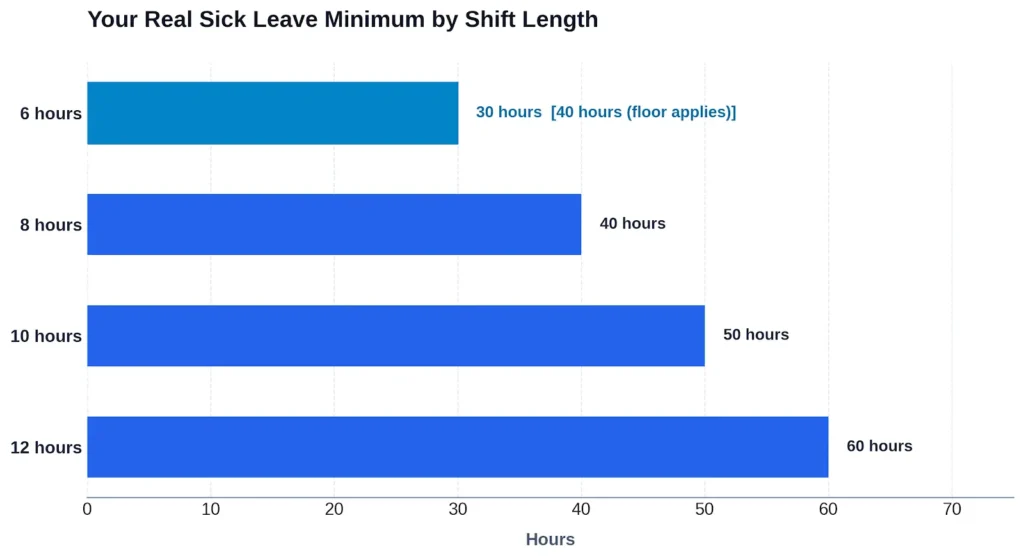
| Shift Length | 5-Day Total | Your Real Minimum |
|---|---|---|
| 6 hours | 30 hours | 40 hours (floor applies) |
| 8 hours | 40 hours | 40 hours |
| 10 hours | 50 hours | 50 hours |
| 12 hours | 60 hours | 60 hours |
These numbers assume the full annual amount has already been earned or given under your employer’s policy.
How California’s rule differs from a simple 40-hour assumption
Five days isn’t five 8-hour shifts once schedules change. Nurses, warehouse workers, and firefighters on 10 or 12-hour rotations often qualify for more than 40 hours without realizing it, the same way California’s overtime laws also scale with actual hours worked rather than a flat number. Check your actual shift length before assuming your total.
How California Sick Leave Works
Paid sick leave is job-protected, paid time off for health and safety reasons. It’s a legal floor, not a bonus. It’s also separate from other protected time off in California, like paid family leave, bereavement leave, and maternity leave pay, which cover longer absences.
What counts as paid sick leave?
Paid time off, at your regular rate, used for illness, medical care, or safety situations. Your paycheck doesn’t shrink when used correctly. A standalone policy or a combined PTO policy can both satisfy the law, as long as PTO meets or beats the state minimums.
Who qualifies for California paid sick leave?
Full-time employees are covered from day one of accrual. Part-time employees build leave based on hours worked. Temporary and seasonal employees qualify once they hit the 30-day threshold.
What are the basic eligibility rules?
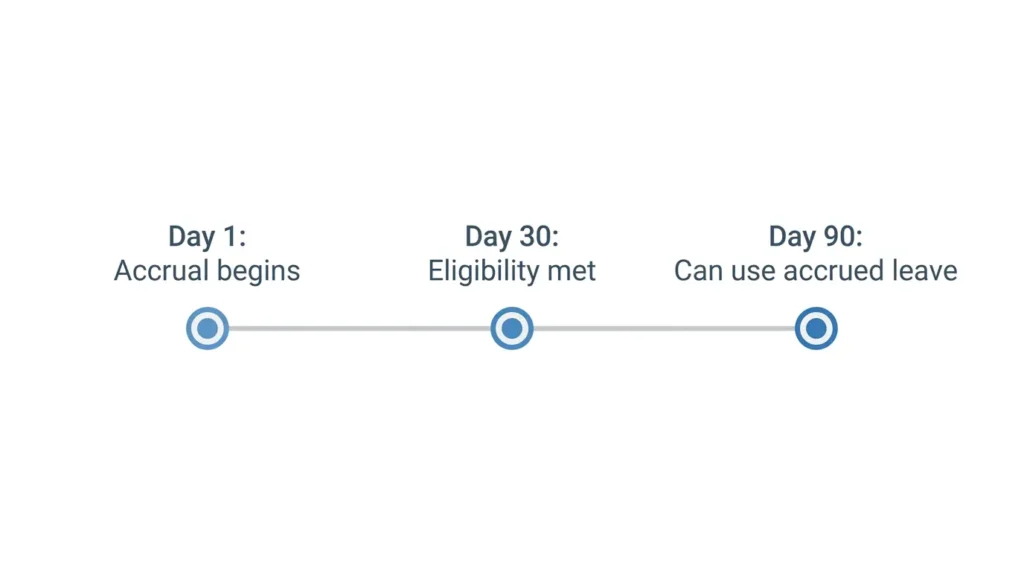
30 days of work with the same employer in California, within a 12-month period, plus 90 days of employment before use. Eligibility and accrual aren’t the same. You build a balance from day one but can’t spend it until day 90.
How California Sick Leave Accrues
Most employers use a simple formula. Once you know it, check it against your pay stub.
The 1 hour for every 30 hours worked method
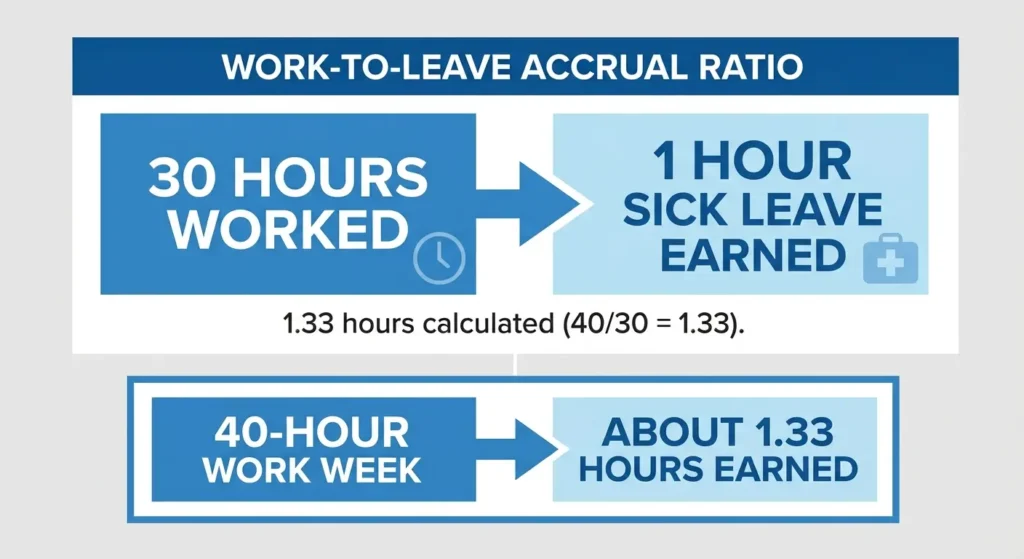
One hour of sick leave for every 30 hours worked, starting day one. A 40-hour week earns about 1.33 hours. This method works well for variable schedules since it tracks actual hours worked.
Alternative accrual methods employers can use
Employers can use a different schedule if it’s at least as generous. One option front-loads a set amount by the 120th calendar day. Another guarantees the full amount by the 200th calendar day. Your balance can never fall below what standard accrual would give by that point.
Front-loaded sick leave
Front-loading gives the full 40 hours or 5 days upfront, no waiting period. True front-loading generally skips carryover since the full amount is already given. Some employers also advance sick leave ahead of what’s technically accrued, which is allowed.
How to calculate your sick-leave balance
Accrued or front-loaded hours, minus hours used, checked against your pay stub or payroll portal, since California requires this balance to be reported. Flag any mismatch early.
Sick Leave Accrual, Carryover, and Annual Limits
Accrual, carryover, and annual use limits are three separate rules. Mixing them up causes most confusion.
Can unused sick leave carry over?
Yes, under accrual-based policies, unused hours roll into the next year. Carryover is about your earned balance, not your annual usage right. Front-loaded plans often have nothing left to carry over by design.
The 80-hour or 10-day accrual cap
Employers can cap your total balance at 80 hours or 10 days, whichever is greater. This caps how much you can stockpile, not how much you can use per year. Hit the cap and accrual pauses until you use some leave and drop below it. A warehouse worker who never uses sick time simply stops accruing at 80 hours.
How much sick leave can you use in one year?
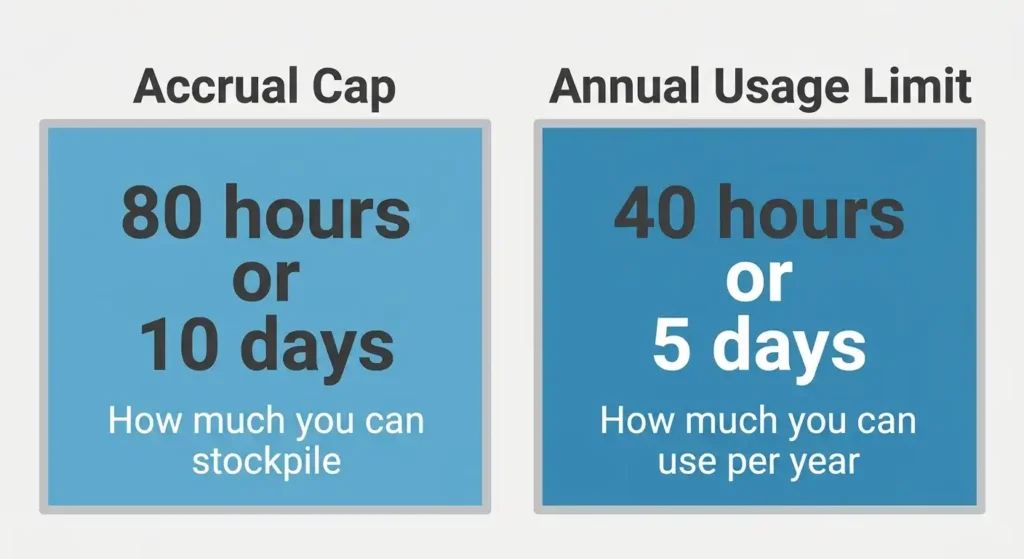
40 hours or 5 days, whichever is more, even if your balance is higher. Balance and annual usage right are different numbers. More generous employer policies can raise this limit.
Does sick leave expire at the end of the year?
No, under standard accrual, hours carry forward, calendar year or rolling 12 months. Front-loaded plans are the exception since the annual reset replaces the balance instead of adding to it.
What Can You Use California Paid Sick Leave For?
The reasons go well beyond “I have the flu.” You can use paid sick leave for:
- Your own illness, injury, or health condition
- Medical appointments and preventive care
- Caring for a qualifying family member
- A designated person you name at the time of the request
- Crime-victim and court-related purposes
- Agricultural emergency conditions like smoke, heat, or flooding
Your own illness, injury, or health condition
Physical illness, injury, or an ongoing condition all qualify. Mental health conditions count too. Diagnosis, care, or treatment and preventive care like checkups also qualify.
Medical appointments and preventive care
Doctor visits, dental checkups, and preventive screenings all qualify. Partial days are allowed for shorter appointments. Anything tied to diagnosis, care, or treatment fits.
Caring for a family member
Children, parents, spouses, and registered domestic partners are covered. So are grandparents, grandchildren, and siblings, a broader list than most employees assume.
Using sick leave for a designated person
You can name one designated person per 12-month period if someone doesn’t fit the standard family definition. You identify them at the time you request leave. Example: a single parent using it to care for a close friend recovering from surgery.
Crime-victim and court-related purposes
Sick leave covers judicial proceedings tied to being a victim of a violent or serious felony, plus getting relief like a restraining order after a qualifying act of violence, including domestic violence, sexual assault, or stalking. AB 2499 and AB 406 expanded and clarified these protections, and also confirmed sick leave can cover jury duty and witness appearances in California. Agricultural workers also have protections under Senate Bill 1105, effective January 1, 2025, to use sick leave during a local emergency involving smoke, heat, or flooding conditions.
How Much Will You Be Paid for Sick Leave?
Getting time off is half the equation. Getting paid correctly is the other half.
How California calculates sick-leave pay
Generally your regular rate of pay, the same figure our California paycheck calculator uses to estimate your take-home pay. Employers with variable pay rates must calculate an accurate blended rate, not default to your lowest. Exempt salaried employees are typically paid their full salary regardless.
What should appear on your pay stub?
Your available sick leave balance, by law, on your pay stub or a same-day document. This is a legal requirement, not optional. If you’re unsure what any line item means, our guide on how to read a California pay stub breaks down every section. Flag a zero or unclear balance immediately, and keep copies of your pay stubs.
What if your employer does not pay the sick leave?
Check hours used against what you were paid. Document any gap with dates, hours, and messages. Bring it to the California Labor Commissioner’s Office if it isn’t corrected. The disputes that resolve fastest have dated pay stubs showing the missing hours side by side.
Can Your Employer Deny or Restrict Sick Leave?
Employers control scheduling, but can’t block protected leave outright.
Can an employer deny a sick-leave request?
Not if you have accrued hours available and a qualifying reason. They can deny it if hours aren’t accrued yet or the reason doesn’t qualify. A staffing shortage is not a valid reason to deny a qualifying request.
Can your employer require advance notice?
Reasonable advance notice for foreseeable situations, like a scheduled surgery. For unforeseeable ones, like waking up sick, “as soon as practical” is the standard, meaning a quick call or text works.
Can your employer require a doctor’s note?
Generally no, not as a blanket policy for ordinary, short-term use. Some extended leave situations may involve documentation, but that’s different from everyday sick days.
Can your employer require you to find a replacement?
No. Coverage is the employer’s scheduling responsibility, not yours. Document it if a manager says otherwise, including what was said and when.
Can your employer require a minimum number of hours?
California limits how much employers can force at once, and many set a two-hour minimum increment for partial-day use. Deductions should reflect actual time used, not be rounded up.
California Sick Leave vs. Employer PTO Policies
Not every company calls it “sick leave.” Many fold it into general PTO.
Can PTO satisfy California sick-leave requirements?
Yes, if the PTO policy meets or exceeds every sick leave minimum, including accrual, usage, and carryover. Older, grandfathered sick leave or PTO plans can still comply if they meet the same standards. See our full breakdown of California PTO law for how accrual caps and payout rules work outside of sick leave specifically. The numbers matter, not the label.
What if your employer offers unlimited PTO?
It gets tricky since there’s no clear balance to track. Some employers still track a separate sick leave allotment underneath it. Ask HR directly how sick leave specifically is handled.
What if your employer gives more than California requires?
That promise generally becomes the standard they must follow. The law is a floor, not a ceiling. A policy can change midyear, but never below the state minimum or by erasing hours already accrued.
Local California Sick Leave Laws Can Give You More
State law is the baseline, not always the finish line.
When local sick-leave rules apply
Several California cities have ordinances that exceed the state minimum. If you work there, the more generous local rule applies. Your work location matters more than your employer’s headquarters.
State law vs. local ordinance
Local ordinances can offer faster accrual, higher caps, or bigger annual limits. State law never lowers what a local ordinance provides. Don’t assume the statewide 40-hour or 5-day rule is your maximum.
How to determine which rule applies to you
Identify your exact work city or county. Check your employer’s policy for that location. Compare it to any local ordinance. Whichever gives more should apply.
Real-World California Sick Leave Scenarios
Numbers make more sense with real situations.
“I work four 10-hour shifts. Do I get 40 or 50 hours?”
Five days at 10 hours each is 50 hours, beating the 40-hour floor. That’s your real minimum, assuming the full amount has been earned or given.
“I have only worked here for two months. Can I use sick leave?”
You’ve likely cleared the 30-day requirement. The 90-day mark is the real barrier for using leave. You’re accruing the whole time either way.
“I work part-time and my hours change every week.”
Accrual tracks actual hours worked under the 1-hour-per-30-hours method. The annual usage minimum applies once you’ve earned enough hours. Check your pay stub regularly.
“My manager says I need to find someone to cover my shift.”
That conflicts with California law, since coverage is the employer’s job. Give notice as required, and document what was said and when.
“My pay stub shows sick hours, but my employer says I cannot use them.”
Verify the balance, confirm you’ve cleared 90 days, and confirm the reason qualifies. If it still doesn’t add up, escalate it.
“I used sick leave and received an attendance point.”
That looks like retaliation, which is illegal. Save the attendance notice, dates, and communications, then consider a Labor Commissioner complaint.
California Sick Leave Rules for Special Employees and Situations
Not every job looks the same, and the law adjusts for it.
Part-time employees
Covered the same as full-time workers. Accrual is based on hours worked, so fewer hours mean a slower build. See our guide on part-time vs full-time paychecks in California for how other benefits scale with hours too. The 40-hour or 5-day minimum still applies once earned.
Temporary and seasonal employees
Qualify once they meet the 30-day work requirement, plus the 90-day rule for use. Contracts under 30 days generally won’t build eligibility in time.
Employees covered by collective bargaining agreements
Some union employees are exempt if their CBA includes equivalent or better protections. This depends on the specific agreement language.
Employees with unusual schedules
10 and 12-hour shifts push the real total above 40 hours, as shown in the shift-length table earlier. The core rule stays the same: 5 days in your actual hours, versus the 40-hour floor.
What Happens When You Leave or Return to an Employer?
Sick leave doesn’t behave like vacation time when your job status changes.
Is unused sick leave paid out when you quit?
Generally no for standalone sick leave. A combined PTO policy often does get paid out, since it’s treated like vacation. Our guide to California’s final paycheck law covers exactly what must and must not be included when you leave a job. The label matters here.
What happens if you are rehired?
Rehired within 12 months by the same employer, your prior accrued balance generally has to be reinstated. Example: a seasonal worker rehired five months later gets their old balance back, not zero.
What happens when you transfer within the company?
Your accrued balance typically carries over between locations. A stronger local ordinance at the new location takes over going forward.
California Sick Leave Myths and Misconceptions
A few common beliefs are simply wrong.
Myth: Everyone automatically gets exactly 40 hours
False for shifts longer than 8 hours. The 5-day rule can push your real number higher.
Myth: Part-time workers do not qualify
False. Part-time employees are covered, just with slower accrual tied to hours worked.
Myth: Sick leave disappears every January
False under standard accrual, hours carry over. The 80-hour or 10-day cap limits stockpiling, not carryover itself.
Myth: Employers can punish you for taking protected sick leave
False, and illegal. Docking attendance points or disciplining for qualifying use is prohibited retaliation. Discipline soon after a leave request triggers a legal presumption of retaliation.
Myth: You always need a doctor’s note
False for routine sick leave, foreseeable or not. Some special leave categories may require more documentation, but that’s separate.
What to Do If Your Employer Violates California Sick Leave Law
Don’t let it slide. Here’s the order to work through.
First, verify your sick-leave balance
Check your latest pay stub against your handbook and your own calculation of hours worked and used.
Document a sick-leave dispute
Save texts, emails, and messages. Write down what a manager said and when. Keep pay stubs and schedules from the disputed period.
When to contact the Labor Commissioner’s Office
Unpaid sick leave, unlawful denial, or retaliation are all valid reasons to file a complaint. Unpaid sick leave is a form of wage theft in California, and the same complaint process applies.
What employees should avoid doing
Don’t skip reasonable notice out of frustration. Never falsify a reason for leave. Don’t delete related messages. Don’t assume every disagreement is automatically illegal.
Frequently Asked Questions About California Sick Leave Laws
How many sick days do you get in California in 2026?
5 days or 40 hours, whichever is more for your shift length. Employers can offer more, and some local ordinances push it higher.
Is 5 days of sick leave the same as 40 hours?
Only for 8-hour shifts. A 10-hour worker’s 5 days equal 50 hours.
Can an employer deny sick leave in California?
Only if hours aren’t accrued yet or the reason doesn’t qualify.
Can my employer fire me for calling in sick in California?
No. Protected sick leave use can’t lawfully lead to termination or discipline. Save records and consider a Labor Commissioner complaint if it happens.
Do unused sick days roll over in California?
Yes, under standard accrual, up to the 80-hour or 10-day cap. Front-loaded plans reset instead.
Can I use California sick leave for a doctor’s appointment?
Yes, including preventive care, with partial-day leave allowed.
Can I use sick leave to care for my child or parent?
Yes. Children, parents, spouses, domestic partners, grandparents, grandchildren, and siblings all qualify, plus one designated person per year if needed.
Can my employer require me to find someone to cover my shift?
No, that’s the employer’s responsibility.
Do California sick leave laws apply to part-time workers?
Yes, fully covered, with accrual based on hours actually worked.
Is unused California sick leave paid out when you quit?
Generally no for standalone policies. Combined PTO plans often are paid out.
What should I do if my employer refuses to pay my sick leave?
Verify hours used, review your pay stub, document the dispute, and escalate to the Labor Commissioner’s Office if unresolved.
California Sick Leave Laws 2026: Sources and Official Rules
California Labor Commissioner’s Office
The Labor Commissioner’s Office publishes current guidance on eligibility, accrual, and use. Its updated California paid sick leave poster reflects the latest changes and is displayed alongside the Notice to Employee (Form 2810.5) given to new hires, which our new hire paperwork requirements guide covers in full. The Labor Commissioner’s Office paid sick leave FAQ and the California Paid Sick Leave FAQ, both published through the California Department of Industrial Relations (DIR) at California.gov, are clear plain-language resources. The Division of Labor Standards Enforcement (DLSE) is the DIR unit that investigates complaints.
California Labor Code
Labor Code Section 246 covers accrual, use, and carryover. Labor Code Section 246.5 covers retaliation and enforcement. California Labor Code Section 230 and California Labor Code Section 230.1 originally protected employees dealing with domestic violence, sexual assault, or stalking, recast as of January 1, 2025 under California Government Code Section 12945.8 within the Fair Employment and Housing Act, now enforced by the Civil Rights Department.
2026 legislative updates
Assembly Bill 2499 took effect January 1, 2025. Assembly Bill 406’s paid sick leave amendments took effect October 1, 2025, with enforcement-transfer provisions starting January 1, 2026. These expanded qualifying uses for victims of violence, court appearances, and jury duty. Alongside these changes, SB 294, the Workplace Know Your Rights Act, adds separate notice obligations for California employers in 2026. The Healthy Workplaces, Healthy Families Act of 2014, also called the Healthy Workplace Healthy Family Act, originally guaranteed 24 hours or 3 days a year, created by AB 1522. Senate Bill 616, effective January 1, 2024, raised the floor to 40 hours or 5 days and the accrual cap to 80 hours or 10 days. The January 2026 workplace poster reflects the AB 2499 and AB 406 changes.
California Sick Leave Laws 2026: Key Takeaways
The rules to remember
- 40 hours or 5 days, whichever is more
- 30 days to build eligibility, 90 days before use
- Carryover and accrual caps differ from your annual usage right
- Retaliation for protected sick leave use is illegal, full stop
The fastest way to check your rights
Check your pay stub balance, compare it to your employer’s written policy, confirm your reason qualifies, and check for a stronger local ordinance. For other protected time off in California, browse our full paid leaves and benefits category.

Yeasin Sorker is the founder of Paycheck Calculator California. He built this tool in 2018 after noticing that most free paycheck calculators missed California-specific rules like daily overtime and the uncapped SDI rate.
He researches California payroll tax updates regularly and keeps this calculator aligned with the latest IRS, FTB, and EDD published rates. All calculations on this site are estimates based on official 2026 government sources. For personalized tax advice, consult a qualified tax professional.