
California estimated tax payments are quarterly prepayments to the Franchise Tax Board, required once you expect to owe $500 or more in state tax after withholding, using California’s own 30/40/0/30 schedule instead of the IRS’s equal quarters.
This guide draws on current FTB rules, safe harbor thresholds, and penalty calculations rather than generic tax explainers.
Exact percentages shift with income and filing status, so confirm your own numbers before paying.
Quick Answer: Do You Need California Estimated Tax Payments?
| Detail | Value |
|---|---|
| MFS threshold | $250+ (vs $500+ standard) |
| Plan-by date | April 15 |
The short answer
W-2 employees with full withholding usually skip this. Freelancers, landlords, business owners, and big one-time paydays usually don’t. If withholding covers what you’ll owe, you’re done. If not, you pay the gap yourself, in installments.
Quick decision checklist
Ask: How much will you owe California this year? Is anything withheld from that income? What type is it, wages, 1099, rental, capital gains? Answer those, then start planning your first payment.
California Estimated Tax vs Federal Estimated Tax
Federal and California estimated payments don’t run on the same clock. I see clients mix them up constantly, and it’s one of the costliest mistakes.
Side-by-side comparison
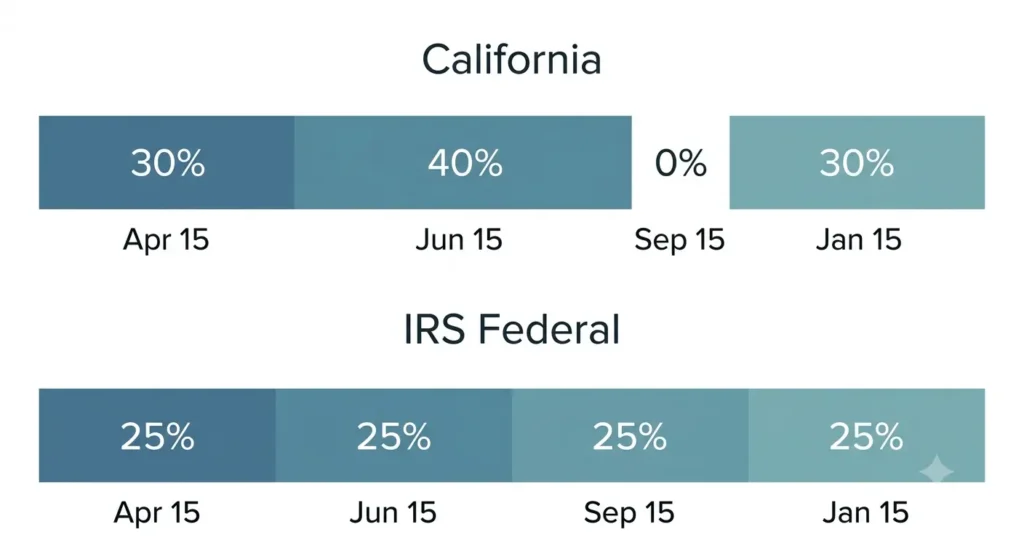
The IRS splits payments into four equal 25% chunks. California front-loads its schedule instead, covered in detail below. Federal uses Form 1040-ES. California uses Form 540-ES. Both have safe harbor rules, but they diverge once income passes $150,000.
Which payments go where
Federal payments go to the Internal Revenue Service, the IRS. California payments go to the California Franchise Tax Board, a separate agency with its own portal and penalty clock. Paying one never covers the other. Track them separately.
What Are California Estimated Tax Payments?
Prepayments on a tax bill you haven’t gotten yet. California runs pay-as-you-earn, not pay-once-in-April, a core part of how California payroll taxes work overall.
Why California requires estimated payments
Employers withhold from every paycheck, so W-2 tax gets collected in real time. Self-employment, freelance, and rental income have no withholding. California requires you to estimate and pay that tax yourself, in installments. Skip it, and interest starts accruing.
Estimated taxes vs regular tax filing
Quarterly payments aren’t a separate tax, they’re credits against your annual return. At filing, the state totals withholding plus estimates against what you owed. Overpaid means a refund. Underpaid means a balance due, possibly with penalties.
Who Must Pay California Estimated Tax?
Some income types almost always require payments, especially 1099 contractors. Others rarely do.
Income sources that commonly require payments
Self-employment, freelance work, and gig work (Uber, DoorDash) have no automatic withholding, and the self-employment tax rate adds another layer most W-2 workers never deal with. Rental income adds up fast with more than one property. Dividends, interest, and capital gains can push you over the threshold in one quarter. Pass-through business income from an LLC, partnership, or S-corp flows straight to your return untaxed, a common worker classification gray area. Pension or IRA distributions can owe too if the payer under-withholds.
Situations where W-2 employees may also owe
A flat-taxed year-end bonus often under-withholds versus your real bracket, since the bonus tax rate uses a flat method that rarely matches your actual liability. A side business stacks untaxed income onto your paycheck. Selling stock, even from an employer plan, can create tax your W-2 withholding never covered. Two jobs at once often causes under-withholding since neither employer sees the other paycheck.
People who usually do not need estimated payments
Full withholding covering your liability means you’re set. Under the $500 threshold, California won’t require quarterly filings. New California residents are exempt for the year if they had zero California tax liability the prior year. A few narrow exceptions exist beyond that, worth a preparer’s check.
How to Know if You Need to Pay
This is math, not guesswork.
California payment thresholds
Pay if you’ll owe California $500 or more after withholding and credits ($250 if married/RDP filing separately). It’s about the gap between what you owe and what’s withheld, not income level alone. Filing status shifts the math.
Safe harbor rules
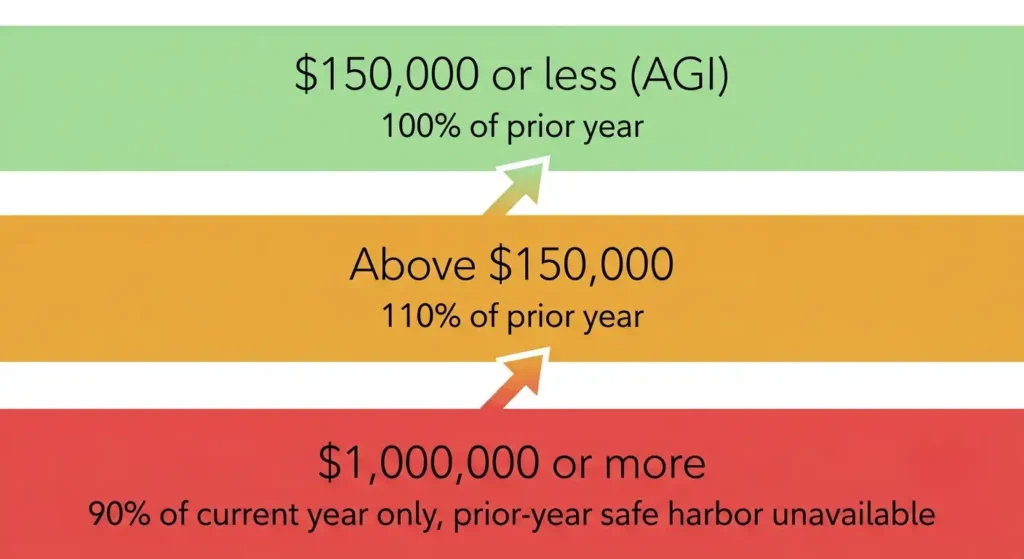
California scales your safe harbor percentage with how much you earned last year, and the prior-year option disappears entirely once you cross the top threshold. Hit your applicable number and no penalty applies, even if you owe more later. IRS Publication 505 covers the federal version, similar but not identical.
| Prior-Year CA AGI | Safe Harbor % |
|---|---|
| $150,000 or less ($75,000 MFS) | 100% of last year’s tax |
| Above that threshold | 110% of last year’s tax |
| $1,000,000+ ($500,000+ MFS) | Prior-year safe harbor unavailable, use 90% of current year |
California Estimated Tax Due Dates
Mark these now, not in March.
Annual payment schedule
2026 dates: April 15, June 15, September 15 (required California payment is usually $0 that quarter), and January 15, 2027. File your full return and pay in full by January 31, and you can skip that fourth installment penalty-free.
California’s installment percentages
California front-loads its schedule instead of splitting evenly like the federal one. Pay evenly across all four quarters like you would federally, and you’ll likely underpay Q2, which still triggers a penalty.
| Quarter | Due Date | CA % | Federal % |
|---|---|---|---|
| Q1 | April 15 | 30% | 25% |
| Q2 | June 15 | 40% | 25% |
| Q3 | September 15 | 0% | 25% |
| Q4 | January 15, 2027 | 30% | 25% |
How Much Should You Pay?
Getting the amount right takes real numbers, not a guess.
Step-by-step calculation
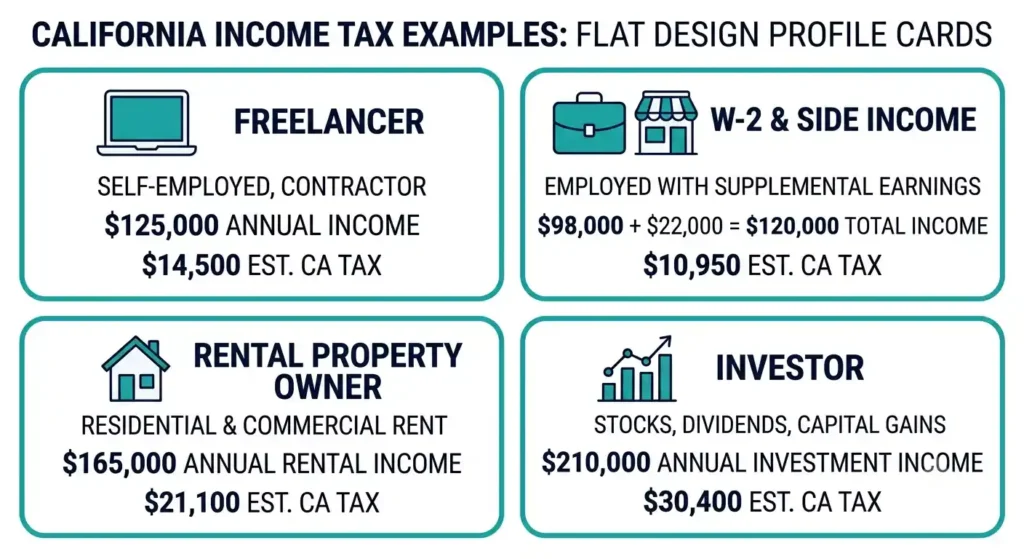
Estimate total annual income across all sources. Run it through California’s tax brackets after subtracting the standard deduction to estimate your tax owed. Subtract expected W-2 withholding, easy to verify with our California paycheck calculator. Split what’s left using the 30/40/0/30 schedule.
Annualized income method
Uneven income, like a wedding photographer earning most of the year’s income in a few months, can overpay early quarters under the standard method. The annualized income installment method matches payments to when you actually earned the income. More paperwork, but it avoids an oversized April payment.
Real Examples
Numbers make this concrete.
Freelancer earning throughout the year
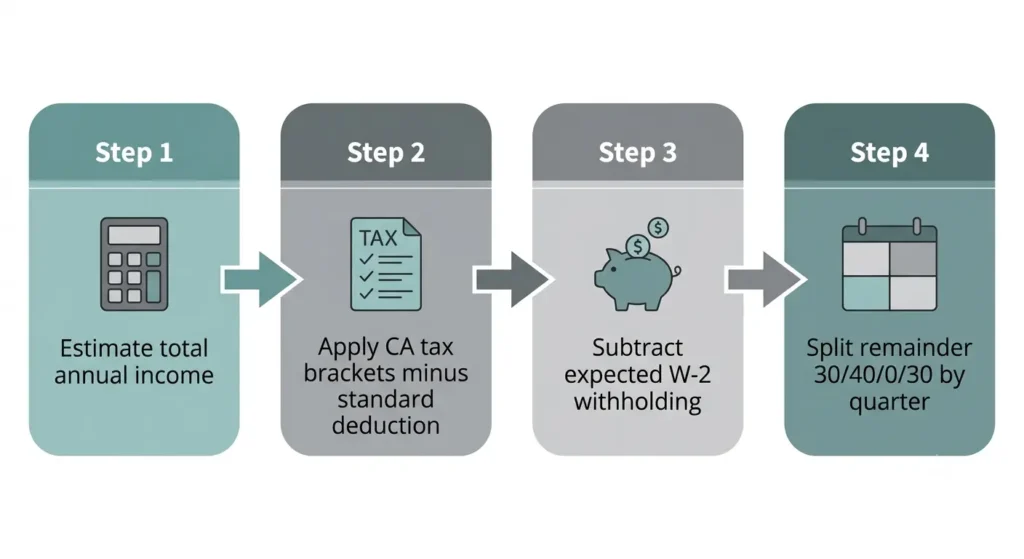
Under the 30/40/0/30 split, that’s $1,800 by April, $2,400 by June, $0 in September, and $1,800 by January. Miss a mid-year installment and interest starts accruing immediately from that due date. First-year freelancers get hit hardest, no prior-year liability or withholding history to lean on.
W-2 employee with side income
$95,000 salary, fully withheld, plus $15,000 from an Etsy shop with $1,200 in California tax owed on it. Your salary withholding doesn’t cover the shop. Pay estimates on that $1,200, split 30/40/0/30, or ask your employer to withhold more instead. Running the numbers through a 1099 vs W-2 calculator makes the side income gap easy to see.
Rental property owner
Nothing gets withheld from rent checks, so the full amount falls on you through estimated payments. A rent increase or property sale can spike your next quarter’s payment.
Investor with capital gains
A $150,000 stock gain in March can create a $13,000-plus state tax bill before your first deadline, based on California’s capital gains tax rate. Recalculate and adjust your April payment immediately. Same logic applies to selling a non-primary home or pulling a large IRA withdrawal, both taxed as ordinary income with little or no withholding.
| Scenario | Income/Gain | Est. CA Tax | Key Point |
|---|---|---|---|
| Freelancer | $90,000 net | $6,000 | 30/40/0/30 split, no withholding |
| W-2 + side income | $15,000 side | $1,200 | Salary withholding doesn’t cover side income |
| Rental owner | $22,000 net | $1,900 | Sale or rent hike spikes next quarter |
| Investor | $150,000 gain | $13,000+ | Recalculate immediately after sale |
Special Situations
Not everyone fits the standard formula.
New California residents
Moving mid-year usually means your safe harbor blends prior-year liability from your old state with new California-source income. Plan ahead in year one.
High-income taxpayers
Prior-year California AGI above $150,000 ($75,000 married/RDP separate) pushes safe harbor to 110%. Above $1,000,000 ($500,000 married/RDP separate), the prior-year safe harbor disappears, you’re locked into 90% of current-year tax. Check whether the alternative minimum tax (AMT) applies too, since it folds into the same calculation.
Farmers and fishermen
Two-thirds farming or fishing income gets you one annual payment, due January 15, under California Revenue and Taxation Code Section 19136, instead of four. Same safe harbor thresholds apply. Confirm details with a preparer.
Common Mistakes People Make
I see the same errors every year.
Mistakes that cost taxpayers money
Assuming California’s schedule matches the federal 25/25/25/25 split, common among first-time freelancers, underpays Q2. Forgetting California is a separate obligation from federal is another. Waiting until filing time to deal with any of it just adds months of interest.
Misconceptions
Estimated tax isn’t extra tax, it’s your regular tax paid early. A federal extension doesn’t delay estimated payment deadlines. W-2 workers aren’t automatically exempt, a bonus or stock sale can pull them in. A refund doesn’t mean estimates were pointless, it means one quarter was overpaid. And paying all four doesn’t skip filing, you still reconcile on your annual return.
How to Pay California Estimated Taxes
Two paths, one faster.
Online payment options
FTB Web Pay is free with instant confirmation. MyFTB tracks your full payment history. Payments post same-day. Have your Social Security number, prior-year California AGI, and the exact tax year and quarter ready before you start. Save your confirmation number.
Paying by mail
Use Form 540-ES with the correct quarter’s voucher, filled out completely. Mail early since the FTB counts date received, not date mailed. Double-check the tax year on the voucher, a payment applied to the wrong tax year won’t count for the right quarter. The Instructions for Form 540-ES cover the details. This form is separate from the California Department of Tax and Fee Administration, which handles sales and use tax, not income tax.
How to Avoid Penalties
Simple math, and it compounds the longer you wait.
Common causes of penalties
Paying late, underpaying an installment, miscalculating, or missing the front-loaded Q2 payment. The penalty is interest on the underpaid amount, currently 7% annualized under California Revenue and Taxation Code Section 19136, calculated on Form FTB 5805, running from the missed due date until paid or filed. Even a few days late starts the clock.
Ways to avoid penalties
Hit safe harbor and none of this applies. W-2 employees with side income can raise withholding by adjusting their DE-4 form instead of filing quarterly. Recalculate the moment income changes meaningfully. A catch-up payment still cuts ongoing interest, even if it doesn’t erase the earlier shortfall. Keep every confirmation number and voucher copy.
Frequently Asked Questions
Do I need California estimated tax if I have a W-2 job?
Only if withholding won’t cover what you owe, usually from side income, a bonus, or a stock sale.
What happens if I miss a payment?
Interest starts the day after the deadline, until paid or filed, whichever comes first.
Can I increase withholding instead?
Yes, often simpler than four separate quarterly payments for modest side income.
What if my income changes during the year?
Recalculate right away and adjust your next payment.
Can I get a refund if I overpay?
Yes, refunded when you file your return. You can track a pending California tax refund status online once you’ve filed.
How do I check whether California received my payment?
Log into MyFTB to see your full payment history and posted dates.
Do I need to pay both California and federal estimated taxes?
Usually yes, separate calculations, separate agencies, slightly different schedules.
Which form do I use for California estimated tax payments?
Form 540-ES, online through Web Pay or mailed with the paper voucher.
Final Takeaway
California’s rhythm: 30/40/0/30, due April, June, and January, with September usually at zero.
What to remember
Check the $500 threshold first. Use real numbers, not last year’s guess. Treat California’s dates as separate from federal ones. When unsure, lean on safe harbor and official FTB resources. For more on related payroll and tax topics, browse our full post library, calculator pages, and topic categories.

Yeasin Sorker is the founder of Paycheck Calculator California. He built this tool in 2018 after noticing that most free paycheck calculators missed California-specific rules like daily overtime and the uncapped SDI rate.
He researches California payroll tax updates regularly and keeps this calculator aligned with the latest IRS, FTB, and EDD published rates. All calculations on this site are estimates based on official 2026 government sources. For personalized tax advice, consult a qualified tax professional.