
California police officers earn between $61,000 and $120,000 a year in base pay in 2026, with big-city departments like LAPD and SFPD paying well past six figures once step increases and overtime are added.
This breakdown pulls straight from official department salary schedules and multiple 2026 wage surveys, not just averages.
Actual take-home pay runs lower after California taxes, pension contributions, and department-specific cost of living.
How Much Do Police Officers Make in California in 2026?
Statewide averages run $70,700 to $79,270 a year according to Salary.com and Glassdoor, though department-by-department figures swing much wider. Full source-by-source numbers are below. For context on how this compares to other public and private sector roles, see our full California salary by job and industry hub, or run your own numbers through our paycheck calculator.
California Police Officer Salary at a Glance
There’s no single “California police salary.” Salary.com puts the statewide average at $70,700 as of July 2026. Glassdoor’s 898 self-reported salaries average $79,270. Talent.com, from a pool of 10,000 salaries, shows a $44,980 median, with entry-level near $38,123 and experienced officers topping $109,073. ZipRecruiter’s $61,334 figure repeats across several unrelated titles on the site, so treat it as a rough estimate, not a precise number. Every California city runs its own pay schedule through its own police union. A rookie in a small Central Valley town and a five-year San Francisco veteran share a job title, not a paycheck.
What a New California Police Officer Can Expect to Earn
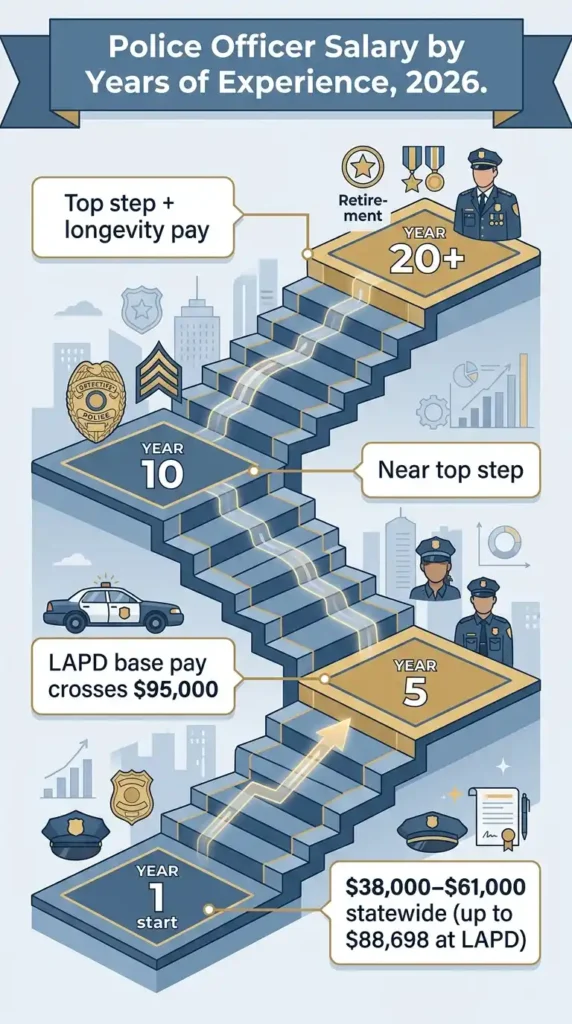
Your first paycheck depends on where you’re hired. Statewide entry-level averages run $38,000 to $61,000 a year. Academy recruits, trainees, and fully sworn officers get paid differently. At LAPD, academy recruits start at $88,698, trainees move to $92,143, and newly sworn officers reach $97,300. Step increases usually start every six months to a year once you’re off probation, so pay climbs fast in the first three years, before overtime.
What Experienced Officers Can Earn
Stick around five, ten, twenty years and the math changes. Most departments use seven to nine pay steps plus longevity pay. LAPD’s semi-annual raises push officers past $95,000 within three years, and averaged across ranks, LAPD base pay lands between $103,000 and $115,000. With overtime, total comp regularly clears $135,000. Senior patrol officers can out-earn some sergeants once overtime and specialty pay count. If you’re comparing public sector pay more broadly, our California teacher salary guide and registered nurse salary guide break down similar step and experience-based pay structures, and our software engineer salary guide shows how a private-sector career stacks up by comparison.
Takeaway: base pay ranges from $38,000 for a rookie to over $115,000 for a senior LAPD officer. Department matters more than title.
California Police Officer Salary by Department
Every department sets its own pay scale, so comparing agencies matters more than statewide averages.
Highest-Paying Police Departments in California
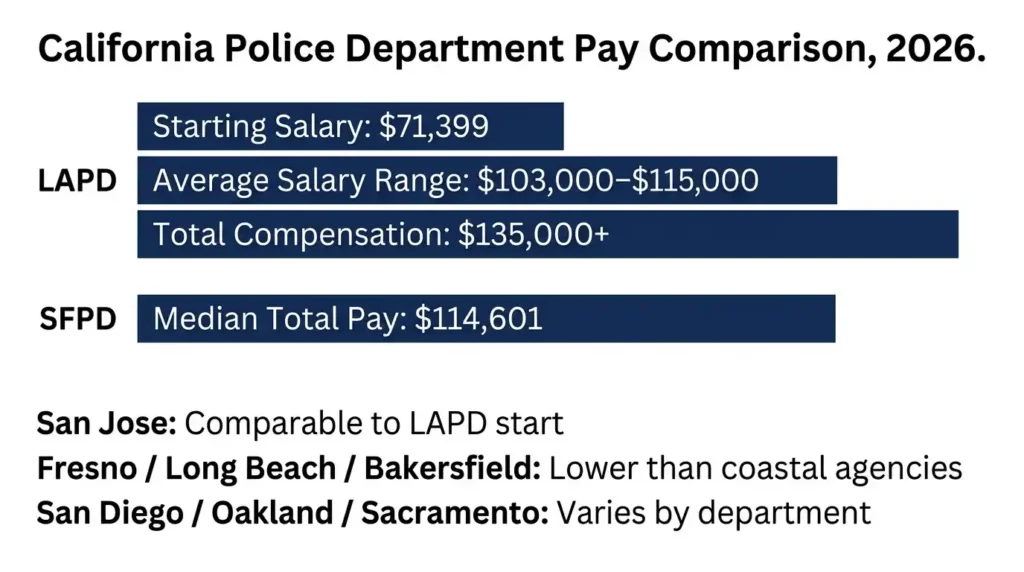
San Francisco, Santa Clara, and San José post the highest total pay in the state. Glassdoor shows San Francisco Police Department leading at $114,601 median total pay, ahead of City of Santa Clara and City of San José. These blend base salary with incentives, so check whether a figure is base schedule or max potential before comparing.
Los Angeles Police Department Salary
LAPD’s Police Officer I starts around $71,399 at Step 1 base salary. Academy recruits are paid separately during training, around $88,698 as a recruit stipend. The gap is recruit pay versus Step 1 sworn base pay. Either way, base pay climbs past $95,000 within three years through semi-annual raises. Overtime, bilingual pay, and specialty bonuses sit on top and aren’t guaranteed. LAPD’s base pay runs slightly below SFPD’s, but LA’s lower cost of living can offset that. Run your own numbers through our Los Angeles paycheck calculator to see what an LAPD salary actually nets in that city.
San Francisco Police Department Salary
SFPD runs a Police Officer pay scale from Step 1 through Step 7. On top of base pay, officers can qualify for POST certificate pay, retention bonuses, and uniform allowances, all separate from the base schedule, which is why SFPD ranks among the state’s highest payers. Total compensation for a mid-career officer can meaningfully exceed the posted base salary. Our San Francisco paycheck calculator shows how that higher base pay actually lands after the city’s cost of living and taxes.
San Jose, San Diego, Oakland, Sacramento, and Other Major Departments
San Jose Police Department posts starting salaries close to LAPD’s, though total comp trails LAPD’s overtime volume. San Diego Police Department, Oakland Police Department, and Sacramento Police Department run their own step schedules with different incentive structures. Fresno Police Department and Long Beach Police Department pay less than coastal agencies but offer lower cost of living, and Bakersfield Police Department follows a similar pattern. Pull the current salary schedule from the department or city HR page, since labor contracts get renegotiated. If you’re weighing an offer in one of these cities, our San Jose, San Diego, Oakland, and Sacramento paycheck calculators break down local take-home pay by salary.
| Department | Starting Base Pay | Reported Average/Top | Source |
|---|---|---|---|
| LAPD | ~$71,399 (Step 1) | $103,000–$115,000 avg, $135,000+ total comp | LAPD salary schedule |
| SFPD | Step 1 (varies) | $114,601 median total pay | Glassdoor |
| San Jose PD | Comparable to LAPD start | Trails LAPD in total comp | Department schedule |
| San Diego, Oakland, Sacramento PD | Varies by contract | Varies by contract | Department schedule |
| Fresno, Long Beach, Bakersfield PD | Lower than coastal agencies | Lower than coastal agencies | Department schedule |
Takeaway: department choice can swing total pay by $20,000 or more. Compare actual salary schedules, not headlines.
How Much Is a California Police Officer Salary per Hour, Month, and Year?
Breaking the annual number down makes your real paycheck easier to picture.
Hourly Pay
At the $70,700 statewide average, that’s roughly $34 an hour for a 40-hour week. Experienced LAPD officers earn over $46 an hour after field training. Overtime hours pay time-and-a-half or higher, so effective hourly rate jumps on heavy overtime weeks. Our annual salary calculator can convert any hourly rate into a yearly figure if you want to run your own scenario.
Monthly and Biweekly Pay
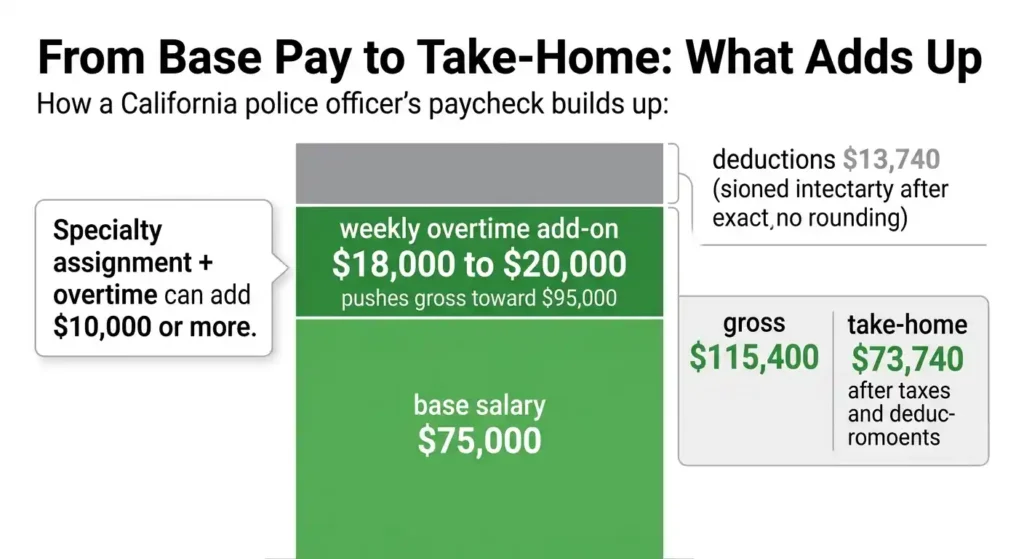
A $70,700 salary breaks down to about $5,891 a month gross, or $2,719 biweekly, before taxes. California’s top tax bracket is 13.3%, but that only applies above $1 million income, so a typical officer’s effective rate runs 5% to 8% after federal tax, state tax, Social Security, and Medicare, based on the current California tax brackets for 2026. A $115,400 gross salary nets roughly $73,740 take-home based on 2026 federal brackets for a single filer, a scenario close to what we break down in our $115k after taxes in California guide. Pension contributions come out on top.
Annual Earnings With and Without Overtime
A no-overtime baseline for a mid-career officer at a large department runs $95,000 to $105,000. Moderate overtime, five to eight hours a week, pushes that to $115,000 to $130,000. Aggressive overtime can push total comp past $150,000. These are examples based on typical patterns, not a promise, and staffing controls how much overtime is actually available.
Takeaway: gross pay looks bigger than your bank account. Budget off net, not the salary offer.
Base Salary vs. Total Compensation: What Will You Actually Make?
This is where most applicants get confused, so let’s separate guaranteed money from maybe money.
What Counts as Base Salary?
Base salary is the number on the official compensation schedule tied to your step and years of service, guaranteed every paycheck. Steps typically increase every six months to a year early on, then slow down. Base salary is the safest number for comparing job offers, since it doesn’t depend on overtime. If you want to see exactly where this shows up on your actual paycheck, our how to read a California pay stub guide walks through each line.
What Can Increase Your Total Earnings?
Overtime is the biggest lever, especially premium overtime for court appearances, holdovers, or events. Bilingual pay, field training officer pay, POST certificate incentives, and retention bonuses can add a few thousand a year. Holiday pay, court pay, and training pay appear occasionally. Night shift often earns a shift differential. Canine handler pay and motorcycle officer pay are common specialty add-ons, and a specialty assignment plus overtime can add $10,000 or more a year. None of this is automatic; you need eligibility, and overtime needs department demand.
Which Earnings Are Not Guaranteed?
Overtime depends on staffing, events, and budget, and can dry up fast. Incentive pay requires testing into or qualifying for a role first. Treat base salary as your real number and everything else as a possible bonus.
Takeaway: base salary is what you plan life around. Overtime and incentives are extra, never guaranteed.
Police Officer Salary by Experience Level
Pay grows in fairly predictable stages, though the pace varies by department.
Starting Salary
Your first year pays less than the advertised “average.” Academy trainees earn less than sworn officers, and most departments run a twelve to eighteen month probation with limited raises. First-year officers can sometimes pick up overtime even during training, depending on department rules.
Salary After 5 Years
By year five, most officers have moved through several steps into mid-range base pay, with longevity and retention incentives kicking in. At LAPD, this is roughly when base pay crosses $95,000. Overtime access grows with schedule flexibility and shift-bidding seniority.
Salary After 10 Years
Ten years in, you’re near a top salary step, and specialty assignments like K9, SWAT, or detective units open up with their own pay bumps. This is when officers weigh staying in patrol, where overtime can be plentiful, against promoting to sergeant, which raises base pay but often cuts overtime access.
Salary After 20+ Years
At twenty years, you’re at top step with maximum longevity pay, and retirement math matters as much as your paycheck. California pensions calculate off final salary and years of service, so a higher late-career salary boosts your pension for life. Formulas vary by department.
Takeaway: pay climbs fastest in the first five years, then levels off unless you promote or chase overtime and specialty pay.
| Career Stage | Typical Base Pay | Key Driver |
|---|---|---|
| Starting (Year 1) | $38,000–$88,698 | Department + academy stipend structure |
| After 5 Years | Mid-range steps; LAPD crosses $95,000 | Step increases, longevity, retention pay |
| After 10 Years | Near top step | Specialty assignments, promotion eligibility |
| After 20+ Years | Top step + longevity pay | Pension formula tied to final salary |
Can a California Police Officer Make $100,000 a Year?
Yes, and at a growing number of departments, that’s the starting point, not the ceiling.
How Soon Can a New Officer Reach Six Figures?
Bay Area departments often start officers close to six figures in base pay alone. Smaller agencies, with entry averages near $38,000 to $61,000, need years of step increases or steady overtime to get there. LAPD officers cross six figures within about three years through base pay alone.
How Officers Can Earn $150,000 or More
Senior officers at top steps, working regular overtime with a specialty assignment bonus, can clear $150,000 in total comp. LAPD’s average total comp across ranks already exceeds $135,000 with overtime and benefits. Getting there usually means volunteering for overtime regularly.
Does Six-Figure Pay Mean You Are Financially Comfortable?
Not automatically. California housing eats into six figures fast, especially in coastal cities where a modest home can run over $800,000. After state tax, federal tax, Social Security, Medicare, and mandatory pension contributions, take-home pay is meaningfully lower than gross, as our $100k after tax in California breakdown shows in more detail. A $115,400 gross salary nets closer to $73,740 based on 2026 calculations. For the mechanics of how gross becomes net, see our gross pay vs net pay explainer.
Takeaway: six figures is achievable, sometimes within a few years, but taxes and housing costs mean gross pay overstates your real lifestyle.
California Police Officer Salary Compared With Other Law Enforcement Careers
Not all badges pay the same. It comes down to who employs you and what the job involves.
Police Officer vs. Sheriff Deputy
Sheriff’s deputies work for the county. Salary.com’s current schedule shows a Deputy Sheriff in California averaging $143,930, ranging $128,400 to $156,850, while Glassdoor’s self-reported data averages lower at $94,745. The gap reflects which counties and experience levels get weighted. Deputy roles often add jail duty or court security to patrol.
Police Officer vs. California Highway Patrol Officer
California Highway Patrol officers work for the state, which changes pay structure and assignment. Base pay climbs toward six figures at senior steps, similar to large municipal agencies, though exact starting pay should be confirmed on CHP’s official cadet pay schedule. CHP officers can transfer between regions statewide, and retirement runs through CalPERS rather than a municipal pension system.
Police Officer vs. Detective, Sergeant, and Lieutenant
Promotion changes your paycheck and your day-to-day job. Salary.com lists Police Lieutenant at $107,234 and Police Sergeant around $83,556, both above general patrol pay, while Glassdoor’s broader sample shows sergeant and lieutenant pay trending higher still at large urban departments once overtime and incentives are counted. Detectives earn a modest bump over patrol with different hours and less physical risk. But promotion usually means less overtime and more administrative work, so a bigger title doesn’t guarantee bigger total pay.
Takeaway: your employer, city, county, or state, shapes pay as much as rank does.
How California Location Changes Police Officer Pay
Where you work in California can matter more than how long you’ve worked there.
Why California Police Salaries Vary by City
Local labor markets, city budgets, and union contracts set pay independently in every city. High cost, high demand markets like San Francisco negotiate differently than smaller inland cities. Recent contract cycles at several large departments have added retention bonuses and faster step timelines to compete for recruits, so a schedule from even a year or two ago can already undercount current pay. Departments struggling to fill positions sometimes raise starting pay or add signing bonuses.
High Salary vs. High Cost of Living
A bigger offer doesn’t mean a better lifestyle. San Francisco pays top salaries but has some of the steepest housing costs in the country. An officer earning $90,000 in a lower cost Central Valley city might have more disposable income than one earning $110,000 in the Bay Area. Purchasing power, not the raw number, determines comfort.
Should You Move for a Higher Police Salary?
Relocating only pays off after accounting for moving costs, a new probation period, and whether prior experience carries over as lateral credit or resets your steps to zero. Pension terms differ by department too. Run the real math, salary difference minus cost of living minus lost seniority, before moving.
Takeaway: chase purchasing power, not just the biggest number on the schedule.
Police Officer Benefits, Pension, and Total Compensation
Salary is only part of the picture. For most officers, the pension is worth as much as decades of paychecks.
California Police Officer Retirement Benefits
Most California police officers get a defined-benefit pension, calculated from final salary and years of service, not personal savings. Both officer and employer contribute throughout the career, typically through CalPERS or a county-run retirement system. Formulas and contribution rates vary by department and retirement system.
Health Insurance and Other Benefits
Most departments offer medical, dental, and vision coverage, plus paid vacation, sick leave, holiday pay, and life insurance. Premium costs and accrual rates differ by department, so compare benefits with the same care as salary. Our paid leaves and benefits category covers how sick leave, PTO, and other California-mandated benefits work in more depth, and officers layering on personal retirement savings can check current 401(k) contribution limits for 2026.
Why Total Compensation Matters More Than Salary Alone
A lower base salary with a stronger pension and cheaper premiums can beat a flashier starting number over a full career. Add salary, pension contributions, and benefit value together when comparing offers.
Takeaway: a smaller salary with a stronger pension can beat a bigger salary with weak benefits over a career.
How to Become a Police Officer in California
Getting hired takes more than passing a fitness test, and the process differs by agency.
Minimum California Peace Officer Requirements
Statewide, you need to be at least 18, though most departments hire at 21 for patrol. You’ll need a high school diploma or GED, legal work authorization, and a clean background investigation. A degree isn’t required at most agencies, but an AA or bachelor’s often qualifies you for an education incentive and can help with promotion. Minimum selection standards come from Government Code Section 1029, Government Code Section 1031, and Government Code Section 1031.4, plus certification requirements in Penal Code Section 13510. Once hired, officers gain administrative protections under the California Peace Officer Bill of Rights, a separate law governing internal investigations. Departments can add requirements above the state minimum.
California POST Academy and Basic Training
Every sworn officer completes the Regular Basic Course through the California Commission on Peace Officer Standards and Training, known as California POST. The Standard Format runs a minimum of 664 hours, while the Modular Format runs a minimum of 730 hours, both governed by Commission Regulation 1005 and Commission Regulation 1950-1955. Candidates take the POST Entry-Level Law Enforcement Test Battery, called PELLETB, before entering the academy. Separately, some peace officer classifications outside the standard academy path qualify instead through PC 832, the 40-hour Arrest Course plus 24-hour Firearms Course. Some departments hire and pay you through the academy as a trainee, and that time usually counts toward service. Others require a POST-certified academy completed on your own first, and that time usually doesn’t count.
The California Police Hiring Process
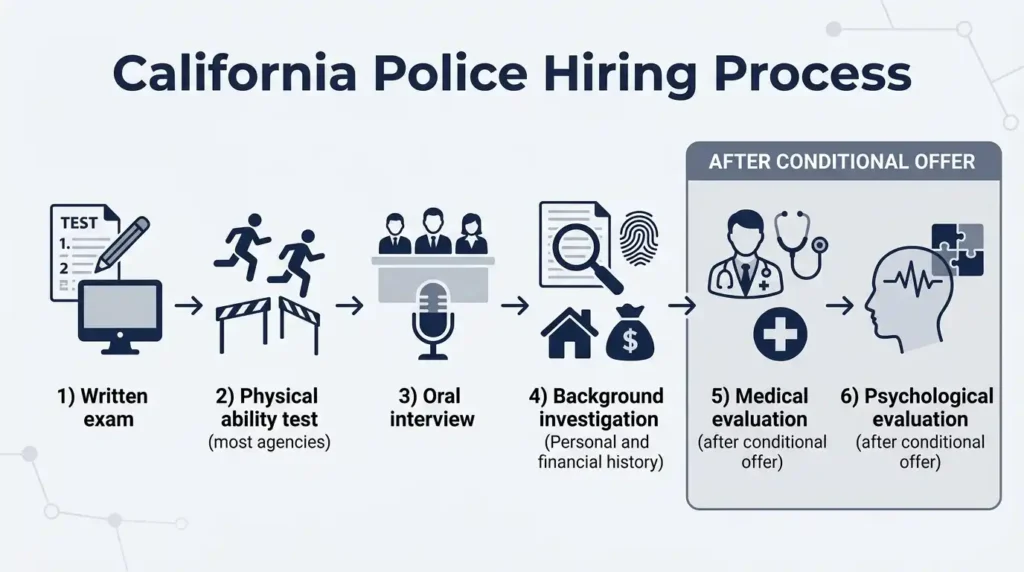
Expect these stages, roughly in order:
- Written exam
- Physical ability test (most agencies)
- Oral interview
- Background investigation, covering personal and financial history
- Medical evaluation (after conditional offer)
- Psychological evaluation (after conditional offer)
How Long the Process Can Take
Timelines run from a few months to close to a year, depending on background investigation staffing and academy class schedules. Background checks are the most common bottleneck. After the academy, new officers enter a department’s Field Training Program with a certified training officer before solo patrol. Well-known departments draw large applicant pools, so a strong application matters as much as timing.
Takeaway: hiring can take months. Start early and confirm each department’s academy and background timeline.
Real-World California Police Salary Scenarios
Four common decisions officers actually face.
Scenario 1: New Applicant Choosing Between Two Departments
Choosing between $65,000 in a lower cost city and $88,000 in a high cost metro, the lower offer might leave more disposable income after rent. Check hiring requirements and benefits too. Better pension terms can make the smaller number the smarter long-term pick.
Scenario 2: New Officer Considering Overtime
A $75,000 base plus eight hours of weekly overtime at time-and-a-half adds roughly $18,000 to $20,000 a year, pushing gross toward $95,000. That overtime is taxed at your marginal rate, so the net boost is smaller than it looks. Weigh that against lost personal time.
Scenario 3: Experienced Officer Considering a Lateral Move
A Step 5 officer considering a lateral move needs to know whether the new department credits prior service or resets to Step 1. Pension portability matters too, since moving retirement systems can affect your final payout.
Scenario 4: Officer Choosing Promotion vs. Staying in Patrol
A sergeant promotion raises base salary but often cuts overtime access and shifts you from field work to supervision. Total comp can actually drop slightly after promotion once overtime disappears, though a higher base salary compounds into a bigger pension long-term.
Takeaway: every decision comes down to total financial outcome, not the salary number on the offer.
Police Officer Salary Myths and Misconceptions
A few things trip up almost everyone researching this career.
Myth: Every California Police Officer Makes Six Figures
Not true statewide. Talent.com shows a $44,980 median, with entry-level near $38,123. Six figures is real at LAPD and SFPD, but many smaller agencies pay significantly less.
Myth: The Highest Posted Salary Is the Starting Salary
The number in a recruiting ad is usually the top step, reached after years of service. LAPD’s top-step officers exceed $120,000, but a new hire starts closer to $71,000 to $88,000. Ask specifically what a first-year officer earns.
Myth: Overtime Is Guaranteed Income
Overtime depends on staffing and budget, and can dry up fast. Voluntary and mandatory overtime carry different pay rules. Never plan finances around unconfirmed overtime.
Myth: Higher Salary Always Means Better Financially
A bigger number doesn’t beat California’s cost of living, commute costs, benefits, and pension terms once you run the full comparison.
Takeaway: verify actual first-year pay and total compensation, not a headline number.
How to Compare Two California Police Department Job Offers
Run the comparison the same way every time.
Compare the Numbers That Actually Matter
Line up starting base salary, top-step base salary, step timing, overtime policy, real incentive pay, and benefit deductions.
Check the Official Compensation Documents
Pull the current salary schedule directly from the department or city, not a third-party aggregator. Check the effective date, review the labor agreement, and confirm incentive pay eligibility.
Calculate Your Real Financial Outcome
Estimate realistic gross pay with a conservative overtime assumption, then subtract federal tax, state tax, Social Security, Medicare, and pension contributions. Add employer-paid benefit value. Compare that final number between offers using our gross pay calculator, or browse our paycheck basics category for more on how deductions work.
Takeaway: compare official documents and real net pay, not marketing numbers.
What to Check Before Applying for a California Police Officer Job
A little homework before applying saves surprises later.
Verify the Salary Before You Apply
Check the agency’s official salary schedule and effective date. Identify your starting step and how base pay differs from advertised max earning potential.
Verify the Requirements
Check statewide POST minimum standards, then any additional department requirements like degree preference, residency, or physical standards. Confirm the academy and certification process.
Calculate Whether the Career Fits Your Financial Goals
Estimate realistic first-year gross income, subtract taxes and living expenses, and weigh that against pension and benefit value.
Takeaway: verify salary, requirements, and real take-home pay before investing months into an application.
Sources for Current California Police Salary and Career Information
Don’t take any single salary aggregator’s word as gospel. Cross-check.
California POST
The California Commission on Peace Officer Standards and Training publishes official selection and training requirements plus statewide law enforcement job listings. Use it for certification and academy standards, not pay.
California Employment and Wage Data
The California Employment Development Department publishes occupational wage data useful for statewide trends, though it reflects occupation-wide averages, not any single department’s plan. The California Department of Human Resources and the U.S. Bureau of Labor Statistics also publish wage data through the Occupational Employment and Wage Statistics program, useful for comparing California to national averages. For how state payroll taxes factor into any of these salary figures, see our California payroll taxes category.
Individual Police Department Salary Schedules
The most reliable number comes from the department’s own compensation plan or the city’s HR page. Check the step table, labor agreement, and any additional pay provisions.
Takeaway: cross-reference POST, state wage data, and the department’s own schedule before trusting any single number.
Frequently Asked Questions About Police Officer Salary in California
What is the average police officer salary in California?
Estimates range from $44,980 median (Talent.com) to $79,270 average (Glassdoor) as of 2026, with Salary.com at $70,700. The range reflects different sample populations, so treat any single figure as a starting point.
What is the starting salary for a police officer in California?
Starting pay runs from around $38,000 at smaller agencies to $71,000 to $88,000 at large departments like LAPD, depending on how academy pay is counted.
Can police officers make $100,000 in California?
Yes. At LAPD and SFPD, base pay alone crosses six figures within a few years. With overtime, total comp often exceeds $130,000 to $150,000.
Which California police department pays the most?
San Francisco Police Department reports the highest median total pay in the state at $114,601, though rankings shift between base salary and total compensation.
How much does a police officer make per month in California?
At the $70,700 statewide average, that’s roughly $5,891 a month gross. Net pay after taxes and pension contributions runs noticeably lower.
Do California police officers get paid during academy training?
It depends on the department. Some pay a trainee salary through the academy, like LAPD’s $88,698. Others require a self-funded POST academy first. Confirm directly with the hiring agency.
How much overtime do California police officers get?
It varies by department, staffing, and whether you volunteer for extra shifts. Some officers add $18,000 to $40,000 a year; others get little. Treat it as a possible bonus, never guaranteed income.
What benefits do California police officers receive?
Most departments offer a defined-benefit pension, medical, dental, vision, paid leave, and life insurance. Exact terms vary by department and retirement system.
Does California have a minimum salary for police officers?
No. California POST sets selection, training, and certification standards, but pay is set locally through each department’s own budget and labor agreements.
Takeaway: every FAQ answer depends on the specific department. Treat statewide averages as a starting point, not a promise.
Final Answer: Is Being a Police Officer in California Worth It Financially?
When the Salary Makes Sense
At a large department with strong base pay, real overtime, and a solid pension, the financial case is strong, especially with retirement value most private-sector jobs don’t offer. Officers who reach top salary steps generally come out ahead over twenty-plus years.
When the Salary May Not Be Enough
In high cost cities, base pay alone may not stretch far without regular overtime, and leaning too hard on overtime costs real time and health. Smaller departments with lower starting pay may not cushion officers supporting a family in expensive parts of the state.
The Numbers to Compare Before Making Your Decision
Line up starting base salary, top-step base salary and how fast you’ll reach it, realistic overtime and incentive pay, and the full benefits and pension package against cost of living and your tax situation. Those four numbers together, not one headline figure, tell you whether the career pencils out.

Yeasin Sorker is the founder of Paycheck Calculator California. He built this tool in 2018 after noticing that most free paycheck calculators missed California-specific rules like daily overtime and the uncapped SDI rate.
He researches California payroll tax updates regularly and keeps this calculator aligned with the latest IRS, FTB, and EDD published rates. All calculations on this site are estimates based on official 2026 government sources. For personalized tax advice, consult a qualified tax professional.