
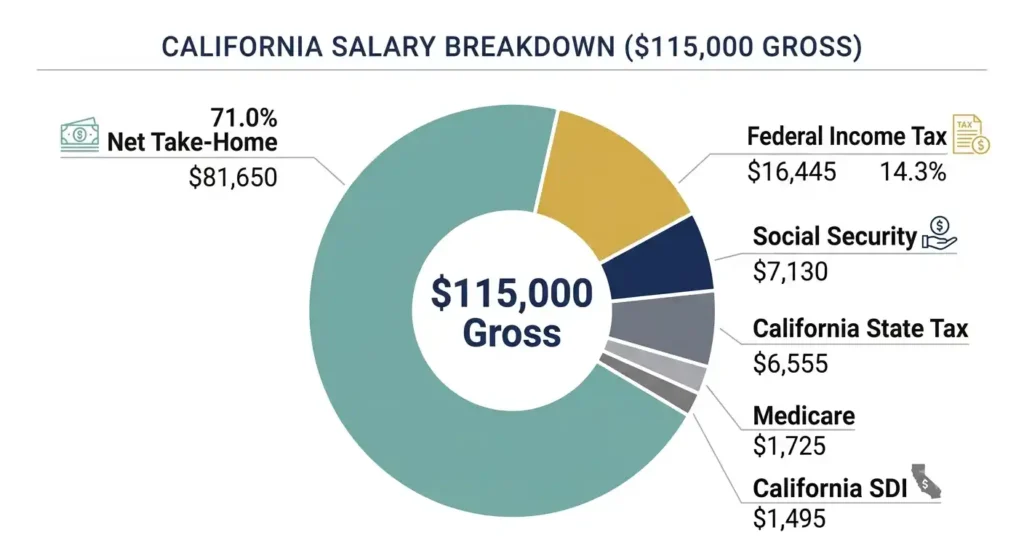
A $115,000 salary in California nets roughly $81,634 a year, about $6,803 a month, for a single filer with no dependents taking the standard deduction, after federal, state, Social Security, Medicare, and SDI taxes.
I’ve run this exact calculation for readers for eight years, and the $81,634 net figure holds up against real 2026 paychecks. See more about how I build these estimates.
This estimate excludes benefits and bonuses, so your actual paycheck may land slightly lower or higher.
Quick Answer: What Is $115,000 After Taxes in California?
Estimated Annual Take-Home Pay
Your $81,634 annual net breaks down to $115,000 gross minus $33,366 in combined taxes, an effective rate of 29.0%. Your real paycheck may differ based on your W-4 and benefits.
Monthly, Biweekly, Weekly and Hourly Breakdown
Monthly: $6,803. Biweekly: $3,140. Weekly: $1,570. At 2,080 hours a year, net hourly pay is $39.25, versus a gross hourly rate of $55.29.
Salary Snapshot Table
Gross pay versus net pay explained simply: gross pay is what you earn before deductions. Net pay is what lands in your bank account after taxes.
| Item | Amount |
|---|---|
| Gross income | $115,000 |
| Total estimated taxes | $33,366 |
| Estimated net income | $81,634 |
| Effective tax rate | 29.0% |
Free California Tax Tool
See What $115,000 Actually Puts in Your Pocket
$115K in California sounds comfortable — but between federal tax, state tax, and SDI, your real take-home is noticeably less. See the exact number.
🧮 See My Exact $115K Take-Home After TaxesUsed by thousands of California workers · FTB-verified 2026 rates
How We Calculated Your Take-Home Pay
This California paycheck calculator stacks paycheck basics like federal tax, state tax, and payroll tax using 2026 rates from the Internal Revenue Service (IRS), the California Franchise Tax Board (FTB), and the California Employment Development Department (EDD). Federal withholding follows IRS Publication 15-T, the same withholding tables employers use.
Assumptions Used
This uses single filing status, the 2026 federal standard deduction of $16,100, a California standard deduction of $5,706, no dependents, and no pre-tax deductions. An accurate estimate needs your filing status, pay frequency, pre-tax deductions, and any extra withholding on your Form W-4. This is built for a W-2 employee, not a self-employed worker or independent contractor, since worker classification changes how taxes work. Contractors pay both halves of Social Security and Medicare through self-employment tax and file quarterly, a key difference in the 1099 vs W-2 tax treatment.
Taxes Included
Four taxes: federal income tax, California state income tax, Social Security tax, and Medicare tax. Social Security tax and Medicare tax together are FICA taxes, funding programs run by the Social Security Administration (SSA).
Taxes Not Included
Health insurance premiums, retirement plan deductions, local employer-specific withholdings, and wage garnishments. These are job-specific, so they’re left out of this baseline.
What Can Change Your Take-Home Pay?
Filing status, W-4 choices, and pre-tax contributions all move this number more than people expect.
Filing Status
Single filers pay the most tax. Married filing jointly pays less, with wider brackets and two standard deductions. Head of household sits in between. Married filing separately uses the same brackets as single but loses several credits, so it almost always costs more.
W-4 Elections
Your Form W-4 sets extra withholding. California also has its own DE-4 form for state withholding, separate from the federal one. More withholding shrinks your paycheck now but grows your refund later. Multiple jobs or claimed dependents lower withholding. None of this changes what you owe, only when you pay it.
Pre-Tax Contributions
401(k) contributions lower taxable income now; a Roth 401(k) taxes you now but not on withdrawal. A Health Savings Account (HSA), subject to the 2026 HSA contribution limits, or Flexible Spending Account (FSA) works the same way. Health premiums are usually pre-tax too. These are all pre-tax deductions the IRS and FTB never touch.
Other Payroll Deductions
Union dues, some benefit costs, after-tax deductions, and wage garnishments come out after tax. They lower take-home pay but not your tax bill.
Complete Tax Breakdown on a $115,000 Salary
Here’s every layer of the math.
Federal Income Tax
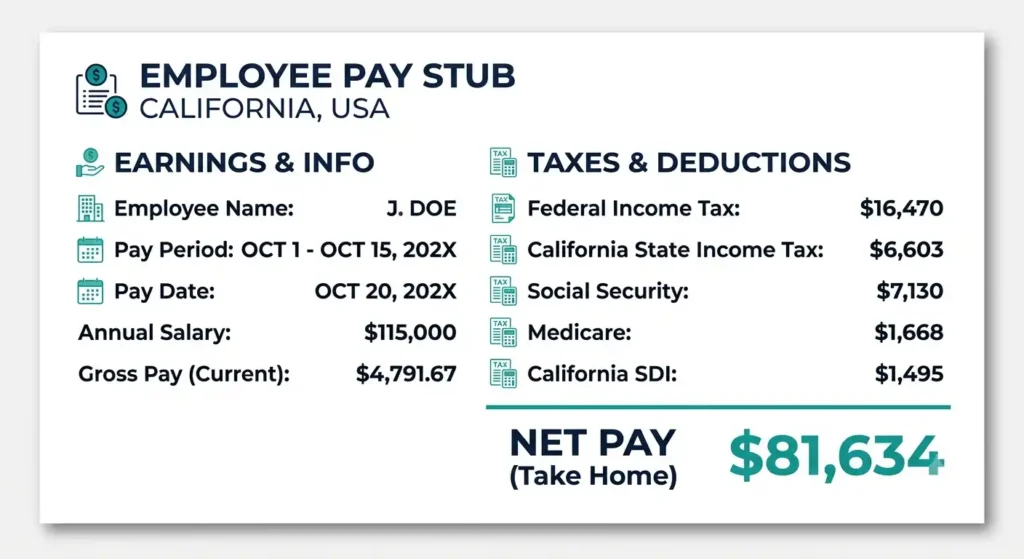
After the $16,100 standard deduction, federal taxable income is $98,900. The IRS taxes this at 10% on the first $12,400, 12% up to $50,400, and 22% on the rest, for $16,470 in federal tax. Only income inside each bracket is taxed at that rate. Gross income minus above-the-line items gives adjusted gross income (AGI); subtracting the standard deduction, or itemized deductions if larger, gives taxable income. Most W-2 earners come out ahead with the standard deduction.
California State Income Tax
California’s standard deduction is just $5,706 for single filers in 2026, leaving $109,294 of state taxable income. Running that through California’s nine tax brackets, 1% up through 9.3%, gives a state tax bill of about $6,603. Most $115k earners land in the 9.3% bracket, covering $72,725 to $371,479 for single filers. This assumes full-year California residency; nonresidents only owe tax on California-sourced income, and remote workers typically pay tax where they physically work. California adds no local city or county income tax.
Social Security and Medicare
Social Security
Social Security withholds 6.2% up to the 2026 wage base of $184,500, set by the Social Security Administration (SSA). Since $115,000 is under that limit, you pay 6.2% on all of it, or $7,130 for the year.
Medicare
Medicare withholds 1.45% on all wages, no cap. The Additional Medicare Tax of 0.9% starts above $200,000 for single filers, so it doesn’t apply here. Medicare comes to about $1,668.
California SDI
California SDI, short for State Disability Insurance (SDI), funds short-term disability and paid family leave. The 2026 SDI rate is 1.3% with no wage cap, confirmed on the EDD’s official rates page, or $1,495 on $115,000. The cap disappeared in 2024, and I’ve seen it catch high earners off guard since it now taxes every dollar.
Real Examples of a $115k Salary
Numbers shift once you add a spouse or a retirement account.
Single Employee Example
A single person earning $115,000 nets about $81,634 a year, or $6,803 a month, enough for rent, a car payment, and savings outside the priciest cities.
Married Couple Example
Married filing jointly with a non-working spouse doubles your standard deduction and widens your brackets, cutting the tax bill on the same $115,000 by several thousand dollars.
Employee Contributing to a 401(k)
Putting 6% into a 401(k) is $6,900 a year. In my experience, this is the easiest way to lower taxable income and build retirement savings while only slightly shrinking your paycheck.
Compare $115k With Other Salaries
$100k vs $115k
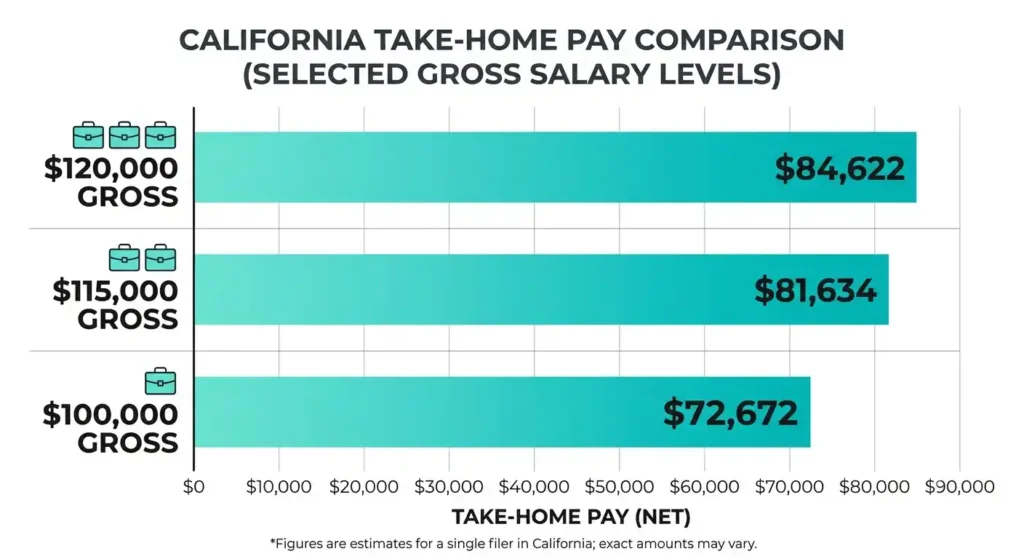
At $100,000, take-home is about $72,672. At $115,000, it’s $81,634, a gain of roughly $8,960 on a $15,000 raise, since you keep about 60 cents of every extra dollar.
$115k vs $120k
At $120,000, take-home rises to about $84,622, just $2,988 more, since roughly 40% of that extra $5,000 goes to combined taxes at the margin, or about $1.65 to $1.70 of extra gross salary per extra $1 of net pay in this range. If your offer lands a bit lower or higher, the same math holds for $95,000 and $130,000 too, or browse more paycheck scenarios to compare nearby salaries.
California vs No-Income-Tax States
Texas, Florida, Washington, and Nevada charge no state income tax, saving you the $6,603 California state tax bill plus the $1,495 SDI deduction, over $8,000 a year, though these states often make it up in property or sales tax. New York does charge state income tax, but its top rate sits below California’s, so a $115,000 earner there typically pays less state tax than in California.
Is $115k a Good Salary in California?
Statewide Perspective
$115,000 sits above California’s median household income and gives real breathing room in mid-cost areas, a comfortable, if not lavish, life in most of the state’s bigger metros.
Cost of Living by City
The Los Angeles paycheck calculator and San Diego paycheck calculator both point to a comfortable budget with room to save. The San Francisco paycheck calculator runs tighter, since rent takes a bigger share. The Sacramento paycheck calculator stretches furthest, thanks to lower housing costs.
Sample Monthly Budget
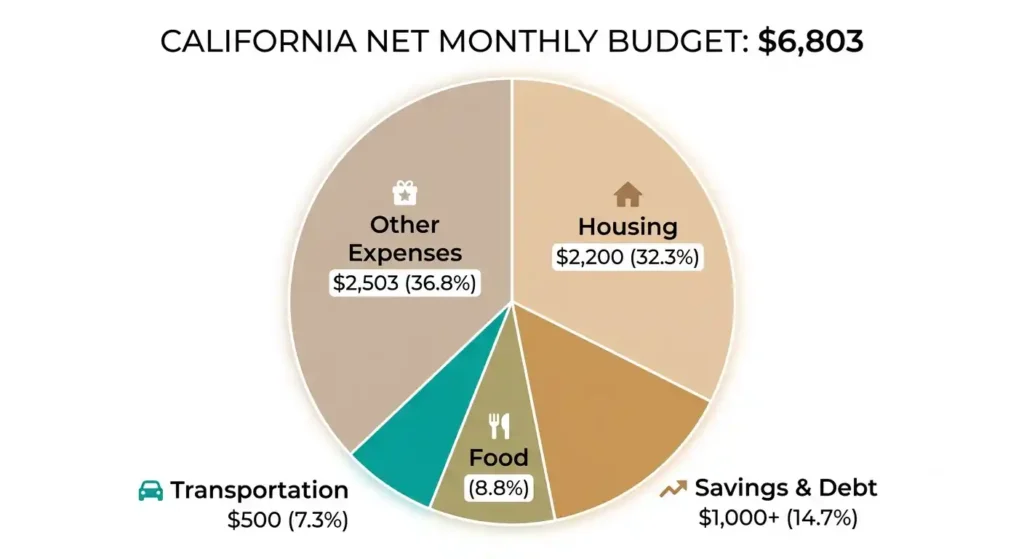
On $6,803 net a month: roughly $2,200 housing, $500 transportation, $600 food, $1,000-plus savings and debt. A single-income family usually needs closer to $2,800 for housing and $900 for food, leaving less for savings.
Why Your Actual Paycheck May Be Different
Common Reasons
Your W-4 setup, benefit deductions, and payroll timing all cause differences. Bonuses withhold at the flat 22% federal supplemental rate covered in the California bonus tax rate guide. RSUs and stock compensation are taxed as ordinary income at vesting, often triggering extra withholding. Overtime, governed by California labor law, is taxed at your normal rate, not a special rate.
Common Mistakes
Confusing marginal tax rate with effective tax rate. Forgetting pre-tax deductions already lowered taxable income. Forgetting SDI exists. Assuming everyone pays the same tax on the same salary, when filing status and deductions change everything.
Common Myths About Salary After Taxes
Myth: Every Dollar Is Taxed at One Rate
False. The US and California use progressive tax systems. Only income inside each bracket is taxed at that bracket’s rate.
Myth: Gross Salary Equals Spending Money
Gross salary is just a number until payroll taxes and required benefit costs shrink it before deposit.
Myth: Online Calculators Always Match Your Pay Stub
Calculators give a solid estimate, not a guarantee. Your employer’s payroll system and your specific withholding choices shift the final number.
Frequently Asked Questions
How much is $115,000 after taxes in California?
About $81,634 a year for a single filer with no dependents, using 2026 tax rates.
What is the monthly take-home pay on $115k?
About $6,803 a month.
Is $115k considered a good salary in California?
Yes, in most of the state, above median income, though it stretches less in San Francisco.
Why is my paycheck lower than the calculator estimate?
Pre-tax deductions, extra W-4 withholding, or employer benefit costs can lower your real paycheck below this estimate.
How much tax do I pay on a $115k salary?
About $33,366 total: federal, California state, Social Security, Medicare, and SDI combined.
Does contributing to a 401(k) increase my take-home pay?
No, it slightly lowers your paycheck now but also lowers taxable income and builds retirement savings.
Does filing status affect my paycheck?
Yes. Married filing jointly usually pays less tax than single filers at the same household income.
How accurate are online paycheck calculators?
Usually within a few hundred dollars of your real paycheck, though your W-4 and benefits, explained in our methodology, cause some difference.
Final Verdict: Should You Base Financial Decisions on a $115k Salary?
Key Takeaways
$115,000 in California nets about $81,634 a year, or $6,803 a month, after every mandatory tax. Filing status, pre-tax contributions, and where in California you live move this number most. Run your own numbers with your real W-4 and benefits before accepting a job offer at this salary.

Yeasin Sorker is the founder of Paycheck Calculator California. He built this tool in 2018 after noticing that most free paycheck calculators missed California-specific rules like daily overtime and the uncapped SDI rate.
He researches California payroll tax updates regularly and keeps this calculator aligned with the latest IRS, FTB, and EDD published rates. All calculations on this site are estimates based on official 2026 government sources. For personalized tax advice, consult a qualified tax professional.