
California employers deposit state payroll taxes on one of four EDD-assigned schedules, quarterly, monthly, semiweekly, or next-day, set by federal deposit status and accumulated withholding, not business size.
That assignment hinges on two numbers EDD watches closely: $350 and $400 in accumulated PIT and SDI withholding, thresholds tightened for 2026.
Miss a threshold shift and EDD sends no warning, a lapse that can trigger a 15% penalty.
California Payroll Tax Deposit Schedule 2026 at a Glance
That change took effect January 1, 2026, dropping the next-day and semiweekly threshold from $500 to $400, so some employers moved to a faster schedule than they had in 2025. The deadlines below reflect that shift.
2026 California Payroll Tax Deposit Calendar
Quarterly DE 88 deposits for 2026 are due April 30, July 31, and November 2, with the fourth quarter due February 1, 2027. October 31, 2026 is a Saturday and January 31, 2027 is a Sunday, so both deadlines roll to the next business day. Monthly deposits are due the 15th of the following month, shifted for weekends and holidays.
Full 2026 monthly deposit calendar, based on the EDD’s California Payroll Tax Calendar 2026 and California Deposit Requirements:
| Payroll Month | Deposit Due Date |
|---|---|
| January | February 17, 2026 |
| February | March 16, 2026 |
| March | April 15, 2026 |
| April | May 15, 2026 |
| May | June 15, 2026 |
| June | July 15, 2026 |
| July | August 17, 2026 |
| August | September 15, 2026 |
| September | October 15, 2026 |
| October | November 16, 2026 |
| November | December 15, 2026 |
| December | January 15, 2027 |
Semiweekly and next-day deposits follow each payroll instead of a fixed date.
California Payroll Tax Deposit Schedule Comparison
Your schedule depends on your federal deposit frequency, set by the IRS, and accumulated California PIT withholding.
| Federal Status | Accumulated PIT and SDI | California Schedule | Due Date |
|---|---|---|---|
| Monthly, quarterly, or annual | Under $350 | Quarterly | April 30, July 31, November 2, or February 1 |
| Monthly, quarterly, or annual | $350 or more | Monthly | 15th of the following month |
| Semiweekly or next-day | Under $350 | Quarterly | April 30, July 31, November 2, or February 1 |
| Semiweekly or next-day | $350 to $400 | Monthly | 15th of the following month |
| Semiweekly or next-day | More than $400 | Semiweekly or next-day | Following Wednesday (Wed/Thu/Fri payday) or following Friday (Sat/Sun/Mon/Tue payday) |
Which California Payroll Taxes Must Employers Deposit?
Employers deposit three payroll taxes through the EDD: Personal Income Tax, State Disability Insurance, and the combined Unemployment Insurance and Employment Training Tax. PIT and SDI come out of employee pay; UI and ETT are paid entirely by the employer. These obligations apply with even one employee correctly classified as such rather than an independent contractor (worth checking if that distinction is unclear, since misclassifying a worker in California carries its own penalties). You must still file DE 9 and DE 9C each quarter, even with zero wages. For the full breakdown of every state payroll tax employers owe, see our guide to California payroll taxes.
California Personal Income Tax (PIT)
PIT is state income tax withheld from each paycheck based on the employee’s W-4 or DE 4, run through the state’s Method B withholding calculation. How much accumulates between paydays sets your deposit frequency. A shop withholding $200 a pay period stays on the slower end; one withholding over $400 moves onto a faster schedule automatically.
State Disability Insurance (SDI)
SDI, withheld from wages, funds short-term disability and Paid Family Leave. You can check the current California SDI rate or run the numbers with the SDI calculator. EDD combines SDI and PIT into one accumulated total for deposit timing, so the “$350 threshold” really means PIT plus SDI together.
Unemployment Insurance (UI) and Employment Training Tax (ETT)
UI and ETT are employer-paid, calculated on the first $7,000 of each employee’s wages per year, at rates covered in our guides to the California UI tax rate and the California ETT rate. They are due quarterly, on the same dates as DE 9 and DE 9C. Employers already depositing more often can pay UI and ETT along with those deposits instead of waiting for quarter-end.
How to Determine Your California Payroll Tax Deposit Schedule
Your schedule is set by your federal deposit status together with your accumulated PIT and SDI withholding against the $350 and $400 thresholds.
Quarterly Deposit Schedule
Quarterly applies when accumulated PIT and SDI stays under $350 all quarter, regardless of federal schedule. Deposits are due April 30, July 31, November 2, and February 1 for 2026.
Monthly Deposit Schedule
Monthly applies once accumulated PIT and SDI reaches $350. For federal monthly, quarterly, or annual depositors, $350 or more triggers it. For federal semiweekly or next-day depositors, $350 to $400 keeps them on monthly. Payment is due the 15th of the next month, shifted for weekends and holidays.
Semiweekly Deposit Schedule
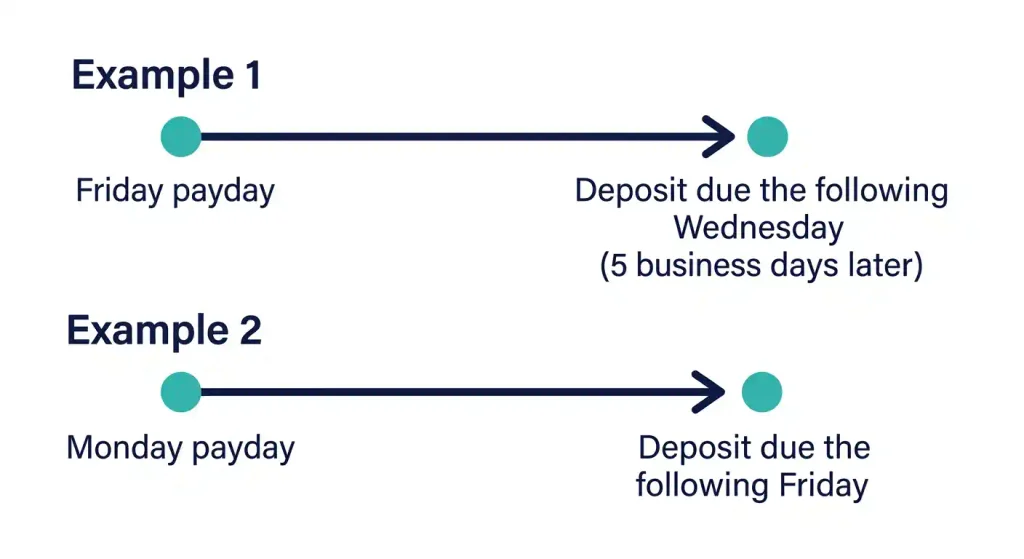
Federal semiweekly depositors move to California semiweekly once accumulated PIT and SDI exceeds $400. A Wednesday, Thursday, or Friday payday is due the following Wednesday; a Saturday, Sunday, Monday, or Tuesday payday is due the following Friday.
Next-Day Deposit Schedule
Federal next-day depositors with more than $400 in accumulated PIT and SDI must deposit the next business day after payday, with no grace period.
California Payroll Tax Deposit Thresholds Explained
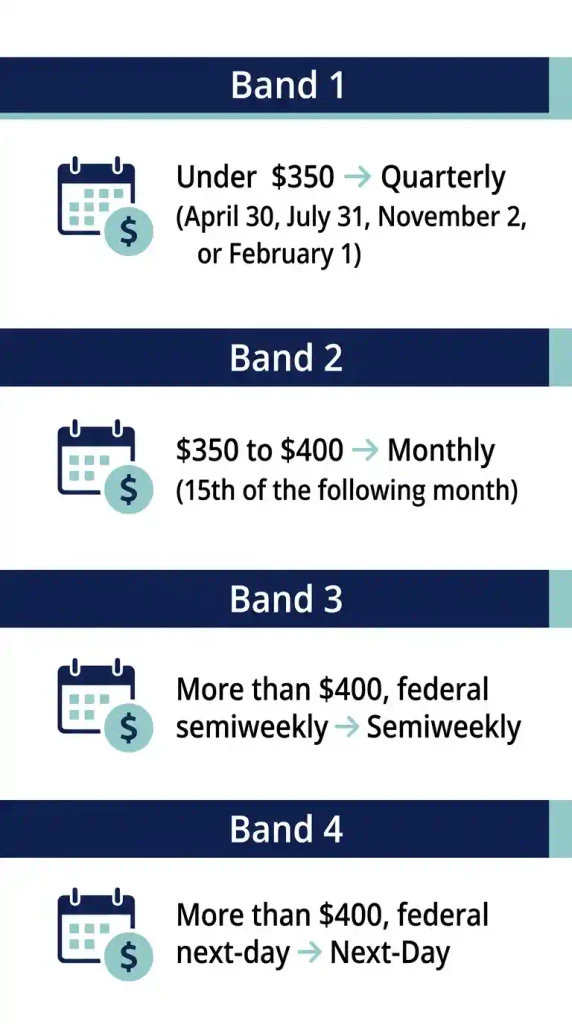
Under $350 means quarterly. $350 to $400 means monthly. Over $400 means semiweekly or next-day, depending on federal status.
What Happens Below $350 in California PIT?
A bakery withholding $300 in combined PIT and SDI stays under $350, so it deposits quarterly, even if federally classified as semiweekly.
What Happens When PIT Reaches $350-$400?
A landscaping company withholding $375 moves to monthly deposits, due the 15th of the next month, whatever its federal status.
What Happens When PIT Exceeds $400?
A restaurant group withholding $450, federally semiweekly, deposits by the following Wednesday or Friday. Federal monthly, quarterly, or annual depositors stay monthly even above $400.
How Accumulated PIT Withholding Affects Your Schedule
“Accumulated” means total withholding across pay periods, not one paycheck. Crossing $350 or $400 mid-quarter shifts your schedule immediately, and EDD sends no notice. The same applies if the IRS reassigns your federal schedule, say from monthly to semiweekly. The California thresholds apply under the new status right away.
California Payroll Tax Deposits vs. Federal IRS Deposit Schedule
California EDD and federal IRS payroll taxes are separate obligations on separate systems.
California EDD vs. Federal IRS Payroll Taxes
EDD handles California PIT, SDI, UI, and ETT. The Internal Revenue Service (IRS) handles federal withholding, Social Security, and Medicare, filed on Form 941 or 944. Paying through the Electronic Federal Tax Payment System (EFTPS) does not satisfy your California obligation.
Monthly vs. Semiweekly Federal Depositors
The IRS sets your federal schedule from a 12-month lookback ending the prior June 30. Under $50,000 in liability means monthly; above means semiweekly. That status then decides which California PIT threshold rule applies to you.
Federal Next-Day Deposit Rule vs. California Next-Day Rule
The federal next-day rule triggers at $100,000 in accumulated liability in one day. California’s next-day rule triggers above $400 in accumulated PIT and SDI, but only for employers already on a federal next-day schedule. Track both separately.
California Payroll Tax Deposits vs. Quarterly Payroll Tax Returns
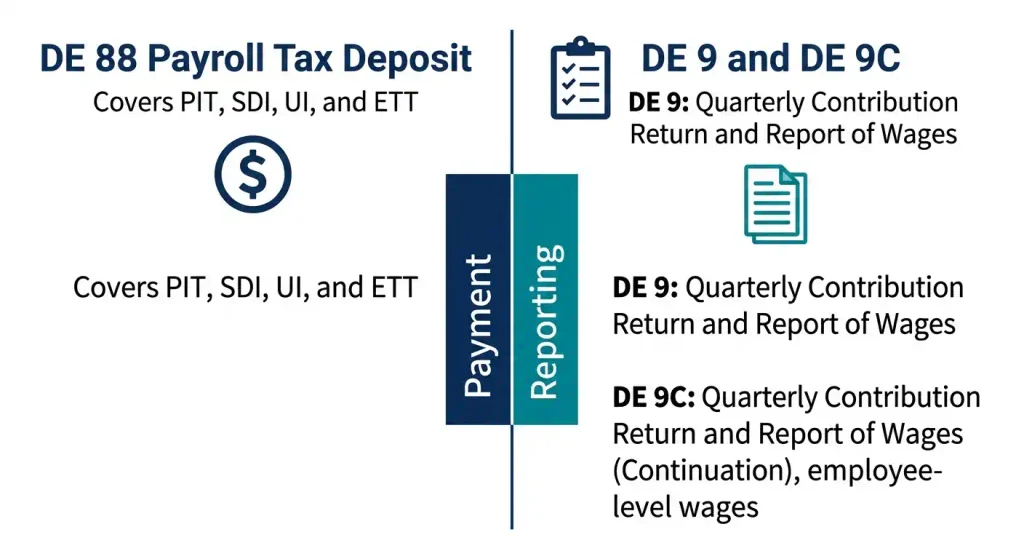
DE 88 pays the tax. DE 9 and DE 9C report wages and reconcile what was paid.
Form DE 88: Payroll Tax Deposit
DE 88, officially the DE 88 Payroll Tax Deposit, is how you send money to the EDD on your assigned schedule. It covers PIT, SDI, UI, and ETT, and is separate from reporting wages.
Form DE 9: Quarterly Contribution Return
DE 9, officially the DE 9 Quarterly Contribution Return and Report of Wages, reconciles reported wages against DE 88 deposits. A shortfall shows a balance due; an overpayment is refunded automatically. Household employers file DE 3BHW quarterly and DE 3HW annually instead. Depositing on time does not excuse a missing DE 9 or DE 9C filing.
Form DE 9C: Quarterly Wage Report
DE 9C, formally the DE 9C Quarterly Contribution Return and Report of Wages (Continuation), lists each employee’s wages, PIT, SDI, and ETT for the quarter, filed together with DE 9.
2026 Quarterly Reporting Deadlines
DE 9 and DE 9C are due April 30 (Q1), July 31 (Q2), November 2 (Q3, since October 31 is a Saturday), and February 1, 2027 (Q4, since January 31 is a Sunday), the same dates as quarterly DE 88 deposits. An unpaid balance on a timely return is still delinquent.
California Payroll Tax Deposit Examples for Real Businesses
These show how the $350 and $400 thresholds play out for real payrolls.
Small Business With $300 in Accumulated PIT
A dog grooming salon withholds $300, under $350, so it deposits quarterly. Its next DE 88 deposit is due July 31, 2026.
Employer With $375 in Accumulated PIT
An accounting firm withholds $375, triggering monthly deposits despite a federal quarterly schedule. A March pay period is due April 15, 2026.
Employer With $450 in Accumulated PIT
A manufacturing company withholds $450 and is federally semiweekly, so it moves to California semiweekly. A Friday payday is due the following Wednesday.
Semiweekly Employer Paying Employees on Friday
A retailer’s Friday payday deposit is due the following Wednesday, five business days later.
Semiweekly Employer Paying Employees on Monday
A logistics company’s Monday payday deposit is due the following Friday. A holiday inside that window, like Labor Day or Veterans Day, shifts the deadline to the next business day.
California Payroll Tax Penalties for Late or Incorrect Deposits
Missing a California payroll tax deposit is costly: EDD penalizes at a flat 15%, on top of interest that accrues the whole time it’s unpaid.
Late Payroll Tax Deposit Penalties
A late deposit, even by one day, carries a 15% penalty plus daily interest. On a $5,000 deposit, that is $750 before interest.
What Happens If You Deposit the Wrong Amount?
A shortfall accrues penalty and interest until paid. An overpayment or duplicate payment is usually caught and refunded at quarterly reconciliation.
How to Correct a Missed or Incorrect Deposit
Pay the correct amount immediately through e-Services for Business, then confirm it posted by checking your EDD payroll tax account balance online. A bounced payment from insufficient funds still counts as missed. A one-time mistake with good cause may qualify for penalty relief from EDD.
Common California Payroll Tax Deposit Mistakes and Misconceptions
The biggest mistakes are assuming one fixed schedule, one form, or one agency covers everything.
Assuming Every Employer Has Quarterly Deposits
Deposit frequency shifts automatically once accumulated PIT and SDI crosses $350 or $400, often within an employer’s first year.
Confusing DE 88 With DE 9 and DE 9C
One handles money, the other handles records: DE 88 moves the payment, while DE 9 and DE 9C document the wages behind it. Filing those returns on time doesn’t erase a skipped DE 88 deposit; you’re still left with a balance due and a penalty.
Assuming Federal IRS Deposits Cover California Taxes
The IRS and EDD run independent systems, and an on-time EFTPS payment carries no weight with the state. Employers who assume otherwise often find out only when an EDD penalty notice shows up.
Ignoring Weekend and Holiday Adjustments
A deadline on a Saturday, Sunday, or legal holiday moves to the next business day, which can compress the gap between two deposits.
How to Pay California Payroll Taxes Online Through EDD
All deposits and filings go through EDD e-Services for Business.
Register for EDD e-Services for Business
Every employer needs an e-Services for Business account built around their EDD Employer Payroll Tax Account. Registration needs your business information, federal EIN, and EDD Employer Account Number. New employers must register within 15 days of paying more than $100 in wages in a calendar quarter, around the same time they’re sorting out other new hire paperwork requirements.
Make a Payroll Tax Deposit Using Form DE 88
Select your deposit period, enter the amount, choose your bank account, and submit. Submitting is not settling: the deposit settlement date is what counts, so submit a day early for next-day or semiweekly deposits. Save your confirmation number, and check your payroll tax payment history in e-Services to confirm receipt.
Electronic Payment Requirements
California requires electronic filing and payment through Electronic Funds Transfer (EFT), with no mailing option. A hardship waiver must be requested and approved by EDD in advance.
Frequently Asked Questions About California Payroll Tax Schedules
What Is the California Payroll Tax Deposit Schedule for 2026?
One of four: quarterly, monthly, semiweekly, or next-day, set by your federal status and accumulated PIT and SDI withholding.
When Are California Payroll Taxes Due Each Month?
By the 15th of the following month, shifted to the next business day on weekends or holidays.
When Are California Quarterly Payroll Tax Deposits Due?
April 30, July 31, November 2, and February 1, 2027 for 2026.
What Is the $350 California Payroll Tax Withholding Rule?
Under $350 means quarterly for everyone. At $350, monthly, quarterly, or annual depositors move to monthly; semiweekly and next-day depositors stay monthly until $400.
What Happens When California PIT Withholding Exceeds $400?
Semiweekly depositors move to semiweekly; next-day depositors move to next-day. Monthly, quarterly, or annual depositors stay monthly.
Are California Payroll Tax Deposits and DE 9 Filings Due on the Same Date?
Only for quarterly depositors. Others deposit throughout the quarter, separate from the DE 9 and DE 9C deadline.
Can I Pay California Payroll Taxes Through EDD Online?
Yes, and it is required, through e-Services for Business, with no paper check option.
What Is the Penalty for Late California Payroll Tax Deposits?
15% of the amount due, plus daily interest, even for a one-day delay.
Official California Payroll Tax Resources and Employer Checklist
Official EDD Payroll Tax Resources
The California Employer’s Guide (DE 44), the EDD Payroll Tax Calendar page, the e-Services for Business portal, and Publication 15 (Circular E), the IRS Employer’s Tax Guide.
For how these numbers show up on an actual paycheck, see our breakdown of California paystub codes, and for the wider compliance picture, browse our payroll compliance and reporting hub.
California Payroll Tax Deposit Compliance Checklist
- Confirm your federal deposit frequency and your accumulated PIT and SDI against the $350 and $400 thresholds.
- Verify each deadline on the actual calendar.
- Reconcile DE 88 deposits against DE 9 and DE 9C each quarter.
- Confirm payroll software has the correct frequency, especially after switching providers.
- Track EDD and IRS deadlines on one calendar.

Yeasin Sorker is the founder of Paycheck Calculator California. He built this tool in 2018 after noticing that most free paycheck calculators missed California-specific rules like daily overtime and the uncapped SDI rate.
He researches California payroll tax updates regularly and keeps this calculator aligned with the latest IRS, FTB, and EDD published rates. All calculations on this site are estimates based on official 2026 government sources. For personalized tax advice, consult a qualified tax professional.