
The California Renter’s Credit is a nonrefundable state income tax credit for renters who meet California residency, rental duration, and income rules, cutting tax owed by $60 or $120 depending on filing status for the 2026 tax year.
That $60/$120 range reflects California’s Franchise Tax Board rules, verified against the agency’s 2026 income thresholds and current statute.
The catch: it’s nonrefundable, and a larger $250 to $500 increase remains unfunded for 2026.
California Renter’s Credit 2026: Quick Answer
| Filing Status | 2026 Income Limit |
|---|---|
| Single / Married Filing Separately | $55,830 or less |
| Married Filing Jointly / Head of Household / Surviving Spouse | $111,660 or less |
Income limit applies to the current $60/$120 credit. The proposed $250 to $500 increase uses a separate, lower threshold and stays unfunded. For more state credits and deductions, browse our California tax savings and planning guides.
What Is the California Renter’s Credit?
It’s a state income tax credit for California renters, not a rebate or rent discount. Officially the California nonrefundable renter’s credit, detailed on the FTB’s Nonrefundable Renter’s Credit page, under the California Personal Income Tax Law at California Revenue and Taxation Code Section 17053.5. Unlike a California standard deduction, which lowers taxable income, a credit cuts your tax bill directly: a $120 credit saves $120, if you owe that much.
How Much Is the California Renter’s Credit in 2026?
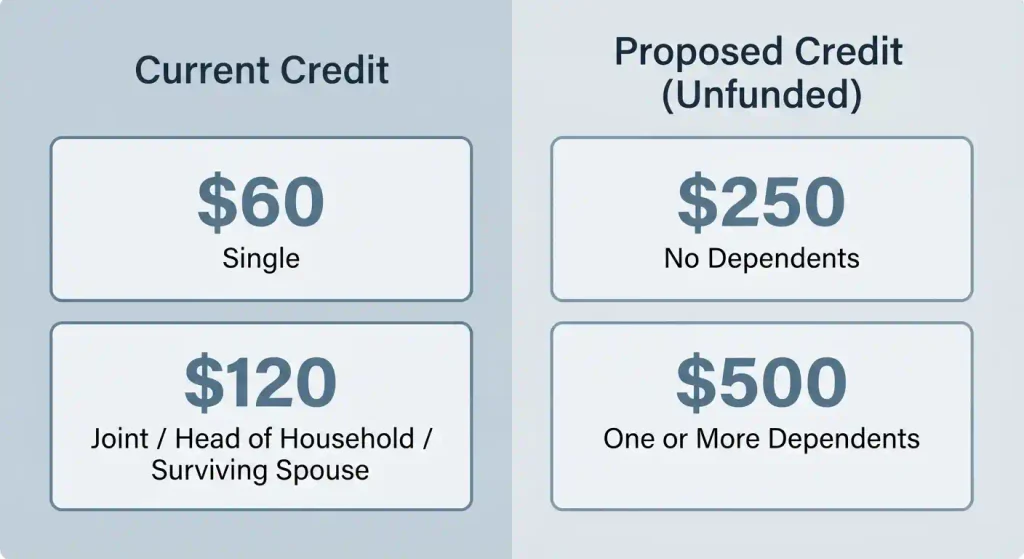
Right now: $60 (single) or $120 (joint, head of household, surviving spouse), unchanged for years. Assembly Bill 130 (AB 130), part of the 2025-2026 state budget, would raise this to $250 (no dependents) or $500 (one or more dependents), regardless of filing status. SB 566 proposed a bigger boost for renters 62 and older, but it failed and never became law. AB 130’s increase only applies once the California Legislature appropriates funding through the California Budget Act, which hasn’t happened. Expect $60/$120 on your 2026 return, filed in 2027, unless that changes.
Who Qualifies for the Credit?
A qualified renter must be a California resident for all or part of the year, rent a main home in the state over six months, stay under the income limit for their filing status, and not live in a property exempt from property tax. Being someone’s dependent, or claiming a homeowner’s exemption on another property, disqualifies you.
- California resident for all or part of the year
- Rented a main home for more than six months
- Income under the limit for your filing status
- Not claimed as someone else’s dependent
- No homeowner’s property tax exemption claimed on another property
California Renter’s Credit Eligibility Requirements for 2026
CA renter’s credit eligibility rests on five things: where you lived, how long you rented, your income, your filing status, and the property’s tax status. Miss one, and you don’t qualify.
California Residency and Principal Residence
You need California residency for all or part of 2026. Your principal residence is the home you actually lived in, not a vacation property. Part-year residents and nonresidents can still qualify for a prorated credit.
Six-Month Rental Requirement
You must rent and live in a California home over six months. Moving between California rentals, months can combine if each was genuinely your home. Temporary stays, like hotels, don’t count.
Income Limits and Adjusted Gross Income
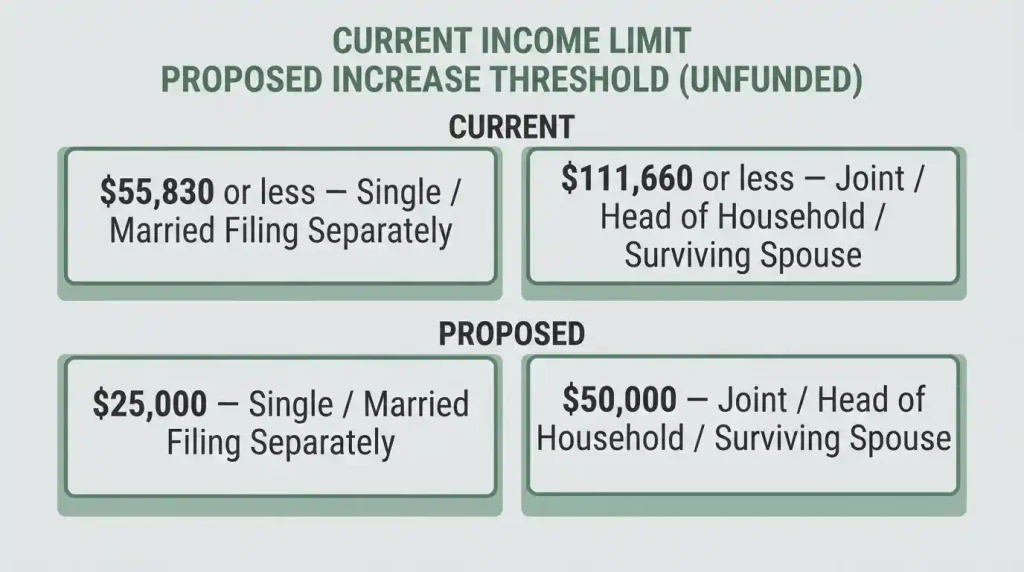
California uses CA AGI, not federal AGI. For 2026, the California Franchise Tax Board (FTB) set limits at $55,830 or less (single, married filing separately) and $111,660 or less (joint, head of household, qualifying surviving spouse), up from $53,994 and $107,988 in 2025. There’s no phase-out: one dollar over disqualifies you. The proposed increased credit uses a separate AGI threshold, before inflation adjustments: $25,000 for single/married filing separately, $50,000 for joint/head of household/surviving spouse, but only if funded.
Filing Status and Dependent Requirements
Single, joint, separate, and head of household filers can all qualify if they meet income and residency rules. Dependents don’t affect today’s $60/$120 amounts, but would under the proposed increase. Being claimed as a dependent disqualifies you; having your own dependents doesn’t.
Property Tax Exemption and Other Disqualifications
Claiming a California homeowner’s property tax exemption on any property, yours or your spouse’s, disqualifies you, even if you rented elsewhere. Homeowners can read more about this exemption in our guide to California itemized deductions. A spouse simply owning a home doesn’t disqualify you unless that exemption was claimed. Renting a tax-exempt property disqualifies you too, except where the owner pays a possessory interest tax or payments in lieu of property taxes. A registered domestic partner (RDP) is treated like a spouse.
California Renter’s Credit Amount by Filing Status
The credit is a flat amount by filing status, not a percentage of rent.
Credit Amount for Single Filers
Single filers and those married filing separately get $60, if CA AGI is $55,830 or less. Funded, the proposed increase would raise this to $250 for renters with no dependents and AGI of $25,000 or less. A single renter in Sacramento earning $42,000 and paying $1,400 in rent still gets just $60, since rent amount doesn’t matter.
Credit Amount for Married Couples
Joint filers get $120, with a combined limit of $111,660. Funded, this becomes $500 with a dependent, or $250 without; it’s based on dependents, not joint filing status. Spouses filing separately or living apart are each judged against the single filer limit.
Credit Amount for Head of Household
Head of household filers get $120, same as joint filers. Under the proposed increase, dependents, not filing status, decide between $250 and $500. A single parent earning $22,000 with two kids gets $120 now, but would be a strong candidate for $500 if funded.
2025 vs. 2026 California Renter’s Credit
The amounts haven’t changed, $60/$120 both years, but income limits rose with inflation:
| Filing Status | 2025 Limit | 2026 Limit |
|---|---|---|
| Single / Married Filing Separately | $53,994 | $55,830 |
| Joint / Head of Household / Surviving Spouse | $107,988 | $111,660 |
AB 130 makes 2026 the earliest year the bigger credit could apply, pending Legislature funding. What matters is the rent and income from that specific tax year.
Does the Amount of Rent You Pay Affect the Credit?
No. The credit stays $60 or $120 whether rent is $900 or $4,000 a month. Rent paid only decides if you qualify at all, not the credit size.
How the California Renter’s Credit Works on Your Taxes
It’s nonrefundable: it only reduces tax you actually owe.
Is the California Renter’s Credit Refundable or Nonrefundable?
Nonrefundable: it reduces your California tax liability to zero, not below. A refundable credit can pay you even at zero liability. Any excess here just disappears.
Does the Credit Increase Your California Tax Refund?
Indirectly, by lowering the tax owed under California’s tax brackets before withholding applies. Owe more than the credit? It shrinks your balance due. Owe nothing already? It adds nothing further. Once you file, track the result through California’s refund status tool.
Can You Claim the Renter’s Credit Without Owing Taxes?
You can claim it, but it only helps against actual tax liability. No balance due isn’t the same as zero liability, since withholding may have already covered it. Many renters still see a bigger refund this way.
California Renter’s Credit vs. Other Tax Benefits
It’s separate from the refundable California Earned Income Tax Credit (CalEITC), and different from homeowner property tax relief. There’s no federal equivalent; it’s a state benefit from the California Franchise Tax Board, not the California Department of Tax and Fee Administration, which handles sales tax. California is one of roughly two dozen states with a renter tax credit. You can claim it alongside CalEITC, the Young Child Tax Credit, or the Foster Youth Tax Credit.
California Renter’s Credit Examples and Common Mistakes
Real numbers make the rules clearer.
Example 1: Single Renter With Qualifying Income
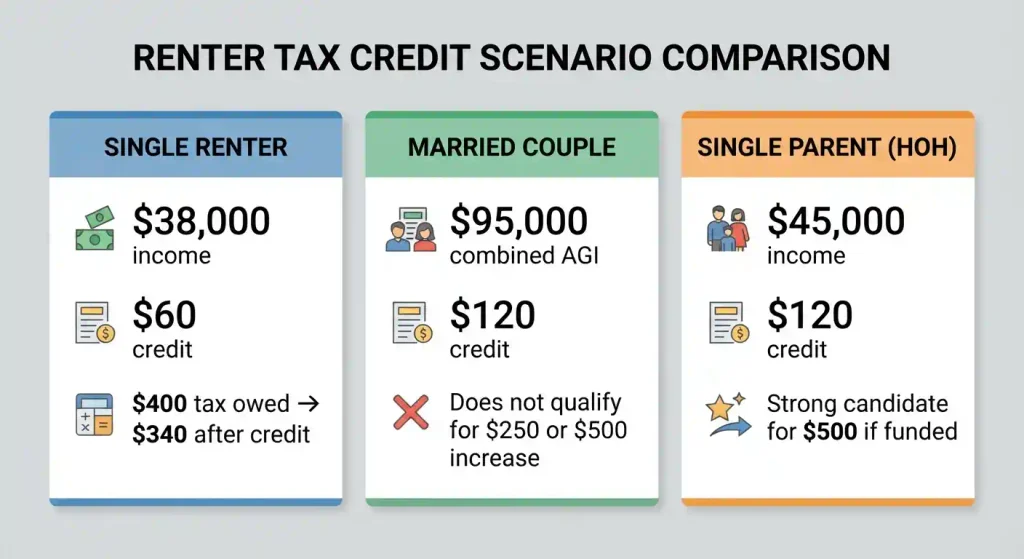
A single renter earning $38,000, renting all year, not a dependent, qualifies for $60. You can check your own gross-to-net numbers with our annual salary calculator. Owing $400 in state tax, the credit drops that to $340.
Example 2: Married Couple Filing Jointly
A couple with $95,000 combined CA AGI, under the $111,660 limit, gets $120. The proposed increase caps joint filers at $50,000 AGI, so their $95,000 income rules out the higher $250 or $500, even if funded.
Example 3: Single Parent Filing as Head of Household
A single parent earning $45,000 with one child qualifies for $120 today. Head of household uses the $50,000 AGI threshold for the proposed increase, and $45,000 is under that, so this renter would be a strong candidate for the $500 amount if it’s funded.
Example 4: Roommates Sharing One Apartment
Each roommate is judged separately. Two unrelated roommates can both claim the credit if each meets every requirement on their own. One claimed as a dependent can’t, even if the other can.
Common California Renter’s Credit Myths
- Myth: Paying rent alone qualifies you. Income limits and dependent status matter too.
- Myth: Higher rent means a bigger credit. The amount is fixed by filing status, not rent paid.
- Myth: The credit always boosts your refund. It only works against tax you actually owe.
- Myth: The $250 and $500 increased amounts are guaranteed for 2026. They depend on funding that isn’t finalized.
- Myth: Every dependent can claim a separate credit. Dependents are excluded, no matter how many share a lease.
Special Situations That Can Affect Your Eligibility
A few living arrangements raise extra questions.
Can Roommates and Unmarried Couples Both Claim the Credit?
Yes, if each person independently meets the full requirements. Unmarried partners are judged separately, like roommates; married joint filers share one combined limit.
Can Students and College Renters Qualify?
Yes, if nobody claims them as a dependent. A student supported and claimed by parents is disqualified, even if they paid rent. International students and temporary workers can qualify too, as long as they meet the same residency, income, and rental-period rules; visa status alone doesn’t disqualify them.
Can Part-Year Residents and People Who Moved Qualify?
Yes. A part-year California resident qualifies based on months actually lived and rented in the state. A California nonresident taxpayer gets roughly 1/12 of the credit per qualifying month.
Can Married Couples Living Separately Claim the Credit?
Married filing separately is allowed, each judged against the single filer limit. Spouses maintaining separate residences can each claim their own credit. If one spouse is a California resident and the other isn’t, the California spouse can still claim it. An exception applies to the homeowner’s exemption rule when spouses live apart.
Do Section 8 and Subsidized Housing Tenants Qualify?
Generally yes. What disqualifies a renter is the property being tax-exempt, not receiving rental assistance; most Section 8 housing sits on taxable property. Housing directly owned by a government agency, like some public housing authority buildings, is often tax-exempt and wouldn’t qualify.
Do Mobile Homes, Rented Rooms, and Shared Homes Qualify?
Yes. Apartments, houses, rented rooms, and mobile homes all qualify as a principal residence, even renting the land separately. Disqualifiers: a tax-exempt property, or a homeowner’s exemption claimed elsewhere that year.
How to Claim the California Renter’s Credit on Your Tax Return
Confirm eligibility, then claim it on your return.
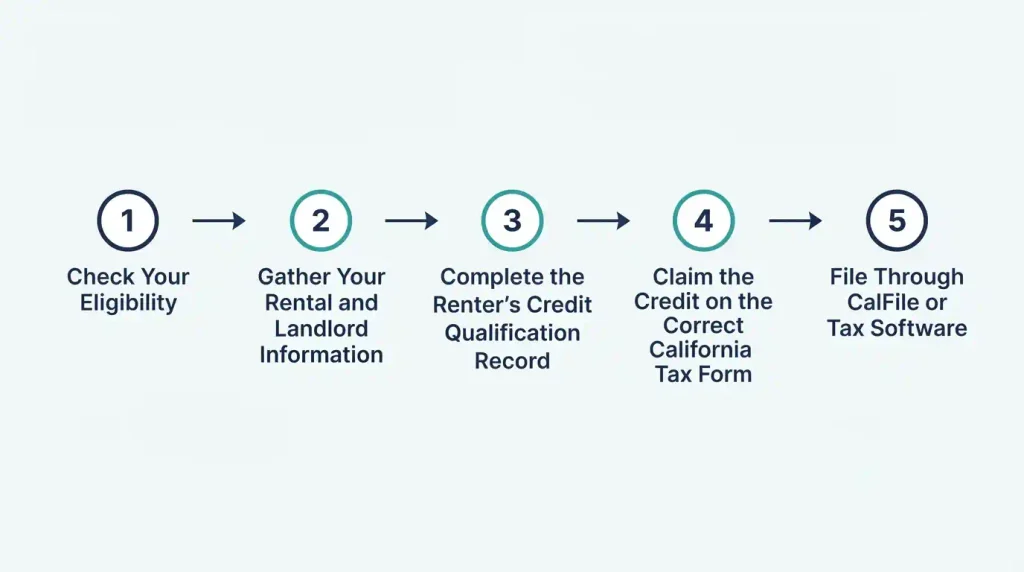
Step 1: Check Your Eligibility
Review residency, rental duration, income, and filing status against 2026 limits. Confirm you weren’t a dependent and no homeowner’s exemption was taken. Confirm your amount: $60 or $120. Low income with no filing requirement? File anyway to claim this credit.
Step 2: Gather Your Rental and Landlord Information
Get your landlord’s name, address, and ideally phone number, plus the rental address and dates lived there. No written lease needed, a verbal agreement works if you can show you paid rent. Keep receipts or bank statements for proof. Landlord won’t share info? Use what you have; their sign-off isn’t required.
Step 3: Complete the Renter’s Credit Qualification Record
The Nonrefundable Renter’s Credit Qualification Record walks through eligibility questions. Keep it with your records, don’t mail it, unless the FTB asks.
Step 4: Claim the Credit on the Correct California Tax Form
Full-year residents use California Form 540. Simpler returns can use California Form 540 2EZ; part-year or nonresidents use California Form 540NR. Check that year’s instructions for the exact line.
Step 5: File Through CalFile or Tax Software
Tax software usually applies the credit automatically if you qualify. California CalFile, the state’s free system, does the same. Flagged ineligible? Recheck your income and dependent-status entries first.
What If You Forgot to Claim the Renter’s Credit?
File an amended return using Schedule X with a corrected Form 540. You generally have four years from the filing deadline, or one year from the tax payment date, whichever is later.
California Renter’s Credit FAQs
Is California Still Offering a Renter’s Credit in 2026?
Yes. $60/$120 nonrefundable, with 2026 income limits of $55,830 (single) and $111,660 (joint).
What Is the Maximum California Renter’s Credit?
Currently $120. A proposed increase to $500 (with dependents) or $250 (without) exists in law but isn’t funded yet.
What Is the 2026 Income Limit for California Renter’s Credit?
$55,830 or less (single, married filing separately); $111,660 or less (joint, head of household, surviving spouse). The proposed increase uses a separate threshold, only if funded: $25,000 AGI for single/married filing separately, $50,000 for joint/head of household/surviving spouse.
Does California Renter’s Credit Depend on How Much Rent I Pay?
No. The amount is fixed by filing status, not rent.
Can I Claim California Renter’s Credit If Someone Claims Me as a Dependent?
No. Being someone’s dependent disqualifies you.
Can Two People Claim Renter’s Credit at the Same Address?
Yes, if each independently qualifies. Roommates are judged separately; joint filers share one credit.
Can I Claim Renter’s Credit If I Moved During the Year?
Yes, if your total qualifying rental period in California exceeds six months, even across addresses.
Where Do I Enter Renter’s Credit on Form 540?
Check that year’s Form 540 instructions; the line number can shift yearly.
Can I Claim Renter’s Credit If I Owe No California Taxes?
No benefit if liability is already zero, since it’s nonrefundable.
Can I Claim Renter’s Credit for a Previous Tax Year?
Yes, by filing an amended return, Schedule X with a corrected Form 540, generally within four years of the filing deadline.
Need help estimating your take-home pay? Try our California Paycheck Calculator.
Explore more of this site: all posts, pages, and categories.

Yeasin Sorker is the founder of Paycheck Calculator California. He built this tool in 2018 after noticing that most free paycheck calculators missed California-specific rules like daily overtime and the uncapped SDI rate.
He researches California payroll tax updates regularly and keeps this calculator aligned with the latest IRS, FTB, and EDD published rates. All calculations on this site are estimates based on official 2026 government sources. For personalized tax advice, consult a qualified tax professional.