
California meal and rest break laws require most hourly employees get a 30 minute unpaid meal break after 5 hours worked and a paid 10 minute rest break every 4 hours, with employers owing premium pay for missed breaks.
That premium pay obligation is exactly what trips up most workers I’ve reviewed pay stubs for over 8 years.
Exact break counts vary by shift length and local ordinances, so confirm your own schedule. For the wider set of rules covering pay and time off in the state, see this California labor laws overview.
Quick Answer: California Break Rules at a Glance
Break requirements scale with hours worked: none under 3.5 hours, up to three meal breaks and three rest breaks past 12 hours, detailed by shift length below.
California Meal & Rest Break Requirements Table
| Shift Length | Meal Breaks Required | Rest Breaks Required | Premium Pay Trigger |
|---|---|---|---|
| Under 3.5 hours | None | None | N/A |
| 3.5 to 5 hours | None | 1 (10 min) | Missed or denied rest break |
| Over 5 to 6 hours | 1 (30 min, waivable) | 1 | Late meal, no meal, denied rest |
| Over 6 to 10 hours | 1 (30 min) | 2 | Late meal, short meal, missed rest |
| Over 10 to 12 hours | 2 (second waivable) | 2 to 3 | Missed second meal, missed rest |
| Over 12 hours | 2 to 3 | 3+ | Any missed or interrupted break |
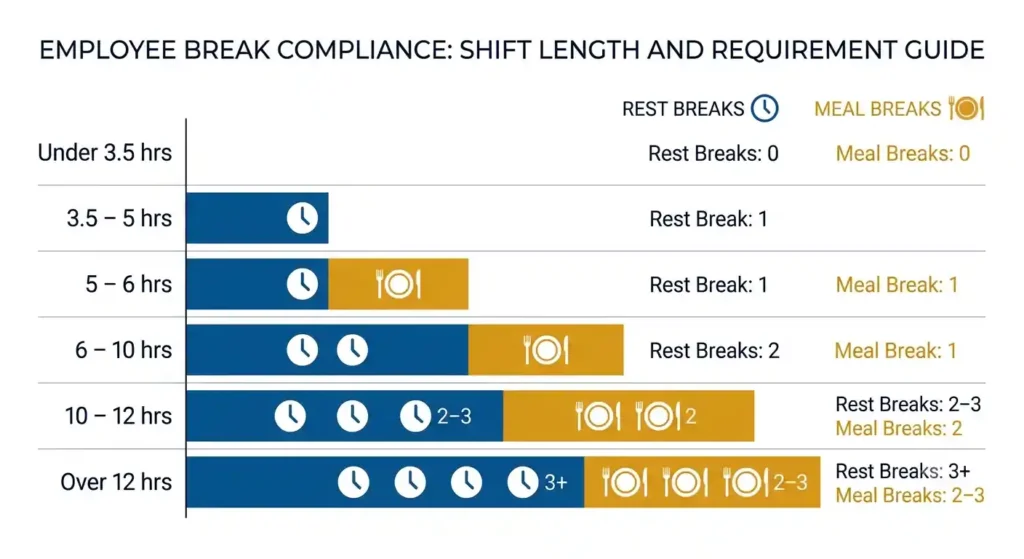
The first meal break must start before the end of your 5th hour. Crossing into hour 6 before eating is already a violation, even if you get fed 10 minutes later.
Who These Laws Apply To
These protections cover nonexempt employees, meaning most hourly workers, in any setting from an office to a warehouse. Exceptions exist. Truck drivers often follow federal rules instead. Union workers under a collective bargaining agreement can follow different negotiated terms. Independent contractors get no protection here at all, since the law only covers employees, not workers who pass California’s ABC test for worker classification. Some cities layer local ordinances on top of the state minimum, so check your city’s rules if you work somewhere like San Francisco or Los Angeles.
Understanding California Meal and Rest Break Laws
The confusion almost always comes from mixing up meal breaks and rest breaks, two very different things. One is paid, one is not. One means you can leave, the other just means you stop working. Your employer can require you to take your breaks and even set the exact time, since they carry the compliance risk either way.
What Is a Meal Break?
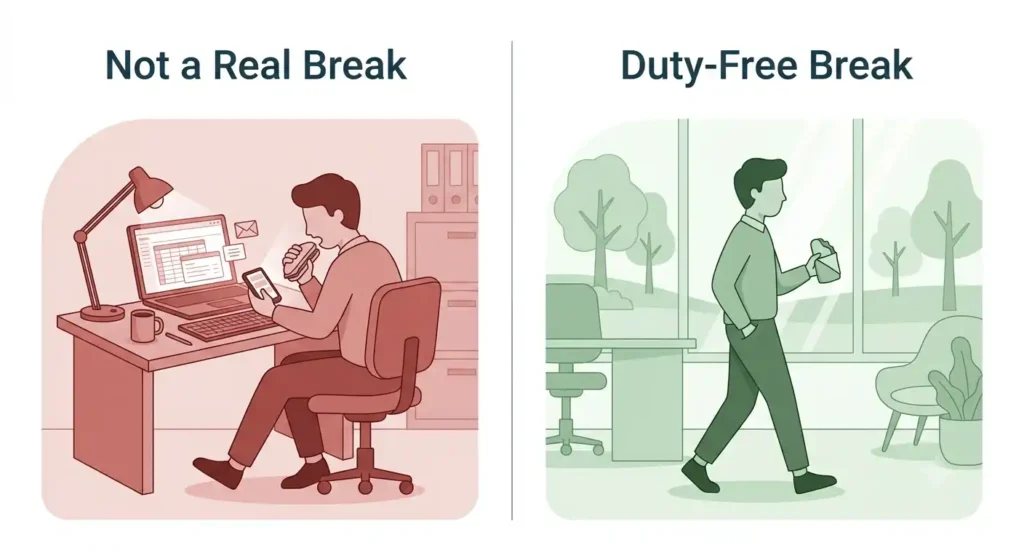
A meal break is 30 minutes long and unpaid, since you are supposed to be fully off duty: no emails, no calls. In Brinker Restaurant Corp. v. Superior Court, the California Supreme Court held you must be relieved of all duty, meaning your employer gives up control and can’t expect you on call. Eating at your desk while watching your inbox, or sitting through a meeting with a sandwich in hand, doesn’t count as a real meal period.
What Is a Rest Break?
A rest break is 10 minutes long and paid. The law says it should fall in the middle of each 4 hour work period whenever practical. Rest breaks are not optional or something you have to earn.
Federal Law vs California Law
Federal law, under the Fair Labor Standards Act (FLSA), does not require meal or rest breaks for most workers. It only requires that any break under 20 minutes be paid if one is given. California built in mandatory timing, duration, and pay penalties on top of that.
California Meal Break Rules Explained
Here is where most of the confusion lives.
First Meal Break Requirements
California Labor Code Section 512 requires a 30 minute unpaid meal break starting before the end of your 5th hour, a rule confirmed on the Department of Industrial Relations meal and rest period FAQ. Shift starts at 9am, your break must begin by 2pm. A 2:15 start is a violation even with a full 30 minutes given.
Second Meal Break Requirements
Past 10 hours, you get a second 30 minute meal break. Exception: if your total shift is 12 hours or less and you did not waive the first meal break, both sides can agree to waive the second. That waiver has to be a real agreement, not a default setting.
Meal Break Waivers
When the First Meal Break Can Be Waived
Only if your shift is 6 hours or less, and only with mutual written agreement.
When the Second Meal Break Can Be Waived
Only if your shift is 12 hours or less and the first meal break was not already waived. Waiving both on a 13 hour shift breaks that condition.
On-Duty Meal Periods
In rare cases, like a solo security guard, an employee can work through lunch under an on-duty meal period, which requires a signed written agreement the employee can revoke anytime. This should not exist in most retail or office jobs.
California Rest Break Rules Explained
Rest breaks look simple until you try to schedule them.
How Many Rest Breaks Are Required?
One paid 10 minute rest break for every 4 hours worked, or a major fraction of four hours. Hit 3.5 hours and you’ve earned one. An 8 hour day earns two. A 10 to 12 hour shift earns three.
When Rest Breaks Should Be Taken
Rest breaks should land near the middle of each work period when realistic, usually one before lunch and one after on an 8 hour shift. A busy day is not a legal excuse to skip one.
Break Requirements by Shift Length
Real examples make the numbers stick, especially once you compare a part-time versus full-time schedule side by side.
Break Schedule Chart
3.5- to 5-Hour Shifts
A 4 hour shift earns one paid rest break, no meal break yet.
6- to 8-Hour Shifts
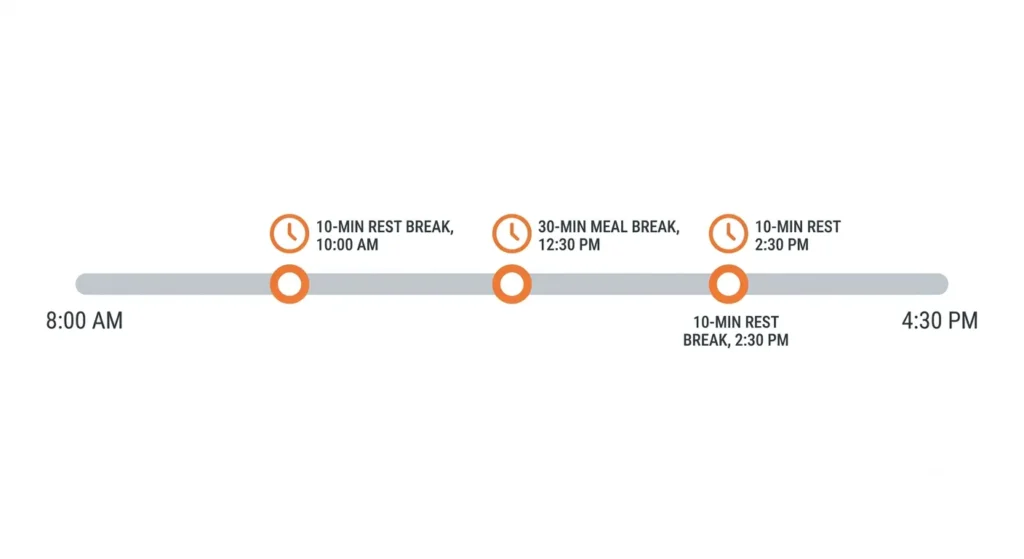
The classic 8 hour workday: one 30 minute unpaid meal break, two paid 10 minute rest breaks.
9- to 12-Hour Shifts
Past 10 hours, a second meal break kicks in (waivable). Rest breaks scale to two or three depending on length.
Over 12-Hour Shifts
An 18 hour shift earns 3 meal breaks, one after each 5 hour block, leaving only 16.5 hours paid. Rest breaks stack to three or more. Shifts this long often trigger California’s double time and overtime rules on top of the break requirements. The same hour by hour counting applies to overnight, split, and back to back consecutive shifts, since California counts total hours worked, not just one clock in to clock out block. Two separate short shifts in one day each need their own break count. Travel time and required training both count as hours worked, so they can push you past a break threshold too.
What Counts as a Break Violation?
Violations often hide in plain sight.
Missed Meal Breaks
A meal that never happens, starts after the 5th hour deadline, gets interrupted, or runs short of 30 minutes. All four are separate violations that trigger premium pay.
Missed Rest Breaks
A skipped break, an interrupted break, two rest breaks combined into one, or a rest break tacked onto the end of a shift instead of spread through the day. All are violations.
Common Workplace Violations
Employees work through lunch with no coverage. Managers call or text during a break, a common form of off the clock work that erodes real break time. Time clock systems auto deduct a 30 minute lunch whether taken or not. I’ve seen this timekeeping shortcut trip up dozens of workers who never noticed the missing premium pay. In Donohue v. AMN Services, LLC, the California Supreme Court ruled employers cannot round meal period time punches, since small rounding gaps can erase a real violation. In United Parcel Service v. Superior Court, the court confirmed missing both a meal and a rest break in one day triggers two full hours of premium pay, not one. A clean 30 minute deduction every single day, no matter how busy the shift got, is worth documenting in your own timekeeping records.
Premium Pay for Missed Breaks
This turns a scheduling mistake into real money owed.
When Premium Pay Is Owed
Under California Labor Code Section 226.7, premium pay applies any time a required meal or rest break is missed, late, shortened, or interrupted. Meal and rest violations count separately, capped at 2 hours of premium pay per day total.
How Premium Pay Is Calculated
The premium is paid at your regular rate of pay, also called your regular rate of compensation. In Ferra v. Loews Hollywood Hotel, LLC, the California Supreme Court confirmed it must include commissions and nondiscretionary bonuses, not just base hourly wage. This premium counts as wages, shows up on your wage statement, but does not count as extra hours worked, so it has no effect on overtime.
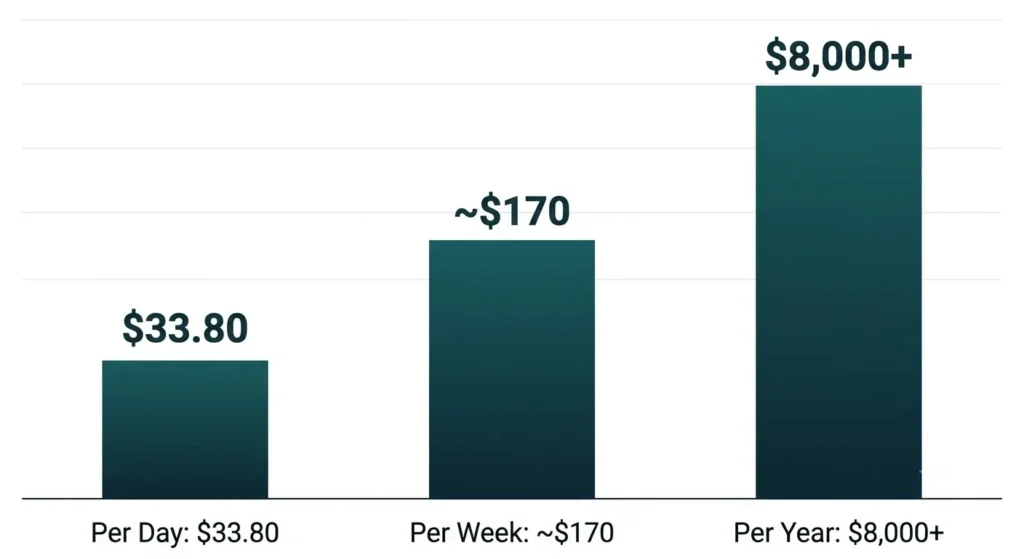
At California’s 2026 minimum wage of $16.90 an hour, confirmed on the state’s Department of Industrial Relations minimum wage page, missing both breaks in one day costs $33.80 per employee per day. You can plug your own numbers into a gross pay calculator to see how a missed break premium changes a paycheck. Cities with higher local minimum wages, like the rate reflected on the Los Angeles paycheck calculator or the San Francisco paycheck calculator, push that number higher. Across a workweek that is close to $170. Across a year of repeated violations it can climb past $8,000 per employee. I’ve seen wage claims built entirely on this math.
Real-World Scenarios Employees Face
Retail Employee
Closing shifts and holiday rushes push lunch past hour 5 when managers are short staffed, a straight violation. Rest breaks near closing often get quietly skipped too, and a shift cut short at the last minute can separately raise reporting time pay questions.
Restaurant Worker
A server pulled back mid break for even two minutes has had an interrupted meal period. Split shifts need their own break calculation for each segment, and often trigger split shift premium pay on top of the missed break penalty.
Warehouse & Manufacturing
Production quotas pressure workers to skip breaks. Auto deducted lunches that never happened are among the easiest violations to prove with time clock data.
Remote & Hybrid Employees
Remote workers get full break rights, no exceptions for working from home. Staying logged into Slack or email during lunch is a violation just like in an office. Remote workers actually skip breaks more often, since no coworker walks by to remind them, and without a digital time clock or attestation prompt, employers have little proof breaks were even offered.
Special Rules and Exceptions
Exempt vs Nonexempt Employees
Exempt employees, usually salaried workers earning at least twice minimum wage in executive, administrative, or professional roles, are not covered. Misclassifying hourly-style work as exempt is one of the most common worker classification disputes and wage claims.
Industry-Specific Exceptions
Healthcare has modified meal break rules for patient care needs, layered on top of the state’s own healthcare worker minimum wage schedule. Motion picture has its own scheduling agreements. Agricultural and domestic workers follow separate wage orders. These come from the Industrial Welfare Commission Wage Orders, or IWC Wage Orders. Restaurants and hotels fall under Wage Order No. 5, the Public Housekeeping Industry order. Retail and wholesale fall under Wage Order No. 7, the Mercantile Industry order. Delivery drivers and construction workers mostly follow the standard schedule, though routes and job sites make timing trickier. Outdoor agriculture and construction workers also get a separate heat illness recovery period on top of normal breaks. Nursing employees get lactation accommodation breaks too.
Collective Bargaining Agreements
Union contracts can replace standard break law within legal limits, but cannot bargain away the core protections.
Common Myths About California Break Laws
“Hourly Employees Can Skip Lunch Anytime”
Not true. Waiving a meal break requires specific shift lengths and mutual agreement, not a unilateral choice.
“Salaried Employees Never Get Breaks”
False. Salaried status alone doesn’t make you exempt.
“Working Through Lunch Means More Pay”
Skipping lunch doesn’t earn overtime by itself, since overtime follows its own daily and weekly triggers under California Labor Code Section 510. It might end your shift earlier, or mean your employer owes a premium instead. Leaving 30 minutes early instead of taking lunch doesn’t satisfy the rule either, and neither does folding a missed break into a longer one later. Each break has its own window.
What to Do If Your Employer Violates the Law
Document the Violation
Note dates, shift times, and actual break length. Save schedules and time clock printouts, and learn to read your pay stub so you can spot a missing premium line yourself. A daily log beats memory.
Talk to Your Employer or HR
Ask directly why a break was late or missing, and keep a written record of that conversation.
File a Wage Claim
File with California’s Division of Labor Standards Enforcement (DLSE), under the California Labor Commissioner’s Office and the California Department of Industrial Relations. The Labor Commissioner FAQs page walks through filing steps. Under Murphy v. Kenneth Cole Productions, a California Supreme Court ruling treating these premiums as wages, you generally have up to 3 years to claim them. Bring your documentation, your schedules, and any pay stubs showing no premium was ever paid.
Missed break premiums are one piece of a broader pattern of wage theft that many California workers never claim. If your final check was also short or late, waiting time penalties may apply on top of the break premiums. For violations hitting many coworkers, a class action or a Private Attorneys General Act (PAGA) claim can recover more than an individual claim. Employers often defend by arguing the break was offered and skipped voluntarily, which is why documentation matters. A pattern going back years or involving a large team is worth a quick attorney consult.
Protection Against Retaliation
California law protects you from being fired, demoted, or punished for raising a violation or filing a claim. Retaliation opens a separate legal claim on top of the original one.
Frequently Asked Questions
Can my employer make me work through lunch?
No. They must offer a fully off duty break. You can choose to work through it, but they cannot require it.
Can I voluntarily skip my meal break?
Yes, under the waiver rules: a 6 hour or shorter shift for the first meal, a 12 hour or shorter shift for the second, with mutual agreement.
Can meal and rest breaks be combined?
No. Each type has its own timing and purpose.
Can I leave work during my meal break?
Yes, almost always, since the break is unpaid and duty free, unless a rare on-duty meal agreement applies.
What if my lunch starts after five hours?
That is a timing violation on its own, worth one hour of premium pay, even with a full 30 minutes given.
Can I receive premium pay for both missed meal and rest breaks on the same day?
Yes. Two separate violations equal 2 hours of premium pay total.
Employee Rights Checklist
Quick Self-Audit
Check your shift length against the chart above. Confirm your meal break started before hour 5. Check pay stubs for premium pay line items. Regularly late, short, or missing breaks with no premium paid means you likely have a claim.
Key Takeaways
Meal breaks: 30 minutes, unpaid, required past 5 hours worked. Rest breaks: 10 minutes, paid, required for every 4 hours worked or major fraction of four hours. Every missed break can mean an extra hour of pay, up to 2 hours per day. You have up to 3 years to claim what you’re owed. Start with your own records.

Yeasin Sorker is the founder of Paycheck Calculator California. He built this tool in 2018 after noticing that most free paycheck calculators missed California-specific rules like daily overtime and the uncapped SDI rate.
He researches California payroll tax updates regularly and keeps this calculator aligned with the latest IRS, FTB, and EDD published rates. All calculations on this site are estimates based on official 2026 government sources. For personalized tax advice, consult a qualified tax professional.