
“No tax on tips” is a federal deduction of up to $25,000 in qualified tips from taxable income, not a full tax exemption, and only workers in specific tipped occupations qualify.
After years breaking down California payroll rules, I’ve seen how often people assume this means tips stop being taxed.
California hasn’t adopted this deduction yet, so state tax savings still don’t apply.
What Does “No Taxes on Tips” Really Mean?
The Short Answer
“No tax on tips” is a federal income tax deduction, not a tax exemption. You still earn and report the tip, but you can subtract up to $25,000 of qualified tips from your taxable income if you qualify.
Why This Rule Was Created
This deduction came from the One Big Beautiful Bill Act, signed in July 2025, to help tipped workers like servers, bartenders, and stylists. It runs for tax years 2025 through 2028 under Section 70201 of the law, alongside a similar deduction called No Tax on Overtime. Unless Congress extends it, it ends after 2028. You can see how this fits into the wider law using our Big Beautiful Bill tax calculator, and browse more updates in our California payroll taxes hub.
Quick Eligibility Checklist
Check this before you get excited about the savings.
You Probably Qualify If…
You have a valid Social Security number and work in a qualified tipped occupation, one of the 70-plus eligible occupations listed by the IRS. Your tips are voluntary and properly reported, and if married, you filed jointly. Many of these jobs also fall under California’s 2026 minimum wage rules, so it helps to know your base pay too.
You May Not Qualify If…
Your income is above the phase-out limit, your job isn’t on the IRS list, your tips came from a mandatory service charge, or you never reported them.
Who Qualifies for the No Tax on Tips Deduction?
The IRS finalized a list of more than 70 occupations in April 2026.
Restaurant Workers
Servers, bartenders, hosts, and bussers are all on the list.
Hospitality Workers
Hotel employees, bellhops, valet workers, and concierge staff qualify too.
Beauty & Personal Care Workers
Hair stylists, barbers, nail technicians, and massage therapists made the final list, which matters a lot for California’s salon and spa workers.
Transportation & Delivery Workers
Delivery drivers, rideshare drivers, and taxi drivers qualify. Gig workers count too, as long as tips are reported on Schedule C.
Other Eligible Occupations
Entertainment workers, casino staff, tour guides, and other IRS listed occupations round out the group. The list is exhaustive: off the list means no deduction, even if you get tipped regularly.
What Counts as a Qualified Tip?
This is where most people trip up.
Tips That Qualify
Cash, credit card, debit card, and pooled tips all count, including tips sent through digital payment apps. The requirement that matters most: the payment must be voluntary tips, meaning the customer could have tipped zero.
Tips That Don’t Qualify
A mandatory service charge is treated as wages, not a tip, even if it’s later handed to the server. Automatic gratuities, employer bonuses, and regular wages don’t qualify either. If your paycheck mixes wages and tips, only the tip portion counts. Per April 2026 final regulations: if the customer couldn’t reduce the amount to zero, it’s not a qualified tip. More on wage classification in our California labor laws hub.
Does “No Taxes on Tips” Mean You Pay No Payroll Taxes?
No. These are two separate systems.
Federal Income Tax vs Payroll Taxes
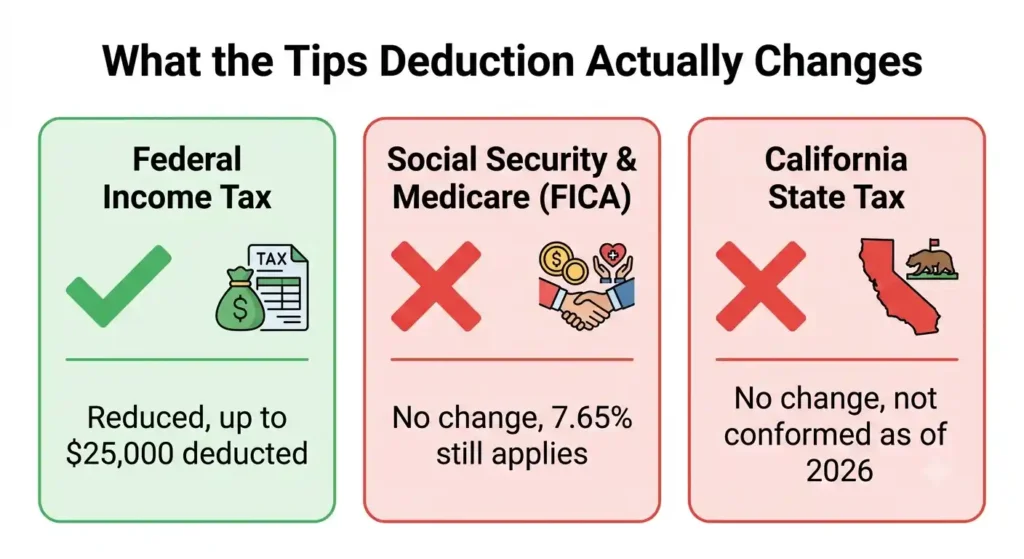
The deduction only reduces federal income tax. Social Security tax and Medicare tax still apply to every dollar of tip income at the standard 7.65% employee rate. Nothing touches FICA, short for the Federal Insurance Contributions Act. California’s own payroll tax, SDI, keeps coming out too. See our CA SDI rate 2026 breakdown for the current withholding percentage.
State Taxes May Still Apply
California has not adopted this deduction. The California Franchise Tax Board still taxes all your tip income, and you must add the federal deduction back on Schedule CA. Bills SB 984 and AB 1550 could change this, but neither had passed as of mid-2026. Other states are deciding independently too. Until California acts, treat tips as fully taxable at the state level. Same conformity gap: our CalEITC and OBBBA non-conformity guide, plus official FTB conformity guidance.
How Much Can You Deduct?
Annual Deduction Limit
The $25,000 deduction limit applies per return, not per job, and isn’t doubled for joint filers. You can’t deduct more than you actually earned, so $18,000 in tips means an $18,000 deduction, not $25,000. This stacks on top of whatever you already claim on your California standard deduction for 2026.
Income Phase-Out Rules
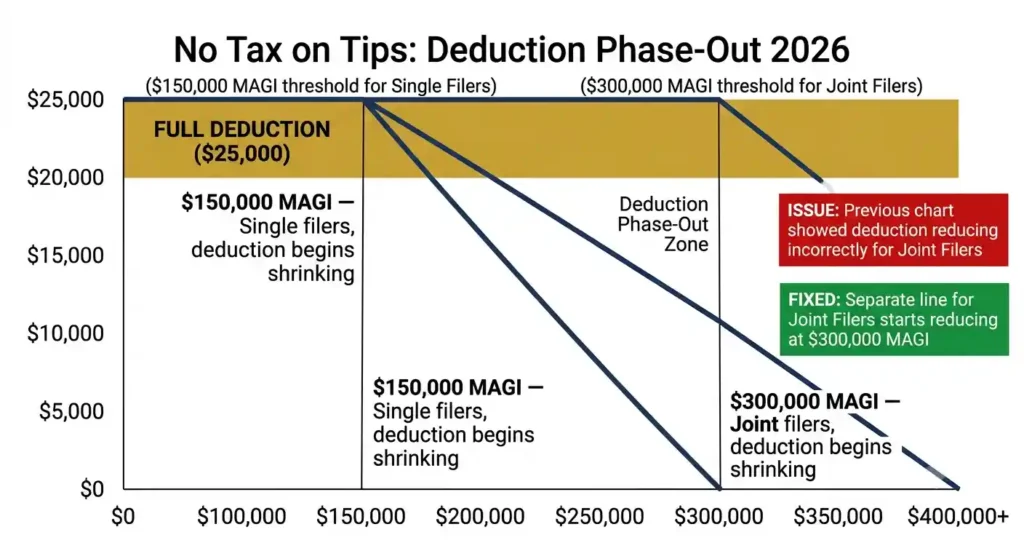
The deduction shrinks once modified adjusted gross income passes $150,000 single or $300,000 joint, disappearing entirely at a high enough income. Most California tipped workers won’t hit this, but a bartender with a second high-paying job could.
How Much Could You Actually Save?
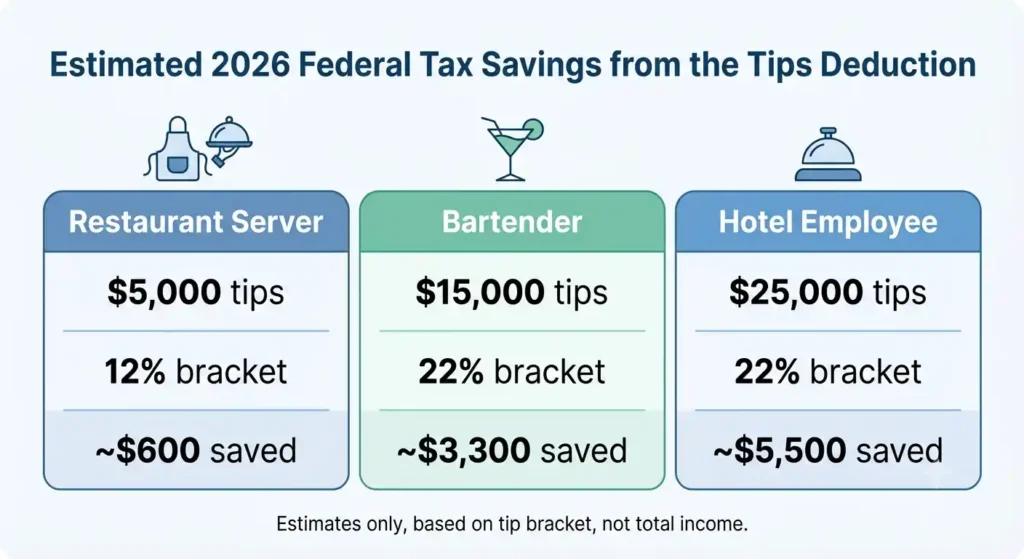
Rough estimates below. Actual savings depend on your full taxable income, not just your tip bracket. Run your own numbers with our gross pay calculator or check where you land using the 2026 California tax brackets.
Example 1: Restaurant Server
$5,000 Annual Tips
A server earning $5,000 in qualified tips in the 12% bracket saves roughly $600 in federal tax, assuming full reporting and no phase-out.
Example 2: Bartender
$15,000 Annual Tips
A bartender earning $15,000 in tips in the 22% bracket saves around $3,300.
Example 3: Hotel Employee
$25,000 Qualified Tips
A hotel employee hitting the full $25,000 cap in the 22% bracket saves about $5,500. Above $150,000 MAGI, the phase-out starts cutting into that fast. If you work in a high-cost hospitality market, our San Francisco paycheck calculator can show your full take-home picture.
Do You Still Have to Report Your Tips?
Yes. Every time. Not optional.
Yes—Reporting Is Still Required
Your employer withholds and reports tips as before. Report any month with $20 or more in tips to your employer by the 10th of the next month. Skipping this costs you the deduction and risks IRS penalties.
Forms You May See
Qualified tips appear on Form W-2, and starting with the 2026 tax year, employers must break them out using Box 12 code “TP” and occupation code in Box 14b. On a 2025 return, your W-2 won’t show this breakout yet, so calculate it yourself. Self-employed workers may see it on a 1099. Unreported tips go on Form 4137. The IRS granted transition relief for 2025, so employers weren’t penalized for skipping the breakout that first year. Withholding feels off? Check our DE-4 form guide and W-4 form guide.
Special Situations and Edge Cases
Self-Employed Workers
Your deduction can’t exceed net business income from the tipped work. Keep clean records and report on Schedule C. Compare setups in our self-employment tax rate guide, 1099 vs W-2 comparison, and worker classification category.
Multiple Jobs
Combine qualified tips across all employers, including any you switched to mid-year. Add up every W-2, not just your current job.
Tip Pooling
Shared tips from a pool count as qualified tips for each recipient, as long as the pool came from voluntary customer tips. Keep documentation of the split.
Married Filing Jointly
You must file jointly to claim this. Filing separately disqualifies you, no exceptions.
Common Myths About “No Taxes on Tips”
Myth: Tips Are Completely Tax-Free
Not true. Tips are still taxable income, payroll taxes still apply, and this only lowers federal taxable income. It also doesn’t change how much anyone should tip. It affects the worker’s tax bill, not the customer’s habits.
Myth: You Can Stop Reporting Tips
False. Reporting rules haven’t changed, and the IRS cross-checks credit card tip data against what you report.
Myth: Every Worker With Tips Qualifies
Only workers in the IRS’s list of over 70 occupations qualify. Occasional tips don’t count if your job isn’t on that list.
Myth: Automatic Gratuities Count
They don’t. An 18% mandatory charge on a large party is a service charge, not a tip, and the final rules exclude it.
How to Claim the Deduction on Your Tax Return
Before Filing
Pull your W-2, confirm your occupation qualifies, add up your qualified tips, and check the income limits. A common mistake: assuming your paycheck or refund changes automatically. Withholding doesn’t adjust on its own, so your refund may grow at filing time instead. If you pay estimated taxes, factor this deduction in so you don’t overpay.
Filing Steps
The Internal Revenue Service, working with the U.S. Department of the Treasury, built Schedule 1-A for this deduction. Calculate MAGI in Part I (joint MAGI if married), then enter qualified tips in Part II, up to the $25,000 cap. Unlike routine adjustments on Schedule 1, this deduction flows directly to line 13b of your Form 1040. You can claim it under the standard deduction or an itemized deduction, since it works with either. Keep records and your W-2 for at least three years. Track your state refund via our refund status guide.
Frequently Asked Questions
Is the No Tax on Tips deduction permanent?
No. It runs 2025 through 2028 under current law and could get extended, but it’s temporary for now.
Can I claim it if I’m self-employed?
Yes, as long as your occupation qualifies and the deduction doesn’t exceed your net business income. Try our 1099 vs W-2 calculator to see how self-employment affects your total tax picture, and browse more real-world numbers in our paycheck scenarios section.
Do credit card tips qualify?
Yes. Cash, credit, and debit card tips all count if voluntary and properly reported.
Does this affect Social Security and Medicare taxes?
No. FICA taxes still apply to every dollar of tip income. This deduction only touches federal income tax.
What if my employer didn’t report all my tips?
Report them yourself on Form 4137. Skipping this costs part of your deduction and risks a penalty.
What happens if my income is too high?
Your deduction shrinks past $150,000 MAGI single or $300,000 joint, and disappears above a certain point. Run the numbers before counting on it.
Does this apply to state income taxes?
Not automatically. It’s federal only. California hasn’t conformed as of mid-2026, so your tips remain fully taxable on your state return unless that changes.
Key Takeaways
What Every Tipped Worker Should Remember
This deduction can save real money on your federal return, up to $25,000 a year through 2028, but only if your occupation qualifies, your tips are voluntary, and you keep reporting everything as before. Payroll taxes never go away, and in California, your state tax bill stays the same for now. Check your numbers every year, since the rules are still moving. For the official rules straight from the source, see the IRS guidance on the qualified tips deduction.

Yeasin Sorker is the founder of Paycheck Calculator California. He built this tool in 2018 after noticing that most free paycheck calculators missed California-specific rules like daily overtime and the uncapped SDI rate.
He researches California payroll tax updates regularly and keeps this calculator aligned with the latest IRS, FTB, and EDD published rates. All calculations on this site are estimates based on official 2026 government sources. For personalized tax advice, consult a qualified tax professional.