
What “No Tax on Overtime” Really Means
The truth behind the headline
No tax on overtime is a federal deduction, not a full exemption: workers can deduct up to $12,500 (or $25,000 married) of FLSA-qualified overtime pay through 2028, though California still taxes that overtime at the state level.
After eight years reviewing California pay stubs, I’ve seen how often workers assume this cap applies to every overtime hour they work.
The real limit: only federal 40-hour overtime qualifies, not California’s daily or double-time premiums.
Congress created this deduction under the One Big Beautiful Bill Act, signed July 4, 2025, and the Internal Revenue Service (IRS) treats it as part of the Working Families Tax Cuts, alongside a separate deduction for tips. You can run your own numbers with our Big Beautiful Bill tax calculator before you file.
Quick answer for California workers
No, California has no matching state-level break. On top of that, California’s overtime rules trigger overtime after eight hours in a single workday, a threshold federal law doesn’t use at all. That gap is exactly why so much of the confusion below happens, and why the rest of this guide breaks it down rule by rule.
Federal vs California Overtime Rules
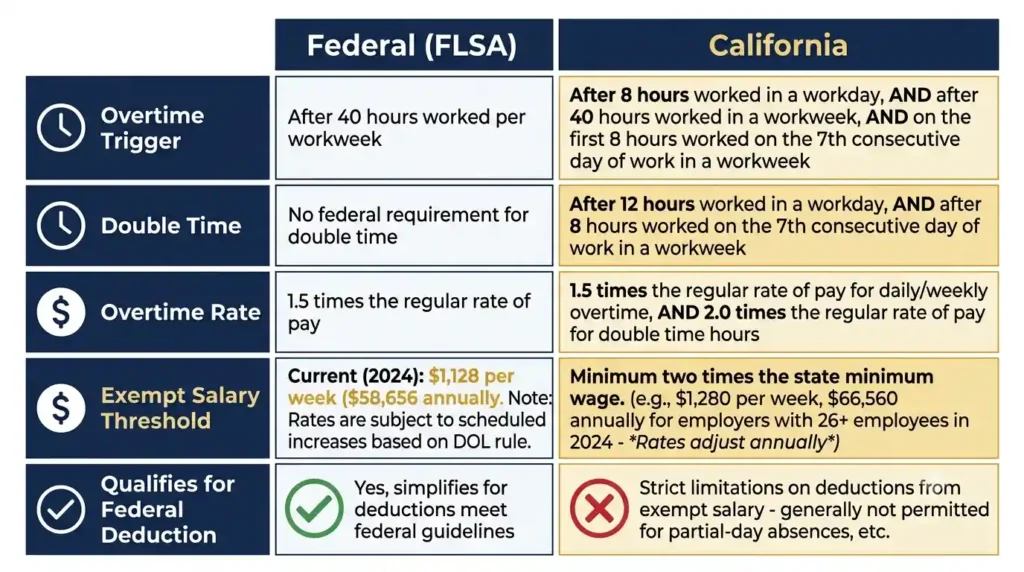
California overtime law and federal overtime law are not the same, and you can browse our full breakdown of California labor laws for more on how these rules stack up. This deduction only recognizes one of them. California’s daily overtime rule comes from California Labor Code Section 510 and the Industrial Welfare Commission Wage Orders, both stricter than federal law.
Comparison Table
| Rule | Federal (FLSA) | California |
|---|---|---|
| Overtime trigger | Over 40 hours in a workweek | Over 8 hours in a workday, or over 40 in a week |
| Double time | Not required | Required after 12 hours in a day, or after 8 hours on the 7th consecutive workday |
| Overtime rate | 1.5x regular rate | 1.5x or 2x depending on hours |
| Exempt salary threshold | $35,568/year ($684/week) | $70,304/year ($1,352/week), effective Jan 1, 2026 |
| Qualifies for federal deduction | Yes | Only the portion that also meets the 40 hour weekly rule |
Why these differences matter
A California worker can log 10 hours in a day, but if the week stays under 40 hours, that daily overtime earns no deduction, even though the stub says “overtime.” The exempt salary threshold jumped to $70,304 a year under the 2026 California minimum wage increase, confirmed by the California Department of Industrial Relations, which also raised the minimum overtime rate. Employers must track qualified overtime separately starting with the 2026 tax year. If your W-2 does not separate it out, you could miss the deduction.
Quick Eligibility Checklist
Check this before you get excited about a refund.
Who generally qualifies
You likely qualify if you are hourly, nonexempt, work over 40 hours a week, and get time and a half under the FLSA. Your income must also fall under the phaseout limits, covered below. This deduction targets regular workers, not salaried executives.
Who usually does not qualify
Exempt employees, independent contractors, and gig workers do not qualify, since none receive FLSA overtime. If you are unsure how your role is classified, our worker classification guide breaks down the differences. Straight California daily overtime with no weekly overtime attached also does not count.
How the Federal Overtime Deduction Works
Here is the breakdown.
What counts as qualified overtime compensation
Only the premium counts, not the full overtime paycheck. At $20 an hour with a $30 overtime rate, the extra $10 is the qualified overtime compensation. It only applies to overtime required under the FLSA, after 40 hours in a workweek. That weekly test is everything.
What does not qualify
California-only daily overtime, union contract overtime beyond federal law, and voluntary overtime premiums above what the law requires all do not count. Same for overtime required by another state’s law. Weekend and holiday pay only qualifies if it comes from crossing 40 hours that week, not from the calendar day. Shift differential pay is not overtime and does not qualify, and neither is split shift premium pay, which follows its own separate rule. Bonus based overtime, where a bonus is folded into your regular rate of pay before the calculation, can qualify, but only for the FLSA required portion.
Does California Have No Tax on Overtime?
No.
California state tax treatment
California taxes overtime like regular wages, at your marginal rate, from 1 percent up to 13.3 percent under the current California tax brackets. There is no separate California deduction, and the California Franchise Tax Board (FTB) has issued no guidance suggesting one is coming. Some lawmakers have floated a matching deduction, but nothing has been introduced as legislation. The federal deduction has zero effect on your California return.
Why California overtime creates confusion
People assume “no tax on overtime” changes their whole paycheck. In California it does not, since daily overtime and double time add layers federal law does not have. I still get emails from readers convinced their employer made a mistake, when really it is just the state and federal rules working as designed.
Income Limits and Deduction Limits
Higher earners get less here.
Maximum deduction amounts
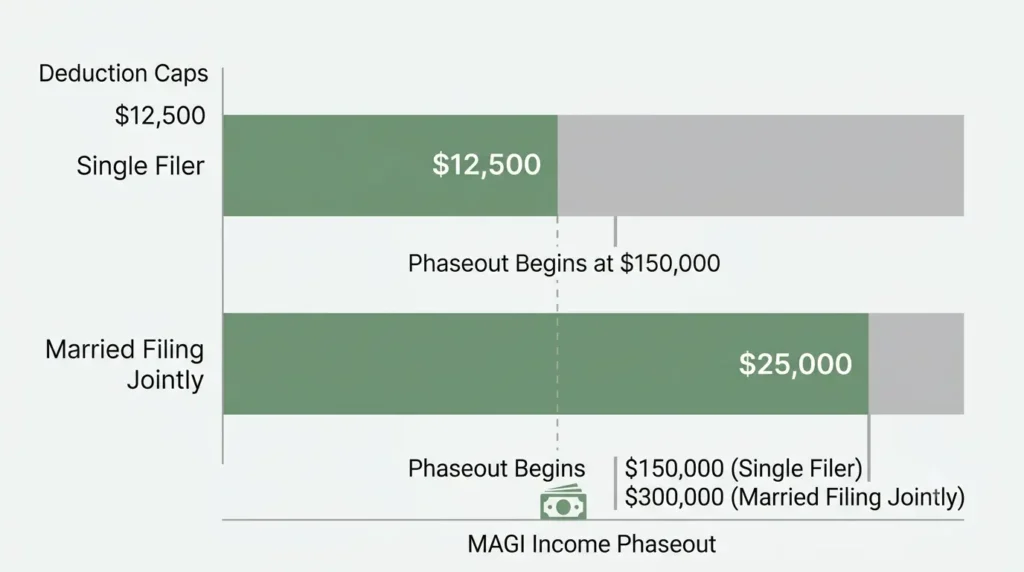
Single filers can deduct up to $12,500 in qualified overtime compensation a year. Married filing jointly can deduct up to $25,000. This runs for tax years 2025 through 2028, then expires unless Congress extends it.
Income phaseout rules
The deduction shrinks once modified adjusted gross income (MAGI) passes $150,000 single or $300,000 joint, phasing out completely above certain higher levels. A single nurse earning $95,000 with $15,000 in qualified overtime stays under the phaseout and claims the full $12,500. A manager near $150,000 gets only a partial deduction on the same overtime amount.
Why Your Paycheck Still Shows Taxes
A common question, and one closely related to our piece on why your paycheck looks lower than expected.
Payroll withholding explained
Withholding and your actual tax bill differ, which is really a gross pay vs net pay distinction. Employers still withhold federal income tax, Social Security, and Medicare on every overtime dollar, the same way they handle every other line covered in our guide to California payroll taxes. The deduction only appears when you file, not on your paycheck, so any benefit arrives later as a refund, not sooner.
Payroll taxes that still apply
Social Security tax and Medicare tax, together FICA taxes, keep coming out unchanged. California state income tax withholding, plus California SDI, and federal income tax withholding also stay the same. Only your federal tax liability at filing time shifts, based on the deduction claimed.
How Much Could You Actually Save?
A few real numbers.
Simple savings examples
A lower income worker might save a few hundred dollars federally. A middle income worker earning $60,000 to $95,000 with several thousand in qualified overtime could save $2,000 to $3,000. Our annual salary calculator can help turn your hourly overtime rate into a yearly figure before you estimate the deduction. A married couple can combine deductions up to $25,000. Near or above the phaseout, the benefit shrinks to almost nothing.
Example calculations
Weekly overtime example
At $20 an hour with a $30 overtime rate, the $10 premium counts. 300 overtime hours under the federal 40 hour rule equals $3,000 in qualified overtime compensation, fully deductible.
California daily overtime example
Picture a warehouse worker clocking 9 hours most days but rarely crossing 40 for the week. California law pays extra for that 9th hour, but since the federal 40 hour threshold never triggers, none of that premium counts for the federal deduction.
Real California Scenarios
Three situations I see constantly, part of the wider set of real paycheck scenarios I cover on this site.
Employee working daily overtime only
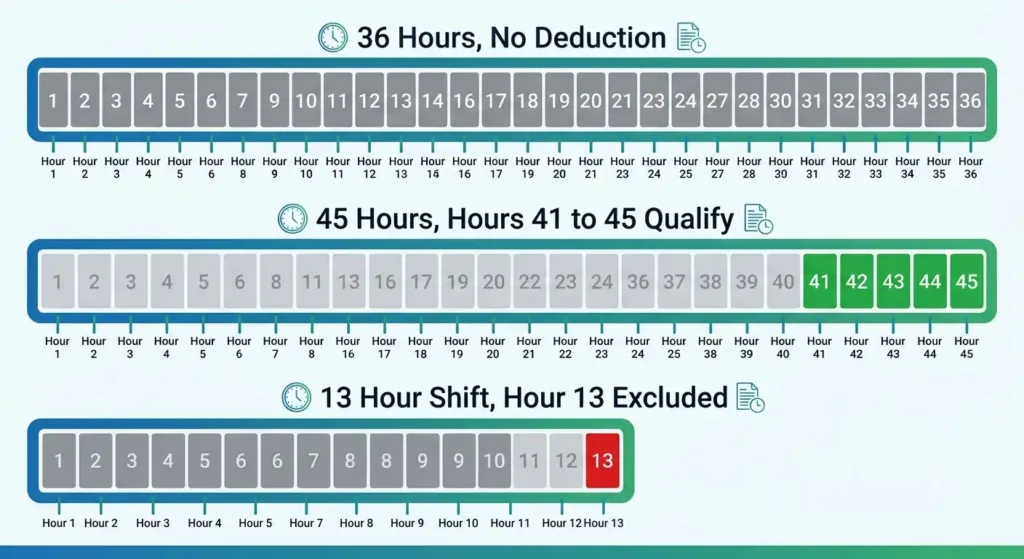
A retail worker logs 9 hour shifts four days a week, 36 hours total. California pays overtime for hour 9 daily, but since the week stays under 40, none of it qualifies. Zero deduction, despite the overtime label on the stub.
Employee working over 40 hours
A retail worker logs five 9 hour shifts, 45 hours weekly. The portion tied to crossing 40 hours qualifies under federal rules, so this worker claims a real deduction.
Employee receiving double time
A 13 hour California shift earns double time on hour 13 under state law, a distinction covered in more depth in our double time vs overtime guide. Federal law does not recognize double time as its own category, so only the standard time and a half premium tied to the 40 hour rule counts. The extra double time premium does not qualify.
Who Qualifies and Who Doesn’t
Some industries hit this constantly, and knowing the full set of California overtime laws helps explain why.
Eligible occupations
Healthcare workers on 12 hour shifts, manufacturing employees, retail workers in peak season, and hospitality staff on long weekend shifts all commonly qualify, since all get hourly nonexempt pay with real federal overtime. Firefighters and police officers often work under special FLSA work period rules, so their overtime threshold can differ from the standard 40 hour week. Agricultural workers were historically excluded from FLSA overtime, so most farm labor overtime does not qualify federally, though California overrides that exemption through its own Labor Code and still requires state overtime for them. Railroad employees fall under a separate federal law instead of the FLSA, so their overtime generally sits outside this deduction too. Tipped employees can potentially claim this deduction alongside the separate qualified tips deduction, since the IRS calculates the two independently on the same return.
Special employment situations
Salaried nonexempt employees
Some salaried workers are still legally entitled to overtime. Their qualified overtime is calculated the same way as any hourly worker’s, based on hours over 40 a week, reported the same way on the W-2.
Union employees
Union contracts sometimes pay overtime beyond federal law, like time and a half after 7 hours instead of 8. Only the portion matching the federal 40 hour standard qualifies.
Public employees
Local government and state workers can qualify, but agencies sometimes follow different overtime and compensatory time rules than private employers. Check with HR, since policies vary more here.
Common Myths About No Tax on Overtime
Quick corrections.
Myth: Overtime is completely tax-free
It is not. It is a capped deduction on your federal return, not a tax exemption on your paycheck.
Myth: My paycheck should immediately increase
Nothing changes on your check until you file. The savings land as part of your refund or lower tax bill, not in your regular pay.
Myth: California removed overtime taxes
California never touched this rule. Your overtime gets folded into regular income and taxed at whatever bracket you already fall into.
Myth: Every overtime hour qualifies
Only overtime tied to the federal 40 hour weekly rule qualifies. California daily overtime and double time generally do not.
Common Mistakes to Avoid
Recurring errors.
Filing mistakes
Do not assume your whole overtime paycheck is deductible, only the premium counts. Do not ignore the phaseout near $150,000 or $300,000. Do not assume qualified overtime is automatically listed on your W-2, or that every labeled overtime hour qualifies.
Payroll misunderstandings
Do not expect withholding to shrink right away. Do not assume California daily overtime automatically counts federally. Do not confuse state and federal tax rules, they operate separately. Keep your own pay records, since incomplete employer documentation can cost you the deduction. If your totals look off, ask payroll how they separate FLSA weekly overtime from California daily overtime.
How to Claim the Deduction
Filing correctly matters as much as understanding the rule.
Tax return process
Claim this deduction on your federal return, reported on Schedule 1-A, available whether you itemize with itemized deductions or take the standard deduction. You need a valid Social Security number, and married couples must file jointly. Your employer’s Form W-2 reporting matters here. Before filing, check your Form W-2 entries against your final pay stub and confirm your income against the phaseout thresholds. File by the normal deadline and keep pay stubs as backup.
What if your W-2 doesn’t show overtime separately?
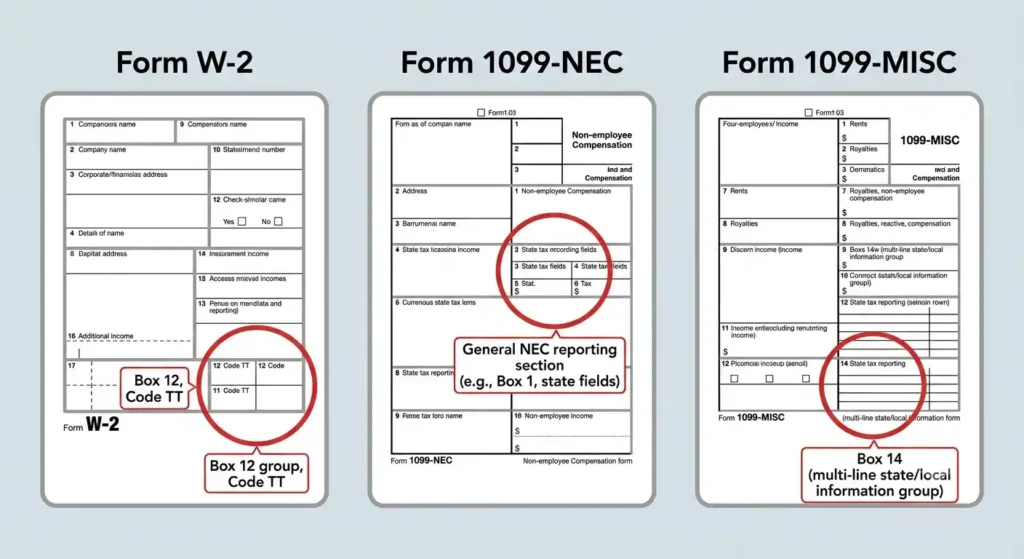
For tax year 2025, the IRS gave transitional relief, so many W-2s had incomplete data, though some employers used Form W-2 Box 14 voluntarily. If you want a refresher on how to read your California pay stub, that guide walks through every box and code. A 2025-only safe harbor let employers estimate the deduction by averaging July through December overtime hours, since the law took effect mid-year. Starting tax year 2026, forms issued in early 2027, employers must report qualified overtime separately, generally Form W-2 Box 12 code TT, or Box 1d of Form 1099-NEC and Box 14 of Form 1099-MISC for eligible payees, under the broader payroll compliance and reporting rules employers now follow. If your W-2 does not break it out, track your own hours and pay stubs, since the IRS allows reasonable calculation methods. You do not need to wait for updated guidance to file. If your employer later issues a corrected W-2, you may need to amend your return.
Frequently Asked Questions
Is overtime tax-free in California?
No. Your overtime gets added to your regular wages and taxed the same way, with no exemption tied to this federal rule.
Does California have its own no tax on overtime law?
No.
Does double-time qualify?
No. California’s double time premium sits outside the federal 40 hour weekly test, so it stays out of the deduction.
Does holiday overtime qualify?
Only if tied to hours over 40 in the week under federal rules. Holiday pay alone typically does not qualify.
Why is overtime taxed so much on my paycheck?
Withholding on overtime works like regular pay, often looking higher since the extra income can push that check into a higher withholding bracket.
Can salaried employees qualify?
Only if nonexempt and legally entitled to overtime. Most exempt salaried employees do not qualify.
Do union workers qualify?
Only for the portion matching the federal 40 hour weekly standard, not extra contractual premiums.
Do independent contractors qualify?
No. Independent contractors do not receive FLSA overtime, which is one of several differences we cover in our 1099 vs. W-2 comparison. They typically get a Form 1099-NEC or Form 1099-MISC instead of a Form W-2, and these forms can report qualified overtime for eligible payees, but true contractors stay excluded, since eligibility depends on FLSA overtime status, not the form used.
Will this deduction expire?
Yes, after tax years 2025 through 2028, unless Congress extends it.
Can I claim the deduction without itemizing?
Yes, available to both itemizers and non itemizers.
Key Takeaways
What California workers should remember
The federal deduction covers up to $12,500 in qualified overtime pay, or $25,000 married filing jointly, through tax year 2028. California has not matched this rule, so state tax on overtime stays the same. The federal 40 hour weekly test decides eligibility, so most California daily overtime and double time pay stays outside the deduction. Before filing, check your W-2 for separate overtime reporting, keep your own pay records, and confirm your income against the phaseout limits. For a fuller picture of your take-home pay, run your numbers through our California paycheck calculator.

Yeasin Sorker is the founder of Paycheck Calculator California. He built this tool in 2018 after noticing that most free paycheck calculators missed California-specific rules like daily overtime and the uncapped SDI rate.
He researches California payroll tax updates regularly and keeps this calculator aligned with the latest IRS, FTB, and EDD published rates. All calculations on this site are estimates based on official 2026 government sources. For personalized tax advice, consult a qualified tax professional.