
California’s average public school teacher salary is $103,552 for 2024-25, according to the NEA Rankings and Estimates report, with starting pay at $59,424 for 2024-25, up from $58,409 the year before.
That $103,552 average blends decades of veteran pay with brand-new hires, so your real number depends entirely on your specific district’s salary schedule.
The headline number looks strong, but new teachers earn far less until they climb the schedule.
California Teacher Salary in 2026 at a Glance
That statewide number mixes every experience level and district together. The sections below break it down by step, column, district, and take-home pay so you know where you actually land. For pay data on other professions, see our California salary guides by profession.
What Is the Average Teacher Salary in California?
The NEA Rankings and Estimates report puts the statewide average at $103,552 for 2024-25, drawing on state-reported payroll data. It blends first-year teachers with 25-year veterans, so your actual pay depends on your district, experience, and education level, not this number. The California Department of Education publishes its own, more granular breakdown by district size and type.
What Can a New Teacher Expect to Earn?
New teachers start at $59,424 a year for 2024-25, up from $58,409 the prior year, according to the NEA benchmark table, the highest starting pay of any state either way. Small or rural districts often start lower. Career changers start at the same step-one placement regardless of prior-field experience, unless that experience earns district-recognized teaching credit.
How Much Can an Experienced California Teacher Make?
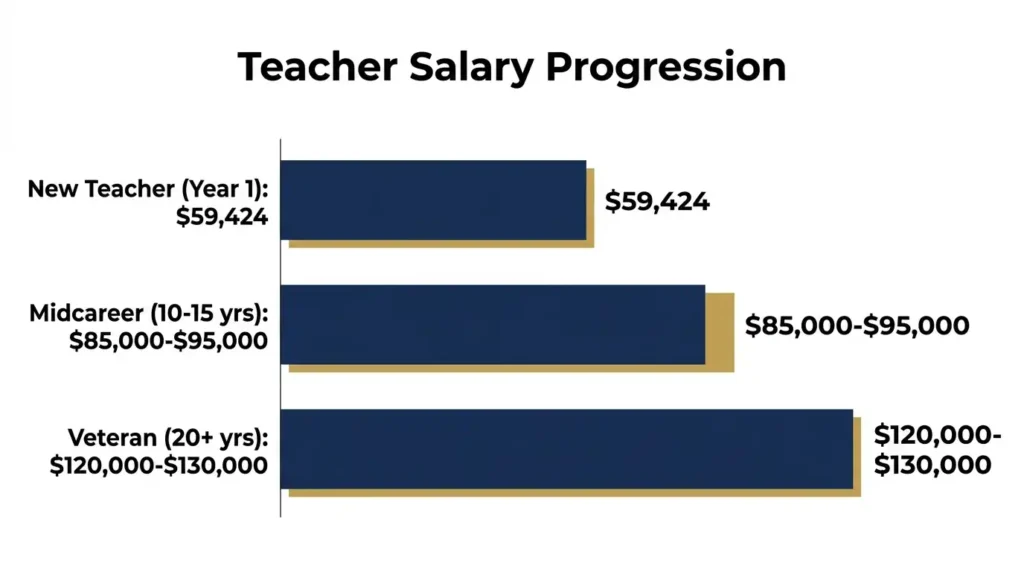
Midcareer teachers (10 to 15 years, often with a master’s) typically earn $85,000 to $95,000. Veterans at 20-plus years with a doctorate or max units can clear $120,000 to $130,000, in line with our $120,000 and $130,000 after-taxes breakdowns. Glassdoor’s self-reported data shows top earners near $126,010, though that’s user-submitted, not official payroll data.
California Teacher Salary Comparison
| Experience Level | Typical Annual Pay |
|---|---|
| New teacher (year 1) | $59,424 (2024-25), up from $58,409 |
| Midcareer (10–15 yrs, master’s) | $85,000 – $95,000 |
| Veteran (20+ yrs, doctorate/max units) | $120,000 – $130,000 |
Same job title, same classroom, wildly different paychecks. That gap comes entirely from the salary schedule.
How California Teacher Salary Schedules Actually Work
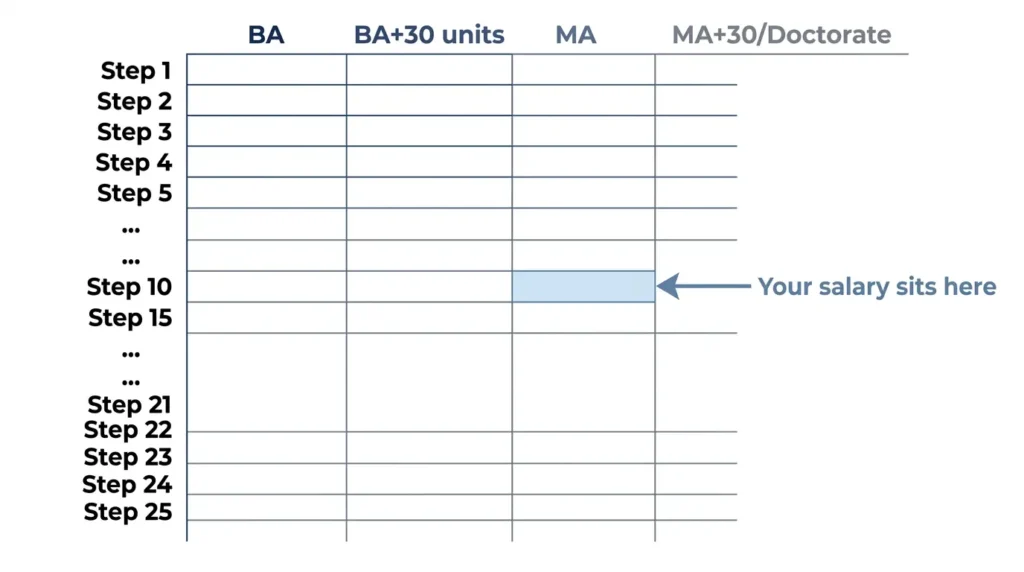
Every district uses a salary schedule, a grid based only on years of experience and education level. There’s no individual negotiating like the corporate world.
What Are Salary Steps?
A step equals one year of qualifying experience. Most districts have 15 to 25 steps. You move up one step per year until you hit the top step, the salary cap. Reaching the true top of the scale, especially highest columns requiring a doctorate or extra graduate credits, often takes 25 to 30 years. Some districts freeze movement in tight budget years.
What Are Salary Columns?
Columns represent education level. Column one is usually bachelor’s plus credential. Extra graduate units, often in blocks of 15 or 30, move you to higher columns. A master’s or doctorate lands the highest columns.
How Steps and Columns Work Together
Your salary sits where your step meets your column. A ten-year teacher with only a bachelor’s can earn less than a five-year teacher with a master’s.
How to Read a California District Salary Schedule
Districts post certificated salary schedules publicly, usually as a PDF on the HR page. This transparency exists partly because the California Education Code, including Education Code Section 41372, requires districts to spend a set share of budget on classroom teacher salaries, keeping schedules public record. Check the effective date since schedules change yearly.
What Determines Your California Teacher Salary?
Four factors: education, experience, credential type, and district.
Education and Advanced Degrees
A completed master’s adds roughly $3,000 to $6,000 a year over bachelor’s-only. A doctorate adds more. Districts count units, so 30 units toward a master’s can help before the degree finishes.
Teaching Experience
California experience counts fully. Districts often cap out-of-state credit at five to ten years. Private-school experience is credited inconsistently. Substitute and student teaching generally don’t count, since districts require contracted, credentialed classroom experience.
Teaching Credential
Every California teaching credential is issued through the California Commission on Teacher Credentialing. A preliminary credential lets you teach while finishing a clear credential. Multiple Subject covers elementary, Single Subject covers specific high school subjects, and Education Specialist Instruction Credentials cover special education. Credential type rarely raises pay directly but can unlock stipend-eligible roles.
School District
District choice matters most of all. Each district bargains its own schedule, so neighboring districts can differ by $10,000 or more at the same step and column.
California Teacher Salary by School District and City
Why Teacher Pay Varies Across California
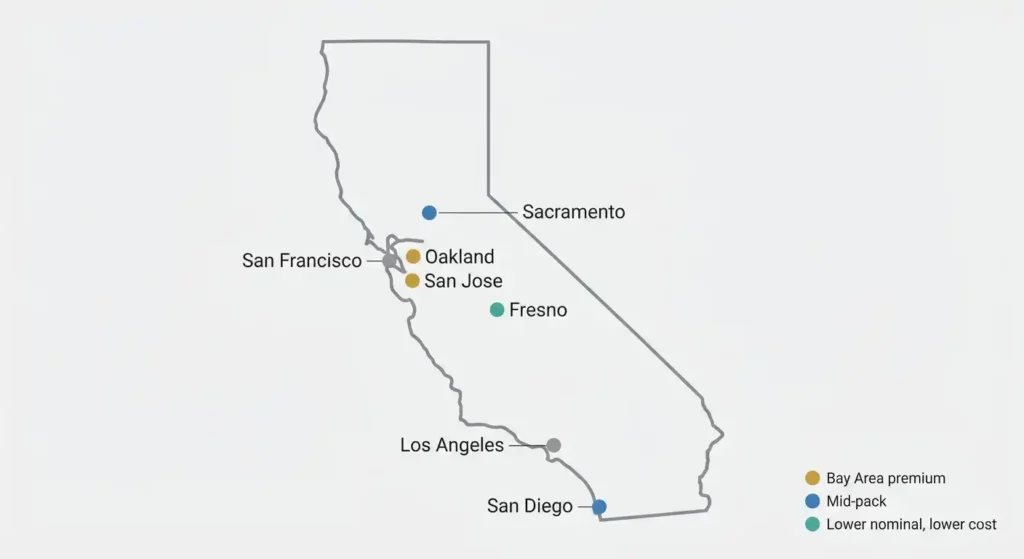
Budgets, tax bases, and bargaining power shape pay. Rural districts with thin tax bases and weaker contracts often land among the lowest-paying in the state, sometimes thousands below a nearby city at the same step and column.
Los Angeles and Southern California
Los Angeles Unified School District, known as LAUSD, the largest district in the state, runs a competitive schedule, though pay stretches thin against LA housing costs. Check our Los Angeles paycheck calculator to see your real take-home.
San Francisco and the Bay Area
Bay Area districts, including cities like Berkeley and Redwood City, post some of the state’s highest nominal salaries. San Francisco Unified School District pays competitively too, though its schedule alone doesn’t offset the area’s cost of living. Run your own numbers with our San Francisco paycheck calculator to see what that pay actually nets you.
San Diego and Other Major California Cities
| District | Pay Tier | Note |
|---|---|---|
| San Diego Unified School District | Mid-pack | Solid but not top tier |
| Sacramento City Unified School District | Mid-pack | Trends similar to San Diego |
| Oakland Unified School District | Bay Area premium | Higher nominal pay |
| San Jose Unified School District | Bay Area premium | Higher nominal pay |
| Fresno Unified School District | Lower nominal, lower cost | Paycheck stretches further |
| Riverside Unified School District | Lower nominal, lower cost | Paycheck stretches further |
| Orange Unified School District | Near state average | Varies by city within the county |
How to Compare Two Districts Correctly
A posted salary range only shows what’s possible across the schedule, not a guarantee at hire. Compare starting pay, max pay, benefits, and local housing costs together.
California Teacher Salary by Grade and Teaching Specialty
Elementary School Teacher Salary
Elementary teachers use the same schedule as everyone else; there’s no separate pay scale. Kindergarten falls under this too. Preschool roles outside K-12 usually pay less and skip CalSTRS membership, running on different funding.
Middle School Teacher Salary
Same general schedule. Department-lead or coaching roles add a few thousand a year in stipends.
High School Teacher Salary
Same base schedule, but more stipend opportunities: coaching, clubs, AP prep pay.
Special Education Teacher Salary
Education Specialist credential holders often earn a $2,000 to $5,000 stipend, since these roles are chronically hard to fill.
STEM and High-Need Subjects
Math, science, and bilingual teachers often qualify for shortage-area bonuses or stipends. Ask HR directly, since these aren’t always advertised.
California Teacher Salary vs. Take-Home Pay
Why Gross Salary Is Not Your Paycheck
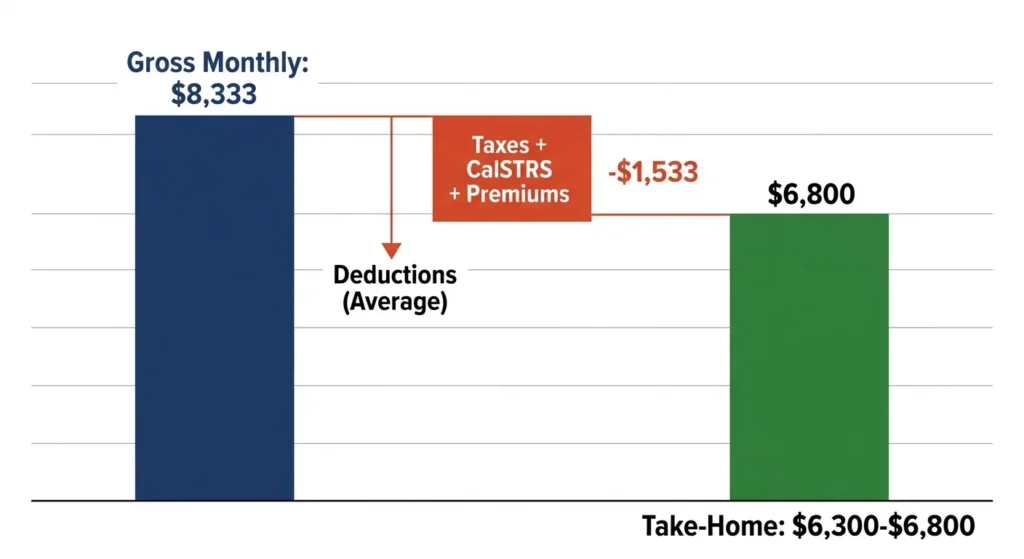
Federal tax, California state tax, and payroll deductions come out first. See our full breakdown of gross pay vs net pay and the current California tax brackets for the exact math. Most teachers still pay Medicare tax despite Social Security exemption. Expect roughly 20 to 25 percent of gross pay gone before retirement contributions.
CalSTRS Contributions and Teacher Pay
Instead of Social Security, you contribute to CalSTRS, formally the California State Teachers’ Retirement System.
| Membership Tier | Member Contribution Rate |
|---|---|
| 2% at 60 | 10.25% |
| 2% at 62 | 10.205% |
This CalSTRS member contribution is mandatory but builds your pension.
Health Insurance and Other Benefits
Health, dental, and vision premiums come out of pay unless the district covers them fully. Coverage varies widely by district. Browse our paid leave and benefits guides for what else California law requires.
How Teachers Are Paid During the Year
Most teachers work a 10-month year, roughly 180 to 185 contract days, paid either over 10 or 12 months. These deductions will make more sense once you can read your California pay stub. Part-time teachers are paid a prorated share of the same schedule, similar to how part-time vs full-time paychecks work generally in California. Summer school or tutoring pay sits outside the base contract and isn’t guaranteed yearly.
$60K, $70K, $80K, $90K, and $100K Teacher Salary Examples
Run any of these numbers yourself with our gross pay calculator to see exactly how deductions stack up at your salary.
What a $60,000 Teacher Salary Looks Like
About $5,000 a month gross. After taxes, CalSTRS, and premiums, expect roughly $3,900 to $4,200 a month take-home. See the full $60,000 after taxes in California breakdown for the line-by-line math.
What a $70,000 Teacher Salary Looks Like
About $5,833 monthly gross; CalSTRS alone takes roughly $580 to $600. Expect $4,500 to $4,800 take-home. No $70,000 breakdown is published yet, so the nearest reference points are $65,000 after taxes and $75,000 after taxes in California.
What an $80,000 Teacher Salary Looks Like
About $6,667 monthly gross. Expect $5,100 to $5,500 take-home, varying by region. Full details in our $80,000 after taxes California guide.
What a $90,000 Teacher Salary Looks Like
About $7,500 monthly gross. Expect $5,700 to $6,100 take-home. See our $90,000 after taxes California breakdown for more.
What a $100,000 Teacher Salary Looks Like
About $8,333 monthly gross. Expect $6,300 to $6,800 take-home. Our $100K after tax in California guide breaks this down further.
Is a $100,000 Teacher Salary Good in California?
$100K Salary in a High-Cost Area
In the Bay Area, $100,000 covers rent but rarely supports homeownership on one income, given median home prices well over a million dollars.
$100K Salary in a Lower-Cost California Area
In the Central Valley or Inland Empire, $100,000 stretches much further, often supporting homeownership.
Single Teacher vs. Teacher With a Family
A single teacher at $100,000 has real flexibility statewide. A family adds childcare and housing costs that change the math; dual-income households fare better.
How Much Can You Increase Your California Teacher Salary?
Move to a Higher Salary Column
Extra graduate units, often in 15-unit blocks, move you up a column even before finishing a degree.
Earn a Master’s or Doctorate
A master’s typically adds a permanent few thousand dollars a year; most teachers recoup tuition within a few years.
Take on Extra Assignments
Coaching, department leadership, or extracurriculars add stipend income, from a few hundred to a few thousand dollars.
Change School Districts
Switching districts can add $10,000 or more instantly. Confirm transfer-credit rules first.
California Teacher Salary Compared With Other Careers and States
California Teacher Salary vs. Other States
California’s $103,552 average leads the nation, ahead of New York and Washington. Starting pay also leads, at roughly $58,400 to $59,400 depending on the reporting year.
Teacher Salary vs. California Nurses
California nurses often earn $110,000 to $140,000, generally with less schooling than a master’s-level teacher. See our full California registered nurse salary breakdown for the comparison.
Teacher Salary vs. Social Workers
Social workers with similar graduate education often earn less than teachers at comparable experience.
Teacher Salary vs. Private-Sector Careers
Private-sector college grads often out-earn teachers by a record 26.9 percent as of 2024 (Economic Policy Institute). Our California software engineer salary guide shows just how wide that gap can get. Teaching offers job stability and a defined benefit pension instead.
Public School vs. Charter vs. Private School Teacher Salary
Public School Teacher Pay
Public schools use transparent, publicly posted schedules from collective bargaining, in the same spirit as California’s broader pay transparency law.
Charter School Teacher Pay
Charter pay structures vary and aren’t always step-and-column based. Ask for specifics.
Private School Teacher Pay
Private schools generally pay less and don’t participate in CalSTRS, so retirement looks very different.
Which Option Pays the Most?
Public districts usually win on base pay and retirement value over a full career.
California Teacher Benefits and Retirement Value
What Benefits Come With a Teacher Salary?
Most positions include health insurance, paid sick leave, and negotiated dental and vision coverage, varying by district.
How CalSTRS Fits Into Total Compensation
CalSTRS is a defined benefit pension: payout is set by a formula based on years of service and final salary, not market performance. You and the district both contribute.
Why Total Compensation Matters
A lower salary with strong benefits can beat a higher salary with weak ones over a career. Compare total compensation, not just base pay.
Real-World California Teacher Salary Scenarios
Scenario 1: New Teacher With a Bachelor’s Degree
Step one, column one placement. Expect roughly $58,000 to $59,000 to start, depending on the district.
Scenario 2: New Teacher With a Master’s Degree
Same year one, but a higher column adds roughly $3,000 to $6,000 immediately.
Scenario 3: Experienced Teacher Moving From Another State
A ten-year out-of-state teacher might only get credit for five or six years. Confirm with HR before accepting.
Scenario 4: Veteran Teacher Considering a Higher-Paying District
A 15-year teacher might gain $10,000 switching districts, but could lose seniority perks or a shorter commute.
Scenario 5: Teacher Choosing Between Two California Offers
Compare full schedules, benefits, retirement, and housing costs, not just the starting number.
Common Myths About California Teacher Salaries
Myth: Every California Teacher Makes More Than $100,000
$103,552 is a statewide average across all experience levels. New teachers start near $58,000 to $59,000; only veterans near the top clear six figures.
Myth: Every California District Pays the Same
Neighboring districts can differ by tens of thousands at the same step and column due to separate bargaining.
Myth: A Master’s Degree Automatically Guarantees a Large Raise
The raise depends on qualifying units and how your district’s schedule places them.
Myth: Your Salary Equals Your Take-Home Pay
Taxes, CalSTRS, and premiums typically remove 25 to 35 percent of gross salary. If your own check feels smaller than expected, our why is my paycheck so low guide walks through the common causes.
How to Find Your Exact California Teacher Salary
Find the District Salary Schedule
Search the district site for “certificated salary schedule,” usually under HR or the bargaining agreement page.
Determine Your Salary Step
Count qualifying years carefully and confirm out-of-state or private-school credit with HR.
Determine Your Salary Column
Match your degree and units to the schedule’s column headers.
Calculate Your Total Compensation
Add base salary, stipends, benefits, and CalSTRS contributions for the full picture. Our annual salary calculator and paycheck basics guides can help you run the numbers.
California Teacher Salary Data: What the Numbers Actually Mean
Statewide Average vs. Beginning Salary
$103,552 and $59,424 (up from $58,409 the prior year) describe two very different points on the same schedule.
District Size and Salary Differences
Larger unified districts often have more funding and bargaining power than small elementary-only or high-school-only districts.
2026 Data-Year Caveat
The $103,552 statewide average cited throughout this guide comes from NEA’s Rankings and Estimates report for 2024-25, not CDE directly. CDE’s own payroll-based figures, known as J-90 data for 2024-25, run on a separate timeline, with 2025-26 figures (C-90) not fully published until later. NEA’s report runs on a separate survey timeline from CDE’s payroll data, which is part of why numbers for the same year can differ slightly.
What Salary Should You Look for Before Accepting a California Teaching Job?
Questions to Ask the District
Ask for exact step and column placement in writing.
Numbers to Compare Beyond Base Salary
Compare benefits, stipends, and work-year structure, not just base pay.
Red Flags in a Teacher Job Offer
Watch for vague placement promises or an outdated salary schedule; always request the current dated version.
Frequently Asked Questions About Teacher Salary California
What is the average teacher salary in California in 2026?
The latest confirmed figure, from NEA’s Rankings and Estimates report, is $103,552 for 2024-25. 2025-26 figures aren’t officially published yet.
How much does a first-year teacher make in California?
$59,424 for 2024-25, up from $58,409 the year before, according to NEA, the highest starting pay of any state either way.
Do California teachers really make $100,000 a year?
Mainly veterans with 20-plus years and advanced degrees near the top of their schedule. Most others earn less.
What is the highest teacher salary in California?
Top step earners can reach $120,000 to $130,000; self-reported Glassdoor data shows figures near $126,010, though that’s user-submitted, not official.
How much does a teacher make after 10 years in California?
Typically $80,000 to $95,000, especially with a master’s or extra units.
Does a master’s degree increase teacher pay in California?
Yes, typically $3,000 to $6,000 a year over bachelor’s-only placement.
How much do California teachers take home after taxes?
Roughly 65 to 75 percent of gross salary, after taxes, CalSTRS, and premiums. See our California payroll taxes overview for the full picture.
Which California school districts pay teachers the most?
Bay Area and several Southern California districts post the highest nominal pay, but weigh that against local cost of living.
Can teachers afford to live in California?
Yes in the Central Valley or Inland Empire on a standard salary. Coastal areas like San Francisco often require a second income.
Final Takeaway: What You’ll Really Earn as a California Teacher
The Number That Matters Most for You
Your real number comes from your specific step, column, and district’s current schedule.
Salary vs. Financial Reality
Gross salary is a starting point; CalSTRS, taxes, benefits, and local cost of living shape what it actually means for you.
The Best Next Step Before Applying
Pull up your target district’s schedule, confirm placement with HR in writing, and compare the full compensation package before signing. Run your own numbers anytime with our free California paycheck calculator.

Yeasin Sorker is the founder of Paycheck Calculator California. He built this tool in 2018 after noticing that most free paycheck calculators missed California-specific rules like daily overtime and the uncapped SDI rate.
He researches California payroll tax updates regularly and keeps this calculator aligned with the latest IRS, FTB, and EDD published rates. All calculations on this site are estimates based on official 2026 government sources. For personalized tax advice, consult a qualified tax professional.