
A SEP IRA is an employer-funded retirement plan for self-employed people and small businesses in California, capped at a percentage of compensation each year. California sets no separate limit and generally follows federal rules.
That federal-first approach is something I confirm with every California client before running their actual SEP contribution numbers.
The tradeoff: contributions are employer-only, and eligible employees must receive the same percentage you take.
SEP IRA Rules at a Glance
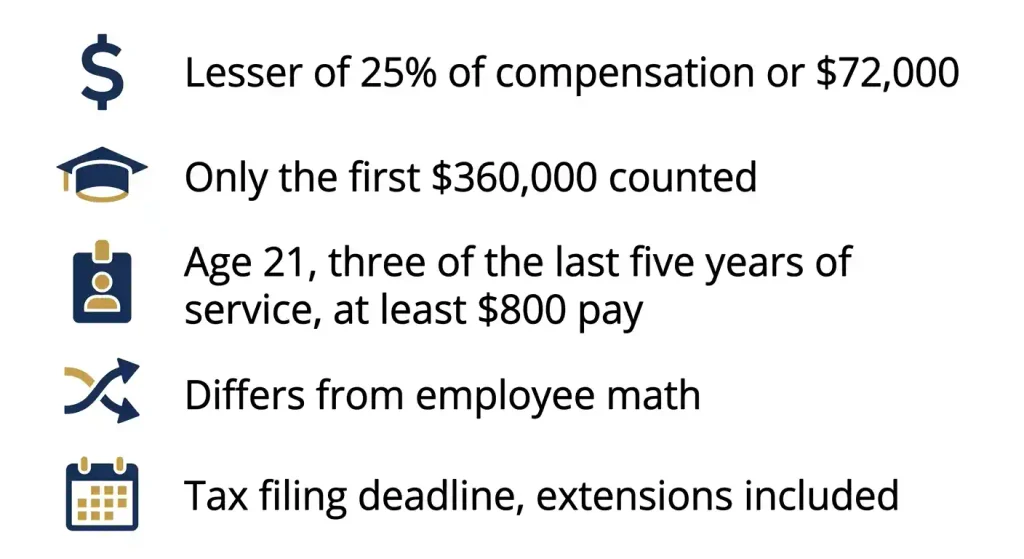
For 2026 you can put in the lesser of 25% of compensation or $72,000, with only the first $360,000 of compensation counted.
The Key Rules in One Quick Table
| Rule | 2026 Detail |
|---|---|
| Max contribution | Lesser of 25% of compensation or $72,000 |
| Compensation cap | Only the first $360,000 counted |
| Eligibility | Age 21, three of the last five years of service, at least $800 pay |
| Self-employed math | Differs from employee math |
| Deadline | Tax filing deadline, extensions included |
Every number comes from the Internal Revenue Service.
What a SEP IRA Is
SEP stands for Simplified Employee Pension. Your business writes the check, not you through payroll. Governed by Internal Revenue Code Section 408(k). You cannot open one without a business or self-employment income behind it.
Who Can Open and Use a SEP IRA?
Sole proprietors, freelancers, LLCs, corporations, and nonprofits can all sponsor one, with or without staff.
Businesses and Individuals That Can Establish a SEP
Sole proprietors, freelancers, independent contractors, gig workers, LLCs, partnerships, S corporations, corporations, and nonprofits can all sponsor a SEP, staff or no staff.
SEP IRA Eligibility for Business Owners
Owners follow the same eligibility rules as everyone else. A self-employed owner with no staff participates as their own employee. Spouse co-owners are separate participants with their own eligibility clock.
Can You Have a SEP IRA Along With Other Retirement Accounts?
Yes. A SEP can run alongside a traditional IRA, a Roth IRA, or a 401(k) from other employment. Employer SEP contributions generally do not shrink your personal IRA limit.
SEP IRA Contribution Limits for 2026
Self-employed owners cannot apply the percentage the same way employees do, which is the single biggest source of contribution errors I see.
The Maximum SEP IRA Contribution
25% of compensation or $72,000 for 2026, whichever is smaller, up from $70,000 in 2025. Only the first $360,000 of compensation counts. The cap ties to Internal Revenue Code Section 415.
How the 25% Rule Works for Employees
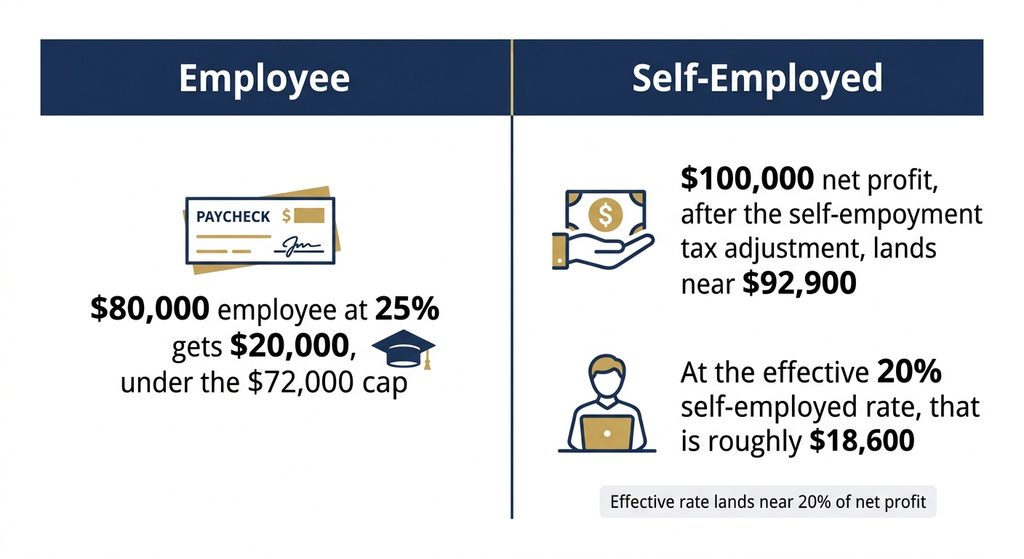
25% applies straight to gross compensation. An $80,000 employee at 25% gets $20,000, under the $72,000 cap. The employer funds it, and the rate must be uniform across eligible employees.
SEP IRA Limits for Self-Employed Individuals
Not 25% of gross profit. Use net earnings from self-employment, subtract one-half of your self-employment tax, and the contribution itself feeds back into the math. Effective rate lands near 20% of net profit.
SEP IRA Rules for S Corporation Owners
Based on W-2 salary only. $100,000 salary plus a $150,000 distribution still caps the SEP at 25% of the $100,000, or $25,000. Distributions never count.
SEP IRA Rules for Partnerships and LLCs
Partners use self-employment earnings from the K-1, not a salary figure. A single-member LLC follows whichever tax treatment it elected. Outside W-2 wages from a separate job do not enter the calculation.
SEP IRA Employee Eligibility Rules
Eligible employees must get the same contribution percentage as the owner, and rules can be loosened but never tightened.
Which Employees Must Be Included?
Age 21 or older, three of the last five years of service, at least $800 earned in 2026. Employers may use less restrictive rules, never stricter ones. This only applies to actual employees, so getting worker classification right matters before you run any SEP eligibility numbers.
How SEP IRA Contributions Must Be Allocated
Whatever percentage you pick for yourself applies equally to every eligible employee’s own compensation. A 15% owner rate means 15% for a $50,000 assistant too. Every contribution is 100% vested on deposit, meaning it belongs to the employee immediately with no clawback.
Can You Skip Contributions in a Bad Business Year?
Yes, contributions are discretionary each year. You cannot apply a different rate to yourself than to eligible employees in a year you do contribute.
SEP IRA Deadlines: When to Set Up and Fund the Plan
Both setup and funding follow the tax return due date, extensions included, not December 31.
Deadline to Establish a SEP IRA
You can open one up to your extended tax return due date and still have it count for the prior year, unlike plans that must exist by December 31.
Deadline to Make SEP IRA Contributions
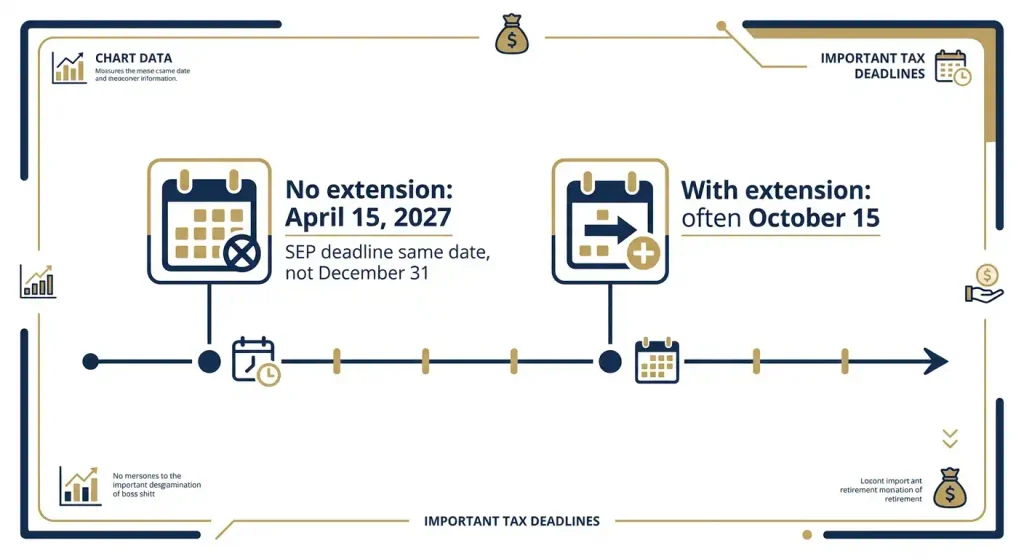
Follows your federal return due date, extensions included, generally April 15, 2027 for 2026, or later with an extension. Miss it and you lose the deduction for that year.
SEP IRA vs. Solo 401(k), SIMPLE IRA and Traditional IRA
A Solo 401(k) often allows more at lower income, a SIMPLE fits businesses wanting payroll deferral, and a SEP wins on simplicity once you have staff.
SEP IRA vs. Solo 401(k)
Solo 401(k) allows employee and employer contributions, often bigger at lower income. Both can hit the $72,000 ceiling for 2026, matching the 401(k) contribution limits for the year. Solo 401(k)s need Form 5500-EZ past $250,000 in assets. A SEP has no deferral election and no 5500-EZ threshold, making it simpler once you hire.
SEP IRA vs. SIMPLE IRA
SIMPLE requires a match or a fixed 2% every year, with employee salary deferral allowed, something a SEP does not offer. Older SARSEP plans, allowed under IRC Section 408(k)(6) before 1997, once let employees defer into a SEP; that option is closed to new plans.
SEP IRA vs. Traditional IRA
Traditional IRA: $7,500 for 2026, $8,600 at 50 or older, funded by you. SEP: funded by your business, up to $72,000. Both can run at once, though your traditional IRA deduction may phase out once you are covered by a SEP.
Quick Comparison Table: Which Plan Fits Your Situation?
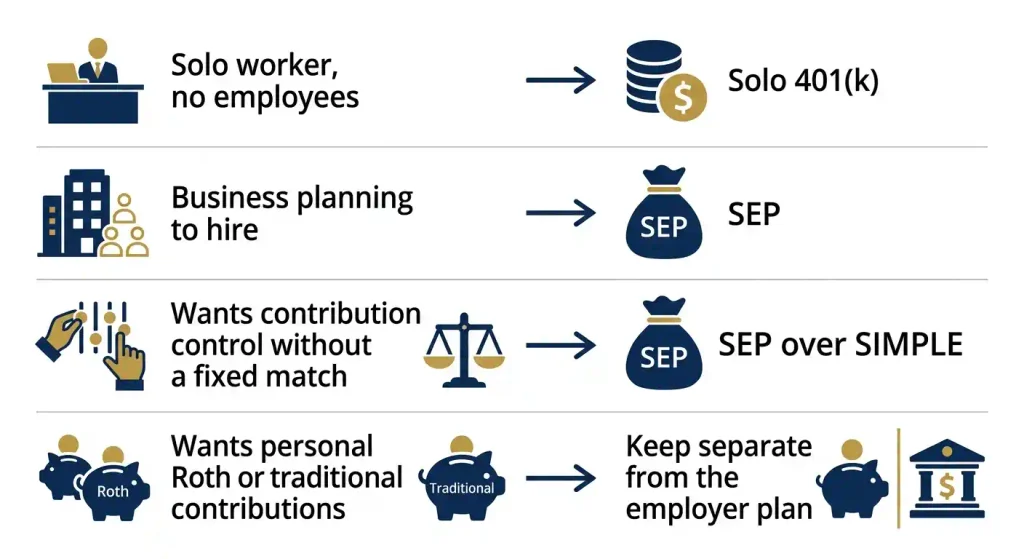
| Situation | Best Fit |
|---|---|
| Solo worker, no employees | Solo 401(k) |
| Business planning to hire | SEP |
| Wants contribution control without a fixed match | SEP over SIMPLE |
| Wants personal Roth or traditional contributions | Keep separate from the employer plan |
How to Set Up a SEP IRA
Pick a custodian, adopt a written plan, notify employees, and open an account for each eligible employee.
Step 1: Choose a Financial Institution
A bank, brokerage, mutual fund company, or insurer holds the assets. Fees and options vary, so compare providers. The institution does not set your contribution amount.
Step 2: Adopt a Written SEP Plan
Most businesses use Form 5305-SEP, kept on file, not filed with the IRS. Complex cases may need a prototype or individually designed document. IRS Publication 560 covers the full rules, and current model forms are on the IRS Retirement Plans section of irs.gov.
Step 3: Provide Required Employee Information
Give eligible employees a copy of the plan and contribution explanation. Notify them of amendments and annual contribution details. This is a legal requirement.
Step 4: Establish a SEP IRA for Each Eligible Employee
Each eligible employee needs their own account, not a shared pool. Some providers offer Roth SEP IRAs. Contributions land directly in each account, and the employee generally controls investments.
SEP IRA Tax Rules and Reporting
Contributions are deductible to the business, tax-deferred for employees, and generally exempt from Form 5500 filing.
Are SEP IRA Contributions Tax Deductible?
Yes, as a business expense. Self-employed individuals deduct on Schedule 1 using the net earnings formula. IRS Publication 590-A covers the underlying IRA contribution and deduction rules. A SEP contribution does not reduce self-employment tax.
How Employees Are Taxed on SEP Contributions
Not included in current taxable income. Grows tax-deferred. Taxed as ordinary income on withdrawal. Not treated like wages on a W-2.
SEP IRA Reporting and Filing Requirements
Most SEP plans skip the annual IRS Form 5500 filing that 401(k)s require. Employers should keep records. Employees report SEP activity like any other IRA.
California SEP IRA Rules and Tax Treatment
California follows federal SEP treatment and does not set its own contribution cap, though reporting can differ by residency status.
Does California Have Different SEP IRA Contribution Limits?
No. The $72,000 2026 limit comes from the IRS statewide. The California Franchise Tax Board, the FTB, does not publish its own SEP cap.
How SEP IRA Deductions Affect California Taxes
California generally follows federal SEP treatment, cutting both federal and state taxable income. At California’s top marginal tax rate of 13.3%, a $50,000 contribution can save roughly $6,650 in state tax alone. If California compensation or self-employment income differs from the federal figures, the deductible SEP amount for state purposes can differ too.
California Residents, Part-Year Residents, and Nonresidents
Full-year residents use Schedule CA (540). Part-year residents and nonresidents use Schedule CA (540NR). Multistate business income needs closer review.
SEP IRA Withdrawals, Rollovers and Required Distributions
Withdrawals are taxable, early ones face penalties, and RMDs apply starting at age 73.
When Can You Withdraw SEP IRA Money?
Anytime, taxed as ordinary income. Before age 59 and a half, generally a 10% federal penalty applies. California adds its own 2½% additional tax on certain early distributions, reported on Form FTB 3805P, on top of the federal penalty on federal Form 5329. The exceptions do not always match. IRS Publication 590-B covers federal distribution rules in more depth.
SEP IRA Rollovers and Transfers
A trustee-to-trustee transfer moves funds directly, the cleanest option. A rollover gives you the funds with 60 days to redeposit them. Confirm the receiving account accepts SEP money first. Converting SEP assets to a Roth IRA counts as taxable income in the year of conversion.
Required Minimum Distributions
SEP IRAs follow standard IRA RMD rules, starting at age 73 for 2026, rising to 75 in 2033. You can still contribute in the same year you take RMDs.
SEP IRA Deadline Examples
Deadlines follow the tax return due date, with real numbers changing by scenario.
Sole Proprietor Filing on the Normal Deadline
A 2026 return due April 15, 2027 with no extension means the SEP deadline is that same date, not December 31.
Business Owner Who Obtains a Filing Extension
An extension pushes the SEP deadline out too, often to October 15, giving more time to finalize numbers, including your estimated tax payments for the year.
Employee Contribution Scenario
Simple Employee Contribution Example
$60,000 salary at 15% employer rate equals a $9,000 contribution, under the $72,000 cap. The same 15% applies to every other eligible employee.
Self-Employed Contribution Scenario
Simple Self-Employed Contribution Example
$100,000 net profit, after the self-employment tax adjustment, lands near $92,900. At the effective 20% self-employed rate, that is roughly $18,600.
S Corporation Owner Scenario
$90,000 W-2 salary at 25% caps the SEP at $22,500, regardless of additional distributions.
Hiring Your First Employee Scenario
A 20% solo rate plus a new $45,000 employee means a $9,000 contribution for them too. Add two more employees at similar pay and that same 20% rate costs roughly $27,000 a year across all three.
Special SEP IRA Situations and Exceptions
Some employees can be excluded, part-timers can still qualify, and hiring changes the SEP’s cost and structure.
Employees You May Be Allowed to Exclude
Employees who do not yet meet eligibility, certain collectively bargained employees, and some nonresident aliens without U.S.-source pay can be excluded, following plan terms.
Part-Time and Seasonal Employees
Part-time status alone does not disqualify anyone. What matters is the three-of-five-years service rule, even from prior seasonal years.
Contributions for Employees Who Leave During the Year
Employees who worked during the year generally still need contributions, even if they left or died before the deposit date. Service during the year is what matters.
What Happens When You Hire Your First Employee?
The SEP decision stops being just about you. Every eligible employee raises total cost at whatever rate you choose.
Can You Have a SEP IRA Along With Other Retirement Accounts?
A SEP does not lock out your other accounts. It pairs fine with a traditional IRA, a Roth IRA, or a separate 401(k) without cutting into your personal IRA room.
More Than One Employer Retirement Plan
Multiple plans from the same employer can interact on limits. Multiple businesses can trigger aggregation and controlled-group rules treating them as one employer.
Common SEP IRA Mistakes and Misconceptions
The most common errors involve gross revenue math, unequal allocation, part-time exclusions, and deadline assumptions.
“I Can Contribute 25% of My Gross Business Revenue”
Wrong. Self-employed contributions use net earnings after expenses and the self-employment tax adjustment, not gross receipts.
“I Can Give Myself More Than My Employees”
The allocation formula must be identical for every eligible employee. A contribution is 100% vested on deposit, so it can never be reduced or taken back later.
“Only Full-Time Employees Count”
Part-time and seasonal workers can qualify once they clear the service requirement, based on years, not hours per week.
“I Must Fund the SEP IRA Every Year”
Contributions are discretionary. A zero-contribution year does not hurt the plan’s status.
“I Have Until December 31 to Make My Contribution”
Wrong. The real deadline is your tax filing deadline, extensions included, not the calendar year.
“A SEP IRA Has No Effect on My Other Retirement Planning”
A SEP can complicate a backdoor Roth through the pro-rata rule, since it counts as a pre-tax IRA balance.
What Happens If You Break a SEP IRA Rule?
Excess contributions, missed employees, and misapplied formulas all have IRS correction paths.
Excess Contributions
Uncorrected excess amounts trigger a 6% excise tax each year they remain, and nondeductible excess can face a separate 10% excise tax. The IRS SEP Fix-It Guide covers correction steps.
Missing an Eligible Employee
A real plan failure, usually owing a missed contribution plus lost earnings, and risking the plan’s tax-favored status. IRS correction programs can fix it if caught in time.
Using the Wrong Plan Document or Allocation Formula
Applying a different percentage than the plan document states is an operational mistake. Review the plan against actual practice yearly.
Is a SEP IRA Right for You?
A SEP fits simple, flexible, owner-driven savings; other plans may fit better with staff or backdoor Roth priorities.
A SEP IRA May Fit You If
You have solid self-employment income, want flexible year-to-year contributions, low administration, and are comfortable tying money up until retirement. A SEP also satisfies California’s CalSavers mandate for employers, since offering a qualified plan exempts you from that state requirement.
Consider Another Plan If
You have employees and want salary deferral options, are an owner-only business wanting a bigger contribution at lower income, or backdoor Roth planning is a priority. Pairing a SEP with an HSA contribution can add another layer of tax-advantaged savings if you carry a high-deductible health plan.
Final Decision Checklist
Confirm your business structure, identify eligible employees and their cost, calculate your real maximum contribution, and compare against a Solo 401(k) or SIMPLE IRA.
SEP IRA Rules FAQ
Quick answers on 2026 limits, eligibility, and deadlines.
What are the SEP IRA contribution limits for 2026?
25% of compensation up to $72,000, whichever is smaller, with only the first $360,000 counted. Self-employed individuals use net earnings, not gross income.
Who is eligible for a SEP IRA?
Age 21, three of the last five years of service, at least $800 in compensation for 2026. Employers can loosen but never tighten these rules.
Can a self-employed person have a SEP IRA?
Yes. Contributions use net earnings after expenses and the self-employment tax deduction, not gross profit.
Can I contribute to both a SEP IRA and a Roth IRA?
Yes, separate frameworks. SEP contributions generally do not reduce your Roth limit, though a backdoor Roth strategy can be affected by the pro-rata rule.
Do I have to contribute to my employees’ SEP IRAs?
Yes, once eligible, at the same percentage you give yourself.
Can I skip SEP IRA contributions for a year?
Yes, contributions are discretionary. Eligible employee rules still apply separately.
What is the deadline to set up and fund a SEP IRA?
Your tax return due date, extensions included, generally April 15 or October 15 with an extension.
Does California tax a SEP IRA differently?
California generally follows federal treatment. Residents use Schedule CA (540); part-year and nonresidents use Schedule CA (540NR).
What happens if I contribute too much to a SEP IRA?
Excess contributions need correction, ideally fast, following IRS guidance.
Key Takeaways
The 2026 cap is $72,000, self-employed math differs from employee math, hiring raises cost, and deadlines follow the tax filing date.
The SEP IRA Rules to Remember
Contribution limit depends on compensation and the $72,000 2026 cap. Self-employed math is not 25% of gross profit. Eligible employees create mandatory cost. Deadlines follow the tax filing deadline, extensions included, not December 31.
Your Next Steps
Confirm your business structure, review staff eligibility, calculate your real maximum contribution, and compare the SEP against a Solo 401(k) or SIMPLE IRA before setting one up. For more guides like this, browse our California tax savings and planning category, and run your own take-home numbers through our California paycheck calculator.

Yeasin Sorker is the founder of Paycheck Calculator California. He built this tool in 2018 after noticing that most free paycheck calculators missed California-specific rules like daily overtime and the uncapped SDI rate.
He researches California payroll tax updates regularly and keeps this calculator aligned with the latest IRS, FTB, and EDD published rates. All calculations on this site are estimates based on official 2026 government sources. For personalized tax advice, consult a qualified tax professional.