
California tip pooling laws allow mandatory pooling only when the split is fair and limited to employees who help serve customers. Managers, supervisors, and owners can never take a cut, regardless of how the policy is written.
That fairness standard traces to Leighton v. Old Heidelberg, Ltd. (1990), and carries real teeth under SB 648’s 2026 update.
Still, no statutory tip-out percentage exists, so each policy’s legality depends on the specific facts.
California Tip Pooling Laws: What Employees Need to Know in 2026
California Labor Code Section 351 makes every tip the employee’s property, and SB 648 now lets the Labor Commissioner investigate and penalize violations directly.
What Is Tip Pooling in California?
Tip pooling combines tips from a shift and splits them among the staff who worked it, instead of each person keeping only what they collected. Pooling can be mandatory or voluntary. California allows both, but a mandatory policy faces more scrutiny if it is poorly designed.
What Does California Labor Code Section 351 Say?
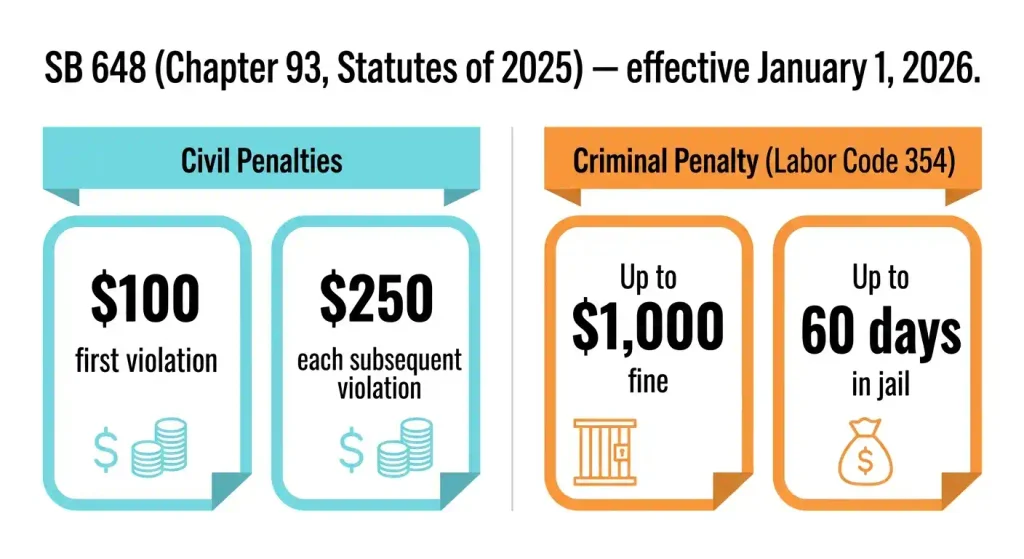
California Labor Code Section 351 makes every gratuity the employee’s property and bars the employer or any employer agent from taking it or crediting it against wages. California Labor Code Section 350 defines a gratuity, California Labor Code Section 353 requires tip records, and California Labor Code Section 356 ties these rules to other wage law. California Labor Code Section 354 makes violations a misdemeanor: up to a $1,000 fine, 60 days in jail, or both.
Is Mandatory Tip Pooling Legal in California?
Yes. Leighton v. Old Heidelberg, Ltd. (1990) first upheld mandatory pooling as long as it is fair and reasonable. That case discussed direct table service, but later courts rejected it as a strict limit, which is part of why kitchen staff can qualify today. No individual consent is required, but favoritism or an unfair split can still violate the standard.
What Changed Under California SB 648 in 2026?
Senate Bill 648 (SB 648), Chapter 93, Statutes of 2025, took effect January 1, 2026. It lets the Labor Commissioner investigate, cite, and sue employers directly, instead of leaving tip theft to employee-initiated lawsuits alone. This SB 648 tip enforcement system adds civil penalties: $100 for a first violation, $250 for each one after, plus repayment with interest.
Which Employees Can Legally Receive Pooled Tips in California?
Eligibility comes down to the chain of service test: does the job genuinely contribute to the service that earned the tip. Servers, bartenders, bussers, hosts, and even kitchen staff can qualify, since California’s ban on tip credits removes the federal limit to front-of-house roles.
Can Servers and Waiters Share Tips With Other Employees?
Yes. Servers are the main tip recipients, and California lets employers require tipping out bartenders, bussers, and food runners who helped deliver the service.
Can Hosts, Hostesses, and Cashiers Receive Pooled Tips?
Yes. Hosts, cashiers, baristas, and counter workers can share tips since they are part of the front-of-house service, even without carrying food to a table.
Can Cooks, Chefs, and Kitchen Staff Receive Tips?
Yes. Unlike federal law, California lets kitchen staff join tip pools because it bans the tip credit that normally restricts pools to front-of-house roles. Eligibility still depends on the specific job’s facts.
Can Dishwashers and Other Non-Customer-Facing Employees Receive Tips?
Yes. Direct customer contact is not required, only a contribution to the chain of service. Job title does not decide eligibility; actual work during the shift does.
Can Part-Time, Temporary, and Different-Shift Employees Participate?
Yes, as long as the split reflects actual participation rather than an equal flat share. There is no rule requiring a full shift; even part of a shift can earn a proportional cut.
Can Managers, Supervisors, and Owners Receive Tip Pool Money?
No, not if they hold real managerial or ownership authority, even if they occasionally serve customers.
Can Restaurant Managers Receive Pooled Tips?
No. Anyone who can hire, fire, discipline, or schedule staff counts as management, even while bussing tables. This is the working manager problem: occasional service work does not make a manager eligible.
Can Shift Supervisors and Assistant Managers Share Tips?
It depends on actual authority, not title. A shift lead without discipline or scheduling power can still qualify; an assistant manager who can write up staff cannot.
Can Restaurant Owners Receive Employee Tips?
No, never, even if the owner personally serves customers. Tips become employee property the moment a customer leaves them.
What Happens When an Ineligible Manager Receives Pooled Tips?
It is a Section 351 violation, the kind SB 648 targets. Compare tips collected against what was paid out, then report violations to the Labor Commissioner. A manager who only organizes the pool without keeping a share is not violating the rule.
How Do California Tip Pooling Percentages and Distribution Rules Work?
California sets no fixed percentage. Any formula an employer uses must be fair and reasonable for each role.
Does California Set a Maximum Tip Pooling Percentage?
No statewide cap exists. A 10 percent or 20 percent tip-out can each be legal or illegal, depending on whether it is a fair and reasonable share for the role.
Can Employers Require Servers to Contribute a Percentage of Sales?
Yes, if the sales-based number tracks what servers actually earn in tips. It becomes illegal if it regularly exceeds their actual tips, since that functions as a wage transfer.
How Should Tips Be Distributed Among Employees?
Distribution should reflect role, hours, and participation, not an identical split for everyone. The formula does not need to be mathematical, but it must be explainable as fair.
Can Restaurants Use Different Tip-Out Percentages for Different Positions?
Yes, as long as the differences reflect real differences in work, including different formulas for lunch versus dinner shifts.
How to Calculate a Tip Pool: Practical Example
On a $500 tip night, a 15 percent tip-out comes to $75, split for example among support staff:
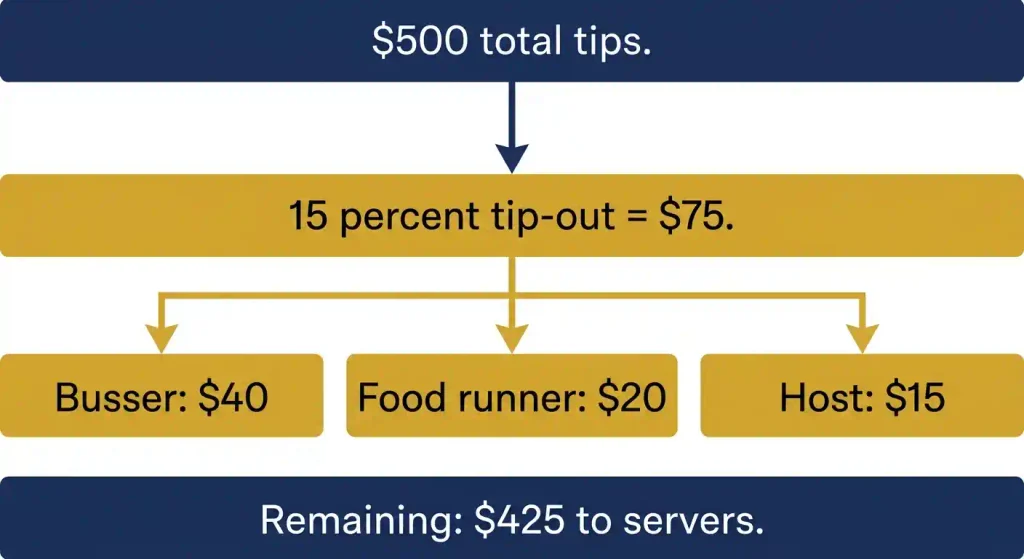
| Role | Share |
|---|---|
| Busser | $40 |
| Food runner | $20 |
| Host | $15 |
The remaining $425 stays with the servers. A gross pay calculator can help check a split like this against an actual paycheck.
Can Employees Keep Tips They Receive Directly From Customers?
Yes, but a valid pooling policy can still require that tip to go into the pool, whether it came in cash or by credit card, including an unusually large tip for exceptional service.
California Rules for Cash Tips, Credit-Card Tips, and Tip Deductions
Cash and credit card tips get the same protection: the employer cannot shave anything off before paying it out, and pooled tips must follow the regular payday schedule.
Can Employers Deduct Credit-Card Processing Fees From Tips?
No. California requires the full tip amount to reach the employee. A $20 tip on a card means the employee gets the full $20.
When Must Employers Pay Credit-Card Tips?
By the next regular payday after the customer authorized the charge, even if the card batch takes longer to settle.
Can Employers Take Cash Tips or Deduct Them From Paychecks?
No. Taking cash tips or using them to offset wages violates Section 351 and often counts as an illegal wage deduction too.
Can Employers Use Tips to Cover Business Expenses?
No. Register shortages, broken dishes, and walkouts are business costs, not something tips can cover.
Tips vs. Service Charges and Automatic Gratuities in California
Not every extra charge is legally a tip. How it is presented to the customer decides who is entitled to it.
Are Mandatory Service Charges Considered Tips Under California Law?
Sometimes. O’Grady v. Merchant Exchange Productions, Inc. (2019) held a mandatory service charge counts as a gratuity if customers would reasonably believe it was a tip, based on the actual wording used.
Can Restaurants Keep Mandatory Service Charges?
Only if it is clearly disclosed as a business charge, not a gratuity. Once it is represented as covering tips, the restaurant must pay it out that way.
Are Automatic Gratuities for Large Parties Treated Differently?
No, they face the same test. An 18 percent automatic gratuity on parties of eight or more must go to staff if customers reasonably expect that.
Who Receives Banquet, Catering, and Hotel Service Charges?
The same disclosure test applies, plus added hotel and local rules. If the charge is legally a gratuity, staff who worked the event can be required to pool and split it like any shift’s tips.
California Tip Pooling Laws vs. Federal Tip Pooling Rules
Both protect tips, but California goes further by banning the tip credit entirely.
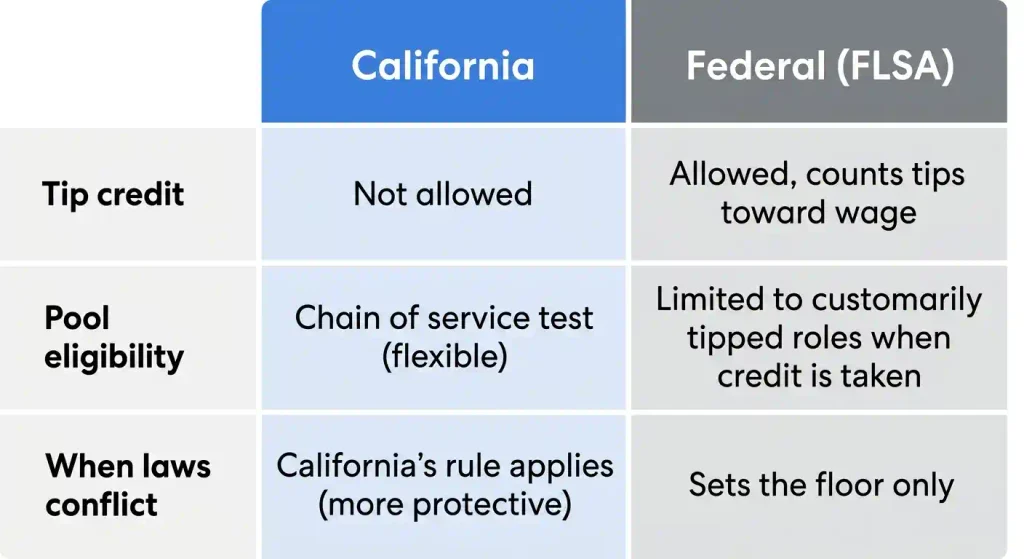
| Rule | California | Federal (FLSA) |
|---|---|---|
| Tip credit | Not allowed | Allowed, counts tips toward wage |
| Pool eligibility | Chain of service test (flexible) | Limited to customarily tipped roles when credit is taken |
| When laws conflict | California’s rule applies (more protective) | Sets the floor only |
What Is the Difference Between California and Federal Tip Pooling Laws?
The Federal Fair Labor Standards Act lets employers pay a lower cash wage and count tips toward it. California bans that, so its chain of service standard for pools is more flexible than federal rules tied to the tip credit.
Can California Employers Use a Tip Credit?
No. This ban traces back to Henning v. Industrial Welfare Commission. Every tipped employee must get the full minimum wage in cash, plus tips, unlike roughly 43 other states that allow some form of tip credit, since only seven states, California included, ban it outright.
Which Law Applies When Federal and California Rules Differ?
Whichever protects the employee more, which on tips is almost always California’s rule, since federal law only sets a floor.
California Minimum Wage, Overtime, and Tip Pooling in 2026
Tips sit on top of wages in California at every wage tier, never as a substitute.
What Is California’s Minimum Wage in 2026?
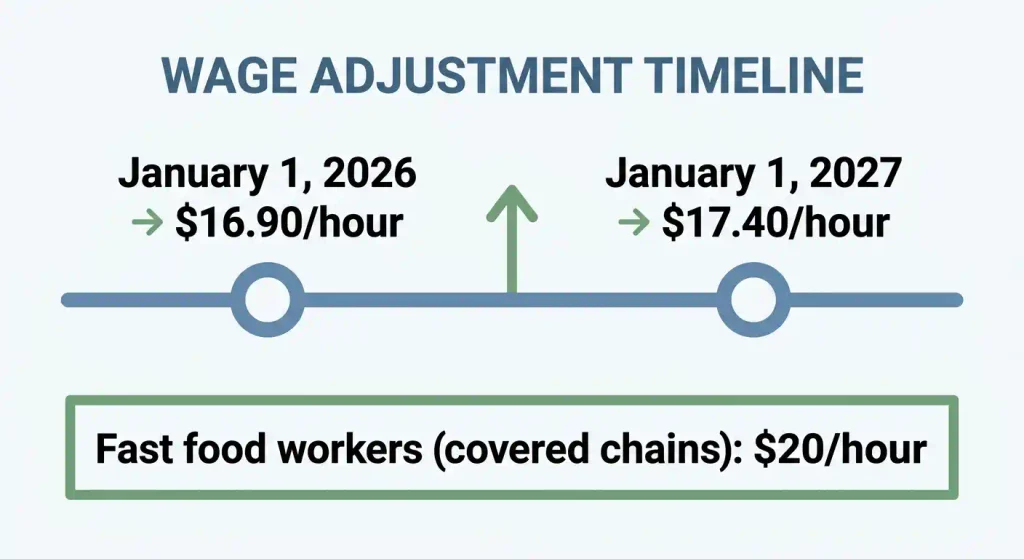
$16.90 an hour as of January 1, 2026, confirmed by the California Department of Industrial Relations (DIR), rising to $17.40 on January 1, 2027. Many cities, like San Francisco, Emeryville, and West Hollywood, set higher local rates. Fast food workers at covered chains keep a separate $20 minimum wage.
Can Employers Count Tips Toward Minimum Wage?
No. Every tipped employee gets the full $16.90 state rate or a higher local rate, separate from tips earned, a core rule covered in our paycheck basics category.
Do Tips Count Toward Overtime Pay?
Voluntary tips do not count under California’s overtime rules. Mandatory service charges can, if they are legally treated as wages rather than gratuities under the O’Grady test.
Can Tip Pooling Reduce an Employee’s Minimum-Wage Entitlement?
No. The employer still owes full minimum wage regardless of how much an employee tips out to coworkers.
Real-World California Tip Pooling Examples: Legal or Illegal?
Applying the rules to real situations makes them easier to use.
A Server Must Share Tips With a Busser and Bartender
Legal. Both are part of the chain of service, unless the required share functions as a wage transfer instead of a reasonable tip-out.
A Restaurant Includes Its General Manager in the Tip Pool
Illegal. A general manager’s hire-fire authority excludes them, no matter how much service work they do.
A Restaurant Requires Servers to Contribute 5% of Sales
Legal or illegal depending on the math. If 5 percent of sales stays below actual tips, it is fine; if it regularly exceeds tips earned, it is a Section 351 problem.
A Restaurant Deducts Credit-Card Processing Fees
Illegal. The full credit card tip must reach the employee, with no fee deducted.
A Restaurant Distributes Tips to Kitchen Employees
Generally legal in California, unlike under federal law, since California’s ban on the tip credit removes that limit. Eligibility still depends on the role’s actual contribution.
An Employee Is Fired for Refusing an Unlawful Tip Arrangement
Illegal retaliation. Records of the arrangement and the firing’s timeline support both a tip claim and a retaliation complaint.
Common California Tip Pooling Violations and Misconceptions
Many disputes come from believing something about the law that is not true.
Common Misconceptions About Tip Pooling
Three myths: employers cannot require pooling (false), any customer contact qualifies someone (false), and managers can join if they serve tables (false). Eligibility depends on chain of service and real managerial authority, not these assumptions.
Illegal Tip Pooling Practices
The most common violations are including a manager or owner, using tips for shortages or breakage, and making unauthorized deductions or delays, the same patterns behind most wage theft claims in California. Unfair is not the same as illegal; a pool turns illegal only when it breaks a specific Section 351 rule.
Is an Employer’s Tip-Pooling Policy Automatically Legal?
No. A signed policy cannot override Section 351. Good practice means disclosing the formula clearly; an employer can update it without everyone’s sign-off, but it must stay fair and reasonable.
What to Do If Your Employer Violates California Tip Pooling Laws
There is a clear path: document the problem, then escalate to the Labor Commissioner if needed.
How to Identify an Illegal Tip-Pooling Arrangement
Compare what customers tipped against what showed up in paychecks, and watch for ineligible names in the pool or payment delays. A manager who will not explain the math is a red flag.
What Evidence Should Employees Collect?
Useful evidence includes:
- Pay stubs
- Personal tip logs
- Receipts
- The written tip-pooling policy
- Work schedules
- Messages about how tips are split
A rough estimate is enough to file a claim; exact figures are not required upfront.
How to File a California Wage Claim for Unpaid Tips
File with the California Labor Commissioner’s Office through the Division of Labor Standards Enforcement (DLSE) wage claim process, no attorney required. The claim is not anonymous, but retaliation is illegal.
Can Employees Sue Employers for Stolen or Withheld Tips?
Yes, but not directly under Section 351, since the California Supreme Court has held that section gives no private right to sue. Lawsuits instead use a tip pool conversion claim, the theory behind California Civil Jury Instructions CACI No. 2752. SB 648 added Labor Commissioner power, not a new right to sue, and that power runs alongside civil litigation. Former employees can still recover tips owed under California’s final paycheck law from when they worked there, and withheld amounts at termination can sometimes trigger waiting time penalties, depending on how the amount is characterized.
Can Employers Retaliate Against Employees Who Report Tip Violations?
No. Reporting, filing a claim, or refusing an illegal pool are all protected. Retaliation gets its own complaint to the Labor Commissioner.
Frequently Asked Questions About California Tip Pooling Laws
Can employers legally force servers to share tips in California?
Yes, if the pool is limited to employees in the chain of service and the split is fair and reasonable.
What percentage of tips can a restaurant legally take?
There is no statutory cap; the percentage just has to be fair and reasonable for the role.
Can managers receive tips if they serve customers?
No, not if they hold real hiring, firing, or scheduling authority.
Can cooks and dishwashers receive pooled tips in California?
Yes, since California’s ban on the tip credit removes the federal limit on back-of-house staff.
Can employers deduct credit-card fees from employee tips?
No. The full credit card tip amount must go to the employee.
Can an employee refuse to participate in tip pooling?
Generally no for a lawful mandatory pool, but refusing an illegal one, like one that includes a manager, carries no legal consequence.
How long do employers have to pay credit-card tips?
By the next regular payday after the charge was authorized.
How do I report tip theft in California?
File a wage claim with the California Labor Commissioner’s Office, or pursue a civil lawsuit for larger cases.
Official California Tip Pooling Laws and Government Resources
Official sources back every rule covered above, and our California labor laws hub covers related workplace rules.
California Labor Code and Legislative Resources
California Labor Code Sections 350 through 356 hold the core rules, with California Labor Code §351 amended 2026 at the center and SB 648 as its 2026 enforcement update. Restaurants also fall under the California Industrial Welfare Commission Wage Orders, specifically Wage Order No. 5, while Wage Order No. 10 covers gratuities separately in the amusement and recreation industry. Find the full text, including the California SB 648 Chaptered Bill Text, through California Legislative Information.
California Labor Commissioner and DLSE Resources
The California DIR Tips and Gratuities FAQ and the California DLSE Enforcement Policies and Interpretations Manual both explain enforcement in detail. Rulings from the California Courts of Appeal, including Leighton and O’Grady, still shape how these rules get applied. Wage claim and retaliation forms are available through the Labor Commissioner’s Office.
Federal Employment Law Resources
The United States Department of Labor (DOL), through its Wage and Hour Division (WHD), publishes federal guidance on the Fair Labor Standards Act and tip credit rules for comparison. For how tips are taxed rather than pooled, see our breakdown of tip tax rules.

Yeasin Sorker is the founder of Paycheck Calculator California. He built this tool in 2018 after noticing that most free paycheck calculators missed California-specific rules like daily overtime and the uncapped SDI rate.
He researches California payroll tax updates regularly and keeps this calculator aligned with the latest IRS, FTB, and EDD published rates. All calculations on this site are estimates based on official 2026 government sources. For personalized tax advice, consult a qualified tax professional.