
California prevailing wage is the minimum hourly pay, including fringe benefits, that public construction projects in the state must pay. Rates vary by county, trade, and project bid date, running from under $30 to over $100 an hour in 2026.
That range reflects California’s 58 separate county determinations, each updated twice yearly by the DIR, not one fixed statewide figure.
The upside is real pay protection; the downside is finding your exact rate.
California Prevailing Wage Rates in 2026: What Should You Earn?
This section breaks down exactly how county, trade, and bid date combine to set your specific hourly rate.
2026 California Prevailing Wage Rates by County and Trade
Every one of California’s 58 counties has its own wage determination for every covered trade. The DIR publishes these as PDF determinations, covering crafts like electrician, plumber, carpenter, cement mason, laborer, Operating Engineer, ironworker, painter, Teamster, Pile Driver, and Brick Tender, plus specialty classifications like Inside Wireman, Cable Splicer, and Field Soils and Material Tester. Each lists the basic hourly rate, employer payments, total hourly rate, and overtime multiplier. Most trades split into Northern and Southern California regions or by county, so always match the determination to your location and craft. Rates update twice a year, so confirm any figure against the live determination.
California Prevailing Wage Rate Comparison by County
Rates for the same trade vary by county. A few 2026 examples:
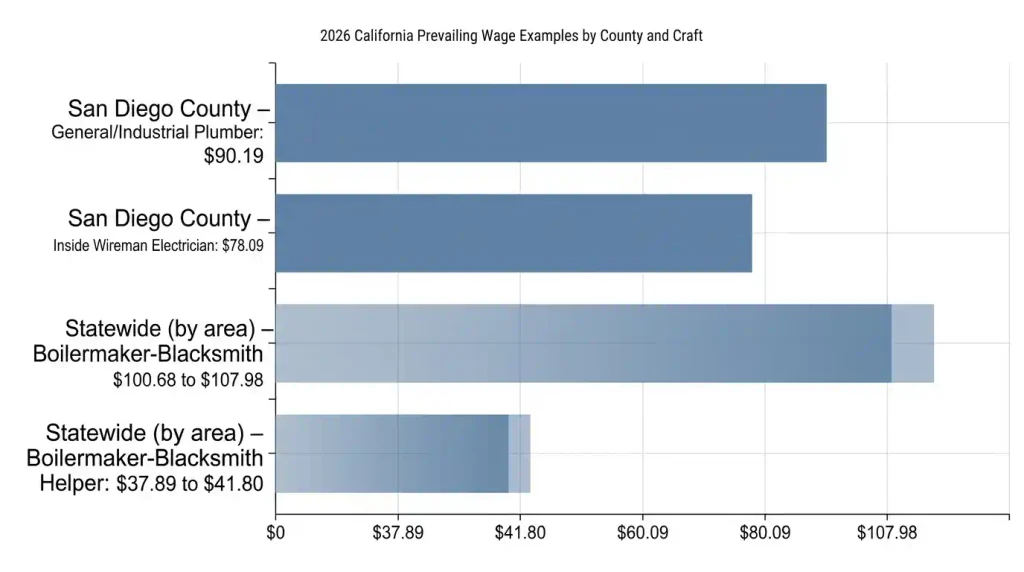
| County / Region | Craft | Total Hourly Rate |
|---|---|---|
| San Diego County | General/Industrial Plumber | $90.19 |
| San Diego County | Inside Wireman Electrician | $78.09 |
| Statewide (by area) | Boilermaker-Blacksmith | $100.68 to $107.98 |
| Statewide (by area) | Boilermaker-Blacksmith Helper | $37.89 to $41.80 |
Los Angeles County, San Francisco County, Alameda County, Orange County, Sacramento County, Riverside County, San Bernardino County, Santa Clara County, San Mateo County, Fresno County, and Contra Costa County each set their own rates too, so the same craft can pay noticeably more in one county than another. If you want to see how a California plumber salary or an electrician salary in California compares outside public works, those breakdowns are worth a look. Anyone budgeting a San Diego paycheck can run the numbers through the San Diego paycheck calculator. The DIR bases rates on local collective bargaining agreements and labor market data, not a flat statewide number. Some specialty crafts pay the same statewide, but most trades follow regional or county schedules.
2026-1 vs. 2026-2 Prevailing Wage Determinations
The 2026-2 determination took effect September 1, 2026, replacing 2026-1. Your bid advertisement date, not your work date, decides which version applies; a project bid before September 1 may stay on 2026-1 for its full contract. If a craft’s determination expires mid-job, the next rate automatically applies to work done after that date. The DIR also issues Interim Wage Determinations, correction notices, and predetermined increases year-round, including several in November 2026, so check for updates even mid-project.
How to Find Your Exact Prevailing Wage Rate
You need three things: your county, your actual tasks, and your trade classification. Job titles don’t set your rate, duties do; if your work spans more than one trade, you’re paid under whichever classification fits the task at hand. Search the DIR’s online wage determination database by county and craft. Most projects use a General Prevailing Wage Determination; qualifying housing projects use a Residential Prevailing Wage Determination; if your craft isn’t listed, the awarding body can request a Special Prevailing Wage Determination from DIR. Check the expiration date and read the footnotes, since they often cover shift premiums, travel pay, or benefits not shown in the main table. For unclear classifications, DIR’s Office of the Director – Research unit takes direct inquiries.
What Is California Prevailing Wage and Who Must Receive It?
Prevailing wage is the minimum pay, including fringe benefits, California requires on public construction projects. It stops contractors from undercutting local pay on public jobs, one of several California labor laws built to protect hourly workers. If you work construction on a project with any public funding, you’re usually entitled to it.
What California Prevailing Wage Actually Means
California Labor Code Sections 1770 and 1771 define prevailing wage, formally the General Prevailing Rate of Per Diem Wages, as the DIR-set standard rate for a craft in an area. The director uses Collective Bargaining Agreements (CBAs), federal data, and input from unions, employers, and associations. The goal: stop public contracts from racing to the bottom on pay.
What Qualifies as a California Public Works Project?
A public works project covers construction, alteration, demolition, installation, maintenance, and repair done under contract, funded wholly or partly by public money. Examples: a new school, repaving a state highway, or solar panels on a government building, plus affordable housing and public infrastructure upgrades. What matters is where the money comes from, not who owns the finished building.
Who Is Covered by Prevailing Wage Requirements?
Coverage includes employees, journeymen, apprentices, many subcontractors, and some sole proprietors doing hands-on labor, following the same worker classification logic used across California labor law. A sole proprietor’s own hours still get reported on certified payroll, even without a traditional paycheck. Material suppliers are usually exempt, but truck drivers hauling to a site often aren’t. Assembly Bill 219 added ready-mixed concrete hauling and delivery to Labor Code Section 1720.9 back in 2016, and that still stands, so ready-mix drivers are generally covered even when other deliveries aren’t. What matters is your actual work, not your title.
Do Private Construction Projects Require Prevailing Wages?
Purely private projects, funded entirely with private money, generally don’t trigger prevailing wage. Ordinary residential construction, like a single family home with no public financing, falls outside it entirely. Affordable housing and other publicly assisted residential projects can get pulled in through subsidies or financing. Even private property can be covered if 50 percent or more of it ends up leased to the state or a local agency. If unsure, request a formal Public Works Coverage Determination from DIR.
California Public Works Contract Thresholds and Exemptions
California’s threshold is $1,000, far below the federal Davis-Bacon threshold of $2,000. Small jobs under a specific Labor Compliance Program (LCP) have limited exceptions. Paying prevailing wages, registering as a public works contractor, and filing electronic certified payroll are three separate requirements; a project can trigger one without triggering all three.
Prevailing Wage vs. Basic Hourly Pay: Understanding Your Total Compensation
Prevailing wage isn’t just your hourly cash rate. It’s the basic wage plus a separate fringe benefit rate, and employers can’t count every benefit toward that requirement.
Basic Hourly Wage vs. Total Prevailing Wage Rate
The basic hourly rate is the cash wage alone. Add qualifying fringe benefits and you get the total prevailing wage rate, the number that matters for compliance. An industrial painter’s basic wage might run around $41.65 an hour, reaching $66.14 or more once health and pension benefits are added. Only specific, qualifying contributions count toward fringe; some employers try to fold required benefits into the hourly wage number on paper, but that doesn’t satisfy the obligation if the actual benefit was never provided.
What Fringe Benefits Are Included in California Prevailing Wage?
Qualifying fringe benefits include health and welfare coverage, pension, vacation pay, and Travel and Subsistence payments. Apprenticeship training fund contributions count too, documented on Form PW 26, the Statement of Employer Payments. Labor Code Section 1773.1 defines exactly which contributions an employer can credit, and getting it wrong means owing back pay.
Cash in Lieu of Fringe Benefits
If an employer doesn’t provide required benefits, they must pay the unmet amount as additional cash wages. Legitimate third-party benefit plans differ from cash an employer just hands the worker. One exception: mandatory apprenticeship training fund contributions generally can’t be swapped for cash paid directly to the worker.
Can Employers Count Benefits Paid on Private Construction Projects?
Since January 1, 2026, Assembly Bill 889 revised Labor Code Section 1773.1 to require employers to annualize fringe benefit credits and document compliance. This stops contractors from loading benefits on public jobs while shorting them on private work, then claiming full credit anyway. Standards include immediate participation and essentially immediate vesting, with some exceptions for defined contribution pension plans.
California Prevailing Wage vs. Minimum Wage, Union Pay and Federal Davis-Bacon Rates
Prevailing wage, minimum wage, union pay, and federal Davis-Bacon rates are four different systems. Mixing them up is a costly, common mistake.
California Prevailing Wage vs. California Minimum Wage
California’s 2026 minimum wage is a floor covering nearly every job. Prevailing wage is a much higher, trade- and location-specific rate for covered public works only. Paying standard minimum wage on a public job isn’t compliant if the determination calls for $50, $60, or $90 an hour.
California Prevailing Wage vs. Union Wages
Many prevailing wage rates come from a union’s Collective Bargaining Agreement (CBA), which is why the two look similar. But getting prevailing wage doesn’t make you a union member, and non-union contractors must pay it too. Total compensation, including wage, benefits, and overtime, has to match the determination regardless of union status. Some public projects also use a Project Labor Agreement (PLA), a pre-hire deal between the awarding body and unions that can add its own rules on top.
California Prevailing Wage vs. Federal Davis-Bacon Wage Rates
California’s law runs separately from the federal Davis-Bacon Act, which covers federally funded contracts. Federal coverage also includes the Davis-Bacon and Related Acts, the Contract Work Hours and Safety Standards Act, and the Copeland Anti-Kickback Act. The U.S. Department of Labor (DOL), through its Wage and Hour Division (WHD), sets federal rates by locality, using the nearest labor market area and often the modal wage rate, the single most common rate paid, rather than county by county; new rates publish in the Federal Register. Check current rates via SAM.gov Wage Determinations. Projects with both state and federal money must pay whichever rate is higher per classification; since California’s rates are usually higher, most contractors default to the state rate anyway.
How to Calculate California Prevailing Wage in 2026
Basic hourly wage plus qualifying employer payments equals your total rate, which typically runs well above the general construction worker salary in California outside public works. Knowing which payments count is the tricky part.
The Basic Prevailing Wage Calculation
Add the basic hourly wage from your trade’s DIR determination to the qualifying employer payments for that classification. A general plumber’s determination might list a $61.73 basic rate plus $28.46 in employer payments, totaling $90.19 an hour, matching the current San Diego County determination. Contractors bidding public work need this total, not just cash wages, since benefits and overtime can add 30 percent or more before a bid pencils out. A prevailing wage calculator separating basic pay, fringe benefits, and overtime saves re-deriving this math each pay period, and the California overtime calculator works well for the overtime portion specifically.
Example: Calculating Weekly Prevailing Wage Earnings
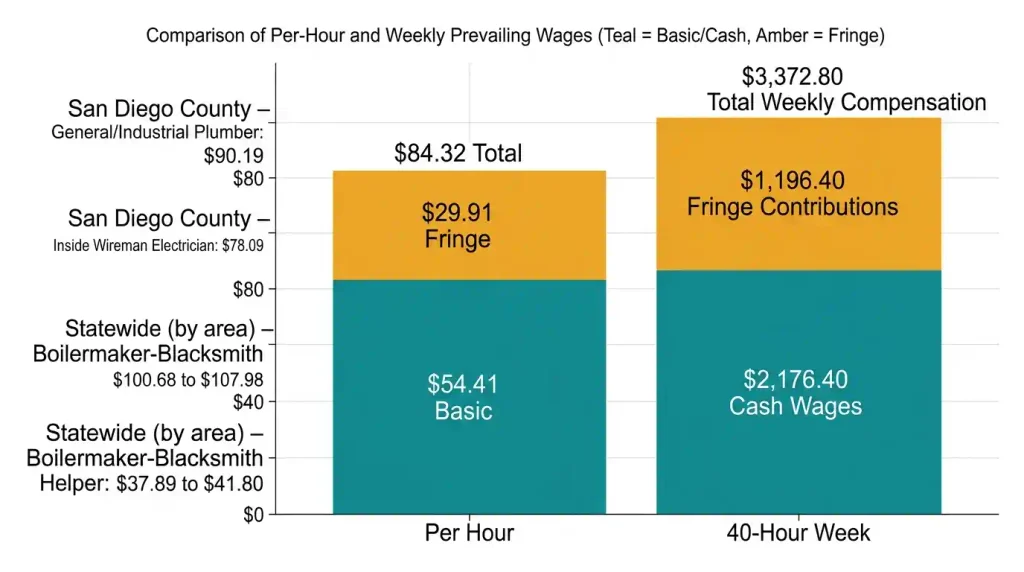
Picture a carpenter working 40 hours at a basic rate of $54.41 an hour with $29.91 in fringe contributions, for a total rate of $84.32 an hour, matching the current San Diego County carpenter determination. That’s $2,176.40 in cash wages plus $1,196.40 in fringe contributions, for $3,372.80 in total weekly compensation. If part of that fringe gets paid directly to the worker instead of into a benefit plan, taxable cash wages rise while the employer’s benefit contribution drops, though the total stays the same.
Example: Calculating Monthly and Annual Prevailing Wage Compensation
That $3,372.80 weekly total comes to roughly $14,615 a month or $175,386 a year at steady full time hours, a figure you can double check with an annual salary calculator. Construction rarely stays that steady; rain delays, gaps between jobs, and seasonal slowdowns cut into actual annual earnings, so treat an annualized figure as a ceiling, not a guarantee.
Prevailing Wage Paycheck vs. Take-Home Pay
A high prevailing wage number doesn’t equal take-home pay, the same gross pay versus net pay gap that shows up on any California paycheck. Federal income tax, Social Security, Medicare, and California payroll taxes come out of taxable cash wages first. Qualifying fringe contributions, like health premiums, generally aren’t taxed the same way since they never hit your paycheck as cash. That’s why a worker earning an $84.32 total rate takes home noticeably less than $84.32 times their hours. Beyond tax withholding, employers can only take payroll deductions a worker authorized in writing or the law allows; they can’t dock pay for tools, uniforms, or breakage, since that would drop cash wages below the required rate. Checking each deduction line against how to read a California pay stub is the fastest way to catch an error.
California Prevailing Wage Overtime, Weekends and Holiday Pay
Overtime on prevailing wage jobs isn’t calculated like a regular hourly job, and getting it wrong is costly.
How Prevailing Wage Overtime Is Calculated
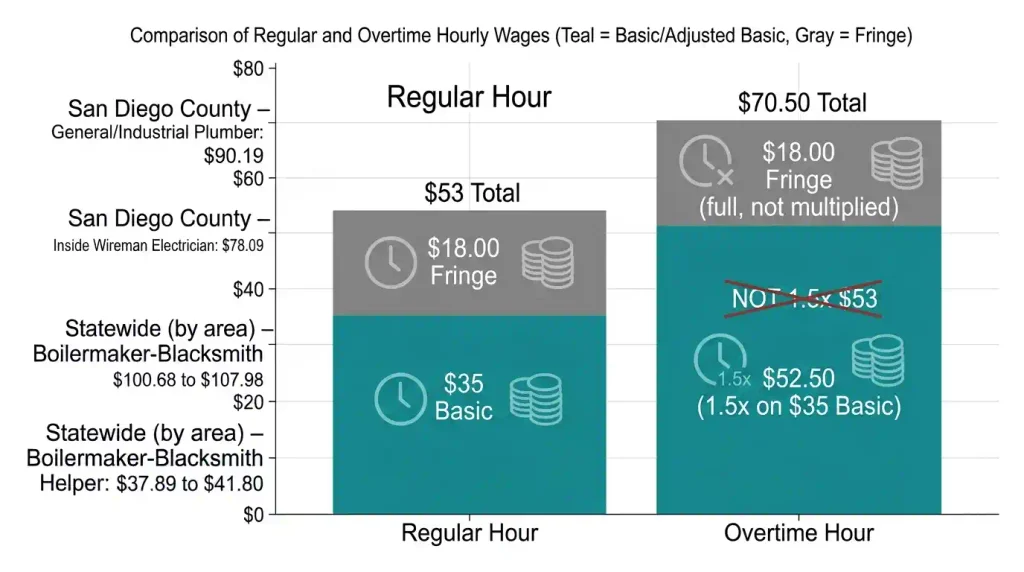
California’s overtime laws apply on top of the prevailing wage structure: time and a half after 8 hours a day or 40 a week, double time after 12 hours a day. Overtime premiums apply to the basic hourly rate, not the full total rate with fringe benefits. So if a laborer’s basic rate is $35 an hour with $18 in fringe for a $53 total, overtime pays $52.50 (time and a half on the $35 basic straight-time rate) plus the full $18 fringe, not time and a half on $53.
Double Time, Saturday and Sunday Pay
Some trades carry their own double time rules and weekend premiums beyond the general state standard, even within regular 8 hour shifts. The general double time versus overtime rules are a useful baseline before checking the determination for your specific craft and county.
Prevailing Wage Holiday Pay
DIR determinations list recognized holidays, and work on those days often requires holiday premium pay. For crafts not based on a union contract, the holiday list defaults to Government Code Section 6700, which Assembly Bill 268 expanded in 2026 to add Farmworkers Day, effective March 26, 2026, and Diwali, effective January 1, 2026. The DIR’s November 4, 2026 notice confirmed these but noted Diwali enforcement is paused pending a court challenge, so check the current notice. Holiday pay differs by craft.
Shift Differentials and Night Work
Second or third shift workers often qualify for shift differential pay on top of the base rate. These premiums show up in determination footnotes, not the main table, so contractors scheduling night or swing shifts need to factor them into labor costs upfront.
Travel Time, Subsistence and Reporting Time
Some determinations require travel pay or subsistence when a site is far enough from a worker’s union hall or home base; this is separate from ordinary unpaid commuting and depends on the determination’s distance and pay terms. Meal breaks and rest periods follow the standard meal and rest break laws that apply to construction work generally, and time spent idle due to equipment delays or safety holds usually counts as paid waiting time. Reporting time pay and waiting time pay can also apply if a worker is sent home early or delayed through no fault of their own, and both need accurate tracking on certified payroll.
California Prevailing Wage for Apprentices vs. Journeymen
Apprentices don’t automatically earn the full journeyman rate, which surprises many new apprentices.
How Apprentice Prevailing Wage Rates Work
Apprentice pay is a percentage of the journeyman rate that climbs as the apprentice advances:
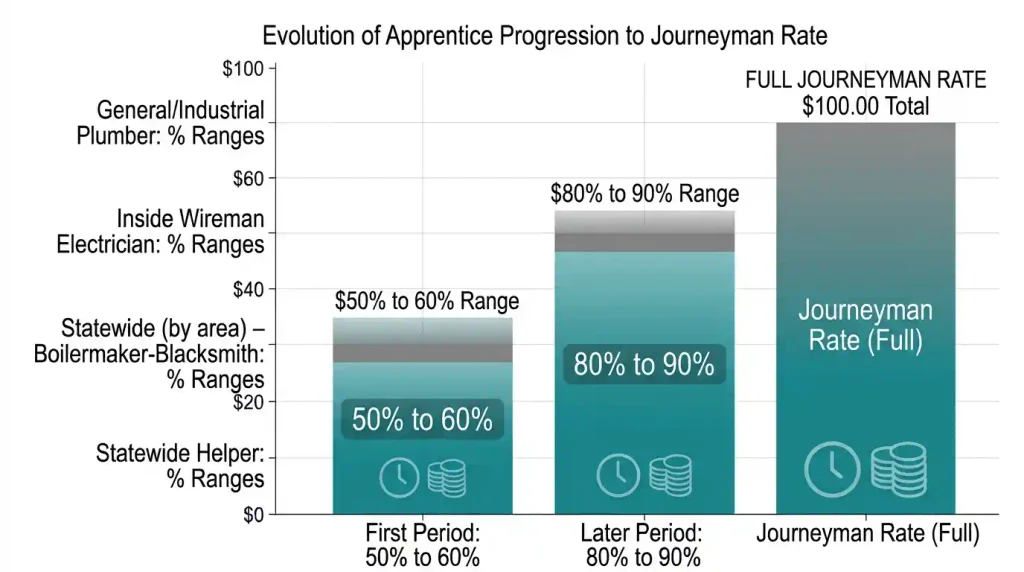
| Apprenticeship Stage | % of Journeyman Rate |
|---|---|
| First period | 50% to 60% |
| Later period | 80% to 90% |
The exact percentage depends on trade and program level; current 2026-2 determinations list official apprentice schedules alongside journeyman rates. Fringe benefits are often prorated to that same percentage, while overtime is calculated on the apprentice’s actual basic rate, not the full journeyman rate.
Registered Apprenticeship Requirements
To legally pay apprentice rates, the apprentice must be enrolled in a program approved by California’s Division of Apprenticeship Standards (DAS), with standards set by the California Apprenticeship Council. Employers generally must maintain apprentice to journeyman ratios, often one apprentice for every five journeymen on contracts of $30,000 or more, request apprentices through proper apprentice dispatch, and contribute to approved training funds. This applies even without a collective bargaining agreement.
What Happens If an Apprentice Is Paid Incorrectly?
Paying apprentice rates to someone not enrolled in a state-approved program means paying below the required journeyman wage, creating back pay liability. Misclassifying an apprentice’s level to justify a lower percentage works the same way. Both create wage recovery claims and compliance penalties, on top of owing the difference.
California Prevailing Wage Requirements for Contractors and Subcontractors
Contractors and subcontractors face a separate layer of registration and reporting requirements alongside the wage rules themselves.
DIR Public Works Contractor Registration
Contractors generally must complete Public Works Contractor Registration with DIR before bidding on or performing covered public works, including most subcontractors and many sole proprietors. Exceptions are narrow. This DIR Contractor Registration must be renewed annually; working without current registration can disqualify a bid or trigger penalties even if wages were paid correctly.
PWC-100 Public Works Project Registration
Beyond contractor registration, the Awarding Body must complete PWC-100 Project Registration for the project before work begins. This creates an official public record tying the project, contractors, and wage requirements together. Contractors should confirm registration before starting work.
Certified Payroll Records and Electronic Reporting
California Labor Code Section 1776 requires contractors to keep Certified Payroll Records (CPR) for every pay period, commonly weekly, and submit them electronically through Electronic Certified Payroll Reporting (eCPR) via the DIR Public Works Portal, with DIR requiring submission at least monthly on non-exempt projects. The standard document is Form A-1-131, with a signed Statement of Compliance covering each worker’s name, classification, hours, wage rate, deductions, and employer payments. This is the primary evidence the state uses to catch underpayment.
How to Correct Certified Payroll Errors
Mistakes happen: wrong classification, wrong rate, missing hours, or fringe benefit errors. If a subcontractor fails to submit certified payroll at all, the prime contractor is still responsible for getting it filed. File amended records as soon as an error is found, and keep backup documentation like timecards and benefit statements.
Contractor and Subcontractor Liability
Prime contractors can be held responsible for a subcontractor’s violations too, often through joint and several liability, so the state can pursue the prime even if the subcontractor underpaid. Payroll audits, back wage assessments, civil penalties, and debarment from future public works bidding are all real consequences.
California Prevailing Wage Violations: Worker Rights and Wage Recovery
If you suspect underpayment, a form of wage theft in California, compare what you’re actually getting against what you’re owed, then act.
Signs Your Employer May Be Underpaying You
Pull the DIR determination for your trade and county and compare it against your pay stubs. Watch for missing fringe contributions, a mismatched classification, and unpaid overtime past 8 hours a day or 40 a week. Discrepancies between pay stubs and certified payroll records are a clear red flag.
How to Report Unpaid Prevailing Wages
File a complaint with the California Labor Commissioner’s Office, part of the Division of Labor Standards Enforcement (DLSE), which handles prevailing wage enforcement. This differs from a standard DLSE Wage Claim; prevailing wage complaints follow their own procedures. Investigations can take several weeks to a few months, depending on documentation and whether the employer disputes the claim. Gather documentation before filing.
Evidence Workers Should Collect
Keep pay stubs, timecards, work schedules, and employment records. Certified payroll records for the project are especially useful; workers have the right to request copies, and a written request to the contractor or awarding body is often fastest. Save texts or emails documenting duties or pay conversations.
Penalties for California Prevailing Wage Violations
Employers who underpay owe back wages and often liquidated damages. California Labor Code Section 1775 allows civil penalties per violation. Serious or repeated violations can lead to contractor debarment from bidding on public works.
Can Employers Retaliate Against Workers Who Report Violations?
No. Workers are legally protected from retaliation, including termination, cut hours, or threats. Retaliation is its own separate violation, reportable through the same Labor Commissioner’s Office channels.
Common Prevailing Wage Myths and Payroll Mistakes
A handful of recurring misunderstandings cause most underpayment cases.
Common Prevailing Wage Misconceptions
The biggest myth: every California construction worker gets the same prevailing wage. Rates actually vary by trade, county, and classification. A close second: assuming prevailing wage always equals union pay, which isn’t true since non-union workers get the same entitlement. A third: treating the basic hourly wage as the full compensation requirement, when fringe benefits add to it. Another slip: assuming the highest rate on a wage schedule applies to every worker doing loosely related work, when pay has to match each person’s specific craft and duties.
Common Contractor and Payroll Mistakes
The most frequent compliance errors:
- Using the wrong county or craft classification
- Running payroll off an outdated determination, or missing a mid-contract predetermined increase
- Miscounting fringe benefits, or calculating overtime on the total rate instead of the basic rate
- Assuming handing records to the general contractor satisfies DIR reporting duty, when each contractor and subcontractor must submit its own certified payroll
Situations That Require Special Attention
Workers performing multiple classifications in one shift need the higher applicable rate for whichever duties they’re doing, requiring careful time tracking. Projects that pick up public funding mid-construction can suddenly trigger prevailing wage obligations. Federally assisted projects layering Davis-Bacon on top of California’s rules need extra attention to satisfy both.
Frequently Asked Questions About California Prevailing Wage in 2026
Quick answers to the most common prevailing wage questions.
What Is the California Prevailing Wage Rate in 2026?
There isn’t one rate. It depends on your trade, county, and the DIR determination for your project.
How Do I Find My California Prevailing Wage Rate?
Identify your county, craft classification, and project details, then search the official DIR wage determination database.
Does California Prevailing Wage Include Fringe Benefits?
Yes. The total rate combines a basic wage with qualifying employer payments like health insurance and pension; any shortfall must be paid in cash.
Is Prevailing Wage the Same as Union Pay?
No, though many prevailing wage rates are built from union agreements. Non-union contractors owe the exact same prevailing wage.
How Much Is Prevailing Wage Overtime in California?
Standard state overtime applies: time and a half after 8 hours a day or 40 a week, double time after 12 hours a day, calculated on the basic rate, not the full total rate.
Do Private Construction Projects Have to Pay Prevailing Wage?
Generally no, unless public funding is involved, which is common with affordable housing and other publicly assisted residential developments.
Do Apprentices Receive the Full Prevailing Wage?
No. Registered apprentices earn a percentage of the journeyman wage that rises as they advance through program levels.
Can I Report My Employer for Not Paying Prevailing Wage?
Yes, through the California Labor Commissioner’s Office, ideally with pay stubs, timecards, and certified payroll records.
Does Prevailing Wage Apply to Independent Contractors?
It can, depending on actual duties and public works contractor registration status, since coverage follows the work performed, not the label. Getting this wrong is a common form of employee misclassification in California.
Which Prevailing Wage Determination Applies to My Project?
Whichever determination was in effect on your project’s bid advertisement date, which may differ from the current one if your contract was bid earlier.
Official California Prevailing Wage Resources and 2026 Updates
Where to find official rates, laws, and 2026 updates.
California DIR Prevailing Wage Determination Database
DIR’s official Prevailing Wage Determinations database hosts current 2026-2 journeyman and apprentice schedules by county, trade, scope of work, and travel provisions. Superseded determinations stay available for projects still operating under an older bid date.
California Prevailing Wage Laws and Regulations
The core legal framework:
- California Labor Code Section 1720, California Labor Code Section 1720.3, California Labor Code Section 1725.5
- California Labor Code Section 1770, California Labor Code Section 1771, California Labor Code Section 1771.5
- California Labor Code Section 1773, California Labor Code Section 1773.1, California Labor Code Section 1773.4
- California Labor Code Section 1774, California Labor Code Section 1775, California Labor Code Section 1776
- California Labor Code Section 1777.1, California Labor Code Section 1777.5
- California Labor Code Section 1813, California Labor Code Section 1815
- California Code of Regulations Title 8, Section 16204, and California Code of Regulations Section 16000 et seq.
The DIR publishes official FAQs, and the California Department of Transportation (Caltrans) covers state transportation projects specifically. Legal questions about a determination can go to DIR’s Office of the Director – Legal Unit.
Important 2026 Legislative and DIR Updates
Assembly Bill 889 is the headline 2026 change, revising Labor Code Section 1773.1 to require annualized fringe benefit credits and new documentation, effective January 1, 2026. Also watch 2026-2 interim determinations and correction notices throughout the year. DIR’s determination database remains the most reliable source to monitor.

Yeasin Sorker is the founder of Paycheck Calculator California. He built this tool in 2018 after noticing that most free paycheck calculators missed California-specific rules like daily overtime and the uncapped SDI rate.
He researches California payroll tax updates regularly and keeps this calculator aligned with the latest IRS, FTB, and EDD published rates. All calculations on this site are estimates based on official 2026 government sources. For personalized tax advice, consult a qualified tax professional.