
$25 an hour is $52,000 a year, based on a standard 40-hour week and 52 weeks worked. That works out to $4,333 per month and $2,000 every two weeks before taxes. Most workers take home between $37,000 and $43,000 after federal, state, and payroll deductions depending on where they live and how they file. Use the California paycheck calculator to find your exact net pay instantly. That gap between gross and net is where most people get caught off guard.
Quick Answer: $25 an Hour Equals How Much Per Year?
Annual Salary at $25 Per Hour
At $25 an hour, 40 hours a week, you earn $52,000 per year before taxes. That is 2,080 hours (40 x 52) multiplied by $25. Most full-time jobs use the 2,080-hour standard as the baseline.
Income Breakdown at a Glance
| Pay Period | Gross Income |
|---|---|
| Annual | $52,000 |
| Monthly | $4,333 |
| Semi-monthly (twice a month) | $2,167 |
| Biweekly (every 2 weeks) | $2,000 |
| Weekly | $1,000 |
| Daily (8-hour day) | $200 |
All figures are pre-tax gross income. Semi-monthly means 24 paychecks per year. Biweekly means 26. Same annualized salary, different cash flow rhythm.
Free California Paycheck Tool
See What $25/Hour Really Earns You After Taxes
$25/hour is $52,000 a year before taxes — but after federal tax, California state tax, and SDI, your real paycheck is a different number. Check it now.
🧮 See If $25/Hour Is Really $52,000 After TaxesUsed by thousands of California workers · FTB-verified 2026 rates
How the $25 Per Hour Calculation Works
Standard Formula
Hourly rate x hours per week x 52 = annual salary. At $25: $25 x 40 x 52 = $52,000. To reverse it, divide a salary by 2,080 — use the annual salary calculator to run any scenario instantly. A W-2 employee at $25 gets employer-matched payroll taxes. A 1099 contractor at $25 pays self-employment tax on top, which cuts their real take-home lower. See the full breakdown in this 1099 vs W-2 comparison.
Why Some Calculators Show Different Results
Different tools use different assumptions: 37.5-hour weeks, PTO deductions, or overtime additions. If two calculators disagree, check their inputs. The cleanest baseline is always 40 hours x 52 weeks.
What Is $25 an Hour After Taxes?
Federal Tax Impact
A single filer earning $52,000 in 2026 lands in the 22% bracket, but the effective rate is around 11% to 13%. After the $16,100 standard deduction, taxable income drops to roughly $35,900. The first $11,925 is taxed at 10%, income from $11,926 to $48,475 at 12%, and only dollars above $48,475 at 22%. The 2026 standard deduction and bracket thresholds are set by the IRS under Revenue Procedure 2025-32.
Payroll Taxes
Social Security takes 6.2% up to the 2026 wage cap of $184,500, as confirmed by the Social Security Administration. Medicare takes 1.45%. Combined FICA is 7.65%, costing about $3,978 per year at $52,000. Your employer matches this separately. Understanding every line on your paycheck matters — this guide to how to read a California pay stub explains each deduction clearly.
State Tax Considerations
Nine states have no income tax: Florida, Texas, Nevada, Washington, Wyoming, South Dakota, Tennessee, New Hampshire, and Alaska. California, New York, and Oregon add meaningful state tax on top of federal. California’s rate on $52,000 runs roughly 4% to 6%, costing $2,000 to $3,000 more per year than a no-tax state. For a full picture of what California takes from each paycheck, see the California payroll taxes breakdown.
Estimated Take-Home Pay Examples
| Scenario | Estimated Annual Take-Home |
|---|---|
| Single filer, no-tax state | ~$42,000 |
| Single filer, average-tax state | ~$39,500 |
| Single filer, high-tax state (e.g., CA) | ~$38,000 |
| Married filing jointly (one income) | ~$43,500 |
| Contributing 5% to 401k | Reduces taxable income by $2,600 |
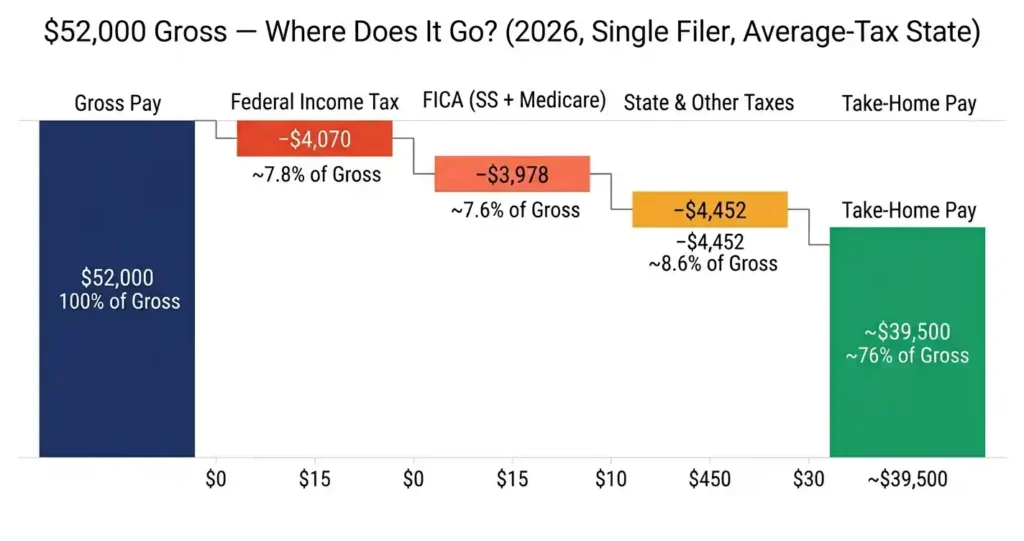
Health insurance premiums and other benefit deductions reduce your net further. Your real take-home depends on state, filing status, and deductions.
How Much Is $25 an Hour for Different Work Schedules?
20 Hours Per Week
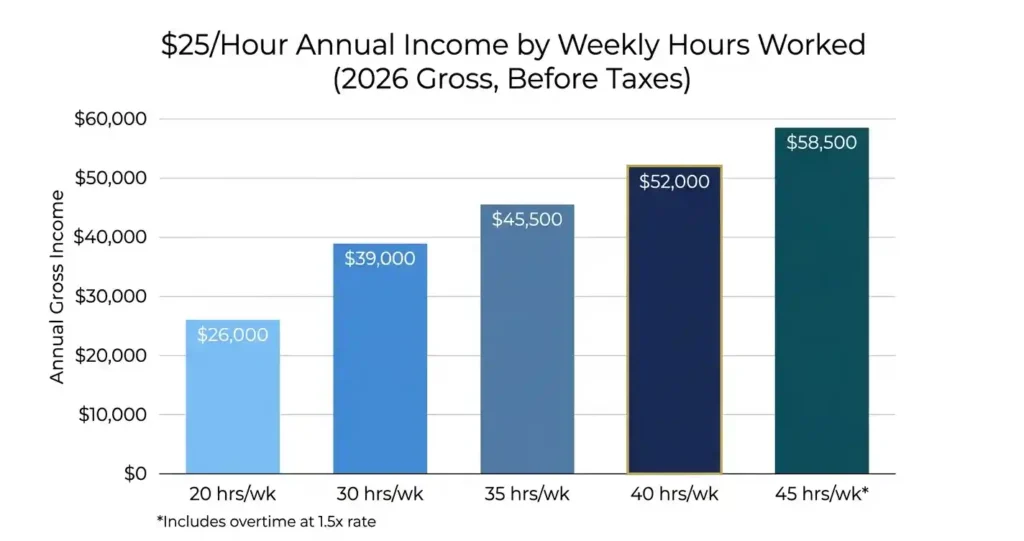
20 hours a week at $25 brings in $26,000 per year gross. Income this low falls near or below the standard deduction, so federal tax is minimal. Payroll taxes still apply from dollar one. For a deeper look at how part-time and full-time hours affect your net paycheck in California, see part-time vs full-time paycheck comparison.
30 Hours Per Week
30 hours a week earns $39,000 annually. Take-home runs $32,000 to $34,000 in a typical tax state. Some employers offer benefits at this threshold, but it varies by policy.
35 to 37.5 Hours Per Week
At 35 hours, annual gross is $45,500. At 37.5 hours, it is $48,750. Both are meaningfully below the 40-hour standard. A job with a 37.5-hour “full-time” schedule pays $3,250 less per year than one with a true 40-hour week.
40 Hours Per Week
The standard 40-hour week produces $52,000 per year. This is the baseline for most job postings, benefit eligibility, PTO accrual, and employer matches.
45 to 50 Hours Per Week
Overtime under FLSA pays 1.5x, making your overtime rate $37.50. At 45 hours per week, you earn roughly $58,500 per year. At 50 hours, about $65,000. At 60 hours, earnings can reach $78,000 or more. Double-time pay (holidays or shifts over 12 hours) puts your rate at $50 an hour, adding $400 or more per shift — learn exactly how California double-time vs overtime rules work before you calculate. Night shift differentials in healthcare and logistics add $1 to $3 per hour on top of base pay. Consistent overtime raises income but also pushes you into a higher tax bracket. For California workers specifically, California overtime laws 2026 trigger daily — not just weekly — so your actual overtime earnings may be higher than you expect.
Is $25 an Hour a Good Salary?
Compared to Minimum Wage
The federal minimum wage is $7.25 in 2026. At $25, you earn more than three times that. Even against California’s $16.50 or New York’s $16.00 minimums, $25 is well above the floor. For a detailed look at where California stands, the California minimum wage 2026 guide covers city-by-city rates and upcoming changes.
Compared to Median Income
The U.S. median household income is approximately $80,000 in 2026, typically covering two earners. The median individual earnings for full-time workers runs $48,000 to $50,000 per Bureau of Labor Statistics data. At $52,000, you are above the individual median and solidly in middle-class income territory for a single earner.
Compared to Living Wage Estimates
MIT’s Living Wage Calculator puts a single adult’s basic needs at roughly $20 to $25 per hour in most U.S. cities. In rural areas, $25 is comfortable. In San Francisco, New York, or Boston, $52,000 is tight — use the San Francisco paycheck calculator to see exactly what $52,000 nets out to after California taxes in that city. For families with children, it falls short without a second income.
Can You Live Comfortably on $25 an Hour?
Single Person Budget Example
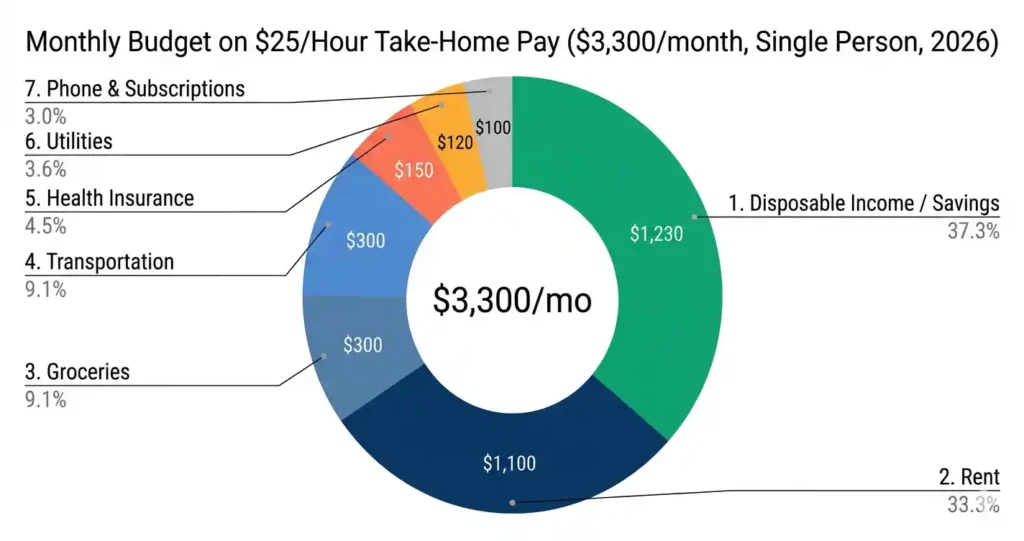
On $3,300 take-home per month: rent $1,100, utilities $120, groceries $300, transportation $300, health insurance $150, phone and subscriptions $100. That leaves $1,230 in disposable income. A 15% to 20% savings rate means $495 to $660 per month saved. A three-month emergency fund takes roughly 12 to 18 months to build. If your paycheck feels smaller than expected, the paycheck basics guide explains exactly why. In lower-cost cities, rent at $700 to $800 makes all of this easier.
Family Budget Example
Childcare alone runs $1,000 to $2,000 per month in most metros. Family health insurance adds $400 to $600. At $52,000 gross, a single-income household with children is stretched thin. Two earners at $25 each is a far more stable position.
High-Cost vs Low-Cost Areas
$52,000 goes far in Austin, Columbus, or Raleigh. It barely covers rent in San Francisco or Manhattan. In rural Mississippi, Alabama, or Oklahoma, it is well above local medians. Always check the cost of living index for the specific city before accepting a job offer.
Real-Life Scenarios for Someone Earning $25 an Hour
Evaluating a New Job Offer
The hourly rate is only the starting point. Employer-paid health insurance can be worth $5,000 to $10,000 per year. A 401k match of 3% to 5% adds $1,560 to $2,600 annually. A long commute costs $2,000 to $4,000 per year in gas, tolls, and wear. A $23/hour offer with full benefits can easily outperform $25/hour with none.
Considering a Career Change
A $5/hour difference is $10,400 per year, or $52,000 over five years. A role that starts at $25 with a clear ceiling matters less than one that starts at $22 with a strong upward path. Look at where people in the target field land after 5 to 10 years before deciding. California’s pay transparency law 2026 now requires most employers to post salary ranges — use it to benchmark any offer before negotiating.
Receiving a Raise to $25 Per Hour
Going from $22 to $25 adds $6,240 in gross pay, or about $4,500 to $5,000 after taxes. That is $375 to $415 extra per month. Put it toward an emergency fund, retirement contributions, or debt before lifestyle inflation absorbs it.
$25 an Hour Compared to Other Hourly Rates
$20 vs $25 Per Hour
$20/hour = $41,600/year. $25/hour = $52,000/year. The gap is $10,400 gross, or $7,500 to $8,000 after taxes, about $625 more per month. For a full breakdown of what $20 an hour actually nets in California, see $20 an hour is how much a year. For context: $50,000/year equals $24.04/hour and $55,000/year equals $26.44/hour, so $25/hour sits right between those two salary benchmarks.
$25 vs $30 Per Hour
$30/hour = $62,400/year. A $60,000 salary is $28.85/hour, so $30/hour clears that benchmark. After taxes, take-home rises from $38,000 to $42,000 (at $25) to $47,000 to $49,000 (at $30). That gap unlocks better housing, easier car ownership, and room to actually save.
$25 vs $35 Per Hour
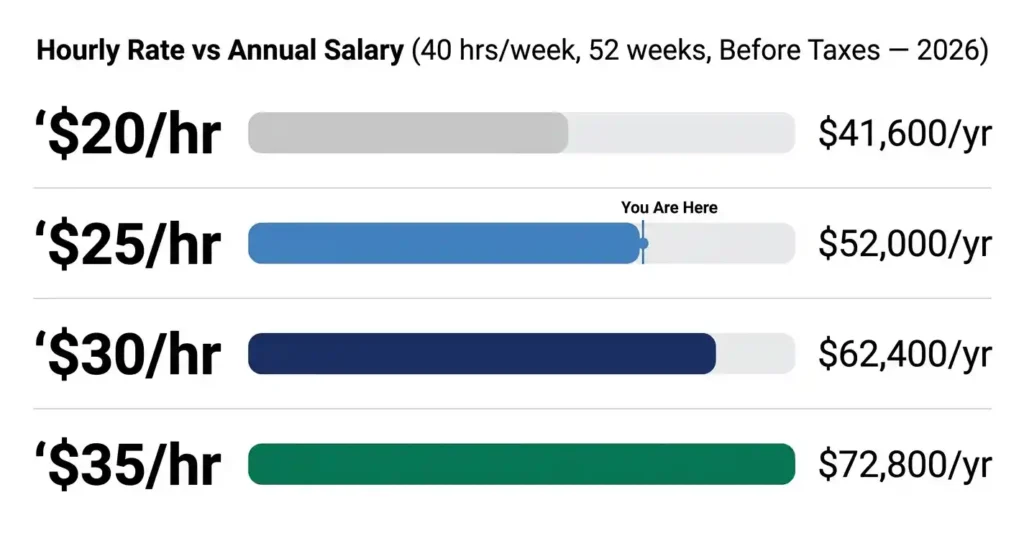
$35/hour = $72,800/year, or $20,800 more gross than $52,000. After taxes, take-home reaches $54,000 to $57,000. At that level you can max a Roth IRA ($7,500 in 2026, per IRS retirement contribution limits), contribute 10% to a 401k, and still have a buffer. See what $40 an hour looks like annually if you are planning your next income target. Getting from $25 to $35 is worth investing in through certifications, negotiation, or a strategic job change.
Common Mistakes People Make When Calculating Hourly Pay
Ignoring Taxes
$52,000 gross is not $52,000 to spend. Most workers at this income take home $37,000 to $43,000 after federal, state, and payroll taxes. That is a gap of $9,000 to $15,000. Always budget from your net, not your offer letter. If you are in California and your paycheck keeps coming in lower than expected, this guide on why your paycheck is so low walks through the most common causes.
Assuming Every Year Has the Same Hours
Two weeks of unpaid leave drops your hours from 2,080 to 1,960 and your income to $49,000. Estimating monthly hours as 160 (4 x 40) also understates reality. Most months average 4.33 weeks, which is why monthly gross is $4,333 and not $4,000. Seasonal workers see even wider swings.
Forgetting Benefit Deductions
Health insurance can pull $150 to $400 per month. A 6% 401k contribution removes $3,120 per year. FSA, dental, vision, and life insurance chip away further. Understanding the California standard deduction 2026 can also help you decide whether to adjust your withholding and increase your monthly take-home. A $25/hour job with a 4% employer match and full health coverage is worth more than $25/hour with nothing. A typical $52,000 earner takes home $2,800 to $3,200 per month after all deductions. Know your full compensation picture before budgeting or accepting any offer.
How to Increase Your Income Beyond $25 an Hour
Earning a Raise
Document results with specific numbers, then ask before your annual review, not during it. A 10% raise gets you to $27.50/hour and adds $5,200 gross per year. To reach $60,000, you need $28.85/hour. To reach $75,000, you need $36.06. To hit $100,000, you need $48.08. Typical wage growth in a healthy labor market is 3% to 5% per year. Job changers with in-demand skills often see 10% to 20% jumps.
Career Advancement Strategies
A PMP, trade license (electrician, plumber, HVAC), coding bootcamp credential, or real estate license can push earnings to $35 to $50/hour within a few years. The same skills that pay $25 in one sector often pay $35 in healthcare, tech, or finance. Research what your transferable skills are worth before assuming you need more school.
Side Income Opportunities
10 extra hours per week at $25/hour adds $13,000 per year. Freelance writing, design, bookkeeping, tutoring, and virtual assistance typically pay $25 to $50/hour. If you go the freelance route, understand how worker classification affects your taxes — a 1099 income stream is taxed very differently than a W-2 paycheck. Platforms like Upwork, Fiverr, and Toptal let you start without clients. Passive income from a digital product or affiliate site can eventually reduce dependence on active side work.
Frequently Asked Questions
Is $25 an hour $52,000 a year?
Yes. At 40 hours per week for 52 weeks, $25/hour equals exactly $52,000. If your actual hours differ, your real income will be higher or lower.
How much is $25 an hour per month?
$4,333 gross per month. Biweekly paycheck is $2,000 before taxes. After taxes and deductions, most single filers in a mid-tax state take home $2,800 to $3,300 per month.
How much is $25 an hour after taxes?
In a no-tax state, a single filer keeps roughly $41,000 to $42,000. In a high-tax state like California or New York, take-home drops to $37,000 to $39,000. Federal, Social Security, and Medicare alone reduce gross by 20% to 22%. California filers can check exact numbers using the California tax brackets 2026 guide.
Is $25 an hour considered good pay?
For most of the U.S., yes. It beats the federal minimum by more than 3x and exceeds median individual earnings. It is comfortable for a single person in lower-cost areas and tight in expensive metros.
Can I buy a house making $25 an hour?
Possibly. Lenders typically cap total debt payments at 43% of gross monthly income. At $4,333/month gross, that is about $1,863/month for all debt. That supports a loan of roughly $280,000 to $320,000 depending on rate and term, which buys a real home in most Midwest and Southern markets but falls short in coastal cities.
What salary is better than $25 an hour?
$30/hour ($62,400/year) is the point where a single person starts building real financial momentum. For long-term wealth building, target $35 to $40/hour within five years.
Final Takeaway: What $25 an Hour Really Means
Key Numbers to Remember
- Annual gross pay: $52,000
- Monthly gross pay: $4,333
- Biweekly paycheck (gross): $2,000
- Estimated annual take-home (mid-tax state, single filer): $39,000 to $41,000
- Estimated monthly take-home: $3,250 to $3,400
What to Do Next
Use the gross pay calculator to confirm your starting number, then run it through the California paycheck calculator to see your true take-home after every deduction. Build your budget from that net number, not your gross. Check your pay stub line by line if you get direct deposit — many people miss deductions coming out automatically. Compare total compensation, not just hourly rate, when evaluating any job offer. For real-world paycheck scenarios at different income levels, browse the paycheck scenarios section.
$25 an hour is $52,000 a year. Now you know exactly what that means for your actual life.

Yeasin Sorker is the founder of Paycheck Calculator California. He built this tool in 2018 after noticing that most free paycheck calculators missed California-specific rules like daily overtime and the uncapped SDI rate.
He researches California payroll tax updates regularly and keeps this calculator aligned with the latest IRS, FTB, and EDD published rates. All calculations on this site are estimates based on official 2026 government sources. For personalized tax advice, consult a qualified tax professional.