
California RSU tax applies to any employee, resident or not, whose restricted stock units vest while working for a California employer or performing services in the state, taxing that value as ordinary wage income alongside federal tax.
That resident-versus-nonresident distinction, covered in detail further down, is where most RSU tax mistakes actually happen.
This guide walks through every scenario, but multi-state situations still deserve a tax professional’s review.
California RSU Tax at a Glance: What You Pay and When
RSUs are taxed at vesting, not at sale. California taxes that vesting-day value as wages, then treats anything after as a separate event. This is especially common among Bay Area tech employees, where equity often makes up a large share of total pay.
When California Taxes an RSU
Vesting is the trigger, before that you own nothing taxable. Grant date is the promise, vesting date is when shares become yours, sale date is whenever you sell. California taxes fair market value at vesting as ordinary wage income. Price changes after that are capital gains.
California RSU Tax vs. RSU Withholding
Withholding is a deposit to the Internal Revenue Service (IRS) and the California Franchise Tax Board (FTB), not your final bill. Federal withholds a flat 22%, California a flat 10.23%. Your real marginal rate, especially with a solid salary, is often higher than both combined.
The Three Tax Events to Remember
Vesting: shares become taxed wage income. Withholding: your company holds back shares or cash at vesting. Sale: any price change since vesting is a capital gain or loss. Confuse them and you’ll overpay in a panic or underpay and owe next April.
California RSU Tax Rates: What Rate Actually Applies?
There’s no single “RSU tax rate.” Your RSU income stacks on your salary and gets taxed at whatever rate that total lands on.
California Does Not Have One Special RSU Tax Rate
RSU income is just wages. California income tax rates run nine brackets up to 12.3%, plus a 1% surcharge over $1 million. Your vest adds to your salary to set your marginal bracket. Two people vesting the same dollar amount can owe different amounts based on base salary.
Federal RSU Withholding Rate
The IRS treats RSU vesting as a “supplemental wage.” For 2026, the flat rate is 22% on supplemental wages up to $1 million per employer per year, 37% above that. This comes from IRS Publication 15. The $1 million threshold accumulates across the year, so a large late-year vest is most likely to cross into 37%. If your real marginal rate is 32% or 35%, the 22% withholding leaves a gap.
California State Withholding on RSUs
California withholds a flat 10.23% on stock-based comp like RSUs, 6.6% on other supplemental wages, not adjustable via W-4. If your income pushes you into California’s 10.3%, 11.3%, or 12.3% brackets, 10.23% falls short.
Payroll Taxes on RSU Vesting
Social Security takes 6.2% up to the $184,500 wage base for 2026, combined across salary and RSU income, part of the same California payroll taxes that apply to your regular paycheck. Medicare takes 1.45%, uncapped. Additional Medicare Tax adds 0.9% above $200,000 single, $250,000 married filing jointly. RSU income also runs through California State Disability Insurance (California SDI), 1.3% with no cap since Senate Bill 951 removed it in 2024. The California Employment Development Department (EDD) administers SDI and Paid Family Leave together.
| Withholding Type | Rate | Cap / Threshold |
|---|---|---|
| Federal supplemental | 22% (37% above threshold) | $1,000,000/year per employer |
| California supplemental (stock comp) | 10.23% | None |
| Social Security | 6.2% | $184,500 wage base (2026) |
| Medicare | 1.45% | None |
| Additional Medicare Tax | 0.9% | Above $200K single / $250K MFJ |
| California SDI | 1.3% | None (cap removed 2024) |
How California Taxes RSUs When They Vest
Vesting is the whole event for RSU tax. Everything else is bookkeeping around that moment.
What Makes an RSU Taxable
RSUs, sometimes called California restricted stock units, are compensation delivered in stock, common in pay packages for software engineers and other tech employees. Internal Revenue Code Section 83 (IRC Section 83) governs when property for services becomes taxable. Vesting triggers the tax, no sale required. Fair market value at vesting is your taxable income, period.
How to Calculate Taxable RSU Income
Multiply shares vested by fair market value per share on the vesting date. That total is gross taxable RSU income, reported on your W-2. Withheld shares or cash reduce what actually lands in your account.
Grant Date vs. Vesting Date vs. Sale Date
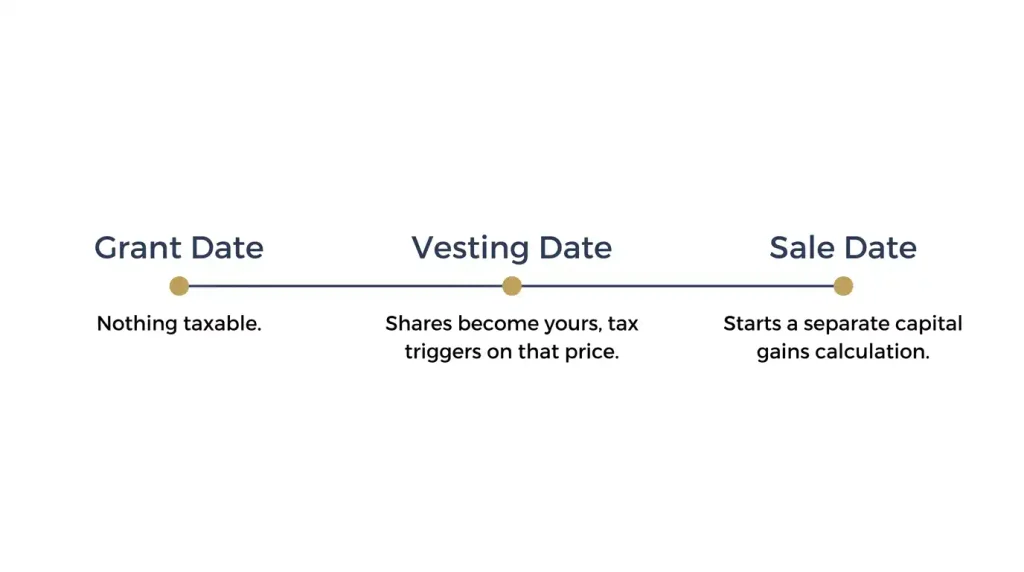
Grant date: nothing taxable. Vesting date: shares become yours, tax triggers on that price. Sale date: starts a separate capital gains calculation. A stock drop after vesting doesn’t refund vesting tax, that was locked in already. Public companies typically use single-trigger vesting, based on time. Private companies often use double-trigger vesting, time plus a liquidity event like an IPO. Vesting can also be cliff (all at once) or graded (incremental).
Simple RSU Vesting Example
200 shares vest at $80, that’s $16,000 of gross taxable compensation. Roughly 32% withholding (federal plus California plus payroll) sells about 60 shares, leaving about 140 net shares worth roughly $11,200. If the stock hits $95 later and you sell, that $15 per share gain is a separate calculation from the original $16,000.
RSU Withholding: Why Did So Many Shares Disappear?
Fewer shares than expected after a vest is the most common RSU shock. Here’s where they went.
How Sell-to-Cover Works
Employers automatically sell a portion of vested shares to cover federal, California, and payroll withholding. You don’t decide this, it happens through payroll. Remaining “net shares” land in your account.
Why Your RSU Withholding May Look High
22% federal, 10.23% California, 6.2% Social Security (under the wage base), 1.45% Medicare, roughly 40% total before Additional Medicare Tax. These are flat statutory rates, unlike your regular paycheck’s W-4-based withholding, and they’re a big part of why a vest can leave you asking why your paycheck looks so low that pay period.
Is RSU Withholding Enough?
Depends on total income. Lower-bracket salaries can overshoot and end up owed a refund. Higher earners often see the flat rates fall short by 10 to 15 percentage points federally, creating an April bill and possibly an underpayment penalty.
What to Check on Your Paystub
Check RSU taxable income, federal tax withheld (22% up to $1 million), California tax withheld (10.23%), and Social Security plus Medicare withheld. Cross-check against your brokerage confirmation using the same line items you’d verify on any California pay stub. If numbers look off, payroll can confirm the vesting-date price, withholding method, and year-to-date supplemental wage total, best fixed before your W-2 is issued.
RSU Tax Calculation: A Step-by-Step Example
Four vest sizes, worked through with real numbers.
Example 1: $25,000 RSU Vest
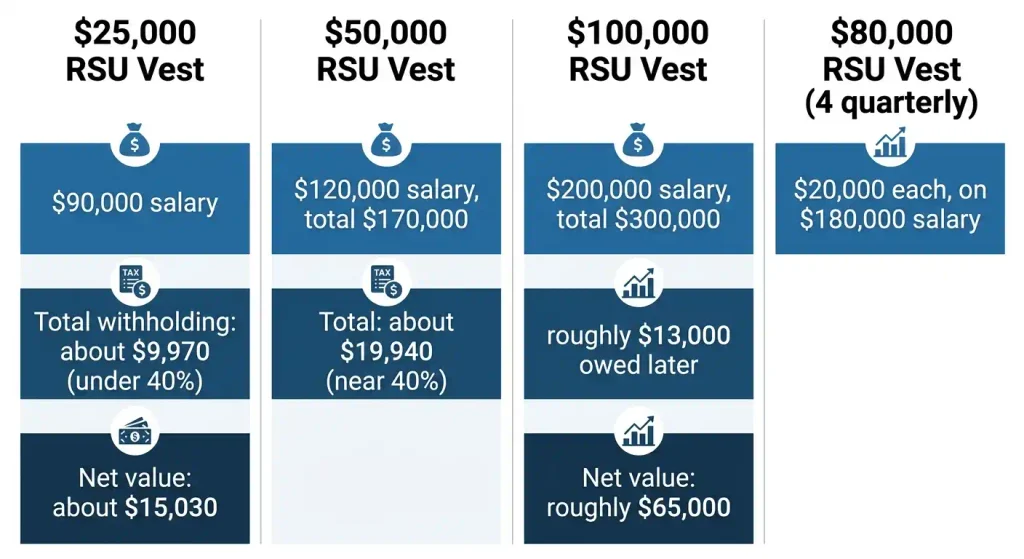
Single filer, $90,000 salary plus $25,000 vest. Federal 22% takes $5,500, California 10.23% takes $2,557, Social Security 6.2% takes $1,550, Medicare 1.45% takes $362. Total withholding: about $9,970 (under 40%). Net value: about $15,030.
Example 2: $50,000 RSU Vest
Salary $120,000 plus $50,000 vest, total $170,000. Federal takes $11,000, California $5,115, Social Security $3,100, Medicare $725. Total: about $19,940 (near 40%). Real federal marginal rate is likely 24%, close to the 22% withheld. California’s real marginal rate at $170,000 is still 9.3%, so 10.23% withholding actually runs ahead, not behind.
Example 3: $100,000 RSU Vest
Salary $200,000 plus $100,000 vest, total $300,000. Federal marginal rate is 35%, but only 22% was withheld, a 13-point gap, roughly $13,000 owed later. California’s 9.3% bracket runs to about $371,000 for a single filer, so at $300,000 the real state marginal rate is still 9.3%, meaning 10.23% withholding covers it with room to spare. Social Security withholding on the RSU may be reduced since a $200,000 salary is already near the $184,500 wage base. Additional Medicare Tax (0.9%) applies above $200,000. Net value after all withholding: roughly $65,000 of the $100,000 vest. At a $200,000 vest on the same salary, total income near $400,000 pushes California into its next bracket (10.3%), while federal stays in the same 35% tier it was already in, so the shortfall keeps widening mainly on the federal side.
Example 4: Multiple RSU Vests in One Year
Four quarterly vests of $20,000 each, $80,000 total, on a $180,000 salary. Each vest withholds at 22% federal and 10.23% California individually. But total income of $260,000 pushes your bracket higher with each vest, so the flat rate matches less by the fourth vest, this is why quarterly vesters often see a bigger April gap than annual vesters at the same total.
What Happens When You Sell RSU Shares?
Selling starts a new tax calculation, separate from the tax already paid at vesting. That calculation runs on the same California capital gains tax rate rules that apply to any other investment sale.
Tax at Vesting vs. Tax at Sale
Vesting tax is wage income, calculated once. Selling compares sale price to cost basis: a gain if the stock rose, a loss if it fell. The vesting wage income stays unchanged either way.
How RSU Cost Basis Works
Cost basis equals fair market value at vesting, the same figure used for your wage income. Brokers often misreport basis as $0 or the grant price on Form 1099-B. Fix it on Form 8949 or you’ll pay tax twice.
Short-Term vs. Long-Term Capital Gains
The holding-period clock starts at vesting. Over a year: federal long-term capital gains rates. Under a year: short-term, taxed as ordinary income. California taxes all capital gains at ordinary rates regardless of holding period.
Example: RSU Shares Rise After Vesting
Shares vest at $80 (wage income taxed then). Sold 18 months later at $110: $30 per share gain, federal long-term rate, California ordinary rate. Cost basis is $80, not the original grant price.
Example: RSU Shares Fall After Vesting
Same $80 vesting price and wage tax already paid. Stock drops to $60 and sells: $20 per share capital loss, offsets other gains or up to $3,000 of ordinary income yearly, rest carries forward. The vesting tax on the original $80 is not refunded.
RSU Tax Forms: W-2, 1099-B, Form 8949 and California Returns
The forms don’t automatically agree with each other.
How RSU Income Appears on Form W-2
RSU income lands in W-2 Box 1 wages, W-2 Box 3 wages, W-2 Box 5 wages, and, for California filers, W-2 Box 16 state wages and W-2 Box 17 state income tax. No separate RSU line exists; some employers note it in Box 14. IRS Publication 525 covers this reporting. Compare your W-2 total against salary plus known vesting values.
How RSU Sales Appear on Form 1099-B
Form 1099-B reports sale proceeds and cost basis. Brokers frequently misreport 1099-B cost basis, often $0 or the grant price instead of vesting-date value. Verify against your vesting confirmation before filing.
Form 8949 and Schedule D
Form 8949 lists proceeds, basis, and gain or loss per sale, correcting any wrong 1099-B basis. Totals flow to Schedule D. Keep this separate from your W-2 wage income.
California Forms and Schedules
Form 1040 is your federal return, RSU wages from your W-2, gains from Schedule D. California residents use California Form 540. Nonresidents or part-year residents use California Form 540NR, allocating income across states. Schedule CA (540) adjusts for California differences. California Schedule D (540) is the California Schedule D for capital gains. Schedule S applies if claiming credit for tax paid to another state.
California RSU Tax for Residents and Nonresidents
Where and when you lived changes how much California can tax, a question that comes up often for part-year residents. Residency (where you actually live) and domicile (your permanent home) are related but not identical, and don’t always align. Married couples should also factor in California’s community property rules, which generally split RSU income earned during marriage equally between spouses, most relevant in divorce, separate filings, or estate planning.
California Resident on the Vesting Date
If you’re a California resident when RSUs vest, the full value is California income, regardless of where you worked earlier, as long as you were a resident at vesting.
California Nonresident on the Vesting Date
Nonresidents can still owe California tax on the portion tied to work performed in-state during the grant-to-vest period, based on where the work happened, not where you live now.
Moving Into California Before an RSU Vests
If you’re a California resident on the vesting date, the full value typically becomes California income, not just the post-arrival portion. Residency at vesting controls, separate from nonresident sourcing rules.
Moving Out of California Before an RSU Vests
Leaving doesn’t erase tax on work already done in California. If you worked in-state during part of the grant-to-vest period, California still taxes that proportional share at vesting, calculated through workday allocation.
California RSU Workday Allocation for Nonresidents
This determines how much of your RSU stays taxable by California after you’ve left.
When California Taxes Only Part of an RSU Vest
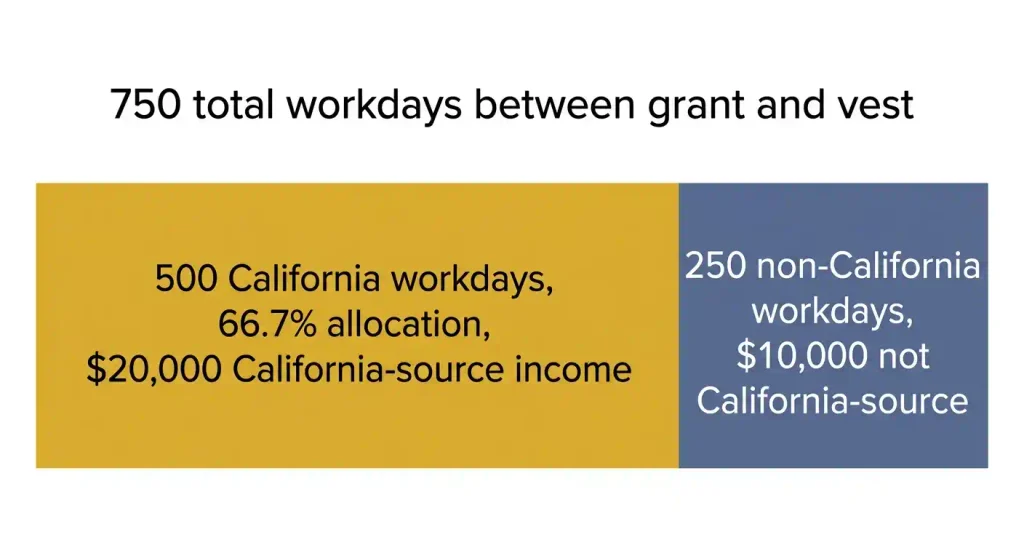
California uses a ratio of California workdays to total workdays over the grant-to-vest period. Only that share counts as California-source income. This traces to the California Revenue and Taxation Code, specifically California R&TC Section 17951, backed by California Code of Regulations Section 17951-5, with sourcing mechanics detailed in FTB Publication 1004 and the actual withholding rates set in EDD Publication DE 44.
California Workday Allocation Example
750 total workdays between grant and vest, 500 worked in California before relocating. That’s 66.7% California allocation. On a $30,000 vest, $20,000 is California-source income, $10,000 is not.
Remote Work and RSU Tax
Physical location controls. Remote work from inside California counts as a California workday regardless of employer location. Remote work from outside California generally doesn’t count, even for a California employer. Keep real records of where you worked.
RSUs That Vest After Leaving California
An old grant can still owe California tax years after you’ve relocated, because the trigger is work performed in California, not your current address. This applies until every California-sourced grant fully vests.
Multi-State RSU Tax and Double Taxation
Two states can legitimately tax pieces of the same RSU vest.
When Two States Tax the Same RSU Income
Your resident state taxes all income by residency. Your source state, like California, taxes income earned from work performed there. Both can have a legitimate claim on the same RSU.
California Other State Tax Credit
California credits taxes paid to another state on overlapping income, claimed via Schedule S, not automatic. Tax professionals sometimes call this OSTC, though the actual form is Schedule S. Get sourcing wrong and the credit calculation fails.
Example: California to Texas Relocation
Two years of California work, then a move to Texas before a third-year vest. Texas has no income tax, so nothing to credit there, but California still taxes the workday-allocated portion from the California years. Keep moving records and old pay stubs.
Example: California and Another Income-Tax State
Swap Texas for New York: both states may tax overlapping income, California on the sourced portion, New York on residency. The Other State Tax Credit becomes essential here, and this scenario is a strong candidate for professional review.
Should You Sell RSU Shares to Pay the Tax?
Tax mechanics and investment decisions are separate questions.
Sell-to-Cover vs. Holding All Shares
Sell-to-cover automatically liquidates shares for withholding. Some plans allow cash payment instead, keeping all shares. Tax owed is identical either way, only your stock exposure changes.
Selling Immediately After Vesting
Selling at vesting locks in almost no capital gain or loss, since sale price nearly equals the vesting-date value already taxed as wages. It doesn’t reduce vesting tax, it just avoids added investment risk.
Holding Vested RSUs
Holding bets on the stock going forward using already-taxed money. Cost basis is the vesting-date value. This concentrates more wealth in one company, on top of your salary and job risk there.
What the Tax Calculation Cannot Decide for You
Your tax rate tells you what you owe, not whether holding company stock fits your financial life. That’s a concentration and risk question. Large stakes warrant a fee-only advisor.
Real-Life California RSU Tax Scenarios
Six situations with real numbers.
Scenario: California Employee With a $150,000 Salary and $50,000 RSU Vest
Total income $200,000. Federal 22% withholding is close to a likely 24% marginal bracket. California’s real marginal rate at $200,000 is still 9.3%, so 10.23% withholding runs slightly ahead, not behind. Watch for Additional Medicare Tax (0.9%), which starts right at $200,000 for single filers.
Scenario: Employee Sells Shares Immediately After Vesting
Vesting income is taxed as wages. Selling the same day means little to no added capital gain, Form 1099-B shows a tiny gain or loss from intraday price movement only.
Scenario: Employee Holds Shares for Two Years
Vesting tax is paid in year one at that year’s fair market value. Selling two years later at a higher price qualifies for federal long-term capital gains rates. California taxes the gain at ordinary rates regardless of holding period.
Scenario: Employee Moves From California to Texas
Two years of California work, then a move to Texas before vesting. Workday allocation determines the California-source percentage. Texas has no income tax, so nothing owed there.
Scenario: Employee Moves Into California Before Vesting
Relocating to California mid-grant and being a resident at vesting makes the full vesting value taxable California income, not just the post-arrival portion, because residency at vesting controls.
Scenario: RSUs Vest After Employment Ends
A grant already vesting per its schedule can continue vesting after termination. The vesting date still triggers tax, and California sourcing still depends on where the underlying work was performed.
Common California RSU Tax Mistakes and Myths
Six misconceptions that cost real money.
Myth: RSUs Are Taxed Only When You Sell Them
False. RSUs are taxed at vesting as ordinary wage income, whether sold immediately or held for years. Selling later only affects the separate capital gains calculation.
Myth: The 22% Federal Rate Is My RSU Tax Rate
22% is a withholding rate, not your bracket. If combined income puts you in the 32% or 35% federal bracket, you owe the difference at filing.
Myth: California Has One Flat RSU Tax Rate
10.23% is a withholding rate. California’s actual income tax is progressive, up to 12.3% plus the 1% surcharge above $1 million.
Myth: Leaving California Means No California RSU Tax
California can still tax the portion tied to in-state work, years later, via workday allocation. Moving alone doesn’t erase that liability.
Myth: My Employer Withheld Enough, So I Cannot Owe More
Flat withholding ignores your full picture, salary, spouse’s income, multiple employers, or other vests. Any of these can push your real liability above what was withheld.
Myth: A Stock Loss Erases the RSU Tax at Vesting
Vesting tax is locked in at that day’s fair market value. A later price drop creates a separate capital loss, it doesn’t refund the original vesting tax.
How to Estimate Your California RSU Tax Before Vesting
A little math before vesting, part of any solid California tax planning routine, beats a surprise after.
Gather These Numbers First
Number of shares vesting, projected fair market value, annual salary and other compensation, and your California residency and work-location history.
Calculate Gross RSU Income
Shares times expected fair market value equals gross taxable RSU income, separate from net shares after withholding. Save the equity plan statement.
Estimate Withholding and Net Shares
Apply 22% federal, 10.23% California, 6.2% Social Security (if under the wage base), 1.45% Medicare, and 0.9% Additional Medicare if applicable, to estimate net value.
Compare Withholding With Expected Tax Liability
Add projected RSU income to total annual income to find your real marginal bracket, federal and California. Compare to withholding. A meaningful gap means setting aside cash or making an estimated tax payment before the shortfall turns into a penalty next April.
When California RSU Tax Gets Complicated
Some situations need more than a spreadsheet.
Situations That Need Extra Review
Multi-state work during grant-to-vest, a residency change near vesting, RSUs from a former employer, or a foreign employer or cross-border arrangement.
Records That Can Support the Tax Calculation
Keep the grant agreement, vesting confirmations, payroll records and W-2s, and a real record of work location and residency, especially around any move.
Questions to Ask a Tax Professional
How much RSU income is California-source. Is current withholding sufficient. Could another state also tax this income. Does the Other State Tax Credit apply.
What to Do Before and After an RSU Vest
Before the Vesting Date
Confirm the vest date and share count. Review the withholding method. Estimate gross taxable compensation. Check California residency and work location, especially after a move.
On the Vesting Date
Record fair market value. Note shares vested and shares withheld. Save the transaction confirmation. Verify payroll processed it correctly.
After the Vest
Confirm the income appears correctly on your W-2. Record tax basis for retained shares. Track future sales separately. Reconcile brokerage and payroll records.
Before Filing the Tax Return
Compare W-2 total against salary plus vesting values. Verify the 1099-B basis. Review multi-state allocation if relevant. Confirm which California forms apply.
California RSU Tax FAQ
Are RSUs taxed when they vest in California?
Yes. Fair market value at vesting is taxed as ordinary wage income on your W-2, sold or not.
How much tax is withheld from RSUs in California?
Federal: 22% flat up to $1 million, 37% above. California: 10.23%. Plus Social Security, Medicare, and Additional Medicare Tax. None of this equals your final bill.
Does California tax RSUs after I move out of state?
Yes, for the portion tied to California work during the grant-to-vest period, via workday allocation.
What happens if I move to California before my RSUs vest?
Full value becomes California income if you’re a resident on the vesting date, not just the post-arrival portion.
Are RSUs taxed as ordinary income or capital gains?
Both. Vesting value is ordinary wage income. Price change to sale is capital gain or loss, using the vesting value as cost basis.
Why is my RSU withholding so high?
Flat supplemental wage rates: 22% federal, 10.23% California, plus Social Security and Medicare, none adjusted for your personal situation.
Do I pay California tax if I sell my RSUs?
Residents owe California tax on the capital gain at ordinary rates. Nonresidents generally don’t, though the original vesting income may still be California-source.
How do I calculate California tax on RSUs?
Shares times fair market value at vesting, apply residency or workday allocation, compare to what was withheld.
What happens to RSUs if I leave my job?
Unvested RSUs are typically forfeited, though some plans allow continued vesting. Shares that vest after you leave still get taxed based on where the work was performed.
Can RSUs be taxed by two states?
Yes, resident state plus source state. California’s Other State Tax Credit, via Schedule S, can offset this depending on the facts.
What forms do I need for RSU taxes?
Form W-2, Form 1099-B, Form 8949, Schedule D. California residents use Form 540, nonresidents or part-year residents use Form 540NR, plus Schedule S if claiming a credit.
California RSU Tax Checklist
Before Vesting
- Confirm the vest date and exact number of shares
- Review your withholding method, sell-to-cover or cash payment
- Estimate gross taxable compensation using the current price
- Check your California residency and work location history
After Vesting
- Save the vesting confirmation statement
- Record the fair market value and resulting tax basis
- Verify withholding amounts on your paystub
- Reconcile net shares against the transaction statement
Before Selling
- Confirm your adjusted cost basis, the vesting-date value
- Check your holding period for federal long-term treatment
- Review the potential gain or loss before placing the trade
- Understand how the sale will be reported on Form 1099-B
Before Filing
- Match your W-2 RSU income against your own payroll records
- Reconcile 1099-B proceeds and basis against vesting statements
- Review multi-state allocation if you worked outside California
- Confirm which California forms and schedules apply to you
California RSU Tax: Key Takeaways
The Core Rule to Remember
RSU income is taxed at vesting as ordinary wages, not at sale. California’s treatment depends on residency and work-location history. Withholding is a deposit, not your final bill.
The Numbers That Matter Most
Shares vested, fair market value at vesting, total salary and other compensation, and California work and residency history.
The Records to Keep
Grant and vesting documents, paystubs and W-2s tied to each vest, brokerage statements and Form 1099-B, and records of where you worked and lived.

Yeasin Sorker is the founder of Paycheck Calculator California. He built this tool in 2018 after noticing that most free paycheck calculators missed California-specific rules like daily overtime and the uncapped SDI rate.
He researches California payroll tax updates regularly and keeps this calculator aligned with the latest IRS, FTB, and EDD published rates. All calculations on this site are estimates based on official 2026 government sources. For personalized tax advice, consult a qualified tax professional.