
A Roth IRA taxes contributions upfront for tax-free qualified withdrawals; a Traditional IRA defers tax, giving a deduction now and taxable withdrawals later. Both share a 2026 limit of $7,500, with Roth eligibility capped by income.
That mechanical difference, tax now versus tax later, drives every 2026 limit, phase-out, and withdrawal rule covered below.
The catch: income limits can shut out a Roth entirely, no matter which bracket you expect.
Roth IRA vs. Traditional IRA: Which Is Better for You?
The Quick Answer Based on Your Tax Situation
If you expect a lower tax bracket now than in retirement, a Roth usually wins, since you pay tax at today’s lower rate. If you’re in peak earning years and expect a lower bracket later, Traditional usually wins. Nobody knows their future bracket for certain, since tax law, income, and retirement income from Social Security or a pension can shift it. That’s why neither account is universally better.
Roth IRA vs. Traditional IRA at a Glance
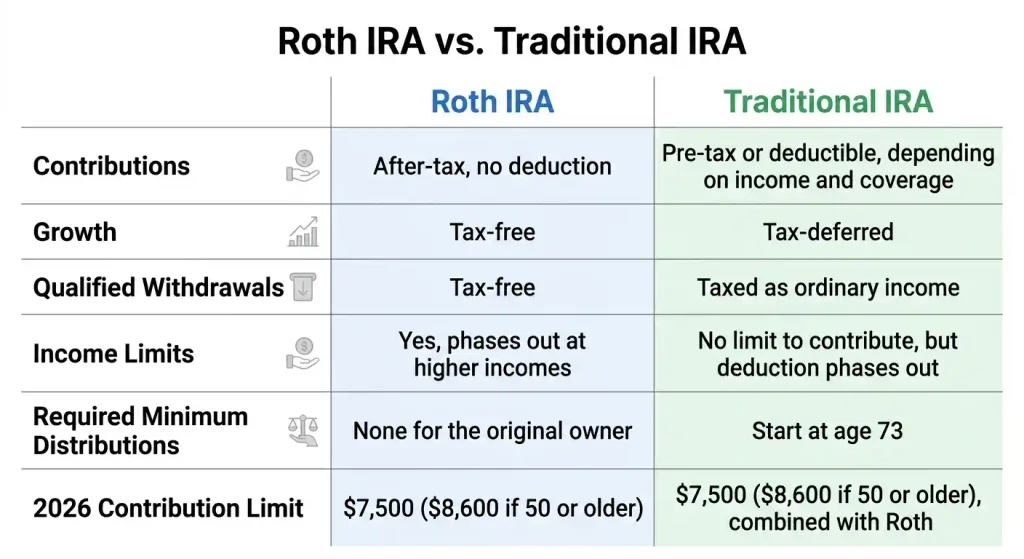
| Feature | Roth IRA | Traditional IRA |
|---|---|---|
| Contributions | After-tax, no deduction | Pre-tax or deductible, depending on income and coverage |
| Growth | Tax-free | Tax-deferred |
| Qualified withdrawals | Tax-free | Taxed as ordinary income |
| Income limits | Yes, phases out at higher incomes | No limit to contribute, but deduction phases out |
| Required minimum distributions | None for the original owner | Start at age 73 |
| 2026 contribution limit | $7,500 ($8,600 if 50 or older) | $7,500 ($8,600 if 50 or older), combined with Roth |
Roth gives the deduction later, as tax-free income. Traditional gives it now, as a smaller tax bill this April.
How Roth and Traditional IRAs Work
Both are a version of the Individual Retirement Arrangement, or IRA, and work the same basic way: invest for retirement and skip yearly tax on the growth. They split on when the IRS gets paid.
What Is a Roth IRA?
A Roth IRA is funded with after-tax money, so there’s no deduction when you contribute. Investments grow tax-free, and a qualified withdrawal owes zero tax, including decades of growth. You can withdraw your original contributions anytime, tax- and penalty-free. Earnings follow separate rules, covered later. Income limits apply, and there’s no forced withdrawal schedule. For the full rules, see our guide on how a Roth IRA works.
What Is a Traditional IRA?
A Traditional IRA may let you deduct your contribution the year you make it, lowering taxable income now. Money grows tax-deferred. At withdrawal, it’s taxed as ordinary income, not a lower capital-gains rate. If income or workplace coverage limits your deduction, you can still contribute as a nondeductible contribution, which changes how withdrawals are taxed later. See our full breakdown of how a Traditional IRA works for more.
When Do You Pay Taxes With Each IRA?
With a Roth, you pay tax once, going in. With a Traditional IRA, you either skip tax now and pay on the way out, or, for nondeductible contributions, pay tax going in and only on growth coming out. A withdrawal isn’t automatically tax-free just because part came from nondeductible contributions. The IRS tracks deductible and nondeductible dollars together, so most withdrawals end up partly taxable.
Roth IRA vs. Traditional IRA Tax Benefits and Disadvantages
Each account trades one benefit for another, and knowing exactly what you give up matters most here.
Roth IRA Pros and Cons
The biggest Roth advantage is tax-free retirement income, on money that could grow for thirty or forty years, plus no required minimum distributions for the original owner. The downside: no deduction now, income limits for higher earners, and a five-year clock on converted or early-withdrawn earnings before they count as qualified.
Traditional IRA Pros and Cons
A Traditional IRA’s advantage shows up immediately. Earn $90,000 in California and contribute $7,500, and you could shave roughly $2,200 to $2,400 off your combined federal and state tax bill. The tradeoff: withdrawals are taxed as ordinary income, RMDs start at 73, and withdrawing deduction-eligible money before 59 and a half usually costs a 10% penalty on top of regular tax. See current California tax brackets for your exact bracket.
Which IRA Offers Better Long-Term Tax Savings?
If your tax rate is the same now and in retirement, both accounts produce the same after-tax result, assuming you invest the Traditional deduction instead of spending it. A lower rate now and higher rate later favors Roth; the reverse favors Traditional. Since future tax law is unpredictable, many people split contributions between both, called tax diversification, for flexibility.
2026 IRA Contribution Limits and Income Rules
For 2026, the Internal Revenue Service (IRS) raised the combined IRA contribution limit to $7,500, up from $7,000 in 2025. At 50 or older, add a $1,100 catch-up contribution, adjusted yearly under the SECURE 2.0 Act, for a total of $8,600.
2026 Roth and Traditional IRA Contribution Limits
The $7,500 limit, or $8,600 with catch-up, covers both account types combined, not each separately. You could put $4,000 in a Roth and $3,500 in a Traditional IRA, but not $7,500 to each. You need taxable compensation at least equal to your contribution, so earning $4,000 caps you at $4,000. Check current figures on IRS.gov before filing.
Contribute too much, from exceeding the limit or an income phase-out, and the excess draws a 6% excise tax, reported on IRS Form 5329, each year it stays uncorrected. Fix it by withdrawing the excess plus earnings before that year’s tax filing deadline, typically April 15, which is also the deadline to make contributions for that tax year.
2026 Roth IRA Income Limits by Filing Status
Roth eligibility phases out by income, with thresholds set by filing status based on modified adjusted gross income (MAGI). Inside a phase-out range, your allowed contribution shrinks on a sliding scale, roughly half at the midpoint.
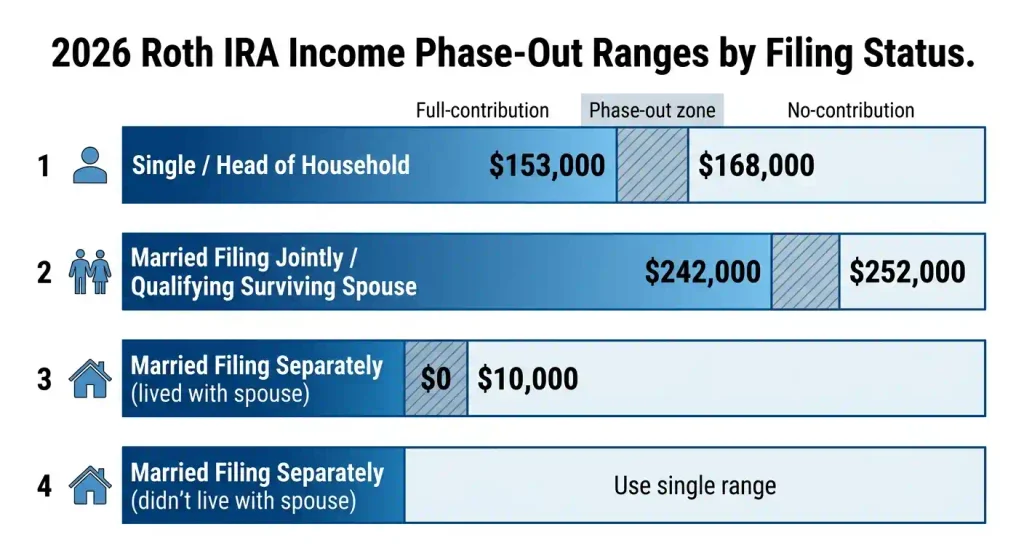
| Filing Status | Full Contribution Below | Phase-Out Range | No Contribution Above |
|---|---|---|---|
| Single / Head of Household | $153,000 | $153,000–$168,000 | $168,000 |
| Married Filing Jointly / Qualifying Surviving Spouse | $242,000 | $242,000–$252,000 | $252,000 |
| Married Filing Separately (lived with spouse) | $0 | $0–$10,000 | $10,000 |
| Married Filing Separately (didn’t live with spouse) | Use single range | Use single range | Use single range |
2026 Traditional IRA Deduction Limits
Anyone with earned income can contribute to a Traditional IRA; deductibility depends on workplace coverage.
| Situation | Phase-Out Range | Full Deduction Below |
|---|---|---|
| Single / Head of Household, covered by a plan | $81,000–$91,000 | $81,000 |
| Married Filing Jointly, contributing spouse covered | $129,000–$149,000 | $129,000 |
| Married Filing Jointly, contributing spouse not covered, other spouse covered | $242,000–$252,000 | $242,000 |
| Neither spouse covered by a workplace plan | No income limit | Fully deductible |
Can You Contribute to an IRA Without Deducting It?
Yes. Above the deduction phase-out, you can still contribute to a Traditional IRA, just without the tax break. This nondeductible contribution is reported on IRS Form 8606, filed alongside your Form 1040, to establish basis so you’re not taxed on it twice.
How Your Income and Workplace Retirement Plan Affect Your Choice
Your IRA choice isn’t isolated. Workplace coverage, household income, and employment type (W-2 or self-employed) all change the math.
Roth IRA vs. Traditional IRA With a 401(k)
A 401(k) or 403(b) reduces or eliminates your Traditional IRA deduction past the phase-out, but doesn’t block IRA contributions outright. You can still fund a Roth IRA, if eligible, or a nondeductible Traditional IRA on top of a workplace plan. Prioritize any employer match first, since it’s free money. A Roth 401(k) or Traditional 401(k) follows its own rules, separate from an IRA.
What If Your Income Is Too High for a Roth IRA?
Past the Roth phase-out ceiling, you can’t contribute directly. That’s where the backdoor Roth IRA comes in: contribute to a nondeductible Traditional IRA, then convert to Roth. Conversions have no income limit. The catch is the pro-rata rule: if you hold other pre-tax Traditional IRA money, the IRS taxes your conversion proportionally across your total IRA balance, not just the new contribution, which can make a supposedly tax-free conversion partly taxable. A conversion also adds to your adjusted gross income (AGI) for the year, which can affect Medicare premium surcharges, financial aid, or other income-based tax breaks.
Can a Nonworking Spouse Contribute to an IRA?
Yes. On a joint return, a spouse with little or no earned income can still open a spousal IRA, as long as household compensation covers both contributions. Each spouse has a separate limit, so a spouse earning $120,000 can fund both their own IRA and a spousal IRA, up to $7,500 each, or $8,600 if 50 or older.
Can Self-Employed Workers Contribute to an IRA?
Freelancers and self-employed workers can contribute using net self-employment earnings, under the same $7,500 combined limit. Many eventually move to a SEP IRA or SIMPLE IRA for higher limits tied to business income, separate accounts with separate rules. Since self-employed income swings year to year, revisit your contribution each tax season.
Roth vs. Traditional IRA Calculations: Which Saves More?
Numbers settle this better than opinions. Here’s how the math plays out.
Compare Equal Contributions and Equal After-Tax Costs
Putting $7,500 into each account isn’t apples-to-apples, since the Traditional contribution comes with a deduction. In a 22% federal bracket, that $7,500 deduction is worth about $1,650 back. To compare fairly, invest that $1,650 too, or contribute less to the Roth to match the same out-of-pocket cost. Equal after-tax cost, not equal contribution dollars, is the fair comparison.
Compare Different Current and Future Tax Rates
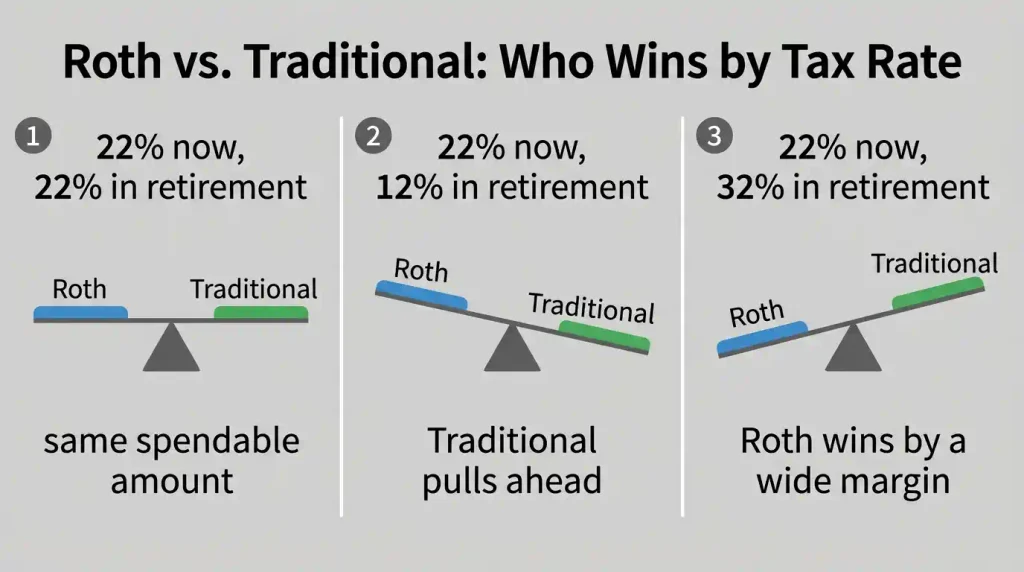
At a 22% rate now and in retirement, a Roth and a Traditional IRA leave the same spendable amount, assuming you invest the Traditional’s tax savings. Drop to 12% in retirement, and Traditional pulls ahead. Climb to 32%, and Roth wins by a wide margin. Nobody knows future brackets for certain, which is the real uncertainty here. A Roth vs. Traditional IRA calculator can turn your actual numbers into a concrete answer. Check current federal tax brackets to see where you actually fall.
Understand the Limits of Retirement Projections
Any projection, including these, is an illustration, not a guarantee. Markets don’t grow in a straight line, fees vary, and inflation erodes purchasing power. A taxable account outside your IRA owes tax on dividends and gains yearly, a drag neither IRA has. State taxes matter too: California taxes retirement withdrawals as ordinary income with no special break (per the California Franchise Tax Board), so relocating to a lower-tax state before withdrawing could change which account wins. Treat every projection as a guide, not a promise.
Roth IRA vs. Traditional IRA Examples for Different Tax Situations
Generic advice breaks down once real numbers enter. Here’s how the choice plays out in four common situations.
A Young Worker Expecting Higher Future Earnings
A 26-year-old in Sacramento earning $55,000 is early in her career, in a relatively low bracket, so a Traditional deduction wouldn’t save much today. Expecting higher earnings and a higher bracket in ten or fifteen years, a Roth usually makes more sense: pay tax on a smaller income now, lock in zero tax on decades of growth, and keep the flexibility to pull contributions out penalty-free in an emergency. She can plug her numbers into our annual salary calculator to see her exact take-home pay either way.
A High-Income Worker Seeking a Current Tax Deduction
A 42-year-old engineer in San Jose earning $185,000, with a 401(k), is too high-income to deduct a Traditional IRA or contribute directly to a Roth. That’s where the backdoor Roth strategy fits, assuming no other pre-tax Traditional IRA balances that would trigger the pro-rata rule. Older Traditional IRA money is best rolled into the 401(k) first for a cleaner conversion.
A Worker Nearing Retirement
A 60-year-old nurse in Fresno earning $95,000, five years out, with a pension and Social Security covering a good chunk of retirement income, saves meaningful tax today from a Traditional deduction. Social Security itself can become partly taxable past certain income thresholds. Her pension and Social Security will fill much of her taxable income floor, so RMDs from a Traditional IRA could push her into a higher bracket later. A mix of both accounts, or a partial Roth conversion before RMDs begin, can smooth that out.
A Married Couple With Different Incomes
A married couple in Oakland: one spouse earns $140,000 with a 401(k), the other $30,000 with no workplace plan. The higher earner’s deduction is limited or phased out by joint income. The lower earner, uncovered, can likely deduct fully unless combined income reaches $242,000 to $252,000, a high bar here. That makes the lower earner’s account the better deductible-contribution candidate, while the higher earner may lean Roth or backdoor Roth.
IRA Withdrawal Rules, Penalties, and Required Distributions
Contributing is the easy part. Knowing how and when to withdraw is where the real planning happens.
Roth IRA Withdrawal Rules
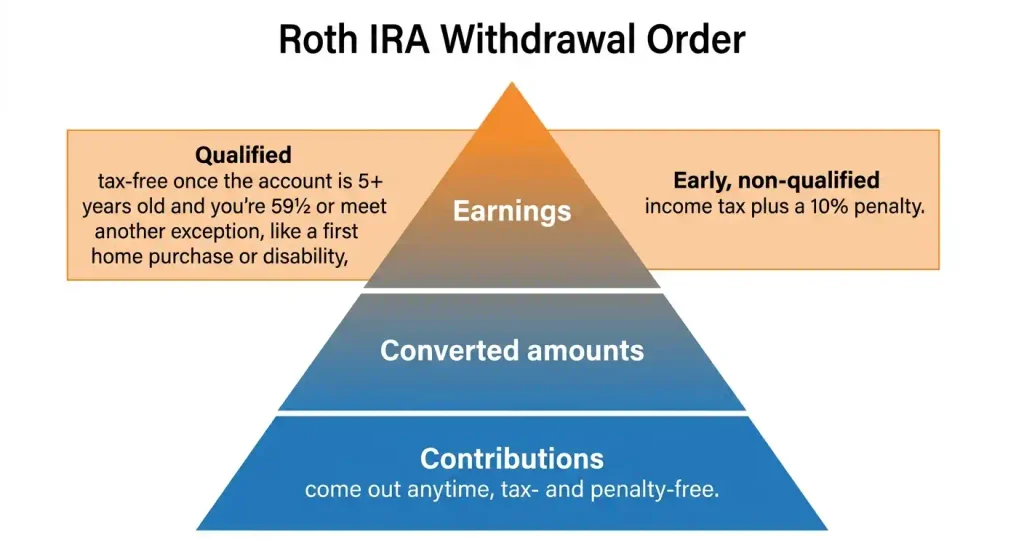
The IRS treats Roth money in layers: contributions first, then converted amounts, then earnings.
- Contributions: come out anytime, tax- and penalty-free.
- Qualified earnings: tax-free once the account is 5+ years old and you’re 59½ or meet another exception, like a first home purchase or disability. This combination makes a qualified Roth IRA distribution.
- Early, non-qualified earnings: income tax plus a 10% penalty.
Traditional IRA Withdrawal Rules
Withdrawals from deductible contributions and growth are taxed as ordinary income.
- Before 59½: a 10% early withdrawal penalty applies, with exceptions for certain medical expenses, a first home purchase up to $10,000, or higher education costs.
- California residents: an additional 2.5% state early-withdrawal tax stacks on top of the federal 10% penalty.
- Nondeductible contributions: the basis portion, tracked on Form 8606, comes out tax-free; everything else is taxable.
Required Minimum Distributions From Each IRA
Required minimum distributions (RMDs) apply only to Traditional IRAs, for the original owner.
- Start age: 73.
- Calculated from: account balance and life expectancy.
- Miss one: triggers a steep penalty.
- Roth IRAs: no lifetime RMDs for the original owner, a clear long-term edge over Traditional.
What Happens When You Inherit an IRA?
Inherited IRAs are taxed differently by account type and beneficiary.
- Inherited Traditional IRA: taxable as withdrawn.
- Inherited Roth IRA: generally tax-free, if the original account met the five-year rule.
- Most non-spouse beneficiaries: must empty the account within 10 years (SECURE Act), and if the original owner had already started RMDs, must also take annual RMDs in years 1 through 9, under 2025 IRS final regulations.
- Spouses: more flexibility, often treating it as their own.
- Minor children or a qualifying disability: special timelines apply, so check current IRS guidance.
Common Roth IRA and Traditional IRA Myths
A few bad assumptions about these accounts show up again and again, and they lead people to make the wrong call.
Every Traditional IRA Contribution Is Tax-Deductible
Myth: Every Traditional IRA contribution is tax-deductible.
Reality: Contributing and deducting are different. Anyone with earned income can contribute; the deduction depends on income and workplace coverage. If you assumed it was automatic and it wasn’t, report it as nondeductible on Form 8606 to avoid double taxation. The Roth IRA income limit doesn’t apply here either: anyone with earned income can contribute to a Traditional IRA no matter how much they make, even though the deduction has its own separate limits.
High Earners Cannot Use Roth IRAs
Myth: High earners can’t use a Roth IRA, or the opposite, that Roth contributions are open to anyone regardless of income.
Reality: Direct Roth contributions do phase out at higher incomes, but the backdoor Roth strategy (explained in the section above on high-income Roth workarounds) can still get money in, provided the pro-rata rule doesn’t apply.
Roth IRA Withdrawals Are Always Tax-Free
Myth: Roth IRA withdrawals are always tax-free.
Reality: Only original contributions come out tax-free and penalty-free anytime. Earnings need the five-year holding period plus age 59½ or another exception. Early earnings without meeting those conditions owe tax and a 10% penalty, like a non-qualified Traditional withdrawal.
Having a 401(k) Prevents IRA Contributions
Myth: Having a 401(k) prevents IRA contributions.
Reality: A 401(k) doesn’t block IRA contributions. It can limit a Traditional IRA deduction past the phase-out, but Roth eligibility depends on income, not workplace coverage. You can max a 401(k) and still fund an IRA within the income rules.
How to Choose the Right IRA for Your Situation
After all the rules and math, the decision usually comes down to a few practical questions about where you stand right now.
Choose a Roth IRA When…
A Roth fits if:
- You’re early in your career, with income and tax bracket likely to rise.
- You want tax-free withdrawals and no forced distributions later in life.
- You value flexibility: contributions come out penalty-free in a real emergency.
Just confirm your income falls under the 2026 phase-out limits before contributing directly.
Choose a Traditional IRA When…
A Traditional IRA fits if:
- You’re in peak earning years and want to lower taxable income now.
- You expect a lower tax bracket once you retire.
- You have no workplace plan, since the deduction then has no income limit.
Confirm your contribution is actually deductible under current rules first.
Consider Using Both IRA Types
You don’t have to pick one and ignore the other. Splitting contributions between a Roth and a Traditional IRA spreads your tax exposure across today and retirement, which gives you more control over your taxable income once you’re no longer working. Just remember the $7,500 combined limit, or $8,600 if you’re 50 or older, applies across both accounts together, not to each one separately. The right split depends on your household’s full retirement picture, not just this year’s tax return. Explore more strategies in our California tax savings planning hub.
Check the Rules Before Contributing
Limits and phase-outs change yearly. Confirm your compensation, filing status, and workplace coverage before you contribute, and check current figures on the IRS eligibility rules. Keep records of deductible, nondeductible, and converted amounts to track your basis accurately.
IRS Publication 590-A covers contribution and deduction rules in detail, and IRS Publication 590-B covers withdrawal and RMD rules, so both are worth bookmarking alongside this article. Depending on your income, contributing may also qualify you for the Saver’s Credit, officially called the Retirement Savings Contributions Credit, which can shave even more off your tax bill.
Frequently Asked Questions
Is a Roth IRA better than a Traditional IRA in 2026?
It depends on whether you expect to pay a lower tax rate now or later. A Roth tends to win if you expect higher taxes in retirement, while a Traditional IRA tends to win if you expect lower taxes later. Your eligibility, withdrawal needs, and retirement goals all factor into the final call.
Can I contribute to both a Roth IRA and a Traditional IRA?
Yes, as long as your combined contributions across both accounts stay within the 2026 limit of $7,500, or $8,600 if you’re 50 or older. Each account still has its own eligibility and deduction rules that apply separately.
Can I have a Roth IRA and a 401(k)?
Yes. A 401(k) and a Roth IRA are completely separate accounts with separate contribution limits. You can max out both in the same year, as long as your Roth IRA income falls within the eligibility rules.
What happens if my income exceeds the Roth IRA limit?
Your direct contribution gets reduced or eliminated entirely, depending on how far over the limit you are. At that point, a Roth conversion, often through the backdoor Roth strategy, becomes the main way to still get money into a Roth account.
Is a Traditional IRA contribution deductible if I have a 401(k)?
It depends on your income. Once your income crosses the 2026 phase-out range for your filing status, your deduction shrinks and eventually disappears. You can still contribute without deducting it, which creates a nondeductible contribution you’ll need to track.
Can I withdraw Roth IRA contributions before retirement?
Yes. Your original contributions can come out anytime, for any reason, without tax or penalty. That rule only covers contributions, not earnings, which have their own five-year and age requirements to come out tax-free.
Which IRA is better if I expect higher taxes in retirement?
A Roth IRA tends to make more sense here, since you lock in today’s lower rate instead of paying tax later at a higher one. That said, future tax rates and personal circumstances are never fully certain, so this is a reasonable bet, not a guarantee.

Yeasin Sorker is the founder of Paycheck Calculator California. He built this tool in 2018 after noticing that most free paycheck calculators missed California-specific rules like daily overtime and the uncapped SDI rate.
He researches California payroll tax updates regularly and keeps this calculator aligned with the latest IRS, FTB, and EDD published rates. All calculations on this site are estimates based on official 2026 government sources. For personalized tax advice, consult a qualified tax professional.