
California workers’ compensation is no-fault insurance that pays medical care and roughly two-thirds of lost wages to employees injured on the job, regardless of fault, with weekly benefits capped between $264.61 and $1,764.11 for 2026 injuries.
That two-thirds formula applies to nearly every California employee, from part-time workers to undocumented workers, under rules the state updates annually.
The catch: that cap means higher earners recover a much smaller share of actual lost income.
Nov 8, 2026
What Is California Workers’ Compensation and How Does It Work?
Here’s how the system actually works: the trade-off between guaranteed benefits and your right to sue, who foots the bill, and how it differs from a personal injury lawsuit.
Understanding California’s No-Fault Workers’ Compensation System
You don’t have to prove your employer did anything wrong to get benefits. Trip over a loose cord, strain your back, or develop carpal tunnel, fault doesn’t matter. In exchange, you give up the right to sue your employer for most workplace injuries. This comes from Labor Code Section 3200, which establishes the system, and Section 3600, which makes injuries compensable without proving fault.
Who Pays Workers’ Compensation Benefits?
Your employer pays, not you. Most businesses buy a policy from a licensed carrier, or self-insure if larger; either way, a claims administrator handles your claim and benefits. Labor Code Section 3700 requires nearly every employer to carry this coverage. Carriers are licensed by the California Department of Insurance (CDI). The cost comes from employer premiums, never your paycheck.
Workers’ Compensation vs. Personal Injury Lawsuits
A lawsuit requires proving negligence but can pay pain and suffering. Workers’ comp skips fault but caps wage replacement at a set weekly rate, with no pain and suffering payout. You can sometimes have both: a defective machine, a negligent driver, or an unsafe job site can mean a separate third-party claim alongside your workers’ comp claim. If you collect from that third party, your employer’s insurer can file a lien to recover what it paid, called subrogation.
Who Qualifies for Workers’ Compensation in California?
Almost everyone working for a California employer qualifies from day one, regardless of hours or immigration status. Eligibility depends on employee classification and whether the injury connects to your work.
Employees Covered Under California Workers’ Compensation Laws
Full-time, part-time, seasonal, temporary, and probationary employees are covered from day one, with no minimum hours or 90-day wait. Undocumented workers qualify too; immigration status doesn’t affect eligibility.
Are Independent Contractors and 1099 Workers Eligible?
True independent contractors aren’t covered, but California’s ABC test, stricter than most assume, presumes you’re an employee unless the company proves you’re free from its control, do work outside its usual business, and run an independent trade in that line of work. This applies to freelancers and gig workers too; a 1099 doesn’t settle the question, and misclassified workers may still have a valid claim.
What Types of Workplace Injuries and Illnesses Qualify?
This covers sudden falls, machinery injuries, burns, lifting strains, and vehicle crashes, plus occupational diseases, repetitive-motion injuries like carpal tunnel, and cumulative trauma. Mental health injuries from extreme, sustained workplace stress can qualify, as can aggravation of a pre-existing condition. Remote injuries at your home desk during work hours qualify too.
When Might a Workplace Injury Claim Be Disputed?
Insurers scrutinize injuries tied to off-duty activities, personal errands, intoxication, or horseplay. On-premises breaks, business travel, and employer-sponsored events are usually covered. Simple carelessness doesn’t disqualify you, and a safety violation doesn’t reduce your benefits, though Cal/OSHA, working alongside the federal Occupational Safety and Health Administration, may investigate separately.
What Workers’ Compensation Benefits Can You Receive in California?
California workers’ comp covers medical care, wage replacement, retraining money, and, in fatal cases, benefits for your family.
Medical Treatment Benefits
Covered treatment includes doctor visits, hospital stays, surgery, prescriptions, physical therapy, rehabilitation equipment, and diagnostic imaging like X-rays and MRIs, with no copay or deductible. The standard is treatment reasonably required to cure or relieve your injury, broader than typical health insurance.
Temporary Disability Benefits
Temporary Total Disability pays roughly two-thirds of your average weekly wage if you can’t work at all. Temporary Partial Disability covers the gap if you’re working reduced hours or a lower-paying modified role. Both end once you heal.
Permanent Disability Benefits
Once you reach Maximum Medical Improvement (MMI), also called permanent and stationary status, the system shifts to permanent disability if impairment remains. Permanent Partial Disability pays based on your rating; Permanent Total Disability applies when you can’t return to any gainful work and can pay for life.
Supplemental Job Displacement Benefits
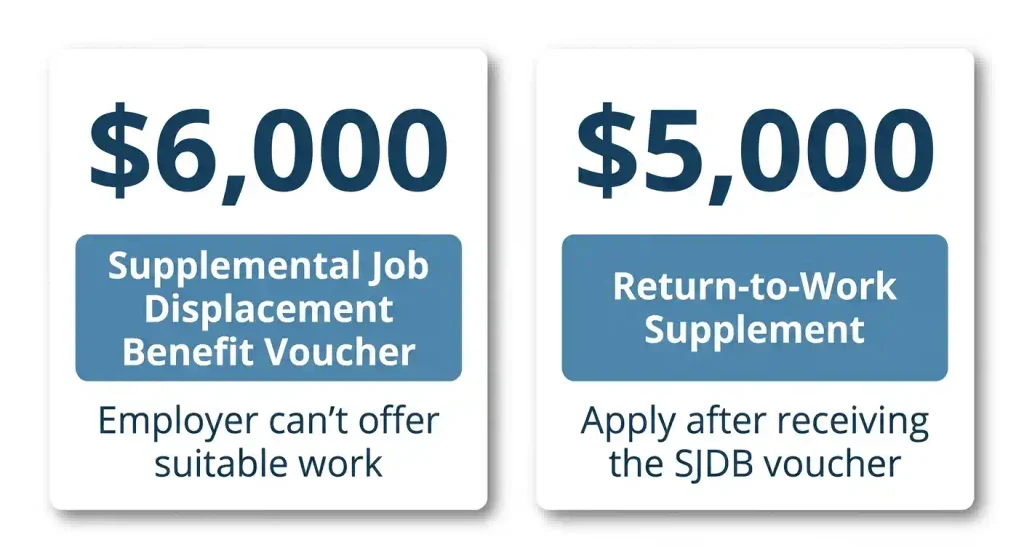
If your employer can’t offer work fitting your restrictions, you may qualify for a Supplemental Job Displacement Benefit voucher worth $6,000 for retraining or skill-building. Your insurer must send a Notice of Potential Rights within 10 days of your temporary disability ending if you might qualify.
Return-to-Work Supplement Program
Eligible workers can also receive an extra $5,000 through California’s Return-to-Work Supplement Program, tied to SJDB voucher eligibility. You must apply; it isn’t automatic.
| Benefit | Amount | Trigger |
|---|---|---|
| Supplemental Job Displacement Benefit (SJDB) voucher | $6,000 | Employer can’t offer suitable work |
| Return-to-Work Supplement | $5,000 | Apply after receiving the SJDB voucher |
Workers’ Compensation Death Benefits
Fatal work injuries trigger death benefits for a spouse, children, and other dependents, covering lost financial support plus burial expenses up to a set limit, based on how many dependents there were.
How Much Does California Workers’ Compensation Pay in 2026?
For injuries on or after January 1, 2026, the weekly minimum is $264.61 and the weekly maximum is $1,764.11. Your actual rate depends on what you earned before the injury.
California Workers’ Compensation Payment Rates for 2026
Temporary disability pays two-thirds of your gross average weekly wage, capped at $1,764.11 and floored at $264.61. Rates adjust every January based on the California statewide average weekly wage (SAWW), per Labor Code Section 4453(a)(10). Your date of injury, not your filing date, locks in which year’s rate applies.
How to Calculate Your Weekly Workers’ Compensation Benefits
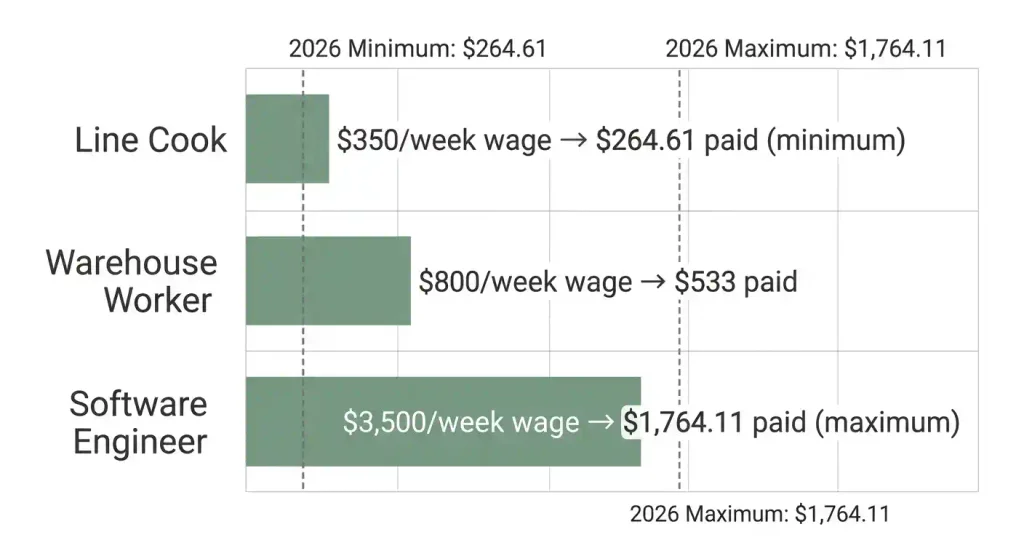
A warehouse worker earning $800 a week gets about $533 (two-thirds). A line cook earning $350 a week gets the $264.61 minimum, since two-thirds ($233) falls below it. A software engineer earning $3,500 a week caps at $1,764.11, since two-thirds ($2,333) exceeds the maximum. Higher earners lose a bigger share of actual income to the cap.
| Worker | Weekly Wage | Two-Thirds | Weekly TTD Payment |
|---|---|---|---|
| Warehouse worker (Sacramento) | $800 | $533 | $533 |
| Line cook | $350 | $233 | $264.61 (minimum applies) |
| Software engineer (Bay Area) | $3,500 | $2,333 | $1,764.11 (maximum applies) |
If you want to run your own numbers before filing, our gross pay calculator can help you estimate your average weekly wage.
Which Earnings Count Toward Workers’ Compensation Payments?
Average weekly wage includes regular wages, overtime, bonuses, commissions, and tips if consistent before the injury. Irregular hours or multiple jobs widen the pay-record window used. Pay stubs, tax records, and wage statements establish the average.
How Long Can You Receive Temporary Disability Payments?
Payments start after a short waiting period, paid retroactively if the disability lasts long enough. Temporary disability caps at 104 weeks within five years of the injury (Labor Code Section 4656), with extensions for some chronic conditions. Section 4650 sets the deadline for your first payment. Benefits stop at return to work, maximum medical improvement, or the cap, whichever comes first.
Are California Workers’ Compensation Benefits Taxable?
No. Workers’ comp benefits aren’t subject to federal or California income tax, unlike wages. Earning $5,000 a month in California, you’d normally lose $1,400 to $1,600 to federal, state, and FICA taxes combined; workers’ comp skips all of that. The IRS doesn’t treat these payments as reportable income.
How Does Workers’ Compensation Medical Treatment Work?
Here’s how California controls who treats you and what gets paid.
Can You Choose Your Own Workers’ Compensation Doctor?
Your employer usually controls treatment through a Medical Provider Network (MPN) of pre-approved doctors, or a Health Care Organization (HCO). You don’t automatically pick your own doctor unless you predesignate a personal physician in writing beforehand. Your employer must give you an MPN notice explaining the network and your predesignation right. Your Primary Treating Physician oversees your care and reports. Emergency care is the exception: go to the nearest ER first.
What Is the $10,000 Medical Treatment Rule?
While your claim is investigated (up to 90 days), the insurer must authorize up to $10,000 in treatment even before formally accepting the claim. This provisional coverage ensures timely care even if the claim is later denied.
What Happens When an Insurance Company Denies Medical Treatment?
A disputed treatment goes through Utilization Review; if denied, you can challenge it through Independent Medical Review by an outside doctor. Your doctor’s Request for Authorization (RFA) triggers UR. Decisions follow the Medical Treatment Utilization Schedule (MTUS), and approved care is billed under the California Official Medical Fee Schedule (OMFS).
Can You Get Reimbursed for Medical Travel?
You can get reimbursed for mileage, parking, and bridge tolls for claim-related travel. The rate rose to 76 cents per mile for travel on or after July 1, 2026, up from 72.5 cents. Submit a medical mileage expense form with your dates, destinations, and miles driven.
How to File a California Workers’ Compensation Claim
Missing a deadline or form can delay your benefits for weeks. Here’s the process.
Step 1: Report Your Workplace Injury Immediately
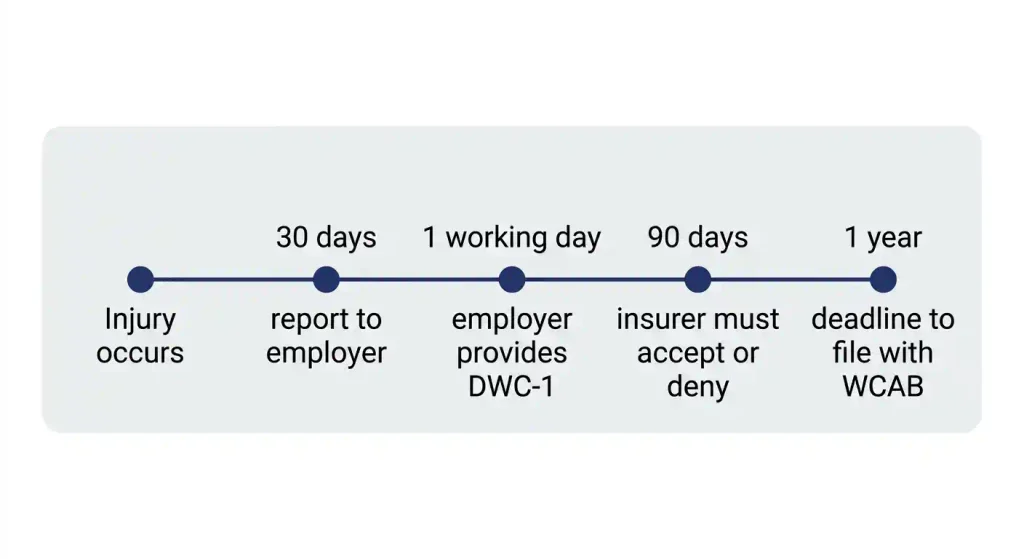
You have 30 days to report the injury; report it the same day if you can. For gradual injuries, the clock starts when you first realize it’s work-related. Reporting isn’t the same as filing: you generally have one year from the injury date to file a claim with the Workers’ Compensation Appeals Board.
Step 2: Complete the DWC-1 Workers’ Compensation Claim Form
Your employer must give you a DWC-1 claim form once you report. Fill out the employee section, sign it, return it, and keep a copy with the submission date.
Step 3: Understand Your Employer’s Responsibilities
Your employer must hand you the DWC-1 within one working day and forward it to their insurer. If they refuse or delay, request the form directly from the DWC or send your written claim straight to the insurer.
Step 4: Understand the Insurance Company’s Investigation
The insurer must acknowledge and investigate your claim. California’s 90-day presumption rule makes the injury compensable if the insurer doesn’t deny it within 90 days of receiving the DWC-1, with limited exceptions for new evidence.
Step 5: Keep Records and Follow Medical Instructions
Save every medical report, work restriction note, and wage statement, including your doctor’s Primary Treating Physician’s Progress Report filed after each visit. These records become your evidence if the claim is disputed.
What Happens If Your California Workers’ Compensation Claim Is Denied?
A denial isn’t the end; it starts a different process.
Common Reasons Workers’ Compensation Claims Are Denied
Denials stem from disputes over whether the injury is work-related, employment status, insufficient medical evidence, late reporting, or pre-existing conditions, often tied to paperwork gaps rather than a real dispute.
What to Do When Your Claim Is Delayed or Rejected
Read the notice for the stated reasons, gather supporting medical evidence, and contact the claims administrator about what’s missing. Many delays resolve here.
How to Challenge a Workers’ Compensation Decision
If unresolved, take your case to the Workers’ Compensation Appeals Board (WCAB) by filing an Application for Adjudication of Claim, then a Declaration of Readiness to Proceed to set a hearing. Many workers hire an attorney at this stage.
What Are QME and AME Medical Evaluations?
Disputed medical questions go to Qualified Medical Evaluators (QMEs) or Agreed Medical Evaluators (AMEs), whose opinions carry serious weight. If both sides can’t agree on an AME, either can submit a QME panel request, and the state randomly assigns an evaluator.
Your California Workers’ Compensation Rights After a Workplace Injury
California law protects you after you file a claim.
Can Your Employer Fire You for Filing a Workers’ Compensation Claim?
Labor Code Section 132a makes it illegal to fire, discriminate against, or punish you for filing a claim, with increased compensation and penalties if violated. Lawful, unrelated decisions like a real layoff are still allowed. Serious retaliation can also support a separate wrongful termination claim.
Can You Return to Work With Medical Restrictions?
Employers may offer modified, transitional, or alternative work fitting your restrictions. If no suitable role exists, that often triggers eligibility for the $6,000 SJDB voucher described above. A functional capacity evaluation can pin down what tasks you can safely handle.
What If Your Employer Refuses to Accommodate Your Injury?
FEHA requires California employers to reasonably accommodate qualifying disabilities, including workplace injuries, separate from workers’ comp. The California Civil Rights Department (CRD) handles FEHA complaints when an employer won’t engage.
Can You Receive Other Disability Benefits at the Same Time?
You generally can’t collect State Disability Insurance (SDI) and workers’ comp temporary disability for the same period. SSDI, administered by the Social Security Administration (SSA), and employer disability plans can sometimes overlap, with offsets. Unemployment usually isn’t available while on temporary disability. If you want to estimate your own SDI payments, try our SDI calculator.
The California Employment Development Department (EDD) runs SDI, California unemployment insurance (UI), and Paid Family Leave, which doesn’t stack with your own injury benefits. Accrued PTO or sick leave can bridge the gap, though your employer isn’t required to allow it.
California Workers’ Compensation Settlements and Permanent Disability
Permanent disability math looks complex but follows a clear logic.
How Is Permanent Disability Calculated?
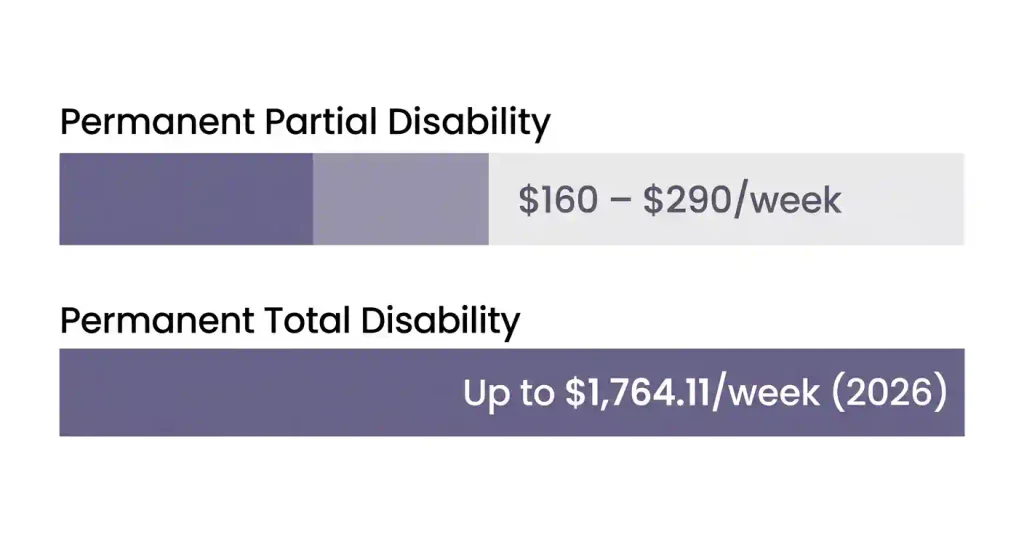
Your doctor assigns a Whole Person Impairment percentage once you reach permanent and stationary status, documented in a Permanent and Stationary (P&S) report. This gets adjusted for age and occupation, and reduced by apportionment if a pre-existing condition contributed. Permanent partial disability pays $160 to $290 a week under Labor Code Section 4658, unchanged since 2014. Permanent total disability pays at the temporary disability rate, up to the 2026 maximum of $1,764.11 a week.
| Disability Type | Weekly Rate | Basis |
|---|---|---|
| Permanent Partial Disability | $160–$290/week (unchanged since 2014) | Labor Code Section 4658 |
| Permanent Total Disability | Same as TTD rate, up to $1,764.11/week (2026) | Labor Code Section 4453(a)(10) |
What Is a Workers’ Compensation Settlement Worth?
Value depends on your disability rating, wage, age, occupation, and future medical needs; a 15% rating with ongoing care differs greatly from a 5% rating with none. A minor injury might settle for a few thousand dollars; a back injury with surgery and a 20% rating often settles in the tens of thousands; a catastrophic, permanently disabling injury can mean a lifetime of permanent total disability payments worth far more than any lump sum.
Stipulations With Request for Award vs. Compromise and Release
A Stipulations with Request for Award sets up ongoing payments and usually keeps future medical rights open. A Compromise and Release (C&R) pays a lump sum but typically closes medical rights entirely. This choice matters if your condition worsens later.
| Stipulations with Request for Award | Compromise and Release (C&R) | |
|---|---|---|
| Payment | Ongoing weekly payments | One-time lump sum |
| Future medical rights | Usually stays open | Typically closed |
Can You Reopen a Workers’ Compensation Case?
You can reopen a case within five years of the injury date if you show new and further disability. Cases closed by a Compromise and Release are much harder to reopen than a Stipulated Award.
Special California Workers’ Compensation Situations
Not every claim fits the standard pattern.
What If Your Employer Does Not Have Workers’ Compensation Insurance?
If your employer illegally skips coverage, you can file with the California Uninsured Employers Benefits Trust Fund (UEBTF), which pays benefits when the employer can’t or won’t. The employer faces legal and financial consequences, including possible criminal penalties.
Workers’ Compensation for Remote and Work-from-Home Employees
A home-desk injury qualifies if it happened while performing work duties under your employer’s control. Documenting what you were doing strengthens a remote claim.
Repetitive Stress and Cumulative Trauma Claims
Carpal tunnel, hearing loss, and repetitive back damage can build up over years as cumulative trauma. The injury date is set when you knew, or should have known, your condition was work-related, even if discovered after you’ve left the job.
What If You Leave Your Job or Move Out of California?
Changing employers doesn’t cancel an existing claim; benefits continue based on the original injury. Moving out of state doesn’t end your rights either; you can keep receiving payments and arrange out-of-state treatment.
What If Multiple Employers Contributed to Your Injury?
Cumulative trauma across more than one job can mean multiple employers share responsibility, with wages calculated from combined concurrent earnings.
California Workers’ Compensation Myths and Misconceptions
Bad information costs injured workers real money.
You Must Be at Fault to Receive Workers’ Compensation
California workers’ comp is no-fault; fault doesn’t determine eligibility. Narrow exceptions exist for intoxication or a fight you started.
Only Full-Time and Documented Workers Qualify
Part-time and undocumented workers qualify too. Employee status and immigration status are separate issues.
Filing a Claim Automatically Means You Will Be Fired
Labor Code Section 132a makes retaliatory firing illegal, with real penalties. Automatic termination for filing isn’t a legal outcome, it’s a violation.
Workers’ Compensation Pays Your Entire Salary
Workers’ comp pays two-thirds of your average weekly wage, capped at the statutory maximum. Higher earners get a smaller percentage of actual income replaced.
Accepting a Settlement Always Ends Every Benefit
A Stipulated Award can preserve future medical rights. Only a Compromise and Release typically closes them, and that’s a choice, not automatic.
Frequently Asked Questions About California Workers’ Compensation
How much does workers’ compensation pay in California in 2026?
You’ll receive two-thirds of your average weekly wage, between the 2026 minimum of $264.61 and maximum of $1,764.11.
How long does a workers’ compensation claim take in California?
Investigation runs up to 90 days before the insurer accepts or denies. Appeals through QME, AME, or WCAB can take months longer.
Can I receive workers’ compensation if I can still work?
Yes. Medical benefits don’t require missing work, and Temporary Partial Disability covers reduced hours or a lower-paying modified role.
Can I be fired while receiving workers’ compensation?
No. Unrelated, lawful decisions are still allowed, but firing can’t be retaliation for your claim.
What happens if my California workers’ compensation claim is denied?
Request the reasons in writing, gather medical evidence, and escalate to the Workers’ Compensation Appeals Board if unresolved.
Do I need a lawyer for a California workers’ compensation claim?
Simple claims often don’t need one; denied claims or WCAB disputes usually do. Fees are a court-approved percentage of your award. The State Bar of California certifies workers’ comp specialists, and a DWC Information and Assistance Officer can refer attorneys.
Can I receive workers’ compensation and SDI at the same time?
Generally no for the same period; SDI covers non-work injuries and workers’ comp covers work injuries.
Does workers’ compensation cover injuries that develop over time?
Yes. Cumulative trauma and occupational illness claims are recognized even without one specific accident.
Where to Get Official California Workers’ Compensation Help
California Division of Workers’ Compensation Resources
The California Division of Workers’ Compensation (DWC), part of the California Department of Industrial Relations (DIR), publishes claim forms, guides, and rate schedules at dwc.ca.gov. Its free Injured Worker Guidebook explains the claims process. Information and Assistance Officers offer free guidance.
How to Contact the Workers’ Compensation Appeals Board
WCAB district offices across California handle hearings, filings, and dispute resolution; find your nearest one through the DWC website.
California Workers’ Compensation Resources for Employers
Employers can find insurance requirements, self-insurance rules, and compliance guidance through the DWC and DIR, under the California Labor Code and regulations, including Title 8 of the California Code of Regulations. Coverage isn’t optional, and penalties apply regardless of company size.

Yeasin Sorker is the founder of Paycheck Calculator California. He built this tool in 2018 after noticing that most free paycheck calculators missed California-specific rules like daily overtime and the uncapped SDI rate.
He researches California payroll tax updates regularly and keeps this calculator aligned with the latest IRS, FTB, and EDD published rates. All calculations on this site are estimates based on official 2026 government sources. For personalized tax advice, consult a qualified tax professional.