
California’s UI tax rate for 2027 ranges from 1.5% to 6.2% of the first $7,000 in wages per employee, set individually by the EDD. New employers pay a flat 3.4% until an experience rate applies.
That range reflects each employer’s claims history, which is why two similarly sized California businesses can pay very different UI rates.
The 2027 SDI rate and full Schedule F+ schedule remain projections until EDD’s official December confirmation.
What Is the California UI Tax Rate for 2027?
Your exact rate depends on two things: whether you are a new or experience-rated employer, and the percentage EDD assigns your business specifically.
2027 California UI Tax Rates at a Glance
The table below breaks down the 2027 rate and wage limit for each tax type. SDI is the only one without a $7,000 cap.
California Employer Payroll Tax Rates for 2027
Three numbers matter: UI, ETT, and SDI rates, together the core California payroll taxes every employer needs. UI and ETT come out of your business account. SDI is withheld from employee paychecks and sent to the EDD.
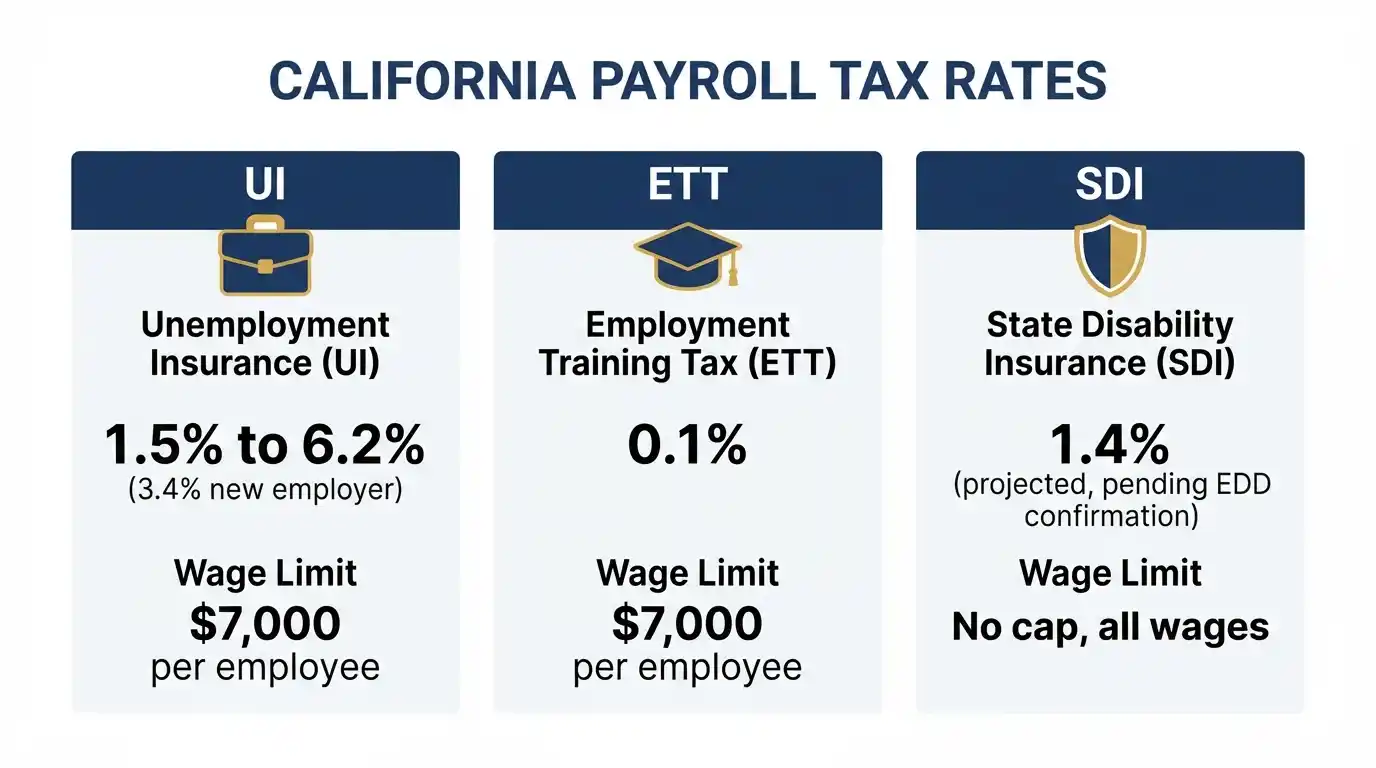
| Tax | Who Pays | 2027 Rate | Taxable Wage Limit |
|---|---|---|---|
| UI | Employer | 1.5% to 6.2% (3.4% new employer) | $7,000 per employee |
| ETT | Employer | 0.1% | $7,000 per employee |
| SDI | Employee (withheld) | 1.4% (projected, pending EDD confirmation) | No cap, all wages |
What Is Schedule F+ and Why Does California Use It?
Schedule F+ is Schedule F plus a 15% emergency surcharge, the Schedule F emergency surcharge, triggered when the unemployment fund runs low. EDD’s January 2026 forecast projects the federal loan balance at roughly $21.3 billion by the end of 2027, a forecast, not a final number. Every tax-rated employer uses the same Schedule F+ table, but your own reserve account sets your exact spot on it.
California UI Tax Rate 2026 vs 2027
Little changes between the years. The table below compares each rate side by side.
2026 and 2027 Employer Tax Rate Comparison
2027 looks almost identical to 2026, as the table below shows.
| Item | 2026 | 2027 |
|---|---|---|
| UI rate range (Schedule F+) | 1.5% to 6.2% | 1.5% to 6.2% (expected) |
| UI wage base | $7,000 | $7,000 (unchanged) |
| ETT rate | 0.1% | 0.1% |
| SDI rate | 1.3% (confirmed) | 1.4% (projected, pending EDD confirmation) |
What the 2027 Changes Mean for Employer Payroll Budgets
Your assigned rate on the DE 2088 notice matters more than the published range. A jump from 1.5% to 3% on a 20-person payroll adds up fast. Update your payroll code settings with the new SDI rate and confirm your assigned UI rate before running your first 2027 payroll.
How Does EDD Determine Your California UI Tax Rate?
Your rate comes from experience rating: the EDD compares what you have paid in against what former employees have drawn in benefits. Two similarly sized businesses can land on very different rates.
Understanding California’s UI Experience Rating System
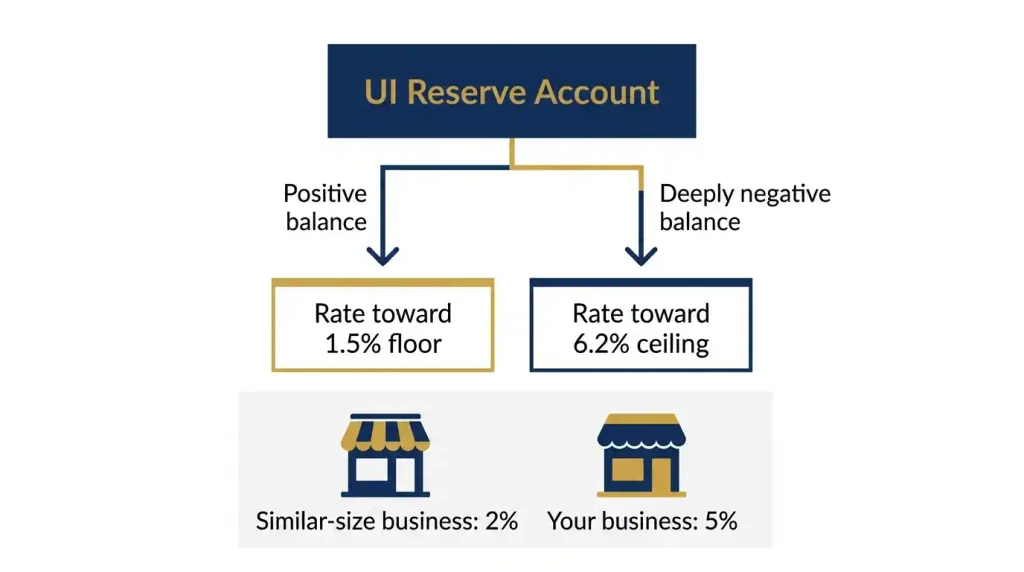
Every tax-rated employer has a reserve account. UI contributions are credits, benefit charges are debits. The EDD compares your reserve balance to your average payroll, called the reserve ratio, to place you on the Schedule F+ table. This is the California UI experience rating system, so a similar-size business can pay 2% while you pay 5%. EDD’s Information Sheet: California System of Experience Rating (DE 231Z) covers the full formula.
What Is a UI Reserve Account?
Your employer UI reserve account is a running tally the EDD keeps. Contributions are credits, benefit charges against former employees are debits. A positive balance pushes your rate toward the 1.5% floor. A deeply negative balance pushes you toward the 6.2% ceiling.
How Employee Unemployment Claims Affect Employer UI Rates
Benefits paid to a former employee get charged to your reserve account, which can raise your future rate. But charges are not automatic. If someone was fired for misconduct or quit without good cause, their benefits may not get charged to you at all.
What Causes an Employer’s UI Tax Rate to Increase?
More benefit charges, usually from layoffs or high turnover, is the main driver. A statewide schedule change can also raise your rate even with a stable workforce, since a worse fund balance pushes every employer’s table higher.
What Is the California New Employer UI Tax Rate for 2027?
New California employers pay a flat 3.4% UI rate for 2027, no experience rating involved until the EDD has enough claims history on file.
The 3.4% New Employer UI Rate
The 3.4% rate applies to the first $7,000 of each employee’s wages. The EDD assigns it automatically on registration, no application needed, until your business builds enough history for an experience rate.
How Long Do New Employers Pay the 3.4% Rate?
Expect two to three years before EDD switches you to experience rating, timed to when your account has enough history, not a fixed date. After that, your rate can move up or down from 3.4%.
What Happens When You Buy an Existing Business?
You can take on the previous owner’s UI rate and account history, or sometimes start fresh, depending on EDD’s classification. Acquiring substantially all of a business usually means the EDD continues that account rather than treating you as new. Confirm with the EDD before the sale closes, and review our new hire paperwork requirements if you are bringing on staff under the new entity.
What Are California’s ETT and SDI Rates for 2027?
ETT stays at 0.1% for 2027. SDI is projected to rise to 1.4%. Only SDI comes out of employee paychecks.
California Employment Training Tax (ETT) Rate
ETT is 0.1% on the same $7,000 wage base as UI, capping it at $7 per employee per year, and funds workforce training. See our full California ETT rate breakdown for how it is calculated. A negative reserve account balance can drop ETT to zero, shown on your DE 2088.
California State Disability Insurance (SDI) Rate
SDI is projected to rise to 1.4% for 2027, up from the confirmed 1.3% in 2026, though EDD finalizes it only in December. See our California SDI rate page for the full year-by-year history. It applies to all wages, uncapped since 2024, and funds disability and paid family leave benefits. It comes out of the employee’s paycheck, not your business account. Use our SDI calculator to estimate your own withholding.
UI vs ETT vs SDI vs California Income Tax
UI and ETT are employer costs capped at $7,000 per employee. SDI and California Personal Income Tax (PIT) withholding come out of the employee’s paycheck instead. SDI has no wage cap; PIT depends on the W-4 and DE 4 form.
How Much Are Combined UI and ETT Taxes Per Employee?
A new employer at 3.4% UI plus 0.1% ETT owes $238 plus $7, or $245 per employee per year, whether the employee earns $30,000 or $130,000, since both exceed the $7,000 cap. An employer at the $434 UI max with zero ETT lands near the same total. Do not add SDI here; that is withheld, not paid by the business.
How Much Does California UI Tax Cost Per Employee in 2027?
Multiply your assigned UI rate by the $7,000 taxable wage base. That is your cost per employee, capped once wages hit $7,000.
How to Calculate California UI Tax
The formula: taxable wages times your assigned rate. Wages stop counting past $7,000, so a $150,000 earner costs the same as a $7,500 earner. Your assigned rate on the DE 2088 is what matters, not the 1.5% to 6.2% range.
Maximum and Minimum UI Tax Per Employee
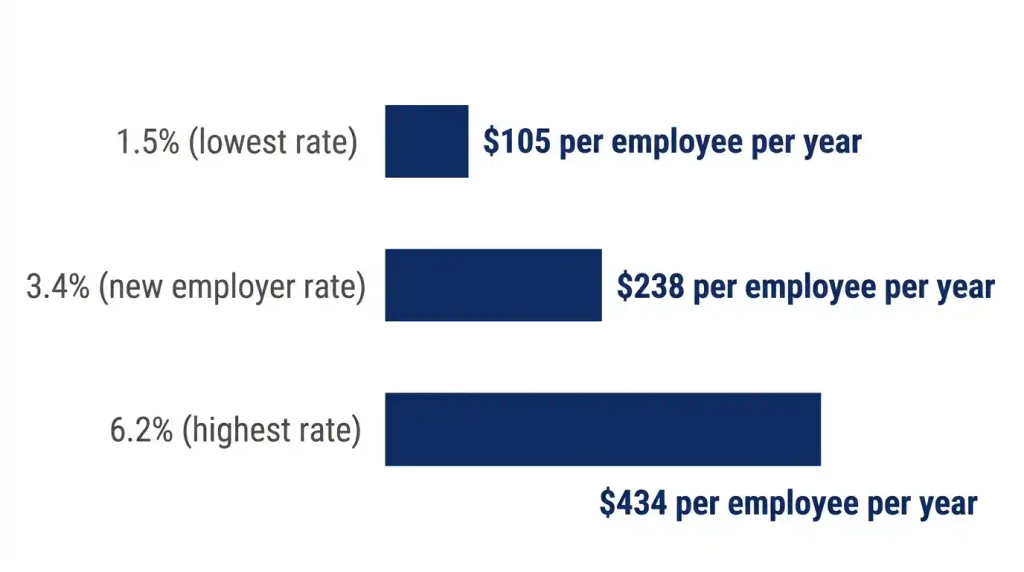
That $105 to $434 spread is the real budgeting range, not the percentage alone:
- 1.5% (lowest rate): $105 per employee per year
- 3.4% (new employer rate): $238 per employee per year
- 6.2% (highest rate): $434 per employee per year
Real-World California UI Tax Calculation Examples
A $5,000 earner is fully taxable: $170 at 3.4%. A $30,000 earner still costs $238 at 3.4%, since only the first $7,000 counts. An $80,000 earner costs the same $238; the other $73,000 is UI-tax-free.
How Much UI Tax Does a Business Pay for Multiple Employees?
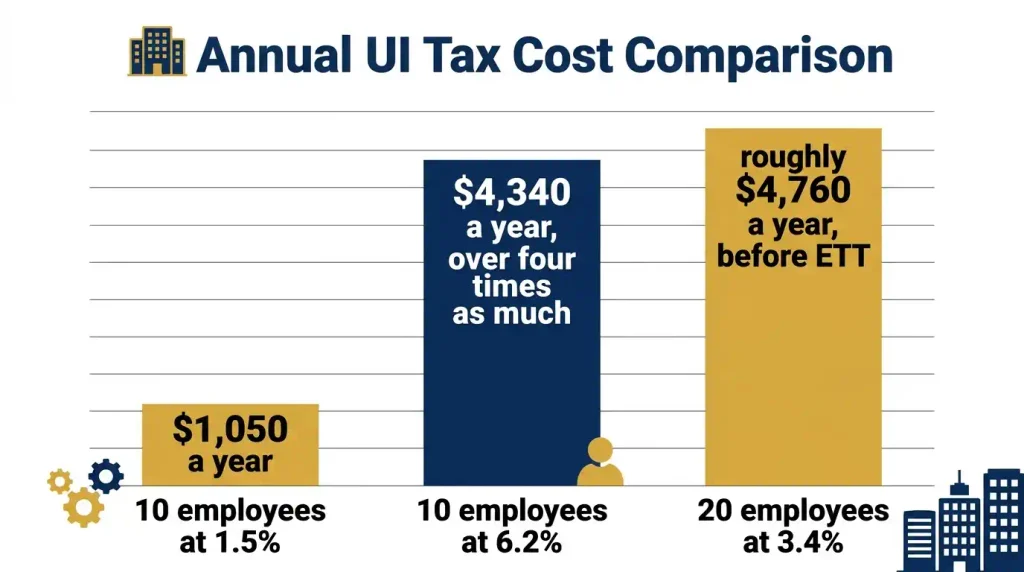
Multiply per-employee UI cost by headcount:
- 10 employees at 1.5%: $1,050 a year
- 10 employees at 6.2%: $4,340 a year, over four times as much
- 20 employees at 3.4%: roughly $4,760 a year, before ETT
California UI Tax Rules, Exceptions, and Common Misconceptions
Not everyone pays the same rate, not every dollar counts toward UI, and one claim does not always raise your rate. Here is where people get it wrong.
Does Every California Employer Pay the Same UI Rate?
No. The 1.5% to 6.2% figure is a statewide range, not a flat tax. Your rate is set by your own reserve account history; check your DE 2088 for the real number.
Does an Employer Pay UI Tax on All Employee Wages?
Only the first $7,000 per employee per year is taxed. Wages beyond that are UI-tax-free for the rest of the year. The limit resets every January 1.
Do Part-Time, Seasonal, and Temporary Employees Count?
Yes, the $7,000 limit applies to full-time, part-time, and seasonal workers alike, tracked within the calendar year. Someone hired in July still gets the full $7,000 limit, not a prorated amount. A returning seasonal worker who already hit $7,000 owes no more UI tax that year.
Are Bonuses, Commissions, and Overtime Subject to UI Tax?
Yes, in almost all cases. Bonuses, commissions, and overtime count toward the $7,000 limit like regular wages. See our California bonus tax rate guide for how withholding works on these payments. EDD’s Types of Payments (DE 231TP) covers exceptions for unusual compensation.
What Happens With Independent Contractors?
True independent contractors owe no UI tax. The risk is misclassification, and California’s ABC test decides which category a worker falls into. Calling someone a contractor when the law says employee can trigger back UI taxes, penalties, and interest; see our guide on employee misclassification for the real cost.
Special Employer UI Tax Situations
Nonprofits and public entities can choose reimbursable status, paying EDD dollar for dollar for benefits instead of a rate. Acquisitions and mergers follow successor rules. SUTA dumping, like shifting payroll to a shell company for a lower rate, draws the maximum rate plus an extra 2% penalty under the California Unemployment Insurance Code (CUIC) Section 977(c), enforced under the state’s AB 664 SUTA dumping provisions. See EDD’s SUTA dumping page for how the state identifies it.
How to Find Your 2027 California UI Tax Rate
Your actual rate lives on one document: the DE 2088. The published range is not your number.
Find Your Rate on the DE 2088 Notice
The DE 2088, officially the Notice of Contribution Rates and Statement of UI Reserve Account, lists your assigned UI rate, ETT rate, and wage limit, plus your reserve account breakdown. EDD’s Explanation of Notice of Contribution Rates (DE 2088C) explains each line. For past years’ rates, see Tax Rates, Wage Limits, and Value of Meals and Lodging (DE 3395), part of EDD’s official rates and withholding page.
Check Your UI Rate Online Through California EDD
EDD’s Get My UI Rate tool pulls your current rate online using your employer payroll tax account number. You can also check EDD e-Services for Business for the same data plus your full account history.
How Payroll Agents Check Multiple Employer UI Rates
Payroll agents can use e-Services for Business’s Bulk Rate Inquiry to pull rates across client accounts at once, instead of logging into each separately.
What If You Have Not Received Your 2027 DE 2088?
EDD typically mails the notice by December 31. Check e-Services for Business first, since rates often post there before the mail arrives. Contact EDD if it is still missing.
What Should You Do If Your 2027 UI Tax Rate Is Wrong?
Review the notice line by line. You have a limited window to protest errors before the rate locks in for the year.
How to Review Your DE 2088 for Errors
Check your assigned UI rate, reserve balance, and itemized benefit charges, where errors like a wrongly charged layoff or missing credit tend to hide. EDD’s statements and information sheets on reserve account charges, available through e-Services for Business, break down the detail.
How to Protest an Incorrect UI Contribution Rate
You have 60 days from the notice date to protest, online through e-Services for Business or by mail. ETT and SDI rates cannot be protested, only your UI rate.
What Happens If You Use the Wrong UI Tax Rate?
A higher-than-assigned rate means overpaying, with paperwork needed to recover it. A lower rate triggers an underpayment, caught eventually with assessments, interest, and penalties, the same result as payroll software left on the 2026 rate past January. Either way, correct your records and settle the difference.
How to Update Payroll Software for 2027
Enter your assigned UI and ETT rates before your first 2027 payroll. Confirm the $7,000 wage limit is reset, and check that wage tracking and quarterly reporting fields are accurate.
Frequently Asked Questions About California UI Tax Rate 2027
Quick answers to the most common questions about the California UI Tax Rate 2027.
What is the California unemployment insurance tax rate for 2027?
1.5% to 6.2% under Schedule F+, assigned individually based on your reserve account and claims history.
What is the new employer UI tax rate in California for 2027?
A flat 3.4%, assigned automatically for roughly two to three years.
What is the California UI taxable wage limit for 2027?
$7,000 per employee per calendar year.
What is the maximum California UI tax per employee in 2027?
$434 per employee per year at the 6.2% top rate, though SUTA dumping penalties can push it higher.
Is California unemployment insurance tax paid by employers or employees?
Employers pay it entirely. It is not withheld from paychecks, unlike SDI.
When will employers receive their 2027 DE 2088 notice?
EDD generally mails it by December 31, 2026, often posted online first in e-Services for Business.
Can an employer challenge its California UI tax rate?
Yes, within roughly 60 days of the notice date, online or in writing. ETT and SDI rates are not protestable.
Final 2027 California UI Tax Preparation Checklist
These final checks take only a few minutes and prevent costly rate errors once 2027 payroll begins.
What Employers Should Verify Before Running 2027 Payroll
Confirm your assigned UI and ETT rates from the DE 2088. Update the $7,000 wage limit and the projected 1.4% SDI rate once EDD confirms it in December. Check wage records and quarterly reporting before running payroll.

Yeasin Sorker is the founder of Paycheck Calculator California. He built this tool in 2018 after noticing that most free paycheck calculators missed California-specific rules like daily overtime and the uncapped SDI rate.
He researches California payroll tax updates regularly and keeps this calculator aligned with the latest IRS, FTB, and EDD published rates. All calculations on this site are estimates based on official 2026 government sources. For personalized tax advice, consult a qualified tax professional.