
$40 an hour equals $83,200 per year based on a standard 40-hour, 52-week schedule. After federal and California taxes in 2026, a single filer takes home roughly $61,740 — over $21,000 less than the gross figure. That gap exists because California layers five separate deductions onto every paycheck: federal income tax, state income tax, Social Security, Medicare, and SDI. For a full breakdown of every deduction on a California paycheck, see the California payroll taxes guide. How much of that $61,740 actually feels like enough depends almost entirely on which city you live in.
Annual Salary at $40 Per Hour
Forty dollars an hour times 40 hours a week equals $1,600 per week. Multiply by 52 weeks and you get $83,200. That is the standard full-time assumption every payroll department and salary calculator uses.
This figure assumes you work every week without unpaid time off. Two weeks of unpaid vacation drops your actual earned income to $80,000.
Salary Breakdown by Pay Period
Here is what $40 an hour looks like across every common pay schedule:
- Daily (8-hour day): $320
- Weekly: $1,600
- Biweekly (every two weeks): $3,200
- Monthly (average): $6,933
- Annual: $83,200
These are all gross figures. Take-home pay will be lower once federal taxes, California state taxes, and other deductions come out.
Takeaway: $40 an hour equals $83,200 per year based on a standard 40-hour, 52-week work schedule.
How the $40/Hour to Annual Salary Calculation Works
Standard Formula Explained
Hourly wage x hours per week x weeks per year = annual salary
For $40 an hour: $40 x 40 x 52 = $83,200. Most salary calculators use 2,080 as the total annual work hours (40 hours x 52 weeks), the industry-standard baseline for full-time employment. You can verify your own figures using the annual salary calculator.
A popular shortcut: multiply your hourly wage by 2,000 for a quick estimate. At $40 an hour, that gives $80,000. It is slightly low because it assumes only 50 work weeks. The precise method uses 2,080 hours, which is why calculators sometimes show different numbers. Some employers also run a 37.5-hour workweek, which changes the annual total to $78,000 at $40 an hour. Always confirm your contracted hours before comparing offers.
What Changes the Final Number
Overtime pushes your income higher. In California, hours beyond 8 in a single day or 40 in a single week are paid at 1.5x your rate. At $40 an hour, your overtime rate is $60 per hour. Hours beyond 12 in a single day or the seventh consecutive day in a workweek trigger double-time at $80 per hour. See the full breakdown of California double-time vs overtime rules to understand exactly when each tier applies.
Paid vacation and PTO do not reduce your annual pay. Two weeks of paid time off still yields $83,200. The reduction only happens with unpaid time off. Hourly workers should verify whether holidays are paid or unpaid. California SDI pays a maximum weekly benefit of $1,765 in 2026 if you need to use it, as confirmed by the California Employment Development Department. The CA SDI rate for 2026 explains exactly how that deduction is calculated on every paycheck.
Part-time schedules reduce the total. At 30 hours a week, gross annual income drops to $62,400. Seasonal work and unpaid leave have the same effect.
Takeaway: The annual salary formula is straightforward, but your real income depends on how many hours you actually work each year.
$40 an Hour After Taxes in California
Estimated Take-Home Pay
California is one of the highest-taxed states in the country. On $83,200 as a single filer in 2026, multiple tax layers come out of every paycheck.
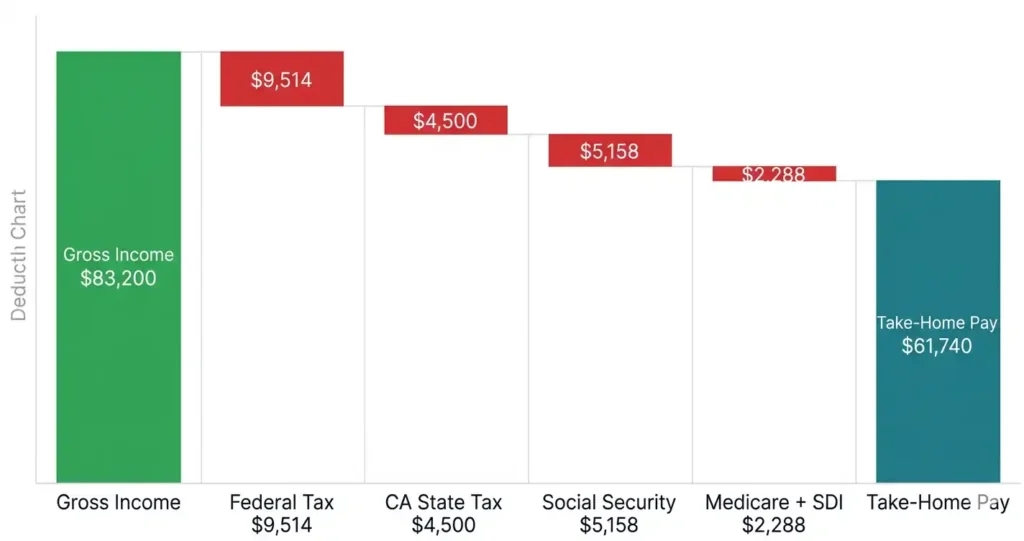
Here is a realistic breakdown for a single filer with no dependents in 2026:
- Federal income tax: approximately $9,514
- California state income tax: approximately $4,500
- Social Security (6.2%): approximately $5,158
- Medicare (1.45%): approximately $1,206
- California SDI (1.3%): approximately $1,082
Your estimated annual take-home pay lands around $61,740, or roughly $5,145 per month. Your combined FICA taxes (Social Security plus Medicare) total about $6,364 per year. Your effective federal tax rate on $83,200 works out to roughly 11.4 percent after the $16,100 federal standard deduction for single filers reduces your taxable income — confirmed by the IRS 2026 tax brackets and standard deduction tables. This is lower than the marginal rate because federal brackets only apply to income within each tier, not your entire paycheck. The full California tax brackets for 2026 show exactly which rate applies at each income tier, based on rates published by the California Franchise Tax Board.
Monthly Take-Home Income
At $5,145 per month in net pay, your biweekly paycheck is around $2,374 after taxes. Your weekly take-home is roughly $1,187. These numbers assume a single filer with standard deductions and no pre-tax contributions like a 401k or health insurance premiums.
Budgeting from your gross income of $83,200 is one of the most common and costly financial mistakes I see people make. Always plan from your net pay.
Factors That Change Your Tax Outcome
Filing status matters significantly. A married couple filing jointly on $83,200 typically owes less federal tax than a single filer. Dependents can qualify you for credits like the Child Tax Credit, which directly reduces what you owe. Retirement contributions to a traditional 401k reduce your taxable income dollar for dollar. Contributing $6,000 per year means you pay income tax on $77,200 instead of $83,200. Health insurance premiums paid pre-tax through your employer also lower your taxable income. Note that Social Security applies to all wages up to the 2026 wage cap of $184,500, so your full $83,200 is subject to that 6.2 percent deduction — a threshold set annually by the Social Security Administration. The California standard deduction for 2026 explains how the state deduction interacts with your federal filing. If you want to see each line item live on your stub, the guide on how to read a California pay stub walks through every deduction field.
Takeaway: Your real take-home pay on $83,200 in California is roughly $61,740 per year for a single filer, but pre-tax deductions can meaningfully increase that number.
Is $40 an Hour Good Pay in California?
How $83,200 Compares to Average Income
In 2026, the median household income in California sits around $91,000. A single earner at $83,200 lands slightly below that household median but well above the U.S. median individual income of around $60,000, according to Bureau of Labor Statistics wage data.
For a single person, this is strong pay. For a family of four trying to cover rent in San Francisco, it starts to feel tight fast.
What Jobs Commonly Pay Around $40 an Hour
Earning $40 an hour is not uncommon in California across several fields.
Healthcare roles like licensed vocational nurses, medical imaging technicians, and physical therapy assistants often land in this range. California’s healthcare worker minimum wage rules set a strong floor for these roles, which is why $40 an hour is increasingly the entry point rather than a ceiling. Skilled trades such as electricians, HVAC technicians, and construction supervisors frequently earn $38 to $45 per hour in California. Union wages in the building trades and public sector often start at or above $40 an hour once full journeyman status is reached, with base wage floors tracked by the California Department of Industrial Relations prevailing wage database. Technology positions including junior software developers, IT support specialists, and systems administrators can also reach this level. Technical specialists in fields like insurance, financial services, and industrial equipment often see $40 an hour once they have a few years of experience.
Is It Considered Middle Class?
In California, middle class depends heavily on location and household size. Pew Research Center defines middle class in a high-cost metro like Los Angeles or San Jose as roughly $70,000 to $200,000 for a household of three. For a single person, $83,200 qualifies as solidly middle class.
In lower-cost regions like the Central Valley or Inland Empire, $83,200 places you comfortably in the middle class with real room to save.
Takeaway: $40 an hour is above the national average and qualifies as middle-class income in most California regions, though purchasing power varies dramatically by city.
$40 an Hour Compared to Other Hourly Wages
$30 vs $40 Per Hour
At $30 an hour, gross annual salary is $62,400. At $35, it is $72,800. At $40, it is $83,200. The jump from $30 to $40 is $20,800 more per year in gross income. After California taxes, the take-home gap is around $14,000 to $15,000 annually, or roughly $1,200 more per month. That difference covers a year of car payments, a full emergency fund, or meaningful down-payment savings. If you work reduced hours at any of these rates, the part-time vs full-time paycheck comparison shows exactly how the tax math shifts when weekly hours drop.
$40 vs $50 Per Hour
Moving from $40 to $50 an hour takes gross income from $83,200 to $104,000. After California taxes, that $20,800 jump translates to roughly $13,000 to $14,000 more in take-home pay annually, or about $1,100 to $1,200 more per month. At $50 an hour, homeownership becomes more realistic in mid-tier California markets and retirement savings can accelerate meaningfully. For context on neighboring income levels, see 75k after taxes in California and 100k after taxes in California to see exactly how the take-home progression works across salary tiers.
Salary Comparison Table
Hourly Rate to Annual Salary Comparison
| Hourly Rate | Gross Annual | Gross Monthly | Gross Weekly | Est. Take-Home (CA, Single) |
|---|---|---|---|---|
| $25/hr | $52,000 | $4,333 | $1,000 | ~$40,500/yr |
| $30/hr | $62,400 | $5,200 | $1,200 | ~$47,500/yr |
| $35/hr | $72,800 | $6,067 | $1,400 | ~$54,500/yr |
| $40/hr | $83,200 | $6,933 | $1,600 | ~$61,740/yr |
| $45/hr | $93,600 | $7,800 | $1,800 | ~$68,000/yr |
| $50/hr | $104,000 | $8,667 | $2,000 | ~$74,500/yr |
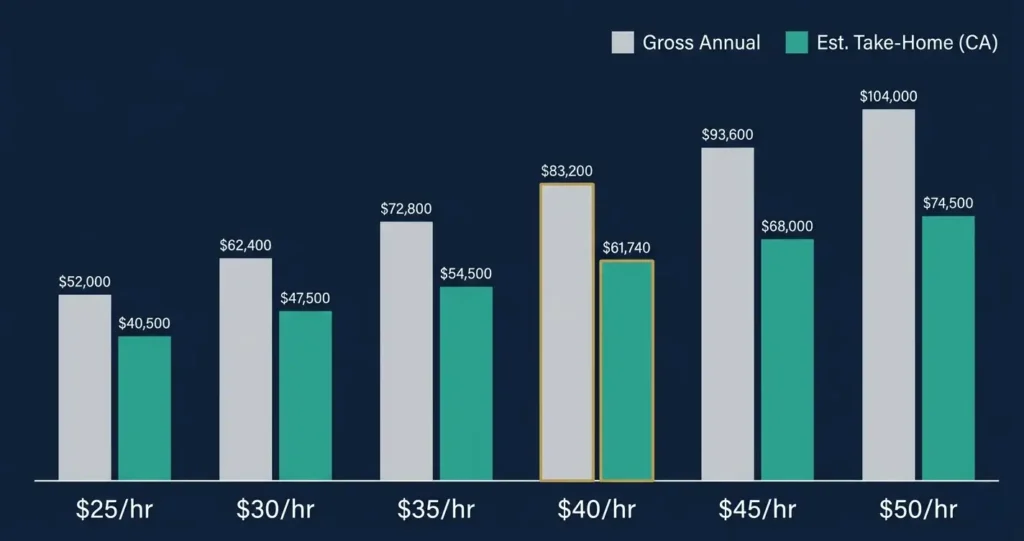
Take-home estimates reflect 2026 California tax rates for a single filer using standard deductions.
Takeaway: Each $10 per hour increase adds roughly $20,800 in gross annual income and approximately $13,000 to $15,000 in additional take-home pay after California taxes.
Can You Live Comfortably on $40 an Hour in California?
Single Adult Lifestyle Scenario
With $5,145 in monthly take-home, a single adult can live comfortably in many California cities. With $1,500 to $1,800 on rent, over $3,000 remains for groceries, transportation, utilities, and savings. In Sacramento, Fresno, or Riverside, you can realistically save $500 to $800 per month while still covering debt repayment or building an emergency fund.
In Los Angeles or San Diego, a one-bedroom often costs $2,000 to $2,600 per month, leaving little room for aggressive savings or debt paydown.
Couple Household Scenario
If both partners earn $40 an hour, household gross income reaches $166,400. Combined take-home exceeds $120,000 per year. Shared housing, utilities, and groceries make a dramatic difference. A couple can afford a two-bedroom in most California cities and still save aggressively toward homeownership or retirement.
In a one-income scenario, a couple can manage a lean budget by keeping housing costs low and sharing expenses.
Family Budget Scenario
Childcare in California averages $1,500 to $2,500 per month for one child in 2026. Add rent, food, transportation, and health insurance, and a single parent at $40 an hour faces real financial pressure. Two parents at this income level have far more flexibility. Families who keep combined housing and childcare below 50 percent of take-home pay have a workable budget. Costs ease significantly once children reach school age.
Takeaway: $40 an hour supports a comfortable single lifestyle in most California cities, works well for couples, and requires careful budgeting for families with young children.
$40 an Hour in Different California Cities
Los Angeles
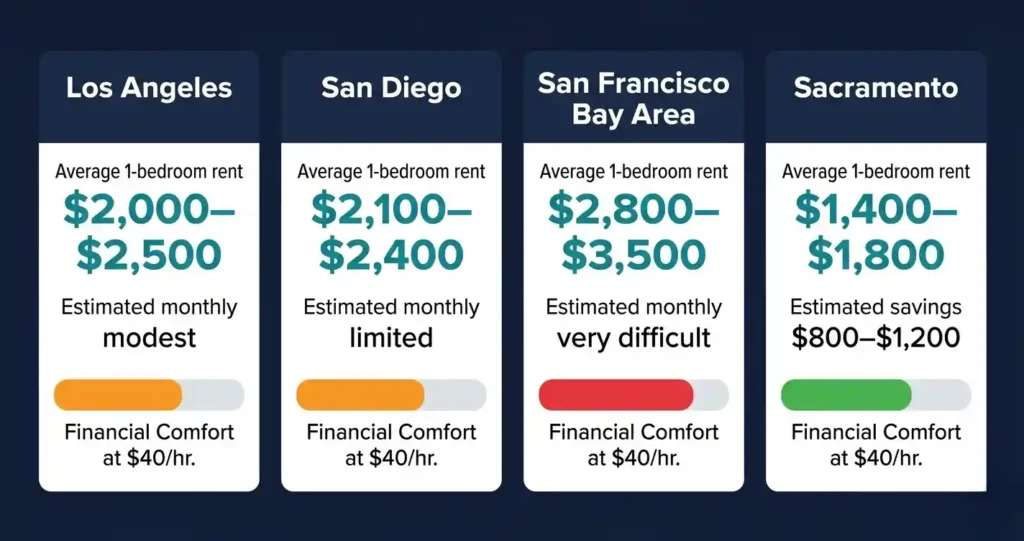
One-bedroom rent in Los Angeles runs $2,000 to $2,500 per month in 2026. On a $5,145 take-home, that leaves $2,645 to $3,145 for everything else. LA is heavily car-dependent, so budget $400 to $600 monthly for transportation. Savings are modest unless you have a roommate or live in more affordable neighborhoods like Van Nuys, Reseda, or Hawthorne. Use the Los Angeles paycheck calculator to run your exact numbers with LA-specific inputs.
$40 an hour in LA is a functional working-class to lower-middle-class income that demands intentional spending.
San Diego
One-bedroom apartments in San Diego average $2,100 to $2,400 per month in 2026. Public transit is limited, so add $400 to $500 monthly for a car. Housing and transportation alone can consume 50 percent of a $5,145 take-home. Financial comfort requires a roommate or living in neighborhoods like El Cajon, Santee, or Chula Vista. The San Diego paycheck calculator lets you plug in your exact salary and filing status for a precise take-home figure.
Saving for a home purchase in San Diego on $40 an hour alone is a long-haul goal.
San Francisco Bay Area
The median rent for a one-bedroom in San Francisco and the surrounding Bay Area sits between $2,800 and $3,500 per month in 2026. That is more than half of a $5,145 take-home before spending a dollar on food or transportation. Most people earning $40 an hour here share housing, live in Oakland or the East Bay, or commute from further suburbs.
The Bay Area requires a second income, shared living, or a very disciplined budget to make $40 an hour work. Purchasing power here is significantly lower than anywhere else in California. The San Francisco paycheck calculator gives you a city-specific take-home estimate to reality-check any Bay Area job offer.
Sacramento
One-bedroom apartments in Sacramento average $1,400 to $1,800 per month in 2026, leaving $3,345 to $3,745 after rent on a $5,145 take-home. Lower transportation costs and a friendlier commute culture add to the advantage. A single person can realistically save $800 to $1,200 per month here. Sacramento is also a growing destination for remote workers priced out of the Bay Area. Run your numbers with the Sacramento paycheck calculator to see exactly how far $40 an hour stretches in this market.
Takeaway: $40 an hour goes furthest in Sacramento and the Central Valley, remains workable in San Diego and LA with careful budgeting, and feels stretched in the San Francisco Bay Area.
What Does a $40/Hour Budget Look Like?
Sample Monthly Budget
Here is a realistic monthly budget for a single adult earning $40 an hour in a mid-cost California city, based on a $5,145 monthly take-home. For a personalized figure, use the California paycheck calculator to enter your exact hours, filing status, and deductions. The paycheck basics category also covers common questions about reading and understanding your net pay.
| Category | Monthly Amount |
|---|---|
| Rent | $1,700 |
| Groceries | $450 |
| Transportation | $500 |
| Utilities | $150 |
| Health & Personal | $200 |
| Entertainment | $200 |
| Dining Out | $200 |
| Savings | $600 |
| Emergency Fund | $200 |
| Miscellaneous | $200 |
| Total | $4,400 |
This leaves a buffer of about $700 per month. Cities with higher rent compress the savings line significantly.
Budget Using the 50/30/20 Rule
Needs (50%): $2,573 per month. Covers rent, utilities, groceries, transportation, and minimum debt payments. In high-rent cities, this frequently exceeds 50 percent.
Wants (30%): $1,544 per month. Dining out, streaming, hobbies, travel, and non-essentials.
Savings (20%): $1,029 per month. Emergency fund, retirement contributions, and savings goals like a down payment.
California’s housing market often pushes this closer to a 60/20/20 split in practice.
Takeaway: A realistic monthly budget on $40 an hour requires keeping housing below $1,800 in most California cities to maintain any meaningful savings rate.
How Much House or Rent Can You Afford on $40 an Hour?
Recommended Housing Budget
The 30 percent rule puts your housing ceiling at $2,080 per month (30% of $6,933 gross monthly income). A more conservative target using 30 percent of take-home is around $1,530 per month. In Sacramento, Riverside, or Fresno, that budget works well for a one-bedroom. In Los Angeles or San Diego, it limits you to shared housing or outer neighborhoods. In San Francisco, it is effectively impossible for a standalone unit.
Renting vs Buying on $83,200 Per Year
Renting is the practical reality for most single earners at this income level in California.
Buying a median-priced California home in 2026 requires $80,000 to $100,000 down on a $700,000 to $900,000 home. Mortgage lenders typically qualify borrowers at 28 to 31 percent of gross monthly income. On $6,933 gross monthly income, your maximum qualified payment is around $1,940 to $2,150, which covers a modest loan in lower-cost markets only. Homeownership on $40 an hour is achievable primarily in inland markets and most likely with a co-borrower or existing savings.
Takeaway: Renting up to $1,700 per month is realistic in most California cities on $40 an hour. Buying requires significant savings and is most achievable in inland markets.
Real-Life Scenarios and Decision-Making Examples
Accepting a New Job at $40 Per Hour
Look beyond the hourly number before accepting any offer.
A job paying $40 per hour but charging $600 per month for health coverage effectively cuts your real pay by $7.50 per hour. An employer matching 4 percent of your salary adds over $3,300 per year to your compensation. A 60-mile daily commute costs $400 to $600 per month in fuel and wear. Two weeks of paid vacation has a dollar value of $3,200 at $40 an hour — a role offering four weeks is worth $3,200 more in effective compensation. A $38 per hour job with a clear path to $50 per hour in two years is often worth more than a static $40 per hour role. Once you accept an offer, make sure you fill out the California DE-4 form correctly so your state withholding matches your actual tax liability from day one.
Moving to California for a $40/Hour Job
Relocation expenses run $3,000 to $10,000 depending on distance. Research housing costs in the specific city before moving — the difference between Sacramento and San Jose is enormous. Have at least three months of living expenses saved before arriving.
What felt comfortable in Texas or Nevada may feel tighter in coastal California. The salary often compensates, but plan for the adjustment period.
Takeaway: Evaluate the full compensation package beyond the hourly rate, and plan your relocation budget carefully before making the move to California.
How Overtime Changes a $40/Hour Salary
Time-and-a-Half Pay
In California, overtime begins after 8 hours in a single day or 40 hours in a single week. At $40 an hour, overtime pays $60 per hour. Working just 5 overtime hours per week for a full year adds $15,600 in gross income, pushing annual earnings to nearly $98,800. These rules are governed by the California Department of Industrial Relations, which enforces some of the strictest overtime protections in the country. The California overtime laws for 2026 cover every trigger threshold and exemption category in detail.
Trades workers, healthcare staff, and manufacturing employees frequently work overtime. At a $40 base rate, annual income of $90,000 to $100,000+ is realistic in these fields.
Takeaway: California overtime at $60 per hour for a $40/hour worker can add $10,000 to $20,000+ in annual income depending on how frequently overtime is available in your field.
Common Misconceptions About Making $40 an Hour
“$83,200 Means I’ll Take Home $83,200”
This is the most costly misunderstanding I encounter.
$83,200 is your gross income before any deductions. After federal income tax, California state tax, Social Security, Medicare, and SDI, you take home roughly $61,740 as a single filer. That is over $21,000 less. Always budget from your net income. Gross is what you negotiate. Net is what you live on. If your paycheck consistently feels smaller than expected, the guide on why your California paycheck is so low walks through the six most common causes.
“$40 an Hour Is Rich Everywhere”
$40 an hour is strong pay in rural Kentucky or small-town Texas. In San Francisco or Santa Monica, it is a working-class wage. California’s housing costs are dramatically higher than most states. A person earning $40 an hour in Sacramento has far more real purchasing power than someone earning the same in San Francisco. The local cost of living determines what the number actually buys.
Takeaway: Always compare your take-home pay to local costs, not gross income to national averages. Where you live determines what $40 an hour actually means for your life.
Frequently Asked Questions
Is $40 an hour good money in California?
Yes, $40 an hour is good money in California for a single person. It places you above the national individual income average and within the middle-class range for most California regions. In inland cities, it supports a comfortable lifestyle with real savings potential. In coastal cities like San Francisco, it is functional but not financially comfortable without careful budgeting or shared housing.
How much is $40 an hour monthly after taxes?
For a single filer in California in 2026, $40 an hour translates to approximately $5,145 per month in take-home pay. This estimate uses the 2026 federal standard deduction of $16,100 for single filers — as published by the IRS — and California’s standard deduction of $5,706. Adding a 401k contribution or other pre-tax deductions will slightly reduce take-home pay but lowers your taxable income, which can improve your overall tax position. You can also use the gross pay calculator to quickly model how pre-tax contributions change your gross-to-net math.
Can I afford an apartment alone making $40 an hour?
In most California cities, yes. The standard guideline is to spend no more than 30 percent of your gross monthly income on rent, which puts your ceiling at about $2,080 per month. One-bedroom apartments at or below that price point are available in Sacramento, Fresno, Riverside, and parts of the Los Angeles and San Diego metro areas. In San Francisco and Silicon Valley, a solo apartment under that budget is extremely difficult to find. If you are considering San Jose specifically, the San Jose paycheck calculator shows what $40 an hour actually nets out to in that market.
Is $40 an hour middle class in California?
By most 2026 economic benchmarks, yes. Pew Research Center defines middle class as earning between two-thirds and double the national median income. For an individual, that range runs roughly $35,000 to $106,000. At $83,200, you fall solidly within the middle-class band. In lower-cost California regions, you sit in the upper-middle portion of that range. In high-cost metros, you are closer to the lower end of middle class in practical purchasing power.
How much is $40 an hour biweekly?
Your gross biweekly paycheck at $40 an hour is $3,200. After California taxes for a single filer, your net biweekly take-home is approximately $2,374.
What salary is equivalent to $40 an hour?
A $40 per hour wage is equivalent to an annual salary of $83,200, a monthly salary of approximately $6,933, and a weekly salary of $1,600. These figures assume a standard 40-hour work week and 52 working weeks per year. If you are comparing job offers between salaried and hourly positions, divide the annual salary by 2,080 to convert it to an hourly equivalent.
How much overtime would it take to reach $100,000 per year?
Starting at a base of $83,200 from your regular 40-hour week, you need an additional $16,800 in gross income to reach $100,000. At the California overtime rate of $60 per hour, that requires approximately 280 overtime hours in a year. Spread across 50 workweeks, that is about 5.6 overtime hours per week. For workers in industries like healthcare, skilled trades, or manufacturing where overtime is routine, reaching $100,000 at a $40 base rate is a realistic goal. The California minimum wage for 2026 provides useful context on how sector-specific wage floors affect base pay across different industries.
Is $40 an hour enough to buy a house in California?
It depends strongly on location. In lower-cost markets like Fresno, Bakersfield, or parts of the Inland Empire, it is possible with a down payment saved and a clean credit history. Median home prices in those markets remain below $400,000 in many zip codes, and a mortgage payment on a $300,000 to $350,000 loan can fit within lender qualification limits on $83,200 annual income. In coastal California, where median prices exceed $700,000 to $1,000,000, $40 an hour alone is typically insufficient without a significant down payment or a co-borrower.
Final Verdict: Is $40 an Hour Worth It in California?
When $40/Hour Is a Strong Income
In Sacramento, the Central Valley, Inland Empire, or other lower-cost regions, $40 an hour is an excellent income. You can cover housing, save consistently, build an emergency fund, and contribute to retirement. A dual-income household at this level can build real wealth. People who budget carefully, avoid lifestyle inflation, and keep housing costs reasonable do very well on this salary. Browse real-world paycheck scenarios for California earners to see how similar incomes are structured across different life situations. If your career trajectory points toward six figures, the 120k after taxes in California breakdown shows what the next major salary milestone looks like after deductions.
When $40/Hour May Feel Tight
In San Francisco, San Jose, or Santa Monica, high housing costs absorb so much take-home that saving is difficult. Single-income families with young children face pressure from childcare layered on top of high rent. A $500 per month student loan payment alone can make living solo in a coastal city genuinely difficult. These are not reasons to decline the offer. They are reasons to plan carefully. Knowing your rights under California labor laws — including minimum wage floors, overtime protections, and sick leave entitlements — ensures you are getting every dollar you are legally owed.
The Bottom-Line Reality
$40 an hour, or $83,200 per year, is a solid income for most California residents. At $61,740 in take-home pay, you have real financial capability. In the highest-cost coastal cities, it requires intentional budgeting. In inland California, it supports a comfortable middle-class life with room to grow.
The people who thrive on $40 an hour budget from net pay, keep housing costs manageable, maximize employer benefits, and build savings from day one.
The bottom line: $40 an hour is a strong, livable wage in California. Your location, household size, and financial habits will determine whether it feels like enough.

Yeasin Sorker is the founder of Paycheck Calculator California. He built this tool in 2018 after noticing that most free paycheck calculators missed California-specific rules like daily overtime and the uncapped SDI rate.
He researches California payroll tax updates regularly and keeps this calculator aligned with the latest IRS, FTB, and EDD published rates. All calculations on this site are estimates based on official 2026 government sources. For personalized tax advice, consult a qualified tax professional.