
At $30 an hour, you earn $62,400 per year working a standard 40-hour week. After federal tax, California state income tax, SDI, and FICA, a single filer takes home roughly $48,000 to $49,500, which works out to about $4,000 to $4,125 per month. That gap between gross and net is where most people get surprised. How far that take-home actually stretches depends heavily on where in California you live.
Quick Answer: What Is $30 an Hour Per Year?
The Fast Calculation
$30 x 40 hours x 52 weeks = $62,400 per year. That is 2,080 total work hours annually. This is your gross income, meaning what you earn before any taxes or deductions are taken out.
Income Breakdown at a Glance
| Pay Period | Gross Amount |
|---|---|
| Annual | $62,400 |
| Monthly | $5,200 |
| Semi-Monthly | $2,600 |
| Biweekly | $2,400 |
| Weekly | $1,200 |
| Daily (8 hrs) | $240 |
All figures assume 40 hours per week, 52 weeks, no overtime, no unpaid time off.
Free California Paycheck Tool
See If $30/Hour Is Really $62,400 After Taxes
$30/hour comes to $62,400 a year before taxes — but federal tax, California state tax, and SDI will take a bite. See your actual paycheck.
🧮 See If $30/Hour Is Really $62,400Used by thousands of California workers · FTB-verified 2026 rates
How the $62,400 Salary Is Calculated
Standard Full-Time Formula
$30 x 40 hours = $1,200 per week. Times 52 weeks = $62,400. To reverse it: $62,400 divided by 2,080 hours = $30 per hour. Use that conversion when comparing a salaried offer to an hourly one.
Why Some Salaries Look Different
37.5-hour schedules produce $58,500 annually. 35-hour schedules produce $54,600. If your offer letter lists anything other than 40 hours, adjust the math. The formula is the same, only the hours change.
How Much Is $30 an Hour After Taxes in California?
Federal Taxes
In 2026, the standard deduction for single filers is $16,100 (IRS Rev. Proc. 2025-32, One Big Beautiful Bill Act). That puts your taxable income at roughly $46,300. You pay 10% on the first $12,400 and 12% on the rest. Effective rate: 9 to 10%. Federal tax bill: approximately $5,700 to $6,200. California has no city-level income tax, so federal, state, and payroll are your only deductions. You can model the impact of the new deduction using the Big Beautiful Bill tax calculator to see exactly how it changes your withholding.
California State Taxes
At $62,400, a single filer owes roughly $2,400 to $2,800 in California state income tax. For a full breakdown of how the state’s progressive rates apply at each income tier, see the California tax brackets for 2026. The SDI (State Disability Insurance) rate is 1.3% on all wages with no cap. California removed the wage ceiling in 2024 and increased the rate to 1.3% in 2026 (up from 1.2% in 2025). On $62,400, SDI adds $811 to your annual deductions. For full details on how SDI is calculated and what it covers, the CA SDI rate 2026 guide explains the current rules.
Payroll Taxes
FICA = Social Security (6.2%) + Medicare (1.45%). Social Security applies up to $184,500 in 2026 per the SSA official announcement. At $62,400, your full salary is taxable. FICA costs you $4,764 per year. Your employer matches it but you never see that money. For a complete overview of every payroll deduction California workers face, visit the California payroll taxes category.
Estimated Take-Home Pay
| Pay Period | Estimated Net |
|---|---|
| Annual | $48,000 to $49,500 |
| Monthly | $4,000 to $4,125 |
| Semi-Monthly | $2,000 to $2,063 |
| Biweekly | $1,846 to $1,904 |
| Weekly | $923 to $952 |

Assumes single filing status, $16,100 standard deduction, no pre-tax deductions. Pre-tax 401(k) or health insurance contributions reduce taxable income and increase take-home. Married filers typically take home $1,000 to $2,000 more annually at this income level. Use the California paycheck calculator to plug in your exact filing status, deductions, and pay frequency for a precise number.
Is $30 an Hour Good Money in California?
Comparing to Average Wages
Yes. The U.S. median hourly wage in 2026 is around $23 to $24. At $30, you earn more than 60 to 65% of American workers. In California, $30 is near the state median, depending on region.
Middle-Class Status
California’s middle-income range for a single person is roughly $54,000 to $160,000 (Pew Research, adjusted for state cost of living). At $62,400, you sit at the lower end. Two earners at $30 an hour each reach $124,800 combined, which is firmly middle class statewide.
Living Wage Comparison
MIT’s Living Wage Calculator puts the California single-adult minimum at $22 to $32 per hour depending on county. In inland areas, $30 clears that bar. In SF and LA, it barely meets it. Inflation context: $30 in 2020 required roughly $37 to $38 in 2026 to match the same purchasing power, based on cumulative CPI growth of 24 to 26%. For comparison, see how earning $25 an hour in California stacks up against the living wage benchmark.
Can You Live Comfortably on $30 an Hour in California?
For a Single Adult
Comfortable in lower-cost cities, tight in expensive ones. Keep rent at or below $1,400 to $1,600 per month, which is doable in Sacramento, Fresno, or Bakersfield. In SF or LA, the same budget leaves almost no room to breathe.
For a Couple
Shared expenses change everything. Splitting rent, utilities, and groceries cuts each person’s housing burden by 40 to 50%. A combined take-home of $8,120 per month covers a solid two-bedroom and still leaves savings room in most California cities.
For a Family
This is where $30 an hour runs short. Childcare alone averages $1,500 to $2,500 per month in California for one child. Add health insurance and school costs, and a single earner at this wage needs careful budgeting or a second income.
California Cost of Living Reality Check
Housing Costs
Renting an Apartment
Statewide median one-bedroom rent in 2026: $1,900 to $2,200 per month. The standard affordability rule is 30% of gross income, which equals $1,560 per month at $62,400 per year. That budget works inland. In the Bay Area, one-bedrooms average $2,800 to $3,200.
Buying a Home
California’s statewide median home price hit a record $930,260 in May 2026 per the California Association of Realtors. Qualifying income for that mortgage is $200,000 or more, which is well above $62,400. In inland markets like Fresno or the Central Valley, where median prices run $350,000 to $450,000, $30 an hour is more realistic, especially with a co-borrower or down payment assistance. Reducing taxable income through pre-tax contributions like the HSA contribution limits for 2026 can also improve your debt-to-income ratio when qualifying for a mortgage.
Transportation Costs
Owning a car in California costs $700 to $1,100 per month between payment, insurance, fuel, and maintenance. Full-coverage auto insurance averages $2,200 to $2,600 annually. Public transit in parts of LA and the Bay Area can cut this significantly.
Food and Utilities
Groceries: $350 to $500 per month for a single adult. Utilities including electricity, gas, water, and internet: $200 to $300 per month. Combined monthly total: $550 to $800.
How Far Does $30 an Hour Go in Different California Cities?
San Francisco
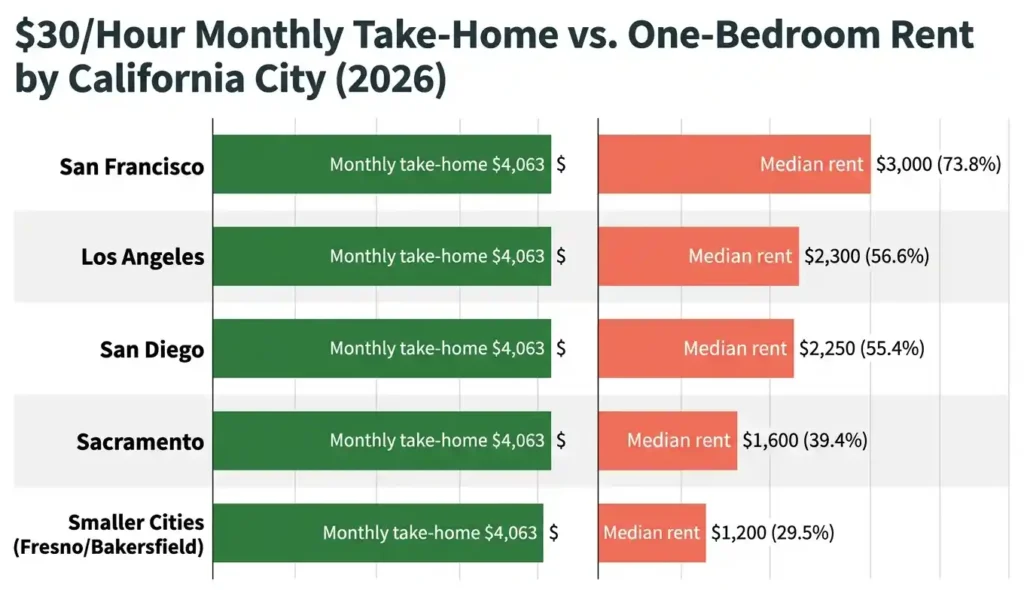
One-bedroom rent: $2,800 to $3,200 per month, which is 70 to 80% of take-home. Living solo in SF on $30 an hour is a serious financial stretch. Most people at this income use roommates or live in the East Bay or South Bay. The San Francisco paycheck calculator can show your exact net pay so you can build a realistic budget before committing to a lease.
Los Angeles
One-bedroom rent in LA proper: $2,100 to $2,500. Add car costs, which are unavoidable in most of LA, and fixed expenses eat most of take-home. Many people commute from Long Beach, Pomona, or the San Fernando Valley where rents drop to $1,600 to $1,900. The Los Angeles paycheck calculator accounts for LA-specific wages and local minimums if you want to verify your net pay.
San Diego
One-bedroom rents average $2,100 to $2,400. Take-home covers rent, transportation, and food, but savings will be thin. Renting alone here is financially tight. Use the San Diego paycheck calculator to see a precise breakdown before you commit to a budget.
Sacramento
One-bedroom rent: $1,400 to $1,800. Housing stays within 30 to 35% of take-home. Transportation and groceries cost less than coastal cities. This is where $30 an hour actually works well as a single adult. The Sacramento paycheck calculator can help you model a full monthly budget based on your exact situation.
Smaller California Cities
Fresno, Bakersfield, Stockton, Chico, and Redding: one-bedroom rents of $1,000 to $1,400. Your purchasing power is noticeably stronger. Trade-off: fewer job markets and potentially longer commutes.
Real Monthly Budgets on a $30/Hour Income
Budget Example for a Single Renter
Single adult, Sacramento-level cost city:
| Category | Monthly Cost |
|---|---|
| Rent (1BR) | $1,500 |
| Car payment + insurance | $600 |
| Gas | $120 |
| Groceries | $400 |
| Utilities + internet | $200 |
| Health insurance (if not employer-covered) | $300 |
| Personal / misc | $200 |
| Total | $3,320 |
| Take-home | $4,060 |
| Monthly savings | ~$740 |
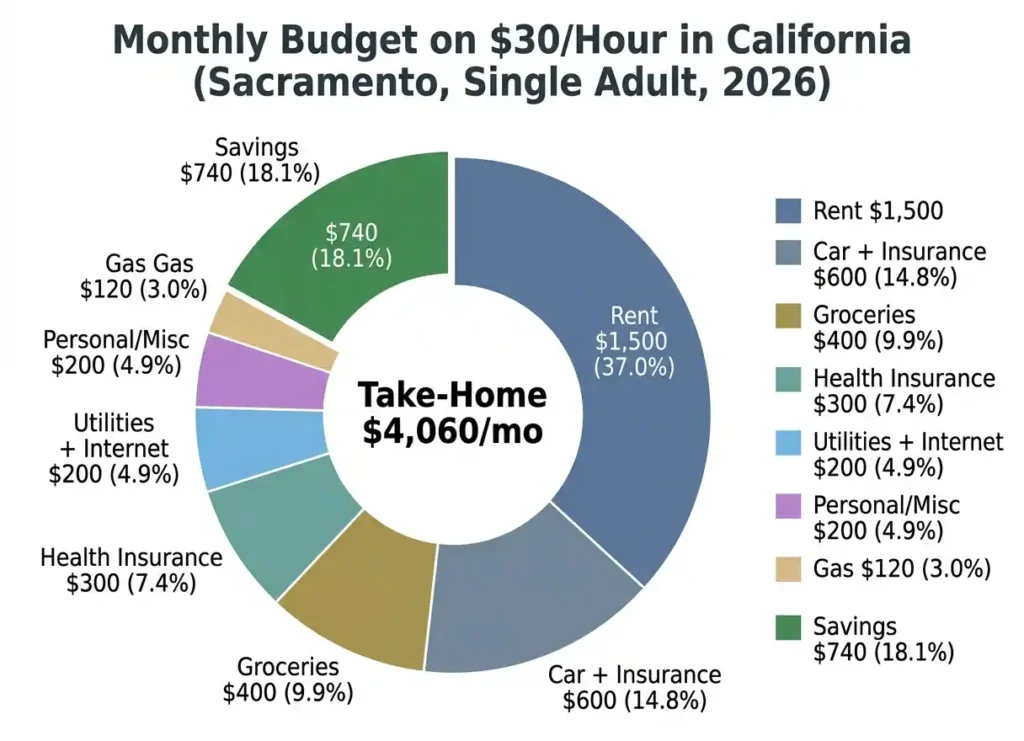
That $740 disappears fast if anything breaks. Build an emergency fund of $10,000 to $20,000 before anything else. High-interest debt should get $200 to $300 per month before investing.
Budget Example with Roommates
Sharing a two-bedroom cuts rent to $900 to $1,100 per month. That frees $400 to $600 monthly, which adds up to $5,000 to $7,000 extra per year. Best case: lower-cost city, shared housing, paid-off car, 15 to 20% savings rate ($600 to $800/month). Worst case: coastal city, solo renter, car payment, almost nothing left. Same wage. Location and housing decide everything.
Budget Example for a Couple
Combined take-home: $8,120 per month. A $2,000 two-bedroom is just 25% of income. Groceries scale modestly, transportation can be shared. Savings potential: $1,500 to $2,000 per month.
What If You Work Different Hours?
Part-Time Scenarios
- 20 hours/week: $31,200 gross, ~$26,000 to $27,000 net
- 25 hours/week: $39,000 gross, ~$33,000 net
- 30 hours/week: $46,800 gross, ~$39,000 net
Part-time at $30 an hour is livable in lower-cost areas but limits financial independence without a second income source. The part-time vs full-time paycheck comparison for California walks through how taxes and deductions shift based on hours worked. For more income scenarios at this wage, browse the paycheck scenarios category.
Alternative Full-Time Schedules
- 35 hours/week: $54,600/year
- 37.5 hours/week: $58,500/year
- 40 hours/week: $62,400/year
The gap between 37.5 and 40 hours is $3,900 per year. Always confirm the exact weekly hours before accepting an offer.
Overtime Scenarios
California overtime kicks in after 8 hours in a day or 40 hours in a week, at $45 per hour (1.5x). At 45 hours per week all year: $74,100 gross. At 50 hours: $85,800. Double-time ($60/hour) applies after 12 hours in a day or on a seventh consecutive workday. For a detailed breakdown of daily and weekly overtime thresholds, the California overtime laws 2026 guide covers every rule including double-time calculation examples. See also the California double-time vs overtime guide for side-by-side pay examples.
Employee vs Contractor at $30 an Hour
W-2 Employee
Your employer covers half your FICA, saving you $4,764 per year compared to self-employment. Benefits (health insurance, 401(k) match, PTO) often add $5,000 to $15,000 in real value. A 6% 401(k) contribution ($3,744/year) also reduces your taxable income.
1099 Contractor
Self-employment tax is 15.3% on net earnings. On $62,400 profit, that is $8,800 before income taxes. No employer benefits, no paid time off. Most contractors need to bill $35 to $40 an hour to match a W-2 employee’s actual take-home at $30. The California self-employment tax rate guide explains quarterly estimated tax obligations and deductible expenses. For the full W-2 vs 1099 tax comparison in California, the 1099 vs W-2 tax guide covers real take-home differences. Browse the worker classification category for related articles on contractor rules under AB5.
Which Leaves You With More Money?
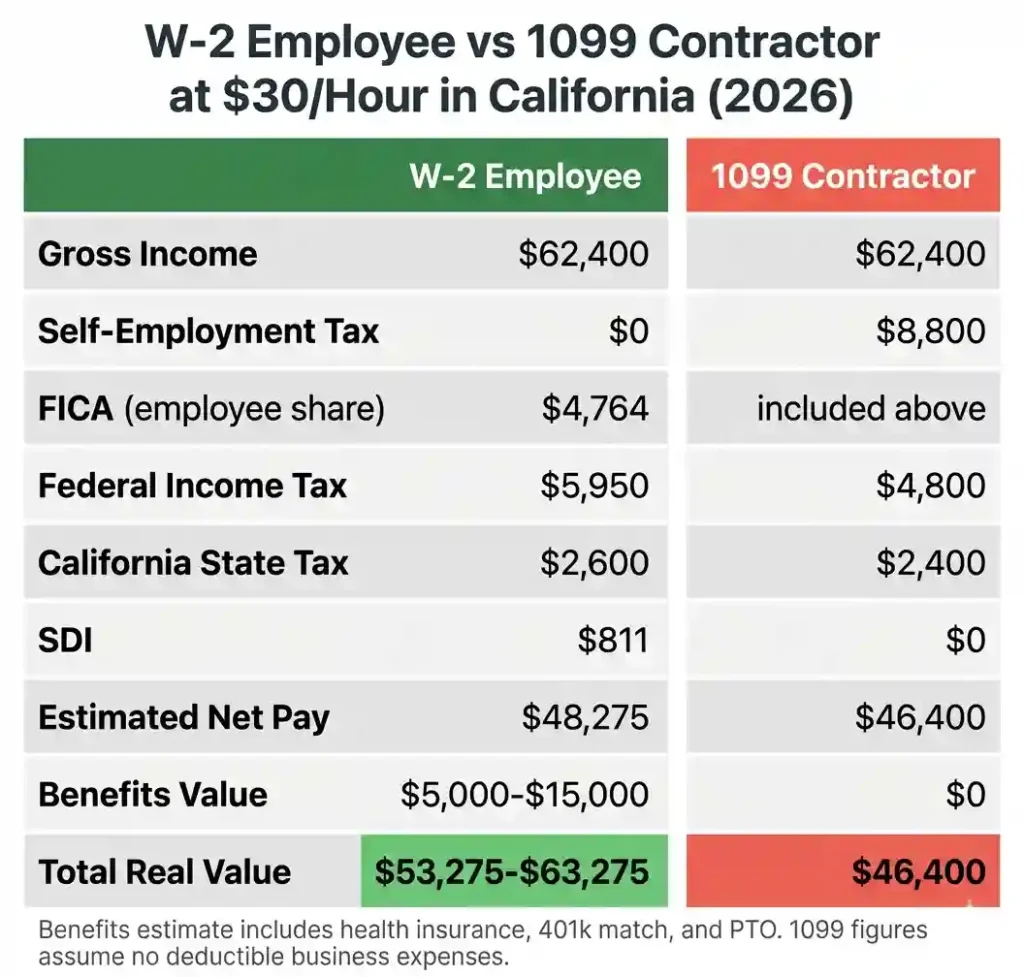
W-2 wins in most cases, once you factor in tax savings and benefits. Contracting only beats it if you bill significantly higher or have substantial deductible expenses.
Common Mistakes People Make When Calculating Hourly Pay
Confusing Gross and Net Income
People plan budgets around $62,400. Real spending money is $48,000 to $49,500. Budget from net, not gross. If you want to understand every line item pulling your gross down, the guide on how to read your California pay stub breaks down each deduction code clearly. If your paycheck feels lower than expected, why is my paycheck so low explains the most common causes.
Ignoring Unpaid Time Off and Assuming 52 Fully Paid Weeks
Two weeks unpaid = 50 working weeks = $60,000 gross, not $62,400. The 2,080-hour calculation only holds if every week is paid. Mid-year starts, unpaid leave, or missed days without PTO all reduce your real annual total. Ten paid holidays equal $2,400 in income you keep without working, so always check how many a job provides.
Forgetting to Count Overtime Income
Five extra hours per week at $45 adds nearly $12,000 per year. Count it when it is consistent. Do not count on it when it is not.
Assuming Every Employer Uses 40 Hours
Healthcare, retail, and education often run 36 to 37.5 hours as standard. Always confirm the exact weekly hours before accepting.
Should You Accept a Job Paying $30 an Hour?
Questions to Ask Before Accepting
How many hours per week are guaranteed? Is overtime available? What benefits are included? Is there a raise path, or is $30 the ceiling? Remote, hybrid, or on-site changes your real take-home once commuting costs are factored in.
Salary vs Total Compensation
Employer-paid health insurance: worth $500 to $1,000 per month. A 5% 401(k) match on $62,400 = $3,120 in free money per year. Three weeks of PTO = $3,600 to $4,800 in income value. A $30/hour W-2 job with full benefits is worth far more than a $30/hour 1099 gig.
Signs the Offer Is Competitive
Verify pay ranges with the Bureau of Labor Statistics Occupational Employment and Wage Statistics, California EDD wage surveys, or Glassdoor. At $30 an hour, you are in the 60th to 65th income percentile nationally. If comparable roles pay $35 to $40 in your area, push back. Most employers have built negotiation room into the initial offer. The annual salary calculator can help you quickly convert any competing offer into an hourly and annual equivalent for a side-by-side comparison.
Frequently Asked Questions
Is $30 an hour considered middle class in California?
At the lower end. $62,400 falls within California’s middle-income range of $54,000 to $160,000 for a single person, but near the bottom of it. Two earners at $30 an hour = $124,800 combined, which is solidly middle class.
How much is $30 an hour after taxes in California?
Single filer take-home: $48,000 to $49,500 per year, or $4,000 to $4,125 per month. Varies by filing status, deductions, and pre-tax contributions.
How much is $30 an hour per month?
Gross: $5,200. Net (single filer, California): $4,000 to $4,125.
Can I afford an apartment making $30 an hour?
In mid-cost cities, yes. Your take-home of roughly $4,060 supports up to $1,200 to $1,400 in rent while staying near the 30% threshold. That works in Sacramento, Fresno, Bakersfield, and parts of the Inland Empire. Solo in SF, LA, or San Diego, it does not work without roommates or supplemental income.
What jobs pay $30 an hour without a degree?
Electricians, HVAC technicians, plumbers, and welders: $28 to $45 per hour in California. Medical coders, dental hygienists, paralegals, and commercial drivers hit this range. IT support with CompTIA or Salesforce certifications can cross $30. Remote roles including customer success managers, technical recruiters, UX researchers, bookkeepers, and digital marketers regularly pay $30 or more. If you are currently earning less, see what making $20 an hour looks like in California or what you could aim for at $40 an hour as a next career step.
Is $30 an hour enough to buy a house in California?
Not in coastal markets. California’s statewide median hit $930,260 in May 2026. At $62,400, standard DTI guidelines support a mortgage of $220,000 to $260,000 at current 6.4 to 6.5% rates. In inland markets like Fresno or Bakersfield ($350,000 to $450,000 range), it is more achievable with a co-borrower or down payment assistance.
How much is $30 an hour with overtime?
Overtime rate: $45/hour. Five extra hours per week all year = $11,700 more, bringing annual gross to $74,100. Double-time ($60/hour) applies after 12 hours in a single day or on a seventh consecutive workday.
Final Verdict: Is $30 an Hour Enough in California?
When $30 an Hour Works Well
In Sacramento, Fresno, Chico, or the Inland Empire, $30 an hour covers rent, transportation, food, and modest savings. It works well for couples and single adults with roommates in most markets.
When It May Feel Tight
In SF, LA, or San Diego, renting alone on $30 an hour is financially stressful. Single-income families face real strain, as childcare and healthcare alone can consume most of take-home pay. High debt makes it worse.
Key Takeaways
$30 an hour = $62,400 gross, $48,000 to $49,500 net after California taxes. Above the national median. Lower-end middle class in California. Works in lower-cost cities and shared living situations. Tight in expensive coastal markets for solo earners and families. A role at $30 that grows to $34 to $36 within two years is a very different deal than one with no upward path. Always evaluate total compensation, not just the hourly rate. For more foundational guides on understanding your California paycheck, visit the paycheck basics category.

Yeasin Sorker is the founder of Paycheck Calculator California. He built this tool in 2018 after noticing that most free paycheck calculators missed California-specific rules like daily overtime and the uncapped SDI rate.
He researches California payroll tax updates regularly and keeps this calculator aligned with the latest IRS, FTB, and EDD published rates. All calculations on this site are estimates based on official 2026 government sources. For personalized tax advice, consult a qualified tax professional.