
California ETT Rate 2027 is expected to stay at 0.1% on each employee’s first $7,000 in wages, capping employer cost at $7 per employee. The rate applies automatically to most UI-covered employers, pending EDD’s official 2027 confirmation.
That 0.1% figure has held steady since at least 2023, tracked directly against EDD’s published rate and withholding schedules each year.
The catch: EDD hasn’t issued an official 2027 number yet, so budget 0.1% provisionally.
What Is the California ETT Rate for 2027?
The three sections below track the rate year over year, confirm when it takes effect, and show exactly where EDD will publish your official 2027 number.
Official 2027 Employment Training Tax Rate
EDD hasn’t published a separate 2027 rate; “official” here means the rate set by law at 0.1%, unchanged since at least 2023 according to EDD’s historical rate data. The wage limit stays $7,000 per employee, capping the maximum contribution at $7. Treat 0.1% as expected, but confirm it on your DE 2088.
2026 vs. 2027 California ETT Rate
Nothing changes: both years sit at 0.1% with the same $7,000 wage limit. A different number on your DE 2088 means your UI reserve account hit one of the two exceptions covered below, not a statewide change. For most employers, updating for 2027 just means confirming the rate stayed the same.
When Does the 2027 ETT Rate Take Effect?
The 2027 rate takes effect January 1, 2027. Statewide numbers usually surface in December through EDD’s rate announcements; your individual DE 2088, with your specific rate and reserve balance, follows by December 31, 2026.
ETT vs. UI vs. SDI: What Is the Difference?
ETT and UI are employer-paid; SDI comes out of the employee’s paycheck, as covered in our guide to California payroll taxes. Here’s how each breaks down for 2027.
Employment Training Tax (ETT)
ETT is an employer-paid tax funding job training programs, administered by EDD. For 2027, expect 0.1% on the first $7,000 of each employee’s wages, pending confirmation. Most UI-subject employers also pay ETT, with two exceptions that drop it to 0%, covered below.
Unemployment Insurance (UI)
Unlike ETT, UI isn’t flat; California assigns each employer a rate based on their experience rating, meaning how many former employees filed claims. For 2026, rates ranged 1.5% to 6.2% on Schedule F+, Schedule F plus a 15% emergency surcharge. New employers start at a flat 3.4% for two to three years. The UI wage limit is $7,000, same as ETT, expected to hold for 2027. California Unemployment Insurance (UI) rates are reassessed yearly on that same experience rating.
State Disability Insurance (SDI)
SDI comes out of the employee’s paycheck, not the employer’s budget, funding short-term California Disability Insurance benefits. The 2026 confirmed rate is 1.3%. EDD’s January 2026 Disability Insurance Fund Forecast projected 1.3% for 2027; its May 2026 forecast revised that to 1.4%. Neither is official; expect confirmation around December 2026. See our California SDI rate breakdown or run the numbers with our SDI calculator. California State Disability Insurance (SDI) is the only tax on this list without a wage cap.
Complete California Payroll Tax Comparison
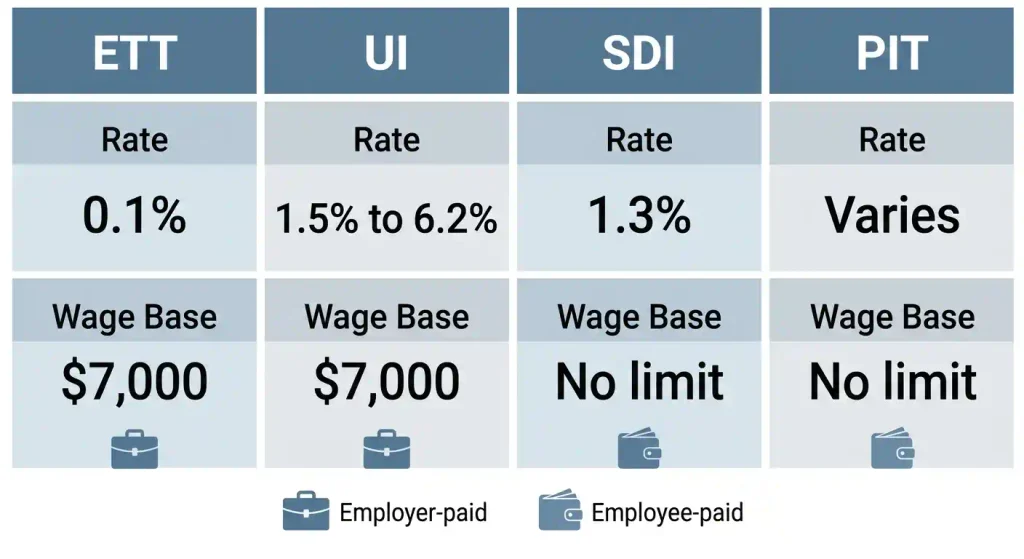
| Tax | Who Pays | 2026 Rate | 2027 Status | Wage Base |
|---|---|---|---|---|
| ETT | Employer | 0.1% | Expected 0.1%, unconfirmed | $7,000 |
| UI | Employer | 1.5% to 6.2% | Rate schedule pending | $7,000 |
| SDI | Employee | 1.3% | Projected 1.4%, unconfirmed | No limit |
| PIT | Employee | Varies | Varies | No limit |
ETT and UI hit the employer’s bottom line; SDI and PIT reduce the employee’s paycheck. California Personal Income Tax (PIT) withholding is employee-paid and bracket-based, tied to the California tax brackets for the year, unlike ETT’s flat employer-paid rate.
Who Has to Pay California Employment Training Tax in 2027?
Most California employers covered by UI also owe ETT. Whether you pay comes down to your UI reserve account status, not your industry or size.
Employers Required to Pay ETT
If you’re subject to California UI, you’re almost certainly subject to ETT too. EDD assigns your rate on the same DE 2088, based on your UI reserve account standing, usually 0.1% on the first $7,000 of each employee’s wages, with no separate registration. It’s automatic, not opt-in, and doesn’t depend on industry or size. UI and ETT are listed separately on the notice; a change in one doesn’t automatically change the other, since ETT only reacts once your reserve account goes negative.
Who Does Not Have to Pay ETT?
Two situations drop ETT to 0%: a negative UI reserve account balance, where claims paid out exceed taxes contributed, or the maximum UI rate plus 2% penalty under California Unemployment Insurance Code Section 977(c), for employers who’ve consistently run negative balances. Both show clearly on your DE 2088 as 0.0% instead of 0.1%.
Do New Employers Pay ETT?
Yes. New employers pay ETT at the standard 0.1% from day one, even though UI starts at the flat 3.4% new-employer rate. ETT doesn’t follow UI’s multi-year ramp-up; your first EDD notice confirms both numbers side by side, alongside the new hire paperwork every new employer files.
Do Nonprofit and Government Employers Pay ETT?
It depends on UI financing. Tax-rated employers owe ETT like any other employer. Reimbursable employers, who reimburse EDD dollar-for-dollar instead of paying a rate, generally don’t; many nonprofits and government entities choose this method for that reason. Out-of-state employers with California-based employees are generally subject to the same rules, since the obligation follows where work is performed. For remote or multi-state employees, the work location on a given day typically determines which state’s taxes apply. Independent contractors are excluded entirely; ETT applies only to employees, a distinction covered in depth under worker classification.
What Is the 2027 California ETT Taxable Wage Limit?
The 2027 ETT taxable wage limit is expected to remain $7,000 per employee, unchanged since 2023, a separate figure from the Social Security wage base that resets each year at the federal level.
Understanding the $7,000 Per-Employee Wage Limit
The $7,000 limit applies separately to each employee, not total payroll, and resets every calendar year. Wages above $7,000, whenever earned, generate no additional ETT.
Which Employee Payments Are Subject to ETT?
Regular wages, hourly pay, bonuses, and commissions all count toward the $7,000 limit. EDD defines special payment types like fringe benefits and severance in Types of Payments (DE 231TP); a payment counting toward UI wages almost always counts toward ETT too, since both share the same wage base.
When Does an Employee Stop Generating ETT?
Once wages hit $7,000, ETT stops accruing for the rest of the year; the counter resets each January 1. A mid-year hire still gets the full $7,000 threshold, not a prorated one. A rehired employee’s wages count cumulatively toward that same limit, not a fresh one. An employee working for more than one California employer gets a separate $7,000 limit at each, since the wage base ties to the employer’s reserve account, not the worker.
How Much Does California ETT Cost Employers in 2027?
ETT cost is small and predictable: at 0.1% on a $7,000 wage base, no employee generates more than $7 a year.
California ETT Calculation Formula
The formula: ETT taxable wages × 0.001. Once wages hit $7,000, the $7 maximum is locked in. A $120,000 salary and a $7,500 salary produce the same ETT bill, since only the first $7,000 counts.
ETT Calculation Examples by Employee Salary
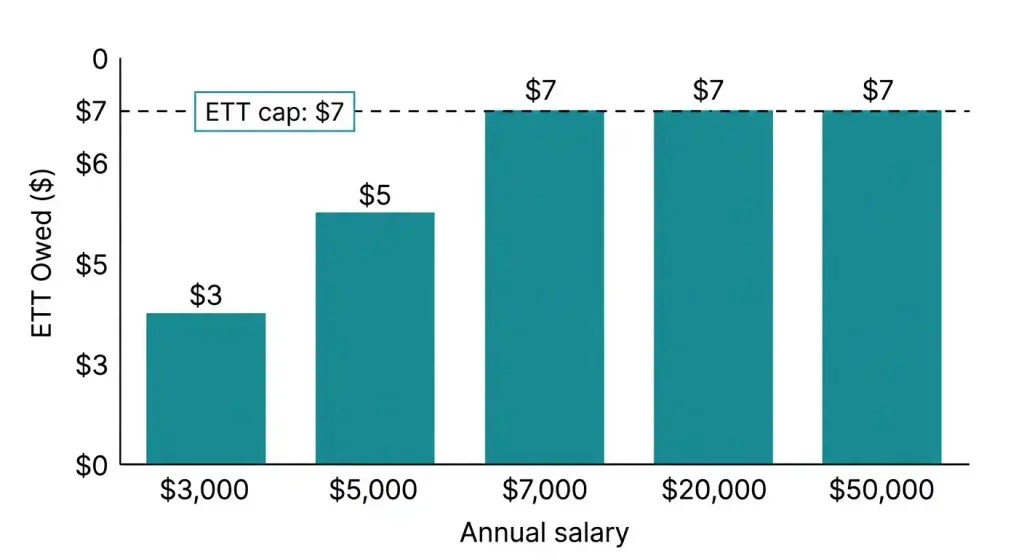
| Annual Salary | Taxable Wages | ETT Owed |
|---|---|---|
| $3,000 | $3,000 | $3 |
| $5,000 | $5,000 | $5 |
| $7,000 | $7,000 | $7 |
| $20,000 | $7,000 | $7 |
| $50,000 | $7,000 | $7 |
Anything above $7,000 caps out at $7. ETT barely moves the needle on payroll cost, even for high-paid staff.
Total ETT Cost for Multiple Employees
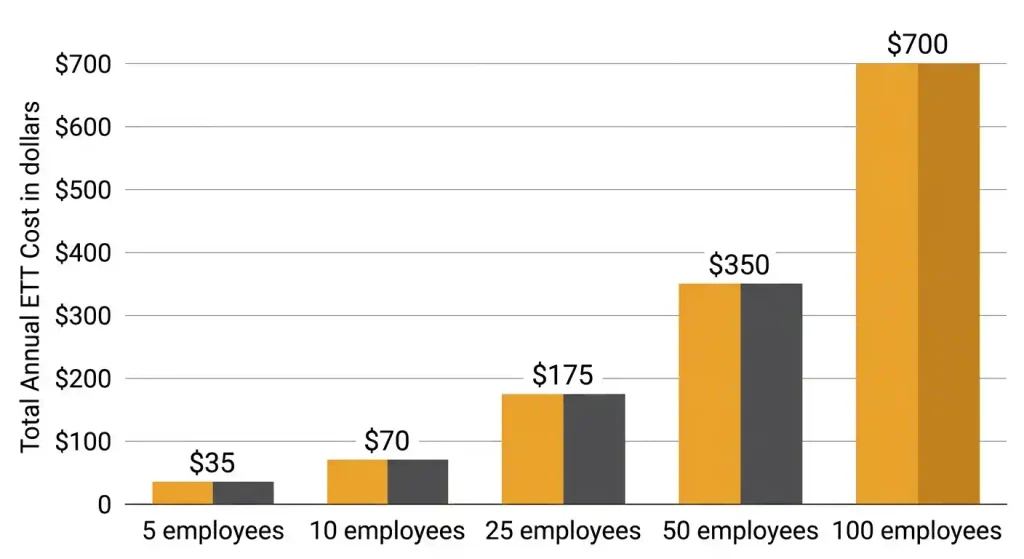
Assuming each employee earns at least $7,000: 5 employees costs $35 a year, 10 costs $70, 25 costs $175, 50 costs $350, 100 costs $700. ETT is one of the smallest line items on the payroll tax bill, dwarfed by UI and SDI.
Quarterly ETT Calculation Example
ETT is reported quarterly, but the annual $7,000 cap determines the final number. An employee who hits the limit in Q1 owes no more ETT that year; one who hits it in Q2 or Q3 shows partial contributions, then $0 after. Your DE 9C should reflect taxable wages only up to that point, not total gross wages.
Why Does Your California ETT Rate Show 0.0%?
If your DE 2088 shows 0.0% instead of 0.1%, it’s not an error. It means your UI reserve account triggered one of two exceptions.
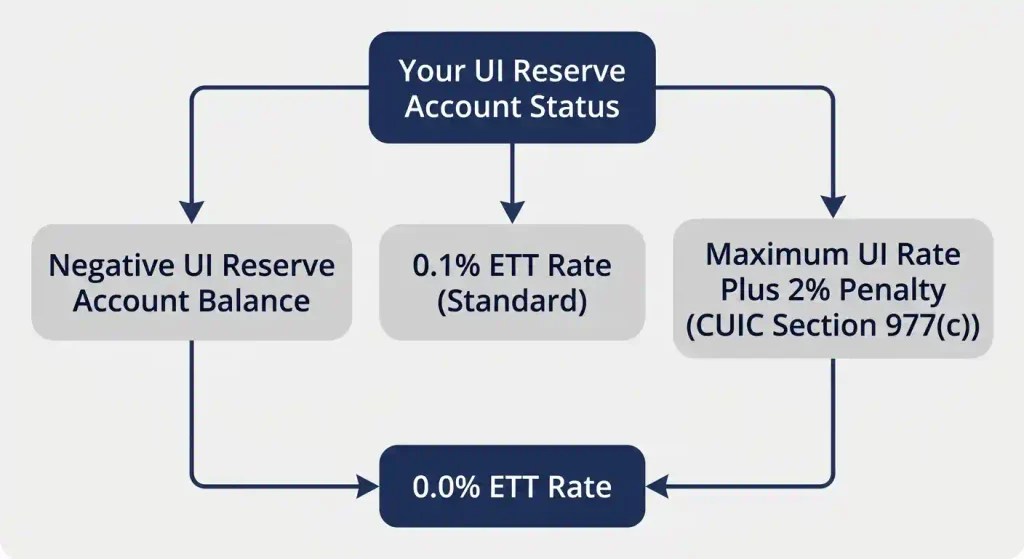
Negative UI Reserve Account Balance
A negative reserve balance means your business has paid out more in UI benefits than it’s contributed in taxes. EDD then assigns 0.0% ETT instead of 0.1%. Verify your status through EDD e-Services for Business. A positive or zero balance keeps the standard 0.1%; 0.0% applies only once the balance goes negative.
Maximum UI Rate Plus 2% Penalty
Under California Unemployment Insurance Code Section 977(c), employers whose reserve account stays negative long enough can be assigned the maximum UI rate plus 2%, not just any temporarily negative balance. This rule, Section 977(c) of the California Unemployment Insurance Code (CUIC), is one of only two ways ETT drops to 0%.
What If Your DE 2088 Shows an Unexpected ETT Rate?
Review the full notice, not just the ETT line; it shows your reserve account balance and history. If the numbers still don’t make sense, contact EDD directly rather than assuming an error.
How to Find and Verify Your 2027 ETT Rate on DE 2088
Your actual 2027 ETT rate comes from the DE 2088 notice, not a general statewide announcement.
What Is the DE 2088 Notice?
The Notice of Contribution Rates and Statement of UI Reserve Account (DE 2088) combines your UI rate, ETT rate, and reserve balance in one document, your most reliable source since statewide rates, published on EDD’s Rates and Withholding page, are only ranges. If unclear, EDD also publishes the Explanation of the Notice of Contribution Rates and Statement of UI Reserve Account (DE 2088C), which walks through each section.
When Will Employers Receive the 2027 DE 2088?
EDD mails the DE 2088 by December 31, 2026, also available online through e-Services for Business, often before the mailed copy arrives. Statewide rates, like the 1.5% to 6.2% UI range, differ from your individual notice, which gives your actual assigned rate. For a full rundown of 2026 payroll codes, see our guide to the California paystub.
How to Check Your ETT Rate Online
Log in to EDD e-Services for Business and locate your contribution-rate information in the dashboard to view your ETT rate and reserve balance without waiting on mail. It’s the fastest way to confirm your 2027 rate once EDD finalizes it.
Can Employers Appeal or Protest Their ETT Rate?
No. ETT is set by law at 0.1%, or 0.0% for the two exceptions above, and EDD doesn’t accept protests on it. Your UI rate, based on claims history, can be protested; ETT involves no individual calculation to dispute.
How to Report and Pay California ETT in 2027
ETT gets reported alongside UI, not as a separate standalone filing, as part of broader payroll compliance reporting obligations.
Reporting ETT on Quarterly Payroll Tax Returns
Employers report ETT through the Quarterly Contribution Return and Report of Wages (DE 9) and the Quarterly Contribution Return and Report of Wages (Continuation) (DE 9C), both available on EDD’s tax forms page. The DE 9C reports individual employee wages, determining how much counts toward the $7,000 limit each quarter.
ETT Payment and Deposit Requirements
ETT payments go through e-Services for Business, on the standard quarterly schedule, deadlines falling the month after each quarter closes. There’s no separate process; it rides along with your UI and SDI deposits.
Updating Payroll Software for 2027
Before your first 2027 payroll run, confirm your software has your correct employer-specific ETT rate loaded, not just a default 0.1%, and the $7,000 wage limit is accurate. Check your withholding setup against Form DE 4, then run a test calculation before processing live payroll.
Common California ETT Mistakes and Misconceptions
Most ETT errors come from employers applying UI logic to a tax that works differently.
Misconceptions About ETT Rates and Wage Limits
Not every employer pays 0.1%; the negative reserve exception or Section 977(c) penalty means 0.0%. ETT is entirely employer-paid, never deducted from gross or net pay the way SDI shows up when you’re reading your pay stub. Employees earning over $7,000 generate no additional ETT past that threshold.
Common Employer Calculation Errors
The most common mistake is applying 0.1% to an employee’s full salary instead of just the first $7,000. Others forget the wage limit exists, use a different employer’s rate, or confuse ETT with UI or SDI as one combined number.
Payroll Reporting and Compliance Mistakes
Carrying over an outdated rate without checking the current DE 2088, entering the wrong rate after a reserve account change, and misreporting taxable wages on the DE 9C near the $7,000 crossover are common slips. A wrong rate for even one quarter usually means amending that quarter’s DE 9 and DE 9C.
California ETT Rate 2027: Frequently Asked Questions
Quick answers to the most common 2027 ETT questions.
What is the California ETT rate for 2027?
Expected to stay 0.1%, unchanged since at least 2023. EDD hasn’t confirmed 2027 yet; check your DE 2088 for your actual rate.
What is the 2027 California ETT taxable wage limit?
$7,000 per employee per calendar year, unchanged for several years.
What is the maximum ETT an employer pays per employee?
$7 per employee per year, based on the 0.1% rate applied to the $7,000 wage limit.
Is California ETT paid by employers or employees?
Employers. ETT is never deducted from an employee’s paycheck.
Why does my DE 2088 show a 0.0% ETT rate?
Either a negative UI reserve account balance or the maximum UI rate plus 2% penalty under CUIC Section 977(c) applies to your account.
Do employers with negative UI reserve balances pay ETT?
No. A negative reserve balance triggers a 0.0% ETT rate instead of the standard 0.1%.
Does California ETT apply to bonuses and commissions?
Yes, bonuses and commissions count toward the $7,000 taxable wage limit the same as regular wages.
Can an employer appeal or protest an ETT rate?
No. ETT rates are set by law and EDD doesn’t accept protests on them, unlike UI rates.
When does the 2027 California ETT rate take effect?
January 1, 2027.
Where can I check my official 2027 ETT rate?
Your DE 2088 notice, mailed by December 31, 2026, or through EDD’s e-Services for Business portal online.
Final 2027 California ETT Payroll Checklist
What to confirm before your first 2027 payroll run, alongside other changes like the 2027 minimum wage.
What Employers Should Verify Before Running 2027 Payroll
- Confirm your ETT rate on your DE 2088 rather than assuming 0.1%.
- Verify the $7,000 wage limit is correctly set in your payroll system.
- Check whether the 0% exception applies to your account.
- Update your payroll software with the confirmed rate and wage limit.
- Review your DE 9 and DE 9C reporting before your first 2027 filing.

Yeasin Sorker is the founder of Paycheck Calculator California. He built this tool in 2018 after noticing that most free paycheck calculators missed California-specific rules like daily overtime and the uncapped SDI rate.
He researches California payroll tax updates regularly and keeps this calculator aligned with the latest IRS, FTB, and EDD published rates. All calculations on this site are estimates based on official 2026 government sources. For personalized tax advice, consult a qualified tax professional.