
At $20 an hour, you earn $41,600 per year working full time. In California, that number tells only part of the story.
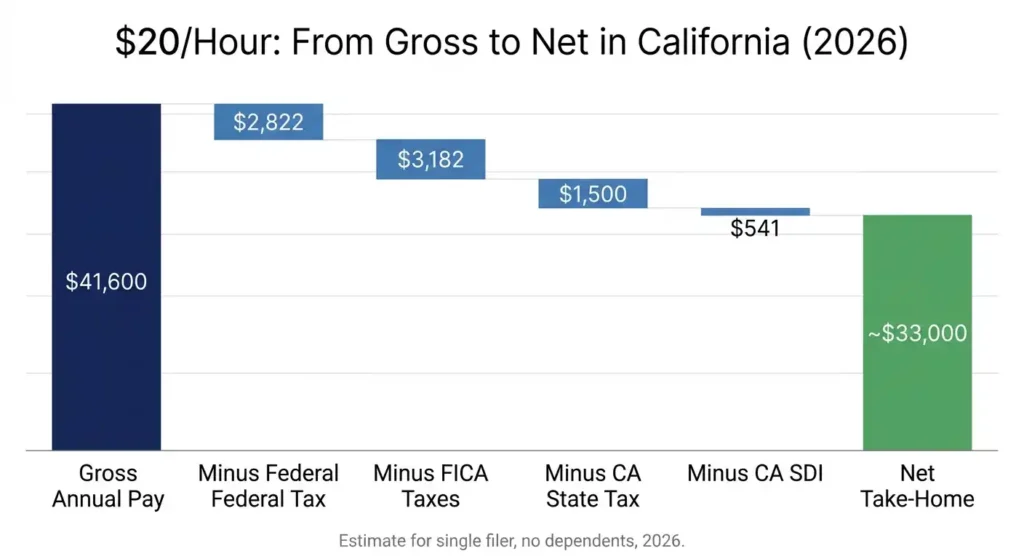
After federal taxes, Social Security, Medicare, California state income tax and payroll deductions, and the 2026 SDI rate of 1.3%, a single filer takes home approximately $31,900 to $33,400. That is $8,000 to $9,700 less than the gross figure on your offer letter.
Keep in mind: exact take-home varies based on filing status, employer benefits, and deductions. Use the numbers here as a planning baseline, not a guarantee.
Quick Answer: $20 an Hour Is How Much a Year?
Here is a quick-reference earnings breakdown for a $20/hour W-2 employee working full time:
| Time Period | Gross Earnings |
|---|---|
| Hourly | $20.00 |
| Daily (8 hours) | $160.00 |
| Weekly (40 hours) | $800.00 |
| Biweekly | $1,600.00 |
| Semi-monthly | $1,733.33 |
| Monthly | $3,466.67 |
| Annual (2,080 hours) | $41,600.00 |
Annual Salary at $20 Per Hour
Working full time at $20 an hour, you earn $41,600 per year before taxes. That is your gross income, assuming 40 hours per week for 52 weeks with no unpaid time off. Your actual take-home pay in California will be noticeably lower once taxes enter the picture.
Takeaway: $20/hour equals $41,600 gross per year at full-time hours.
Monthly Income Breakdown
Divide $41,600 by 12 and you get $3,467 per month in gross earnings before any deductions. Your paycheck amount stays consistent each month even though the number of working days varies.
Takeaway: Expect around $3,467 gross every month on a $20/hour salary.
Weekly and Biweekly Paychecks
Your gross weekly earnings come to $800. If your employer pays every two weeks, your biweekly gross check will be $1,600. On a daily basis, a standard 8-hour shift earns you $160 per day before any deductions.
After California taxes and federal withholding, a single filer with no dependents typically takes home around $1,180 to $1,220 per biweekly check. Some employers issue semi-monthly paychecks instead, which means two checks per month totaling roughly $1,380 to $1,390 net each. That is a real difference you need to plan around.
Takeaway: Biweekly gross is $1,600 but net take-home lands closer to $1,200.
Free California Paycheck Tool
See If $20/Hour Is Really Enough After Taxes
$20/hour adds up to $41,600 a year on paper — but after federal tax, California state tax, and SDI, your actual paycheck tells a different story.
🧮 See If $20/Hour Is Really Worth It After TaxesUsed by thousands of California workers · FTB-verified 2026 rates
How the Calculation Works
Hourly Wage to Annual Salary Formula
Here is the salary formula:
Hourly wage x hours per week x weeks per year = annual salary
$20 x 40 x 52 = $41,600
The annualized salary figure of $41,600 is what you will see on offer letters, income projections, and loan applications. It represents your full yearly earnings as a full-time hourly employee working all 2,080 annual work hours. Use the annual salary calculator to check any hourly rate instantly.
Takeaway: Multiply your hourly rate by 2,080 to get your full-time annual salary.
Why Your Actual Income May Differ
Part-time schedules shrink your total. Working 30 hours drops annual income to $31,200. At 35 hours per week, you land at $36,400. At 50 hours per week with California overtime, earnings climb well above $41,600.
If your employer offers paid time off (PTO) and paid holidays, your income stays at $41,600 even when you are not working. California workers also have protected sick leave rights under 2026 California sick leave laws that affect how unpaid time off is counted. Two weeks of unpaid leave drops actual gross to $40,000 based on 50 working weeks. With a full 52 paid weeks, $41,600 holds firm.
Takeaway: Think of $41,600 as a baseline, not a guarantee.
$20 an Hour After Taxes in California
California has some of the highest combined tax rates in the country. Here is what you actually keep.
Federal Taxes That Affect Your Paycheck
At $41,600 per year, a single filer in 2026 falls into the 12% federal income tax bracket for most of their income. After the standard deduction of $16,100, taxable income sits around $25,500. Federal income tax on that is roughly $2,822. The IRS publishes the full 2026 federal income tax brackets and standard deduction amounts for reference. For a deeper look at how California layered rates work on top of federal taxes, see the California tax brackets for 2026.
On top of that, Social Security takes 6.2% of your gross earnings. Medicare takes another 1.45%. Together, these FICA taxes pull about $3,182 from your annual paycheck.
Takeaway: Federal taxes and FICA alone reduce your annual take-home by roughly $6,000.
California State Taxes and Deductions
California charges its own income tax on top of federal taxes. At $41,600 gross, a single filer pays approximately 4% to 6% in state income tax after the standard state deduction. That works out to roughly $1,200 to $1,800 per year in California state income tax. The California Franchise Tax Board publishes the full state income tax rate schedules for every filing status.
California also deducts State Disability Insurance (SDI) at 1.3% of wages in 2026, up from 1.2% in 2025. That adds another $541 taken from your gross annual pay with no wage cap. The California EDD confirms the current SDI rate and withholding rules on its official payroll tax rates page. The full breakdown of how SDI is calculated is also covered in the 2026 California SDI rate guide.
Takeaway: California state taxes and SDI cut your take-home by an additional $1,700 to $2,300 per year.
Estimated Take-Home Pay
For a single filer in California with no dependents:
- Annual net income: approximately $31,900 to $33,400
- Monthly net income: approximately $2,660 to $2,780
- Weekly net income: approximately $613 to $640
Your exact amount varies based on health insurance premiums and retirement contributions taken from your paycheck.
Takeaway: Plan your budget around $2,700 per month net, not the $3,467 gross figure.
Single vs Married Filing Status
Married couples filing jointly get a $32,200 standard deduction in 2026, which eliminates federal income tax almost entirely at $41,600 income. A single-income household with a stay-at-home partner keeps noticeably more per paycheck than a single adult at the same wage. See how California’s standard deduction works in 2026 for both state and federal filing scenarios.
Takeaway: Married filers at this income level keep noticeably more each paycheck than single filers.
Is $20 an Hour Good Pay in California?
The honest answer depends on where in California you live. MIT’s Living Wage Calculator has historically estimated California’s living wage for a single adult well above $20 per hour, with county-level figures varying significantly. That benchmark puts $20 an hour below what researchers consider a living wage in most parts of the state. Whether you work a day shift, rotating shift work, or nights, the lifestyle pressure varies considerably by location.
Comparing $20/Hour to California Minimum Wage
California’s statewide minimum wage in 2026 is $16.90 per hour for most workers, effective January 1, 2026. That makes $20 an hour roughly 18% above the floor. Fast-food workers in California benefit from a sector-specific minimum of $20 per hour, meaning your wage sits right at the fast-food industry floor. The California Department of Industrial Relations publishes the official minimum wage schedule for all industries and dates. The full picture of sector-by-sector floors is covered in the California minimum wage guide for 2026.
Healthcare workers in California earn a mandated minimum ranging from $18.63 to $24 per hour depending on facility type. If you work in healthcare, check the California healthcare worker minimum wage rules to confirm the exact floor for your employer type. Compared to those benchmarks, $20 an hour positions you at the lower end of the state’s wage scale for experienced workers.
Takeaway: $20/hour beats California’s general minimum but barely clears the fast-food wage floor.
How $20/Hour Compares to Average Wages
California’s median hourly wage in 2026 sits around $28 to $30 per hour, with a median annual wage of approximately $62,000. The U.S. Bureau of Labor Statistics tracks state and metro wage data for California across all industries. At $41,600, a $20/hour worker earns well below the state median. It is not poverty-level pay in smaller cities, but it falls short in most metro areas.
Takeaway: $20/hour is 30% to 35% below California’s median wage.
What Type of Jobs Pay Around $20/Hour?
In 2026, jobs commonly paying $20 an hour in California include:
- Retail shift supervisors and lead associates
- Medical assistants and phlebotomists
- Warehouse associates and shipping coordinators
- Entry-level administrative assistants
- Customer service representatives at larger companies
- School paraprofessionals and teaching aides
- Remote data entry and virtual assistant roles at mid-size companies
These roles typically require a high school diploma or some vocational training and rarely include strong health benefits at the $20 mark.
Takeaway: $20/hour fits entry-level and support roles across healthcare, logistics, and retail.
$20 an Hour Compared to Other Hourly Wages
$15 vs $20 Per Hour
The jump from $15 to $20 per hour adds $10,400 per year gross. That is roughly $780 more per month before taxes and about $620 more per month after taxes. In California, that difference could cover a car payment, eliminate a personal loan, or fund a small emergency savings account.
Takeaway: Going from $15 to $20/hour adds roughly $620 per month to your net pay.
$20 vs $25 Per Hour
At $25 per hour, annual gross rises to $52,000. After California taxes, take-home reaches $3,300 to $3,450 per month versus $2,700. That extra $600 to $750 per month makes renting alone feasible in mid-cost California cities and creates real room for savings.
Takeaway: $25/hour is the point where living alone in mid-cost California becomes genuinely realistic.
$20 vs $30 Per Hour
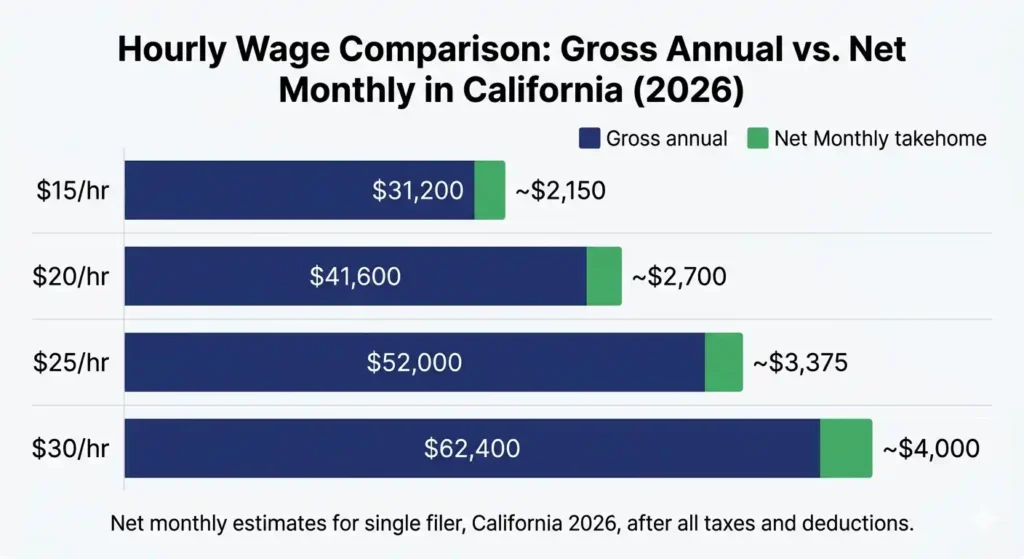
At $30 an hour, annual gross climbs to $62,400 and net monthly take-home rises to approximately $4,000. That is roughly $1,300 more per month than $20 an hour after taxes. A $30/hour worker in California can afford a solo one-bedroom in most non-coastal cities, fund a 401(k), and still have discretionary spending left over. If you are curious how the math scales further, see what $40 an hour looks like as a yearly salary in California.
Takeaway: $30/hour is where financial stability truly begins for a single adult in California.
Can You Live on $20 an Hour in California?
I have helped dozens of people build budgets around this wage. Here is what I have found.
Living Alone Scenario
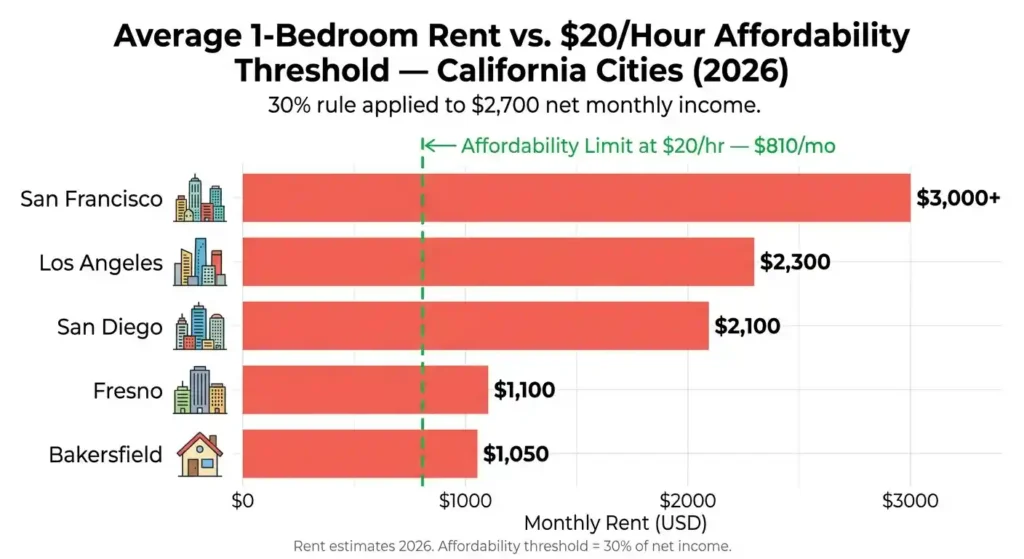
Living alone at $20 an hour is extremely tight. With $2,700 net per month, you would need rent below $900 to follow the 30% rule. That amount does not exist in most California cities in 2026.
A studio in Fresno averages around $1,100. In Riverside, expect $1,300. Utilities add $150 to $200. Groceries run $350 to $450. Transportation costs $300 to $500 depending on whether you own a car.
After those basics, nothing remains for savings or emergencies. Homeownership is out of reach. The median California home price exceeds $800,000 in 2026, requiring household income above $150,000 to qualify comfortably. Building an emergency fund or contributing to retirement savings is nearly impossible when rent alone exceeds the budget.
Takeaway: Living alone on $20/hour in California requires extreme budgeting and leaves almost no financial cushion.
Living With Roommates
Split a two-bedroom three ways in Fresno or Bakersfield and housing drops to $450 to $600 per month. With shared housing, you free up $400 to $700 compared to living alone. That margin covers an emergency fund, car insurance, and a small retirement contribution. Contributing 3% of gross income to a 401(k) costs about $104 per month before any employer match. With roommates, that is actually possible.
Takeaway: Roommates are the single biggest factor in making $20/hour livable in California.
Urban vs Smaller Cities
High-Cost Cities
In Los Angeles, San Francisco, and San Diego, $20 an hour creates real strain. A one-bedroom in San Francisco averages over $3,000 per month. Los Angeles averages $2,300. San Diego sits near $2,100. These rents alone consume or exceed your entire net monthly income. If you are evaluating a job in Los Angeles specifically, the Los Angeles paycheck calculator gives you a precise city-level take-home estimate.
Takeaway: Geography is everything. $20/hour is barely survivable on the coast but workable inland.
More Affordable Areas
Bakersfield, Fresno, Stockton, Visalia, and Redding offer significantly lower costs. A one-bedroom in Bakersfield averages around $1,050. Shared housing drops rent to $500 to $700. In these cities, $20 an hour is tight but functional with roommates or family support.
Real Monthly Budget on $20 an Hour
Example Budget for a Single Adult
Here is a realistic monthly budget based on $2,700 net income in a mid-cost California city:
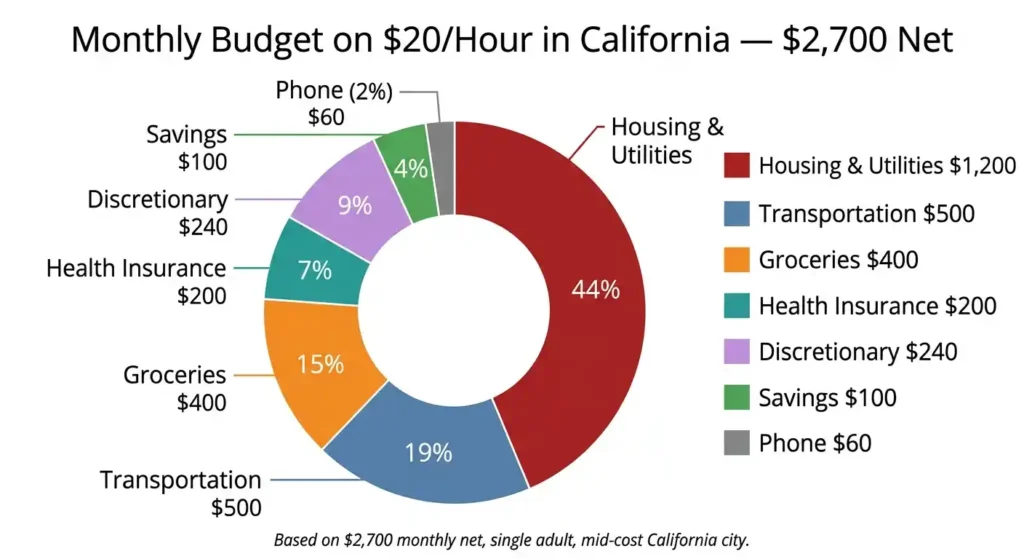
- Housing (rent + utilities): $1,200
- Groceries and household supplies: $400
- Transportation (car payment, gas, insurance): $500
- Health insurance (if not employer-covered): $200
- Phone: $60
- Savings: $100
- Discretionary spending: $240
This only works where rent stays under $1,000. There is no buffer for car repairs or medical bills.
Takeaway: A realistic single-adult budget at $20/hour leaves under $300 per month for anything unplanned.
A family budget is far harder. One earner at $20 an hour with one or two children faces California childcare costs of $1,200 to $2,000 per month alone. Two-income households or subsidized childcare are practically a requirement. For more real-world income scenarios at different wage levels, see the California paycheck scenarios section.
Example Budget With Roommates
Shared housing shifts the math significantly. Here is the same budget with a roommate splitting a two-bedroom:
- Housing (split two ways): $800
- Groceries: $350
- Transportation: $450
- Health insurance: $200
- Phone: $60
- Savings: $250
- Discretionary spending: $590
You can save $250 per month, handle small emergencies, and still have spending money. This is the version that actually functions in California.
Takeaway: Splitting housing costs turns a stressful budget into a functional one at this wage.
Areas Where Most People Overspend
Three categories derail budgets consistently. Housing is first. Many people stretch to rent alone when their income cannot support it. Car payments are second. A $400 to $500 monthly payment on $2,700 net is crippling. Third is dining out. Spending $300 to $400 per month at restaurants eliminates any chance of saving. Together, these three can consume an extra $600 to $800 per month.
Takeaway: Housing, car payments, and food spending are the three categories that most often wreck a $20/hour budget.
Full-Time vs Part-Time Earnings at $20 Per Hour
Part-time and full-time schedules produce very different yearly totals at the same hourly rate. For a side-by-side comparison of how deductions differ between the two, the California part-time vs full-time paycheck guide breaks it down in detail.
20 Hours Per Week
At 20 hours per week, annual gross drops to $20,800. After California taxes, net annual income falls to approximately $18,000 to $19,000. This schedule is common for students, caregivers, or people supplementing household income. At this income, many workers qualify for California’s Medi-Cal program.
Takeaway: 20 hours per week at $20/hour yields about $18,500 net annually.
30 Hours Per Week
Working 30 hours per week brings in $31,200 gross per year. Monthly gross is $2,600 and take-home sits around $2,100 to $2,200 after California taxes. On its own, this schedule makes independent California living very difficult.
Takeaway: 30 hours per week at $20/hour yields roughly $2,150 net monthly.
40 Hours Per Week
Forty hours per week produces $41,600 gross per year and roughly $2,700 net per month in California. All budget breakdowns in this article are based on this 40-hour standard.
Takeaway: Full-time at $20/hour means $41,600 gross and approximately $2,700 net per month in California.
Overtime Pay at $20 an Hour
Overtime Rate Calculation
California’s overtime rate is 1.5 times your regular wage. For $20 an hour, that means $30 per hour for every overtime hour. California requires overtime for any hours over 8 in a single workday, not just over 40 in a week. Hours over 12 in one day get paid at double time: $40 per hour on a $20 base. The California DIR’s official overtime FAQ explains exactly which workers are covered and how daily thresholds apply. The complete rules are also explained in California overtime laws for 2026.
Takeaway: California overtime kicks in after 8 hours per day, not just 40 hours per week.
Annual Income With Overtime
Even modest overtime adds up fast:
- 5 hours of overtime per week: Adds $7,800 per year, bringing gross to $49,400
- 10 hours of overtime per week: Adds $15,600 per year, bringing gross to $57,200
- Regular double-time shifts: A few long days per month at $40/hour can add $3,000 to $5,000 annually. Learn exactly when California double time vs overtime applies to your work schedule.
Many warehouse and healthcare workers at the $20 base rate earn $50,000 or more annually through consistent overtime.
Takeaway: Regular overtime can push a $20/hour income well into the $50,000 range annually.
Hidden Costs That Reduce Your Real Income
Many workers are surprised by how far their net paycheck falls from their gross wage. If your check seems lower than expected, the reasons your California paycheck is so low walks through every common cause.
Housing Costs
A $20/hour worker spending more than $830 per month on rent has crossed the 30% rent burden threshold. Most California cities offer almost nothing at that price. Utilities average $150 to $250 per month depending on climate zone, plus $20 to $40 for renter’s insurance.
Takeaway: Housing costs almost always create rent burden for California workers earning $20/hour.
Transportation Expenses
Average car insurance in California runs $2,200 per year in 2026. Add $150 to $250 per month in gas, plus $50 to $100 monthly for maintenance and registration. Total transportation costs range from $500 to $700 per month.
Takeaway: Transportation costs alone can consume 20% or more of a $20/hour take-home in California.
Healthcare and Benefits
Jobs at this wage often include limited health benefits. Employer-sponsored plans typically require $100 to $300 per month in employee premiums with deductibles of $2,000 to $5,000. Without employer benefits, Covered California unsubsidized premiums average $350 to $500 per month for a 30-year-old earning $41,600. You can check current plan costs and subsidy eligibility directly on the Covered California official marketplace.
Takeaway: Healthcare costs are a major hidden expense that dramatically reduces real purchasing power at this wage.
Debt Payments
Many California workers at this income level carry federal student debt. Income-driven repayment on $30,000 in loans runs $100 to $200 per month. Credit card debt adds another $150 to $300. Combined debt payments of $300 to $500 per month push an already tight budget to the breaking point.
Takeaway: Debt payments can eliminate any financial flexibility that exists at the $20/hour income level.
Common Myths About Making $20 an Hour
Here are the most common calculation mistakes I see when people figure out their annual compensation from an hourly rate.
The biggest mistake is assuming all 52 weeks are paid. Two weeks unpaid drops annual income to $40,000, not $41,600. The second is budgeting around gross rather than net income. The third is confusing salary and hourly pay: a salaried employee at $41,600 earns that amount regardless of hours, while an hourly employee only earns for hours clocked. A fourth mistake is excluding overtime when projecting annual income, which leads to underestimating what W-2 earnings will show at tax time. For a broader overview of rules that affect hourly workers, the California labor laws category covers the most common protections and obligations.
“$20 an Hour Means You’re Comfortable”
In California, $20 an hour means you are working hard and likely still stressed about money. Housing costs, state taxes, car insurance, and healthcare premiums combine to create one of the highest costs of living in the country. Comfortable does not apply at this income level in most California zip codes.
Takeaway: $20/hour is a survival wage in most California metro areas, not a comfortable one.
“$41,600 Is What You’ll Take Home”
Gross income and net income are very different numbers. In California, a single adult earning $41,600 gross keeps approximately $31,900 to $33,400 after taxes. That gap of $8,200 to $9,700 per year surprises people every time. If the deductions on your paycheck are confusing, the guide on how to read a California pay stub shows exactly what every line means. Always budget from net income, not gross.
Takeaway: Your take-home is roughly $8,000 to $10,000 less than your gross salary in California.
“$20/Hour Is the Same Everywhere”
A worker at $20 an hour in rural Mississippi lives a completely different financial life than one in Los Angeles. Average rent in the country’s cheapest markets runs under $700 for a one-bedroom. Texas and Florida workers also pay zero state income tax. California workers lose another 4% to 6% that workers in no-tax states keep entirely.
Takeaway: Location turns $20/hour into either a decent wage or a difficult one, and California lands on the hard side.
Ways to Increase Income Beyond $20 an Hour
Fastest Career Paths Above $25/Hour
Certain moves offer the fastest path past $25 per hour without a four-year degree. HVAC technician, plumber, and electrician apprentice roles pay $25 to $35 per hour within two to three years. Licensed vocational nurses (LVNs) earn $28 to $35 per hour. IT help desk and cybersecurity support positions frequently start at $25 to $30 per hour. While you are building toward those roles, check whether you qualify for the 2026 California Earned Income Tax Credit — workers at $20/hour may be eligible for a meaningful refund.
Takeaway: Skilled trades, healthcare support, and IT roles offer the fastest route past $25/hour.
Certifications That Boost Pay
CompTIA A+ opens IT support roles paying $22 to $28 per hour. CNA or Medical Assistant credentials raise healthcare wages to $22 to $26. OSHA 30-hour certification qualifies warehouse workers for lead positions at $24 to $28 per hour. Most take two to six months to complete and are available through California’s community college system.
Takeaway: A targeted certification can add $3 to $8 per hour to your earnings within six months.
Side Income Opportunities
Delivery driving through DoorDash or Instacart can add $500 to $1,200 per month. Skilled freelancers in writing, graphic design, or social media management earn $25 to $50 per hour on their own time. Five to ten hours of side work per week at $25 per hour adds $6,500 to $13,000 per year. If you take on freelance work, understand the tax difference between 1099 vs W-2 income in California before you start — self-employment taxes affect your real take-home significantly.
Takeaway: Side income of even $500 per month dramatically changes financial stability at this wage level.
Frequently Asked Questions
Is $20 an hour $40,000 a year?
Almost. At 40 hours per week for 52 weeks, $20 an hour equals $41,600 per year, not exactly $40,000. The $40,000 figure comes from using 2,000 hours worked per year, which accounts for two weeks of unpaid vacation. If your employer gives you paid vacation, your annual earnings stay at $41,600.
How much is $20 an hour after taxes in California?
A single filer earning $41,600 per year in California takes home approximately $31,900 to $33,400 after federal income tax, Social Security, Medicare, California state income tax, and SDI. Monthly net income lands between $2,660 and $2,780.
Is $20 an hour enough to live alone in California?
In most California cities, no. To rent a studio or one-bedroom apartment comfortably, financial experts recommend spending no more than 30% of gross income on housing. That puts your housing budget at $1,040 per month. Studios in most California cities cost $1,100 to $2,500. Living alone at $20 an hour in California requires extreme sacrifice and leaves virtually no financial cushion.
What is $20 an hour monthly?
At full-time hours, $20 an hour equals $3,467 gross per month. After California taxes, net monthly income is approximately $2,660 to $2,780 for a single filer.
What is $20 an hour biweekly?
Biweekly gross earnings at $20 an hour are $1,600. After taxes in California for a single filer, the net biweekly paycheck is approximately $1,180 to $1,220.
How much is $20 an hour for 30 hours a week?
Working 30 hours per week at $20 an hour produces $31,200 gross per year. Monthly gross is $2,600. Net monthly take-home in California falls to approximately $2,100 to $2,200.
What jobs pay $20 an hour with no experience?
Several California jobs pay around $20 an hour with minimal prior experience in 2026. These include warehouse associate roles at major distribution centers, entry-level customer service positions at tech and insurance companies, basic medical assistant roles in large healthcare systems, and retail lead positions at grocery and home improvement chains.
Is $20 an hour considered middle class in California?
No. California’s middle class is generally defined as households earning two-thirds to double the state median income. With a median household income of approximately $91,000 in California in 2026, the middle class range starts near $60,000. A single earner at $41,600 per year falls below this threshold and is generally considered lower-income for California standards.
How much overtime would I need to make $50,000 a year?
To reach $50,000 gross from a $20 an hour base, you need to earn an additional $8,400 beyond the standard $41,600. At the California overtime rate of $30 per hour, you need approximately 280 overtime hours per year. That works out to about 5.4 hours of overtime per week, every week, for the entire year.
Final Verdict: Is a $20/Hour Job Worth Taking in California?
Here is my honest verdict after years of analyzing wages and living costs across California.
When $20/Hour Makes Financial Sense
This wage works when housing costs are dramatically reduced. Living with family or roommates makes it functional. As a career entry point with clear advancement, $20 an hour buys time to build skills and move up. Workers in smaller inland cities like Bakersfield, Fresno, or Redding can make it work with discipline and shared housing.
Takeaway: $20/hour works best when housing costs are shared and the job offers a clear path to higher pay.
When It May Not Be Enough
Renting alone in any major California metro creates immediate financial stress. Single-income households with children face severe budget pressure. Workers with significant student loans or credit card debt will find the numbers do not work. In San Francisco, San Jose, Los Angeles, and San Diego, $20 an hour has minimal real purchasing power. Workers considering San Francisco can get a precise take-home figure using the San Francisco paycheck calculator.
Takeaway: In high-cost California metros as a solo adult with debt, $20/hour creates genuine financial hardship.
Key Takeaways Before Accepting a Job Offer
Before accepting a $20 an hour offer in California, answer these honestly:
- What is your actual net monthly income after all California taxes and deductions?
- What will your housing cost be, and does it stay below 35% of your net income?
- Does this employer offer health insurance, and what is your premium contribution?
- Is there a clear path to $25 or $30 per hour within 12 to 24 months?
- Can you reduce fixed expenses through shared housing or other means?
Your reality is the net paycheck multiplied by 12, minus every essential bill. Use the California paycheck calculator to run your exact numbers before signing. For more on understanding how California paychecks work from gross to net, browse the paycheck basics guides. What I have found is that workers who succeed at this wage level always have a plan to move beyond it.
Takeaway: Know your real net income, map your actual costs, and ensure the job offers a clear path upward before accepting any $20/hour offer in California.

Yeasin Sorker is the founder of Paycheck Calculator California. He built this tool in 2018 after noticing that most free paycheck calculators missed California-specific rules like daily overtime and the uncapped SDI rate.
He researches California payroll tax updates regularly and keeps this calculator aligned with the latest IRS, FTB, and EDD published rates. All calculations on this site are estimates based on official 2026 government sources. For personalized tax advice, consult a qualified tax professional.