
A single filer earning $60,000 in California in 2026 takes home roughly $47,872 a year, about $3,989 a month, after federal, state, and payroll taxes. This assumes the standard deduction, no dependents, and no pretax benefit deductions.
I have run these payroll numbers for California workers for eight years, and this figure holds up in most single-filer cases.
Actual take-home varies with filing status, benefits, and withholding, so treat this as an estimate.
How Much Is $60K After Taxes in California in 2026?
| Item | Amount |
|---|---|
| Gross salary | $60,000 |
| Federal income tax | ~$5,020 |
| FICA | $4,590 |
| California income tax | ~$1,738 |
| SDI | $780 |
| Total taxes | $12,128 |
| Net take-home | $47,872 |
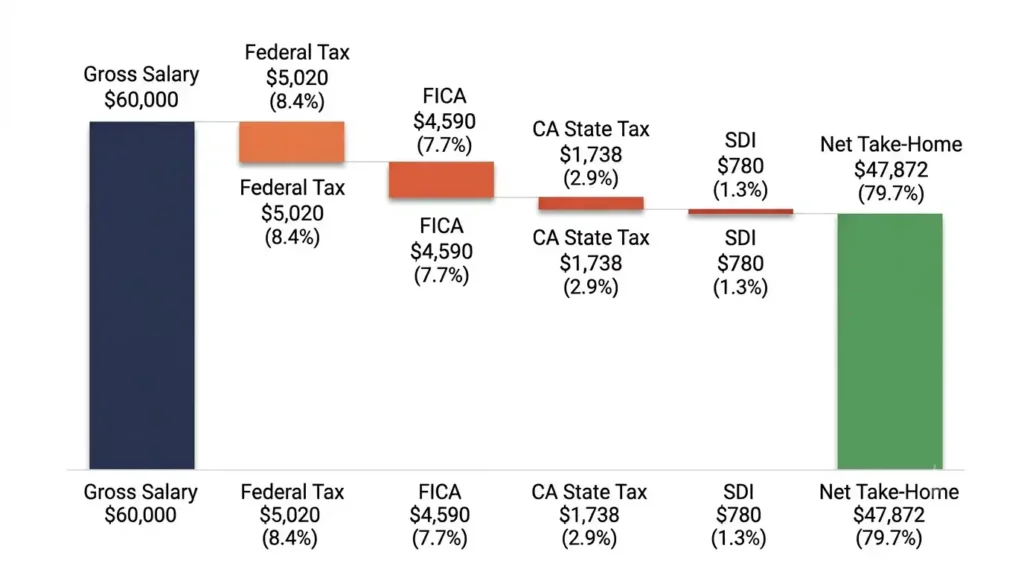
$60,000 California Take-Home Pay at a Glance
Per the table above, that $47,872 breaks down to about $3,989 a month, $1,995 twice a month, $1,841 every two weeks, $921 a week, and roughly $23 an hour on a 40 hour week. This assumes a single filer, no dependents, no pretax deductions. Taxes are mandatory. 401(k) and insurance are optional, and change the number differently.
$60K Salary After Taxes: Quick Paycheck Breakdown
Four separate deductions make up that $12,128 total: federal income tax, FICA, California income tax, and SDI. None of them is one flat cut, and each runs on its own formula.
What This $60K Estimate Assumes
This baseline is a single W-2 employee, standard deduction, no dependents, no side income, using the same approach explained in our methodology. A $60,000 W-2 salary is not taxed like $60,000 in 1099 income, since an independent contractor also owes self-employment tax. Run your own side by side numbers with our 1099 vs W-2 calculator. No 401(k), health premiums, or HSA money is factored in here.
$60K California Salary Breakdown Before and After Taxes
$60,000 gross becomes roughly $47,872 net once four separate deductions apply. See our full gross pay versus net pay breakdown for how this works at any salary.
From $60,000 Gross Pay to Net Pay
Federal income tax and FICA come out first, leaving $50,390. California income tax and SDI come out next, landing at the $47,872 net shown above. Each of the four runs its own formula, which is why the order and math matter, not just the final total.
Federal Income Tax on $60,000
The 2026 standard deduction for a single filer is $16,100, per the Internal Revenue Service’s 2026 tax inflation adjustments under Revenue Procedure 2025-32 and the One Big Beautiful Bill Act. See our full breakdown of the federal and California standard deduction for how this compares to itemizing. Taxable income: $43,900. The first $12,400 is taxed at 10%, the remaining $31,500 at 12%. Federal income tax: about $5,020, an effective rate near 8.4%, though the marginal tax rate is 12%. FICA, short for the Federal Insurance Contributions Act, is separate and funds Social Security and Medicare. Most filers take the standard deduction instead of itemizing, since itemizing only helps past $16,100. Final numbers land on Form 1040.
Social Security and Medicare Taxes
The Social Security tax rate 6.2% on $60,000 is $3,720. The Medicare tax rate 1.45% adds $870. Combined FICA: $4,590. Social Security tax stops at the $184,500 Social Security wage base for 2026, far above $60,000. Medicare has no ceiling, and a 0.9% Additional Medicare Tax applies well above $60,000. Employers withhold per IRS Publication 15. In my experience, this is the tax people forget until they see it on a stub.
California Income Tax and SDI
California’s progressive brackets run 1% up to higher rates, under the California Revenue and Taxation Code and the California Franchise Tax Board. See our full California tax brackets for 2026 guide for every filing status. This is the California Personal Income Tax, and California has no local income tax on ordinary wages. On $54,120 of California taxable income, state tax is about $1,738. California SDI 1.3% for 2026 adds $780, and you can run your own numbers with our SDI calculator. This traces to Senate Bill 951 and the California Unemployment Insurance Code, which removed SDI’s wage cap. The California Employment Development Department updates its EDD withholding schedules yearly. SDI has no ceiling, unlike Social Security.
How Much Is $60K Take-Home Pay Per Month, Week, and Paycheck?
Your $60,000 breaks down differently by pay frequency.
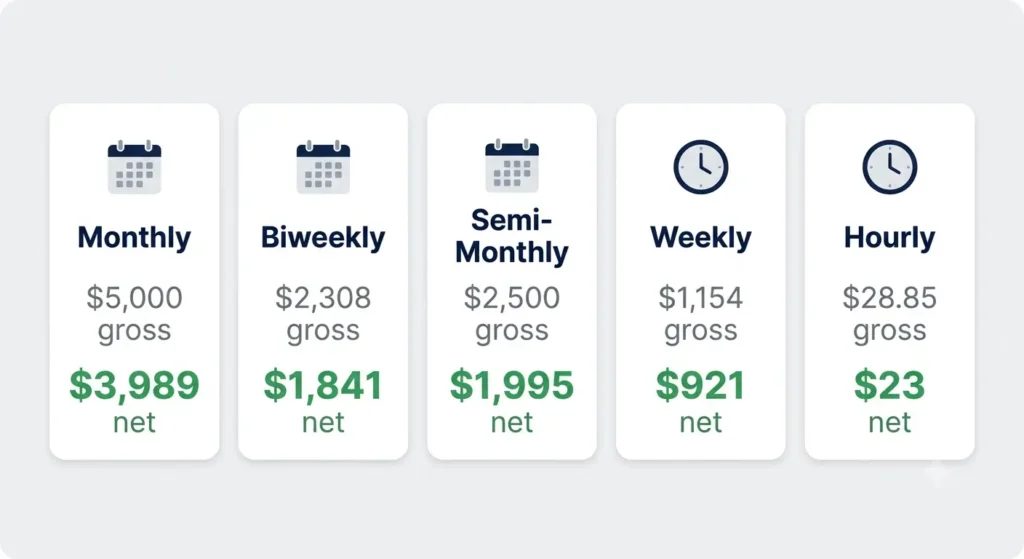
| Frequency | Gross | Net (after tax) |
|---|---|---|
| Monthly | $5,000 | ~$3,989 |
| Biweekly (26x/yr) | ~$2,308 | ~$1,841 |
| Semi-monthly (24x/yr) | $2,500 | ~$1,995 |
| Weekly | ~$1,154 | ~$921 |
| Hourly (40hr week) | $28.85 | ~$23 |
$60K After Taxes Per Month
Gross monthly: $5,000. Net: about $3,989. That $1,011 gap is why a $5,000 salary quote can feel misleading on the first paycheck.
$60K After Taxes Biweekly
26 paychecks a year. Gross: about $2,308. Net: around $1,841. Two months a year bring three paychecks instead of two, since 26 does not divide evenly into 12.
$60K After Taxes Semi-Monthly
24 paychecks a year, usually the 1st and 15th. Gross: $2,500. Net: about $1,995. No extra check, unlike biweekly.
$60K After Taxes Weekly and Hourly
Weekly gross: about $1,154. Net: roughly $921. Gross hourly on 40 hours: $28.85. Net hourly: close to $23. Overtime or a short first week shifts these.
Why Your $60K Paycheck May Be Different From This Estimate
Filing status, dependents, and benefits move the number.
Filing Status Can Change Your Take-Home Pay
Married filing jointly uses wider brackets and a bigger standard deduction, usually less federal tax than a single filer at $60,000. Head of household sits between single and joint, for unmarried filers covering over half their household costs with a dependent. Married filing separately rarely helps. Your spouse’s income changes household tax even if your $60,000 stays the same.
Dependents and Tax Credits
A qualifying child can lower federal tax through credits like the Child Tax Credit. These reduce what you owe at filing but may not show up in paycheck withholding unless you update your Form W-4, or your California Form DE 4 for state withholding.
Pre-Tax Payroll Deductions
Traditional 401(k) contributions, health premiums, HSA, and FSA contributions all come out before taxes, lowering taxable income and today’s tax bill while building savings or covering costs.
After-Tax Payroll Deductions
Roth 401(k), certain life insurance, and union dues come out after tax and do not lower taxable income. Basic calculators often skip these, so check your pay stub for the full list.
$60K After Taxes for Different California Filing Situations
Filing status shifts the numbers at the same salary. For more on how each tax is calculated, see our California payroll taxes overview.
Single Filer Earning $60,000
The baseline: $16,100 standard deduction, $5,020 federal tax, $4,590 FICA, $1,738 California tax, $780 SDI. Net: $47,872 a year, about $3,989 a month.
Married Filing Jointly With $60,000 Household Income
As full household income, the $32,200 joint standard deduction for 2026 (nearly double single) lowers federal taxable income, usually meaning less federal tax than a single filer at $60,000.
Head of Household With $60,000 Income
The $24,150 standard deduction for 2026 sits between single and joint. Qualifying means unmarried, paying over half home costs, with a qualifying dependent. Usually a lower bill than filing single.
$60,000 With Children or Other Dependents
Dependents do not change gross pay, but can add thousands in credits at filing. Withholding may not reflect this until you update your Form W-4.
$60K Salary With 401(k), Health Insurance, and Other Benefits
Benefits move your real take-home more than people expect.
$60K With a 401(k) Contribution
At 0%: baseline $47,872 net. At 5%: $3,000 a year set aside, softening the tax hit. At 10%: $6,000 a year, a bigger check reduction, bigger long-term savings. Traditional 401(k) money is taxed later. Roth 401(k) money is taxed now, tax-free later. Employer matching is free money on top.
$60K With Health Insurance
Premiums usually come out pretax, lowering taxable wages like a 401(k) does. A $200 monthly premium removes $2,400 a year from taxable income, which is why tax-only calculators overstate real take-home pay.
$60K With HSA or FSA Contributions
A Health Savings Account lowers taxable income with a qualifying high deductible plan and rolls over yearly. A Flexible Spending Account works similarly but is usually use-it-or-lose-it. Skipping either means a higher check now, no tax-free medical cushion later. Workers who skip the HSA often end up paying full price out of pocket for the same costs it would have covered.
Example of a Real $60K Paycheck
Biweekly gross: $2,308. After taxes: around $1,841. Subtract a $100 health premium and $50 401(k): about $1,691 real deposit. Always check your actual pay stub.
Why Different $60K After-Tax Calculators Give Different Answers
Two calculators, two answers, same $60,000, for a reason.
Tax Year Differences
2025 rules will not match 2026 rules. The 2026 federal standard deduction for single filers is $16,100, up from $15,750 in 2025.
Filing Status and Withholding Assumptions
Some calculators default to single, zero dependents. Others factor multiple jobs or extra withholding on your Form W-4 or California’s DE 4. Small input changes shift the withholding estimate.
Taxes Versus Total Payroll Deductions
“After taxes” should mean income tax, FICA, state tax, and SDI only, not voluntary 401(k) or insurance. Know which one a calculator is showing.
Tax Liability Versus Paycheck Withholding
Withholding is a running estimate all year. Tax liability is calculated once, at filing, on Form 1040. Too much withheld means a refund. Too little means you owe, and in some cases an underpayment penalty.
Is $60K a Good Salary to Live on in California?
It depends almost entirely on where you live.
How Much Rent Can You Afford on $60K?
At $3,989 a month net, a 30% guideline puts rent near $1,197. That is tight for a one bedroom in many California metros before utilities and transportation.
Living Alone on $60K in California
Rent alone can eat a third to half of take-home pay depending on area. Add insurance and transportation, and discretionary spending shrinks fast. Works better with a roommate or a lower cost city.
$60K in High-Cost Versus Lower-Cost California Areas
$60,000 stretches very differently in Fresno versus San Francisco. Housing cost drives the gap, not state taxes, since California income tax applies the same statewide. Try the San Francisco paycheck calculator or Los Angeles paycheck calculator for high-cost cities, or the Sacramento paycheck calculator for a more affordable comparison.
Example $60K Monthly Budget
At about $3,989 a month net:
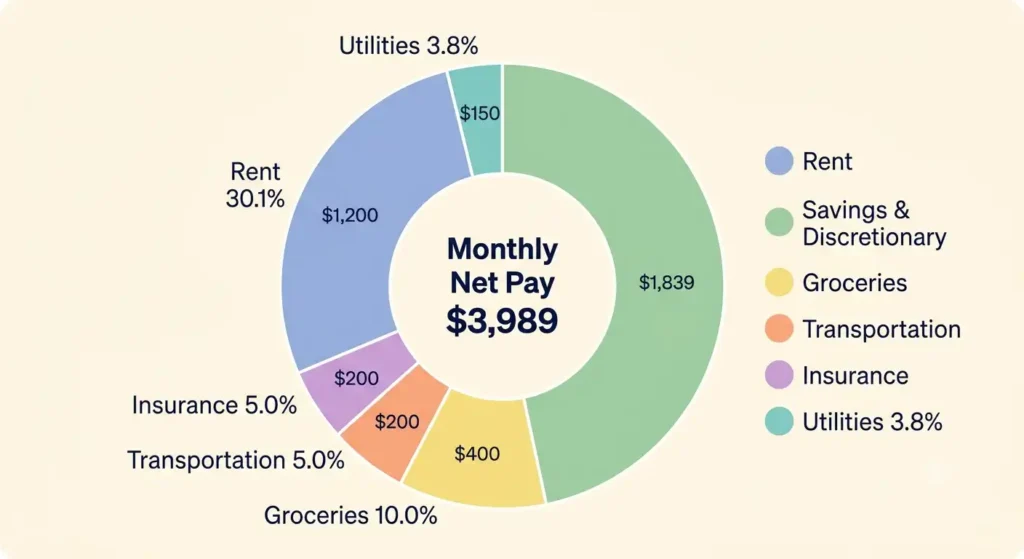
- Rent: $1,200
- Groceries: $400
- Transportation: $200
- Utilities: $150
- Insurance: $200
- Left for savings/discretionary: ~$1,839
Rent share varies widely by city.
How $60K Compares With Other California Salaries
Raises do not translate dollar for dollar into spending power.
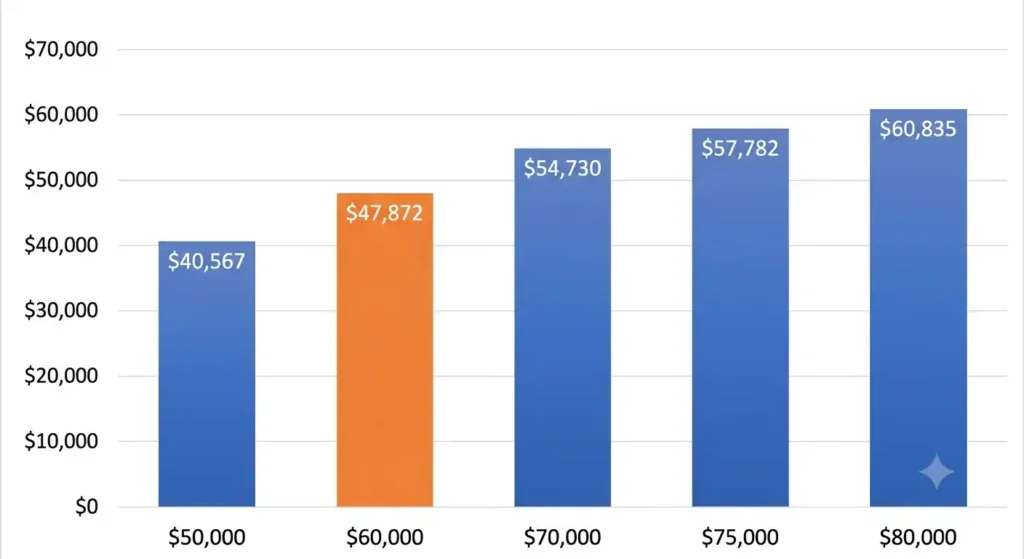
| Gross salary | Est. net/year | Est. net/month |
|---|---|---|
| $50,000 | ~$40,567 | ~$3,381 |
| $60,000 | ~$47,872 | ~$3,989 |
| $70,000 | ~$54,730 | ~$4,561 |
| $75,000 | ~$57,782 | ~$4,815 |
| $80,000 | ~$60,835 | ~$5,070 |
$50K vs. $60K After Taxes
A $10,000 raise from $50,000 to $60,000 does not add $10,000 in spending power, since part gets taxed at higher marginal rates. See the full $50,000 after taxes in California breakdown for the exact comparison. Still adds several hundred dollars a month in real take-home.
$60K vs. $70K After Taxes
Moving to $70,000 pushes more income into higher brackets. Expect a few hundred extra dollars a month net, not the full $10,000.
$60K vs. $75K and $80K
Take-home rises each step from $60,000 to $75,000 and $90,000, slightly slower than the raw salary gap due to higher brackets, but still a meaningful monthly jump.
How Much Salary Do You Need for a Target Take-Home?
For about $4,000 a month net, a single filer needs roughly $60,000 gross. For $4,500 a month, closer to $68,000 to $70,000. For $5,000 a month, high $70,000s to low $80,000s, roughly what it takes to approach $100,000 after taxes in California. Married or head of household filers often need less gross for the same net.
Real-Life $60K California Salary Scenarios
Real paychecks vary from the clean baseline. Browse more paycheck scenarios for other income levels and situations.
Single Worker With No Dependents
The baseline: $47,872 a year, about $3,989 a month, after federal tax, FICA, state tax, and SDI.
Single Worker Contributing 5% to a 401(k)
5% of $60,000 is $3,000 a year saved, take-home drops close to $250 a month, building retirement savings instead of sitting in checking.
Married Worker With a $60K Household Income
As total household income, the bigger joint standard deduction usually means less federal tax than a single filer at $60,000. If a spouse also earns income, total tax depends on the combined amount.
$60K Salary With Health Insurance and Other Benefits
A $150 monthly premium plus a modest 401(k) contribution puts the real paycheck noticeably below a tax-only calculator estimate.
What Happens If You Start a $60K California Job Midyear?
Starting or leaving a job partway through the year changes the annual math.
Starting the Job Partway Through 2026
$60,000 is an annual rate. Starting in July, withholding still assumes a full year of $60,000, which can mean a refund since actual annual income ends up lower.
Changing Jobs During the Year
Each employer withholds Social Security tax independently. Combined wages crossing the Social Security wage base can mean overpayment, refundable at filing. Review your Form W-4 and DE 4 after a job change.
Moving Into or Out of California
California taxes residents on all income, nonresidents only on California-source wages. Moving midyear usually means filing as a part-year resident.
Common $60K After-Tax Mistakes and Myths
A few misunderstandings, cleared up directly. If your check looks smaller than expected, our why is my paycheck so low guide covers the six most common causes.
“I Take Home $60K Minus a Flat Tax Percentage”
Not one flat cut. Federal brackets, California brackets, FICA, and SDI each apply separately.
“The 22% Federal Bracket Means I Pay 22% on Everything”
Only income above a threshold is taxed at that rate. At $60,000, you sit in the 12% bracket, and even then only income above $12,400 is taxed at 12%.
“$60K Means $5,000 a Month in Spendable Income”
$60,000 divided by 12 is $5,000 gross, not what lands in your account. Real net is closer to $3,989 a month before any optional deductions.
“Everyone Earning $60K Takes Home the Same Amount”
Filing status, benefits, and dependents all shift the final number, even at identical salaries.
“Tax Withholding Is the Same as the Tax I Owe”
Withholding is an estimate all year. Liability is calculated once, at filing. They rarely match exactly.
How to Estimate Your Own $60K California Take-Home Pay
The process I walk clients through, or run it instantly with our annual salary calculator:
- Confirm gross salary and pay frequency
- Identify your tax profile (filing status, dependents, residency)
- List all payroll deductions (401(k), insurance, HSA/FSA)
- Compare the estimate against your actual pay stub
Start With Your Gross Salary
Confirm the $60,000 rate and pay frequency. Check whether bonuses or commissions are included or paid separately, since bonus income is often withheld at a different flat rate.
Identify Your Tax Profile
Confirm federal filing status, dependents, other income sources, and California residency status.
Add Your Payroll Deductions
List your 401(k) percentage, health premium, and any HSA or FSA elections, plus other regular deductions like union dues.
Compare the Estimate With Your Pay Stub
Check gross pay, federal withholding, California withholding, SDI, FICA, and voluntary deductions against your actual stub. Our guide on how to read your California pay stub walks through each line.
Frequently Asked Questions About $60K After Taxes in California
How much is $60,000 after taxes in California in 2026?
A single filer with no dependents nets roughly $47,872 a year, about $3,989 a month, assuming the standard deduction and no pretax benefits.
How much is $60K a month after taxes in California?
Gross is $5,000 a month. Net, after federal tax, FICA, state tax, and SDI, is roughly $3,989.
How much is $60K biweekly after taxes in California?
Gross is about $2,308 per check. Net is roughly $1,841.
How much federal tax do you pay on $60,000?
After the $16,100 standard deduction, taxable income is $43,900, resulting in about $5,020 in federal income tax for 2026.
How much California state tax do you pay on $60,000?
Using California’s standard deduction and progressive brackets, state income tax on $60,000 is roughly $1,738 for a single filer, separate from SDI.
How much Social Security and Medicare tax is taken from $60K?
Social Security tax rate 6.2% is $3,720. Medicare tax rate 1.45% is $870. Combined FICA: $4,590.
Does California SDI come out of a $60K paycheck?
Yes. California’s 2026 SDI rate is 1.3%, no wage cap, about $780 a year on $60,000, funding disability and paid family leave benefits.
Is $60,000 a good salary to live on in California?
At about $3,989 a month net, it works comfortably in lower cost areas, especially with shared expenses. In high-cost coastal cities, housing alone can consume a third or more of that income.
Final $60K After-Tax Takeaway
The Number to Remember
A single filer earning $60,000 in California in 2026 nets roughly $47,872 a year, about $3,989 a month, assuming the standard deduction, no dependents, no optional deductions. Filing status, benefits, and dependents shift this either way.
What to Check Before Accepting a $60K Job
Compare the gross salary against realistic net pay, not just the offer letter number. Check health insurance costs and retirement matching. Factor in commute and local housing costs. The full compensation package decides whether $60,000 works for you.
For more California paycheck guides, browse our full post index, page directory, and category index, or head to the California paycheck calculator homepage to try the gross pay calculator for any other salary.

Yeasin Sorker is the founder of Paycheck Calculator California. He built this tool in 2018 after noticing that most free paycheck calculators missed California-specific rules like daily overtime and the uncapped SDI rate.
He researches California payroll tax updates regularly and keeps this calculator aligned with the latest IRS, FTB, and EDD published rates. All calculations on this site are estimates based on official 2026 government sources. For personalized tax advice, consult a qualified tax professional.