
California dental hygienists earn near six figures in 2026, with actual pay driven by license type, city, and weekly hours rather than one fixed number. Location and experience matter most.
Having compared hourly offers and pay stubs across California practices for years, that pattern holds consistently.
One caveat: private salary sites and official BLS data can differ by $20,000, so verify locally.
How Much Does a Dental Hygienist Make in California in 2026?
This falls under Standard Occupational Classification 29-1292, or SOC 29-1292, the code the U.S. Bureau of Labor Statistics uses nationwide. It sits above dental assistant pay and trails registered nurse pay in California, since RNs train longer. California doesn’t license a separate dental therapist role, so RDHs remain the primary preventive-care providers statewide.
California Dental Hygienist Salary at a Glance
ZipRecruiter puts the California average at $86,811 a year ($41.74/hour). SalaryExpert reports $105,870 ($51/hour). Salary.com reports $83,632 ($40/hour). The typical range runs $72,000 to $101,000, with top earners clearing $110,500. The official U.S. Bureau of Labor Statistics OEWS figure for California, government-collected rather than a private estimate, puts the median closer to $121,000 to $125,000. That figure comes from BLS-OEWS-based industry aggregators rather than a direct BLS.gov state pull, so treat it as a strong estimate and confirm against BLS.gov’s own state OEWS table if you need an exact figure. That’s roughly $1,670 to $2,040 a week, or $7,235 to $8,825 a month before taxes. Range at a glance: $85,000 to $106,000 (private salary sites) or $121,000 to $125,000 (official BLS state data).
Dental Hygienist Salary by Experience Level
New graduates start around $75,000 to $75,700. SalaryExpert’s entry-level figure (1 to 3 years) is $75,716. Mid-career hygienists typically earn $90,000 to $105,000. By year five, most reach that mid-career range. Past eight years, $118,000 to $118,400 is realistic with periodontal maintenance skills or high-volume work, and that range typically holds through year ten. At fifteen-plus years, especially with specialty skills, pay sits near the top. Takeaway: experience adds real dollars, not just cost-of-living bumps.
What Is the Typical Dental Hygienist Hourly Pay?
Hourly rates run $38 to $54, with $40 to $51 most common in 2026 data. Most full-time hygienists work 32 to 36 hours a week, not a strict 40. At 32 hours, $45/hour is about $74,880 a year. At 40 hours, that’s $93,600. A $60/hour offer sounds great until you learn the office only guarantees three days a week. The number on the flyer means nothing without the schedule attached.
California Dental Hygienist Salary Comparison Table
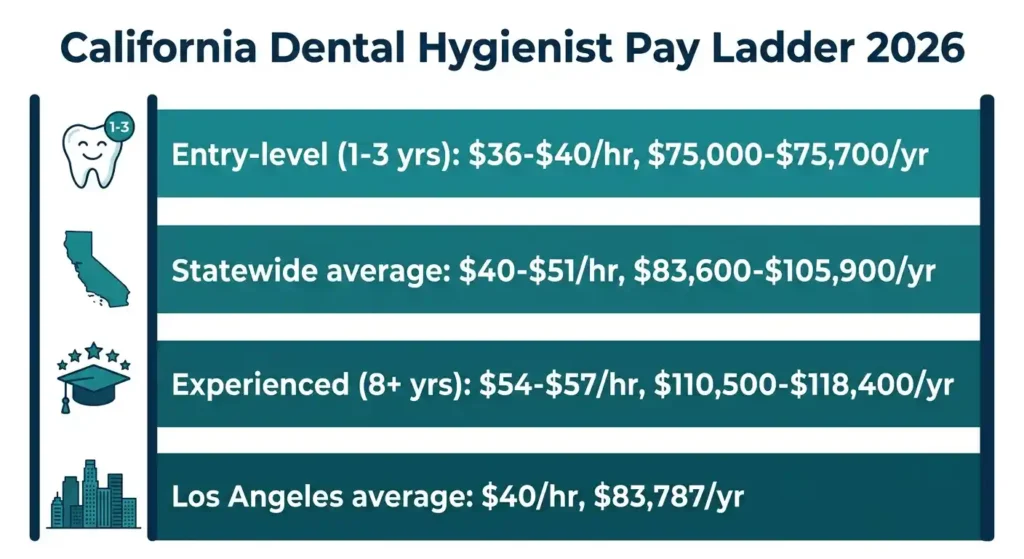
| Level | Hourly Rate | Annual Estimate |
|---|---|---|
| Entry-level (1-3 yrs) | $36-$40 | $75,000-$75,700 |
| Statewide average | $40-$51 | $83,600-$105,900 |
| Experienced (8+ yrs) | $54-$57 | $110,500-$118,400 |
| Los Angeles average | $40 | $83,787 |
If your offer sits well below the entry-level row, the hours are thin or the practice is underpaying. For pay data on other California roles, browse the California salary by job and industry hub, and run your own numbers with the annual salary calculator.
California Dental Hygienist Salary by City and Region
Highest-Paying California Areas for Dental Hygienists
Bay Area cities top California pay data. San Francisco, San Jose, and the peninsula post the strongest hourly rates, driven by high patient volume and a tight labor pool. Higher wages offset some of the higher cost of living, not always dollar for dollar. Your paycheck will reflect the Bay Area, but so will your rent.
Los Angeles, San Diego, San Jose, San Francisco, and Sacramento Pay
Los Angeles, part of the Los Angeles-Long Beach-Glendale metro division, averages $83,787 ($40/hour), close to the statewide figure. San Diego runs similar. The San Jose-Sunnyvale-Santa Clara and San Francisco-Oakland-Berkeley metros trend higher from Silicon Valley wage pressure. Sacramento, part of the Sacramento-Roseville-Folsom metro, sits lower, around $75,000 to $85,000. Bay Area pays more; Sacramento and San Diego offer an easier cost-of-living trade-off.
Rural and Lower-Cost California Markets
In the Central Valley or far Northern California, hourly rates can drop to the high $30s or low $40s, but housing drops faster. Hygienists moving from LA to Fresno often take a $6/hour cut and see rent fall by half. Lower pay in a cheaper market can leave more real money at month’s end.
Dental Hygienist Salary by Job Type and Workplace
Private Dental Practice Pay
Independent general practices are the most common employer, with pay tracking the statewide average. Specialty practices, periodontics especially, pay a few dollars more per hour. Benefits vary by office size. Ask about total compensation, not just hourly pay, before comparing offers.
Corporate Dental Practices and Larger Employers
Corporate and DSO-affiliated offices offer more predictable rates and stronger benefits, including health insurance and paid time off from day one. The trade-off is a faster patient pace and less scheduling flexibility. Corporate practices trade autonomy for steadier hours and better benefits.
Hospital, Public Health, and Community Dental Jobs
Community health centers pay somewhat less hourly but often include pension-style retirement, strong health coverage, and loan forgiveness tied to underserved-area service. Public health work rarely wins on hourly pay, but wins on long-term stability.
Temporary, Per-Diem, and Contract Dental Hygienist Work
Per-diem rates can run well above $50 to $60, sometimes into the $70s, but with zero guaranteed hours and no benefits. Fifteen per-diem hours at $65/hour earns less annually than a full-time 36-hour week at $45/hour. Most per-diem work is still W-2 pay, though some offices classify hygienists as independent contractors, meaning no upfront withholding and full self-employment tax responsibility at filing. Getting this classification wrong carries real risk. See our guide on employee misclassification in California for the ABC test and penalties involved, or browse the full worker classification category for more. A higher hourly rate on paper doesn’t automatically mean more money in your bank account.
How Much Can a Dental Hygienist Make Per Year?
Annual Salary at Different Hourly Rates
At $40/hour: 20 hours a week is about $41,600 a year, 30 hours is $62,400, 40 hours is $83,200. Those assume 52 working weeks, which rarely happens; trim 5 to 10 percent for a realistic figure. Gross pay on paper and what lands in your account are different numbers, mostly because of taxes.
$60, $70, and $80 per Hour Examples
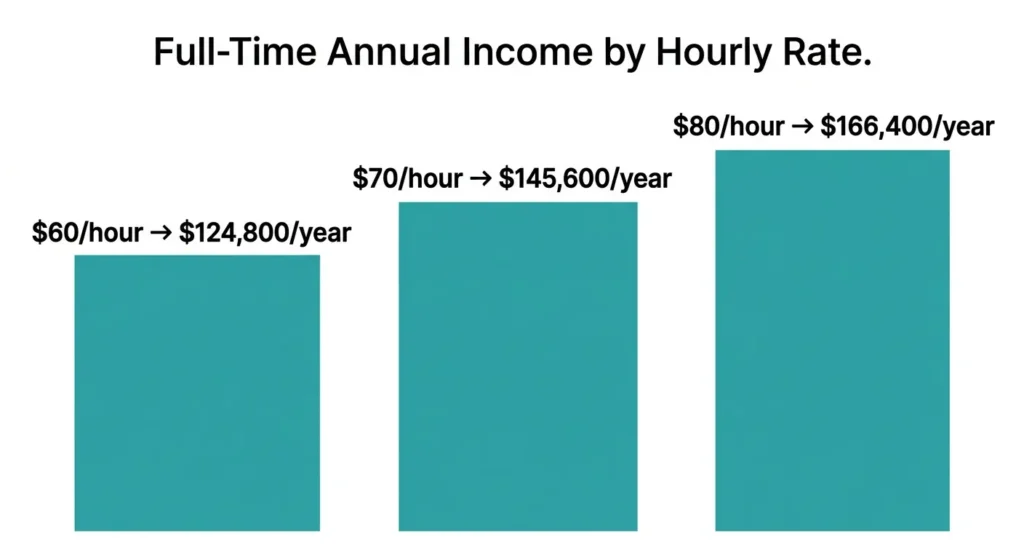
Full time: $60/hour is about $124,800 a year, $70/hour is $145,600, $80/hour is $166,400. These rates fit experienced Bay Area or multi-office per-diem hygienists, not the statewide norm. A high hourly rate isn’t the smartest choice once schedule reliability matters.
Can a California Dental Hygienist Make $100,000 a Year?
Yes, without an extreme rate. $50/hour at 40 hours reaches $104,000. $48/hour at full time is $99,840, essentially six figures. Four long days, or a second per-diem day, can also cross six figures at more modest rates. See what $100K actually nets after taxes in California for the real take-home picture. Six figures is realistic, but it takes full-time hours, not just a high rate.
Dental Hygienist Salary vs Cost of Living in California
Why a Higher Salary Does Not Always Mean More Money
A $95,000 salary in San Jose doesn’t stretch like it does in Bakersfield. Housing can eat 40 to 50 percent of take-home pay in coastal cities, versus 20 to 25 percent inland. Look at what’s left after rent, not just what’s on the offer letter.
High Salary in San Jose vs Lower Salary in a Less Expensive Area
Two hygienists earning $50/hour full time both gross around $104,000. One pays $3,200/month rent in San Jose; the other pays $1,500/month in Fresno. The Fresno hygienist keeps an extra $20,400 a year before any other expense. Same gross pay, very different real-world outcome.
What Salary Is Comfortable for a Dental Hygienist in California?
In a coastal metro, a single hygienist typically needs $85,000 to $95,000 to live comfortably without roommates. In Fresno, Bakersfield, or Redding, $60,000 to $70,000 covers similar comfort. There’s no single comfortable number statewide, only one for your zip code.
Dental Hygienist Take-Home Pay After Taxes
Gross Salary vs Take-Home Pay
A $95,000 earner loses a meaningful chunk before ever seeing it: federal income tax, California state income tax, Social Security, Medicare, and California State Disability Insurance. State tax can reach the 9 to 10 percent bracket for mid-level earners, on top of federal brackets, 7.65 percent FICA, and a 1.3 percent CASDI deduction, per the EDD, funding paid family leave and disability programs. For the full breakdown of every line on a stub, see gross pay vs net pay in California or browse the California payroll taxes category. Expect 23 to 29 percent of gross pay gone before it hits your account.
Example California Dental Hygienist Paychecks
A single filer at $85,000, paid biweekly, sees a $3,270 gross paycheck shrink to roughly $2,450 to $2,550 after withholdings, and that gap traces straight back to how you filled out your W-4 form. Someone at $110,000 loses a slightly higher percentage. A married hygienist filing jointly with a lower-earning spouse often keeps more per paycheck than a single filer at the same salary. If the line items on your stub don’t add up, our guide on how to read a California pay stub breaks down every deduction. Filing status and pre-tax deductions swing take-home pay more than most expect.
Benefits That Change the Real Value of a Job
Employer-paid health insurance can be worth $400 to $800 a month. A 3 percent 401(k) match on $90,000 adds $2,700 a year free. Paid time off matters too, since per-diem and hourly-only roles often skip it. A job paying $2 less an hour with strong benefits often beats one paying $2 more with none.
What Factors Increase a Dental Hygienist’s Salary in California?
Experience and Clinical Skills
Skills matter as much as years. Deep scaling, local anesthesia administration, and efficient chairside management move pay up faster than staying generalist. Continuing education hours for license renewal are a natural chance to build these. Skill growth, not just time served, moves pay.
Location and Employer Type
Where you work sets your ceiling. Specialty practices and corporate DSOs in high-demand metros out-pay small practices in lower-demand areas. Public health trades hourly pay for stability. Zip code and employer type together set what’s realistically possible.
Schedule, Availability, and Workload
Evenings, Saturdays, or a second office add income at the same base rate simply by adding hours. Some offices pay $2 to $5 more an hour for evening and weekend shifts. Overtime past 8 hours a day or 40 a week is legally time and a half in California, though hygienist schedules are usually built in patient blocks rather than fixed shifts. Steady appointment volume beats a practice with frequent cancellations. More available hours, filled consistently, is the most controllable way to raise income.
Advanced Credentials and Career Paths
An active RDH license is the baseline. Pursuing RDHAP opens alternative practice settings with more independence. Certifications in local anesthesia or nitrous oxide monitoring, where not already licensed in, can unlock higher-paying roles. Stacking credentials is one of the clearest paths to a bigger paycheck.
Is Dental Hygiene School Worth the Cost in California?
Dental Hygiene Education Costs
Programs run $10,000 at community colleges to over $60,000 at private schools, before books, exam fees, and licensing costs. Most associate degree programs, prerequisites included, take two to three years. The real cost is tuition plus everything you didn’t earn while in school.
Education Cost vs Expected Dental Hygienist Earnings
Even a $60,000 investment recovers fast against a $75,000 entry salary, faster than many bachelor’s degrees costing similarly but paying half that. Career earnings climbing toward $110,000-plus bring the break-even point to two or three years of full-time work. Dollar for dollar, dental hygiene is a strong education-to-income ratio.
What You Need Before You Can Work as an RDH
- Graduation from a board-approved program
- A passing score on the national written exam
- An approved clinical examination
- California’s law and ethics exam
Skip any step and there’s no license, and no legal work. Every step is required, no shortcuts.
California Licensing Rules That Can Affect Your Career Start
Recent grads from approved in-state programs can sometimes waive clinical exam requirements, speeding up the first paycheck. Out-of-state hygienists follow a different pathway. Your license must be fully issued, not pending, before treating patients. Know your pathway early, since it affects how fast you start earning.
How to Become a Dental Hygienist in California
Step-by-Step California RDH Path
- Complete an approved program, typically a two-to-three-year associate degree with prerequisites.
- Finish coursework and pass exams.
- Submit your licensure application to the Dental Hygiene Board of California.
- Wait for the license before treating patients.
Four steps, no skipping, but a clear path.
California RDH Clinical Examination Options
Options include WREB (Western Regional Examining Board), the CDCA-WREB-CITA exam, commonly known as ADEX, or CRDTS (Central Regional Dental Testing Service), depending on the program. Some recent CA grads qualify for an exam waiver. Everyone must pass the National Board Dental Hygiene Examination, with results via the National Board Dental Hygiene Examination Scorecard, plus California’s law and ethics exam. Applications run through the state’s BreEZe licensing system. Multiple roads to licensure, same destination requirements.
Can an Out-of-State Dental Hygienist Work in California?
Yes, through RDH Licensure by Credential, for hygienists already licensed elsewhere with around five years of clinical practice, without repeating every California exam. This differs from RDH licensure by clinical examination, the standard first-time path. California’s requirements aren’t identical to other states, so an out-of-state license doesn’t guarantee automatic approval. Hygienists trained outside the U.S. face added restrictions. California’s scope of practice sits in Business and Professions Code Sections 1900 through 1967.4. Moving to California with an out-of-state license is possible, but plan for paperwork and processing time.
Can an RDH Earn More Through RDHAP?
What Is an RDHAP?
A Registered Dental Hygienist in Alternative Practice, or RDHAP, works independently in settings a standard RDH can’t, including nursing homes, schools, and homebound care, without a supervising dentist. An RDHAP essentially runs their own small practice.
California RDHAP Eligibility Requirements
RDHAP licensure needs an active, unrestricted California RDH license, 2,000 clinical practice hours in the preceding 36 months, and a bachelor’s degree or equivalent, typically 120 semester credit hours or 180 quarter credit hours. That 2,000-hour rule is RDHAP-specific; a separate rule, 750 clinical practice hours per year for five years, applies instead to RDH Licensure by Credential, not RDHAP. A bachelor’s degree doesn’t raise standard RDH pay, but it’s required here. RDHAP-specific coursework, about 150 hours additional education, completes the requirement. Built for experienced hygienists, not a beginner pathway.
Is RDHAP Worth Pursuing for Higher Income?
Added education and certification costs are real, but so is the earning potential from independent contracts in underserved settings like memory care. The trade-off: RDHAPs also handle their own scheduling, billing, and business logistics, including the California self-employment tax rate on any 1099 income. RDHAP raises your income ceiling but trades a steady paycheck for small-business responsibilities.
How to Compare Two California Dental Hygienist Job Offers
$70 per Hour Without Benefits vs $60 per Hour With Benefits
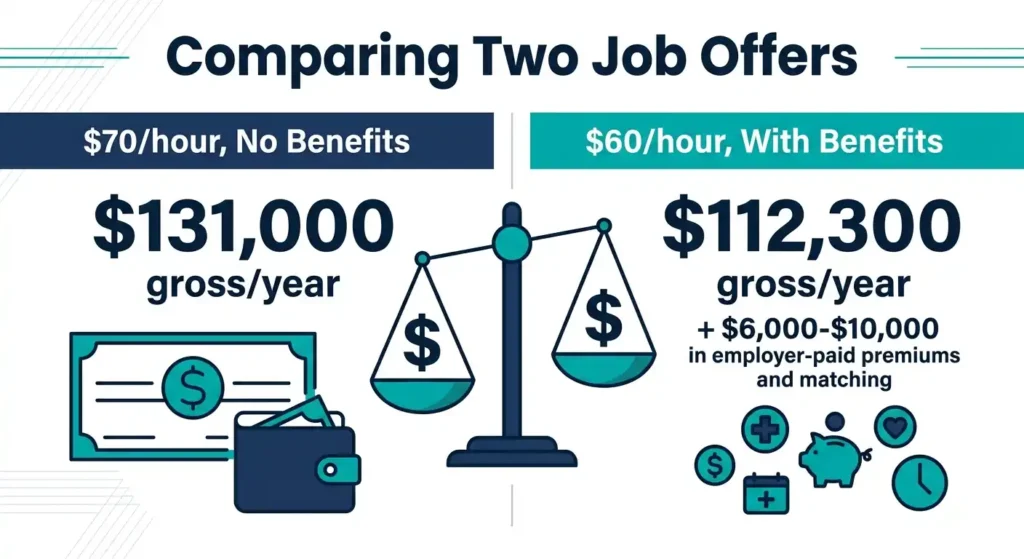
At 36 hours a week, $70/hour with no benefits grosses about $131,000, all benefits self-funded. $60/hour with full benefits grosses about $112,300, but add back $6,000 to $10,000 in employer-paid premiums and matching, and the gap narrows sharply. Run the full math before assuming the bigger hourly number wins.
Higher Hourly Rate vs More Guaranteed Hours
A $65/hour offer at only 24 guaranteed hours can produce less predictable income than $50/hour with a firm 38-hour guarantee. Cancellations hit hourly-only pay hardest. Guaranteed hours are worth more than they sound on paper.
Questions to Ask Before Accepting a Dental Hygiene Job
- How many hours are truly guaranteed each week
- What’s the cancellation and no-show policy
- What benefits are included, and when they start
- How raises or bonuses work
- Whether the rate itself is negotiable, especially with a proven patient base
Some practices also add production-based or commission pay tied to billable treatment, which gets taxed differently than your regular hourly wage, so it’s worth understanding the California bonus tax rate before counting on it. These questions reveal real annual income better than the hourly rate alone. Switching employers every year or two is one of the more reliable ways to push pay up, since new employers often pay more to fill a chair than existing ones pay to retain you.
Real-World California Dental Hygienist Salary Scenarios
The scenarios below sit alongside our other California paycheck scenarios, and if you’re weighing hours directly, see part-time vs full-time paycheck differences in California for the general math.
New Graduate Working Part-Time
A new hygienist at $38/hour working 24 hours a week earns roughly $47,400 a year. Rate and hours typically rise together over the first two to three years. Reduced schedules are also common for pregnancy (see our guide on California maternity leave pay), young kids, or finishing a degree part time, and most offices treat this as normal. An advertised hourly wage almost never includes benefits, so two identical rates can mean very different total pay. Part-time entry is normal, not a red flag.
Mid-Career Hygienist Working Four Days a Week
Five years of experience at $47/hour across four eight-hour days (32 hours) lands around $78,200 a year, plus a three-day weekend. Many offices treat 32 hours as full-time for benefits, so “full-time” isn’t always a strict 40. Four solid days can beat five stretched-thin ones.
Experienced Hygienist Working Multiple Offices
Splitting 20 hours between two offices at $52/hour, 40 hours combined, reaches roughly $108,200 a year. Added commute and coordination are real costs. Multiple offices can raise income, if the logistics hold together.
High-Earning Hygienist Pursuing RDHAP
An experienced RDH earning $115,000 who pursues RDHAP and contracts with skilled nursing facilities can climb further, since independent rates in underserved settings often run above standard employed wages, minus added business overhead. This is the ceiling scenario for hygienists taking on the most responsibility.
Can a Dental Hygienist Earn More With Advanced Credentials and Career Paths?
Advanced Credentials and Clinical Skills
Credentials in local anesthesia administration, nitrous oxide monitoring, and specialty periodontal techniques expand which practices will hire you, and at what rate. Every added credential opens a slightly bigger door.
RDHAP Career Opportunities
Registered Dental Hygienists in Alternative Practice work in skilled nursing facilities, schools, and home health settings standard RDHs can’t access without a supervising dentist, often at independent contractor rates. X-rays in these mobile settings still require the same ADA radiation safety program standards as a fixed office. This credential shifts you from employee toward small operator.
Career Progression Beyond Traditional Dental Hygiene
Some hygienists move into clinical education, teaching at community colleges. Others move into public health leadership or dental industry roles like clinical sales. Chairside work isn’t the only long-term path.
Common Dental Hygienist Salary Myths in California
“Every California Dental Hygienist Makes the Statewide Median”
The median is a midpoint, not a guarantee. Location, experience, and employer type shift individual pay by $20,000 or more either way. A median is a reference point, never your personal paycheck.
“The Highest Hourly Rate Is Always the Best Job”
As shown in the $70 versus $60 comparison, benefits and guaranteed hours can outweigh a few extra dollars an hour. The best offer has the highest total value, not the highest single number.
“A Dental Hygiene Degree Guarantees a High Salary”
Licensing gets you in the door; local job markets and clinical skill determine what you actually earn. The degree is the entry ticket, not the salary guarantee.
“Six Figures Is Easy for California Dental Hygienists”
Six figures needs close to full-time hours at a solid rate, not just any license and schedule. Plenty of hygienists working reduced hours by choice earn well under $100,000. Six figures is achievable, not automatic.
Is Being a Dental Hygienist in California Worth It in 2026?
When the Career Can Make Financial Sense
Strong statewide wages, a two-to-three-year entry path, and flexible scheduling make this career pencil out for most people who finish licensing, with long-term potential toward $110,000-plus. The financial math works out solidly for most licensed hygienists.
When the Career May Not Be the Best Financial Choice
Private-institution program costs can strain the math without aid, and California living costs hit hard early on. A typical workday means back-to-back patients in a fixed chair position for six to eight patients straight. Repetitive motion, awkward neck and wrist angles, and prolonged close-up focus create real ergonomic strain that can shorten a clinical career. It’s not the right fit for everyone.
What to Check Before Choosing a Dental Hygiene Program
Confirm it’s a California accredited dental hygiene program, check exam-waiver eligibility, and research local job openings before enrolling. Do this homework before paying tuition.
California Dental Hygienist Salary Sources and 2026 Data
California Employment Development Department Wage Data
The California Employment Development Department, the EDD, tracks occupational wage data by region through its California LaborMarketInfo portal, broken down by percentile. Its projections show continued job growth for hygienists, with demand strongest in the Bay Area, LA metro, and San Diego. State data confirms location changes everything.
U.S. Bureau of Labor Statistics Data
The U.S. Bureau of Labor Statistics reported a median dental hygienist wage of $98,100 a year ($47.16/hour) as of May 2025, ranging from $74,880 at the 10th percentile to $126,050 at the 90th, under SOC 29-1292. California ranks among the higher-paying states. National numbers set the floor; California sits above it.
Dental Hygiene Board of California Requirements
The Dental Hygiene Board of California governs licensing, RDHAP eligibility, and scope-of-practice rules. Requirements can change, so check current rules before deciding. This is the one source that overrides every salary survey on what you’re legally allowed to do.
Frequently Asked Questions About Dental Hygienist Salary in California
How much does a dental hygienist make in California in 2026?
$86,800 to $105,900 a year, or $40 to $51 an hour, depending on the survey and city.
What is the starting salary for a dental hygienist in California?
$75,000 to $75,700, rising quickly with clinical experience.
What is the highest-paying city for dental hygienists in California?
Bay Area cities, particularly San Francisco and San Jose.
Can dental hygienists make $100,000 in California?
Yes, a full-time schedule at $48 to $50 an hour crosses six figures.
Do dental hygienists get paid hourly or salary in California?
Mostly hourly, even full-time, so guaranteed weekly hours matter as much as the rate.
How much does a dental hygienist make per hour in California?
$38 to $54, with $40 to $51 most common.
Does experience increase dental hygienist pay in California?
Yes, entry-level to eight-plus years can add $35,000 or more, especially with new clinical skills.
Is dental hygienist a good-paying career in California?
Yes, for a three-year associate degree: entry pay near $75,000, long-term potential above $110,000.
Key Takeaways About Dental Hygienist Salary in California
The Numbers to Remember
| Metric | Figure |
|---|---|
| Statewide average | $86,800-$105,900 |
| Entry-level | ~$75,000 |
| Experienced (8+ yrs) | $110,500-$118,400 |
| Highest-paying region | Bay Area |
| Full-time crosses six figures at | $48-$50/hour |
What to Check Before Making a Career Decision
Verify current local wage data, compare full compensation packages, weigh education costs against realistic entry earnings, and confirm current licensing rules with the Dental Hygiene Board of California.
The Bottom Line for 2026
California remains one of the strongest states for dental hygienist pay. City, guaranteed hours, and years of clinical experience move actual income more than the state average does. Check current local wage data and run the full compensation math, using the gross pay calculator if needed, before signing anything. For how we source and verify these numbers, see our methodology.

Yeasin Sorker is the founder of Paycheck Calculator California. He built this tool in 2018 after noticing that most free paycheck calculators missed California-specific rules like daily overtime and the uncapped SDI rate.
He researches California payroll tax updates regularly and keeps this calculator aligned with the latest IRS, FTB, and EDD published rates. All calculations on this site are estimates based on official 2026 government sources. For personalized tax advice, consult a qualified tax professional.