
The 2027 federal tax brackets keep the 10% to 37% rates, but income thresholds, the standard deduction, and the Social Security wage cap should rise. All are projections until the IRS and the Social Security Administration (SSA) publish them.
These projections come from Bloomberg Tax, Wolters Kluwer, and the 2026 Trustees Report, checked against IRS Revenue Procedure 2025-32.
Treat them as estimates: missing October 2025 inflation data could shift the final IRS numbers.
What to Expect From 2027 Federal Tax and Payroll Changes
Bracket lines should rise about 3.2%. The standard deduction is projected near $16,600 for single filers and $33,200 for joint filers. The Social Security wage cap is projected near $190,200, up from $184,500 in 2026. Most workers will feel small changes, while higher earners will notice the wage cap most.
Which 2027 figures are official and which are still projections?
Only 2026 numbers are official: a $16,100 single deduction, a $32,200 joint deduction, and a $184,500 Social Security wage base, per IRS Revenue Procedure 2025-32 and the SSA. Every 2027 figure is a projection from inflation data or the Social Security Trustees Report. Bloomberg Tax and Wolters Kluwer both put the joint deduction at $33,200.
2026 vs. Projected 2027: What Could Change?
| Item | 2026 (official) | 2027 (projected) |
|---|---|---|
| Standard deduction, single | $16,100 | about $16,600 |
| Standard deduction, married filing jointly | $32,200 | about $33,200 |
| Standard deduction, head of household | $24,150 | about $24,950 |
| Social Security wage base | $184,500 | about $190,200 |
| Top tax rate | 37% | 37% |
The deduction changes your tax bill. The wage cap changes your paycheck only if you earn above it.
When Will the Official 2027 Numbers Be Released?
Expect both announcements this fall. The SSA usually posts the wage base in October, and the IRS posts its yearly inflation changes in October or early November. As of October 2, 2026, I could not find official 2027 amounts from either agency.
When the IRS typically announces annual tax adjustments
The Internal Revenue Code requires the U.S. Department of the Treasury to index the brackets each year, and the Internal Revenue Service (IRS) publishes the result in a Revenue Procedure. These IRS tax inflation adjustments land every fall. The 2026 numbers came out in October 2025. The 2027 numbers apply to income earned in 2027, reported on your return filed in early 2028. Payroll teams use them to update withholding for the new year.
When the SSA announces the Social Security wage base
The SSA sets the wage base using growth in the national average wage index. It usually posts the new cap in mid-October, with the cost-of-living adjustment for benefits, and is reportedly scheduled to announce on October 14, 2026. The $190,200 figure is a Trustees Report projection. The final cap can differ: for 2026, the Trustees first projected $183,600, and the final cap was $184,500. Watch October and early November for official 2027 numbers.
2027 Federal Tax Brackets: What to Expect
Rates stay the same in 2027, and bracket lines should rise about 3.2%. Congress made the seven rates from the 2017 law permanent in 2025: 10%, 12%, 22%, 24%, 32%, 35%, and 37%. More of your income should land in lower brackets. Your state return uses separate California tax brackets.
How federal tax brackets are expected to change for 2027
A rate is the percent. A bracket is the income slice where it applies. Inflation moves the slices, not the percents. The IRS tax rate schedules list them by filing status. For 2026, a single filer pays 10% on the first $12,400 of taxable income and 12% up to $50,400. At about 3.2% growth, Wolters Kluwer projects that 12% line near $52,025. That is a projection, not an IRS number. One projection puts the head of household 10% line at $18,250, up from $17,700.
Why an inflation-adjusted bracket can affect your taxes
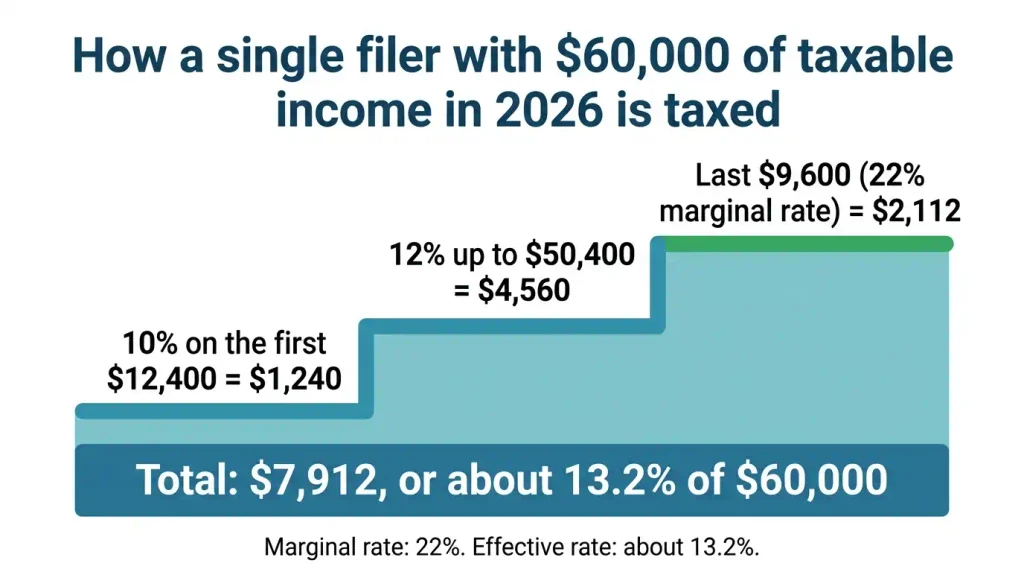
You pay a higher rate only on the part of your income that sits in the higher bracket. Take a single filer with $60,000 of taxable income in 2026. They pay $1,240 on the first slice, $4,560 on the second, and $2,112 on the last $9,600. That is $7,912, or about 13.2% of $60,000. If the 12% line rises about $1,600, income in that gap is taxed at 12%, not 22%. That saves up to about $160.
How filing status affects the 2027 brackets
Your filing status sets where each line sits. The table shows the official 2026 lines. Joint lines are double the single lines in the lower brackets. A qualifying surviving spouse can use the joint lines for two tax years after the year a spouse dies, with a dependent child at home. Married filing separately rarely saves money, and if one spouse itemizes, the other must too. Head of household is easy to overlook if you pay most costs for a qualifying person.
| Filing status (2026, official) | 10% bracket ends | 12% bracket ends | Standard deduction |
|---|---|---|---|
| Single | $12,400 | $50,400 | $16,100 |
| Married filing separately | $12,400 | $50,400 | $16,100 |
| Head of household | $17,700 | $67,450 | $24,150 |
| Married filing jointly | $24,800 | $100,800 | $32,200 |
| Qualifying surviving spouse | $24,800 | $100,800 | $32,200 |
What could change before the final 2027 brackets are published
Four things can move the final numbers. The inflation math may shift. The IRS rounds results. Congress can change the rules: in 2025, lawmakers gave the 10% and 12% brackets a one-time extra bump for 2026, so those lines rose about 4% while others rose about 2.3%. And October 2025 inflation data was never released because of the shutdown. Wolters Kluwer used an 11-month average, and it is unclear how the IRS will handle the gap. Rates stay put, lines rise about 3.2%, and only the IRS makes it final.
2027 Standard Deduction: What Taxpayers Should Watch
The 2027 standard deduction is projected at about $16,600 single, $33,200 joint, and $24,950 for head of household, up from $16,100, $32,200, and $24,150 in 2026. It is the first slice of income the IRS does not tax.
How the 2027 standard deduction is expected to change
It rises with inflation each year. The projected jump is about $500 for single filers and $1,000 for joint filers. Projections put head of household at about $24,950. Use $16,600 and $33,200 as planning numbers only. The joint amount is always double the single amount.
How the standard deduction affects taxable income
Gross income is your full pay. See gross pay vs. net pay for how it becomes take-home. Taxable income is what remains after deductions. Your adjusted gross income (AGI) is income after a few adjustments, and the standard deduction comes off it on Form 1040 before the brackets apply. A single filer earning $70,000 with a $16,600 deduction is taxed on $53,400, before other pre-tax items like a 401(k). A credit cuts the tax bill dollar for dollar, so a $1,000 credit saves $1,000. A $1,000 deduction saves $120 to $220 in the 12% to 22% brackets.
Standard deduction vs. itemizing for 2027
Take whichever is bigger. Itemize only if mortgage interest, state and local taxes, and charity exceed the standard deduction. The state and local tax cap is $40,804 for 2027 under current law, with income limits. A married couple with $20,000 of mortgage interest and $23,000 of state and local taxes has $43,000, which beats $33,200. A couple with $30,000 of deductions should take the standard amount. Starting in 2026, standard deduction filers can also deduct up to $1,000 of cash gifts to charity ($2,000 married filing jointly). California sets its own standard deduction and itemized deductions, so check both for your state return. Add up your deductions, then take the bigger number.
2027 Social Security Wage Cap: What to Expect
The 2027 wage cap is projected at $190,200. You pay 6.2% Social Security tax on pay up to that amount, a maximum of $11,792.40 for an employee. Medicare tax has no cap.
What the Social Security wage base means
The wage base is the most pay in a year that Social Security tax can touch. The SSA also calls it the Social Security contribution and benefit base. Above it, no more Social Security tax comes out that year. It is not the earnings test, which can trim benefits for people who collect early and keep working. Unlike the income tax brackets, it is one flat dollar limit on one tax. Your pay stub may label the 6.2% as OASDI tax.
What the current 2027 projection indicates
The 2026 wage base is $184,500, and it is final. The 2026 Trustees Report, released in June 2026, projects $190,200 for 2027, a jump of $5,700, or about 3.1%. The SSA ties the cap to growth in the national average wage. Treat $190,200 as an estimate until the SSA posts the final cap.
How the wage cap affects your paycheck
Your employer takes 6.2% for Social Security from your first dollar and matches it. Multiply your pay up to the cap by 6.2% to estimate your bill. Once year-to-date pay hits the cap, that withholding stops and checks grow. Medicare keeps coming out at 1.45% on every dollar. Single filers also pay the Additional Medicare Tax, an extra 0.9% on wages above $200,000.
My quick trick: divide $190,200 by your monthly pay to find the month Social Security tax stops. At $20,000 a month, that is 9.5, so it stops in October. Higher earners get bigger late-year checks.
How 2027 Changes Could Affect Your Paycheck and Tax Planning
Most workers will see small changes. Income tax shifts a little as the deduction and brackets grow. Payroll tax changes only if your pay crosses the wage cap. New to paychecks? Start with paycheck basics.
If your income stays about the same
Expect a small drop in federal income tax. Your federal tax liability and effective tax rate edge down, since more pay sits in lower brackets. A single filer earning $70,000 is in the 22% bracket, so a $500 bigger deduction saves about $110 a year, roughly $4 per biweekly check. Payroll tax, also called FICA taxes, stays at 7.65%. California adds its own payroll taxes, including SDI.
If you receive a significant raise
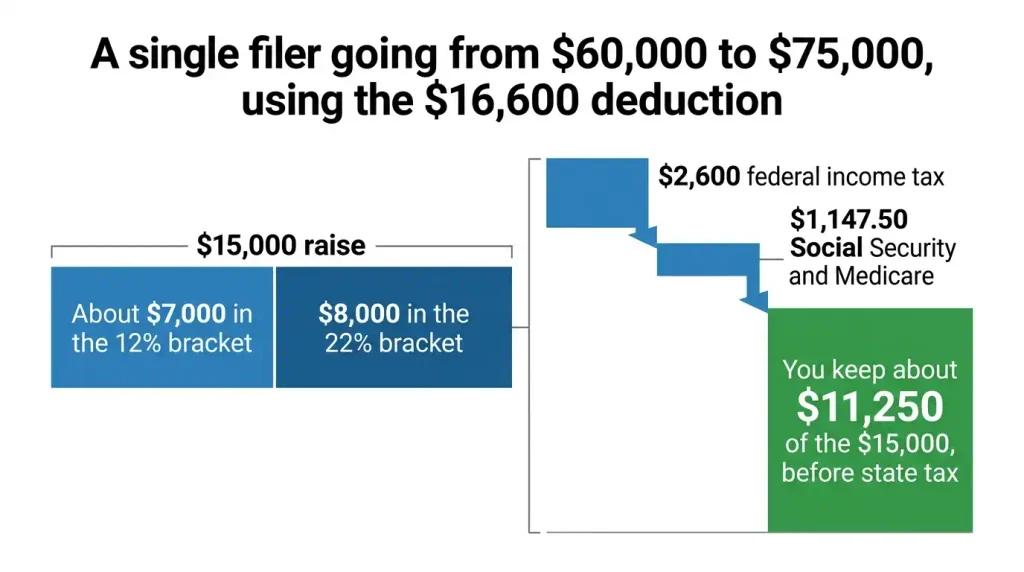
A raise is taxed at your top bracket, not your old average. A single filer going from $60,000 to $75,000, using the $16,600 deduction, has about $7,000 of the raise in the 12% bracket and $8,000 in the 22% bracket. That is $2,600 of federal income tax plus $1,147.50 of Social Security and Medicare. You keep about $11,250 of the $15,000, before state tax. Review your Form W-4 after any big raise. If a raise still feels small, see why your paycheck is so low.
If you earn above the Social Security wage base
If you earn more than $190,200, Social Security withholding stops partway through the year. The more you earn, the earlier it stops. At $300,000 a year, it ends in August, and late-year checks jump. Medicare keeps coming out. Know your stop month and plan cash flow around it.
If you are self-employed
You pay both halves: 12.4% Social Security plus 2.9% Medicare, or 15.3%, on 92.35% of net profit. Income tax is a separate bill. The Social Security part stops at the wage cap, a projected maximum of $23,584.80 for 2027. Medicare does not stop. Run two calculations for quarterly estimates, one for income tax and one for self-employment tax. Not sure whether you are an employee or a contractor? Start with worker classification.
Real-World 2027 Tax Planning Scenarios
These examples use 2026 bracket lines and the projected 2027 deduction. Real 2027 brackets should be wider, so actual tax may land a little lower. All numbers are rough, and our methodology explains how we run them. More examples live in paycheck scenarios.
| Scenario | Taxable income | Federal income tax | Payroll tax |
|---|---|---|---|
| $50,000, single | $33,400 | about $3,760 | $3,825 |
| $100,000, single | $83,400 | about $13,060 | $7,650 |
| $100,000, head of household | about $75,050 | about $9,400 | $7,650 |
| $150,000, married filing jointly | $116,800 | about $15,120 | $11,475 |
A salaried employee earning around $50,000
A single filer earning $50,000 has $33,400 of taxable income after a $16,600 deduction. Federal income tax is about $3,760, or 7.5% of pay. Payroll tax adds $3,825. All taxable income sits in the 10% and 12% brackets, with about $17,000 of room before 22%. A raise, second job, or side income could fill that room. For state taxes too, see $50,000 after taxes in California.
A worker earning around $100,000
A single filer earning $100,000 has $83,400 of taxable income and owes about $13,060 in federal income tax, or 13.1% of pay. Payroll tax adds $7,650. Filing status matters: a head of household filer with the same pay owes about $9,400, but only if you truly qualify. For state taxes too, see $100,000 after tax in California.
A high-income employee approaching the wage base
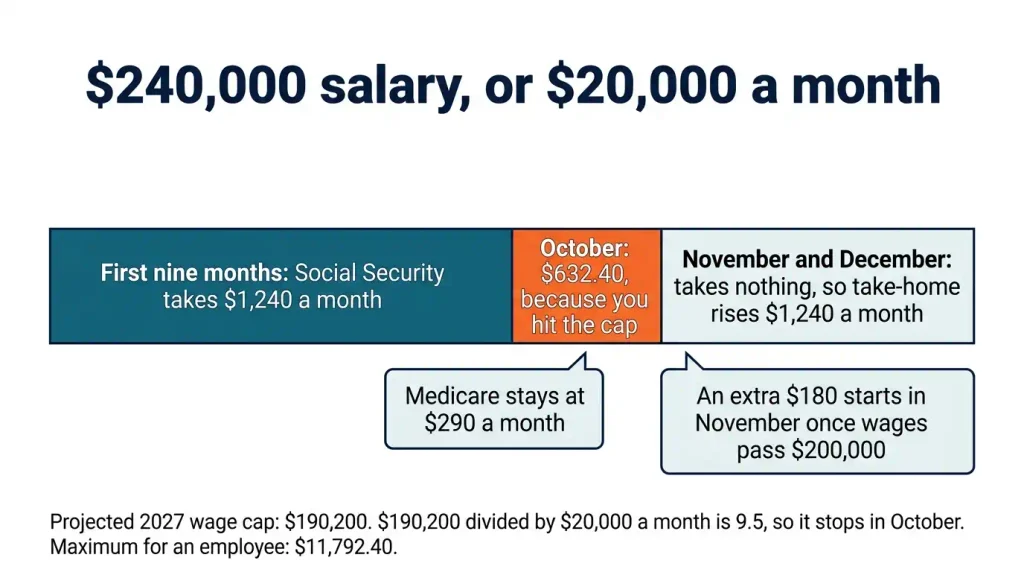
On a $240,000 salary, or $20,000 a month, Social Security takes $1,240 a month for nine months. In October it takes only $632.40, because you hit the cap. In November and December it takes nothing, so take-home rises $1,240 a month. Medicare stays at $290 a month, and an extra $180 starts in November once wages pass $200,000. For a similar income with California taxes, see $250,000 after taxes in California.
A married couple planning their 2027 household budget
A couple earning $75,000 each, or $150,000 together, has $116,800 of taxable income after a $33,200 joint deduction. Federal income tax is about $15,120. They sit $16,000 into the 22% bracket, with lots of room before 24%. Each employer withholds as if that job is the only one, so use the multiple-jobs step on the W-4. For California taxes on this income, see $150,000 after taxes in California. Run the deduction first, then the brackets.
What Happens in Special 2027 Tax Situations?
The Social Security wage cap follows you as a person. The brackets and deduction follow your tax return.
What if your income changes significantly during 2027?
Raises, bonuses, and new jobs can throw off withholding. Federal bonus withholding is usually a flat 22%, which may be too high or low for you. See the California bonus tax rate for the state side. A new job restarts the Social Security count with the new employer. See new hire paperwork requirements for the forms that set your withholding. Uneven pay, like seasonal work, can also cause wrong withholding, since the system assumes steady pay.
What if you have multiple employers?
Each employer withholds Social Security separately. Two jobs paying $120,000 each withhold $7,440 apiece, or $14,880. The projected cap is $11,792.40, so you overpaid $3,087.60. You claim it back as a credit on your tax return. The employer match is not refunded.
What if you are self-employed and also have W-2 income?
W-2 wages use up the wage cap first. With $150,000 from a job and $60,000 of net profit on the side, self-employment tax applies to $55,410 of that profit. Only $40,200 of it faces the 12.4% Social Security tax, which is $4,984.80, plus $1,606.89 of Medicare. Your own mix needs its own math, so try the 1099 vs W-2 calculator. Read about 1099 vs W-2 tax in California too, and see employee misclassification in California if you are unsure of your status.
What if tax laws change before 2027?
Inflation changes are math. Law changes are votes. Congress also added a $6,000 deduction per person age 65 or older for 2025 through 2028 ($12,000 for a couple where both qualify), phased out above $75,000 single or $150,000 joint modified AGI. The extra standard deduction for people 65 and older or blind is $2,050 for single filers and $1,650 per married person in 2026. The same law added the no tax on overtime and no taxes on tips deductions, and the Big Beautiful Bill tax calculator shows how they hit your pay. A new law can make a projection wrong overnight, so recheck IRS.gov and SSA.gov before planning. Projections age fast, so confirm before you act.
Common Misconceptions About 2027 Federal Taxes
Four myths trip people up the most. Each has a simple answer.
“A higher tax bracket means all my income is taxed more.”
No. Only dollars above the line get the higher rate. If a raise pushes $100 of income past the 12% line, only that $100 is taxed at 22%. Your marginal rate applies to your last dollar. Your effective rate is the average across everything, and it is always lower. A single filer with $60,000 of taxable income has a 22% marginal rate but about a 13.2% effective rate.
“The 2027 projected numbers are already official.”
No. Official means the IRS or the SSA published it. Projected means someone did the inflation math or read a trustees report. Projections can still move before the IRS and the SSA publish. Use IRS.gov and SSA.gov as the final word.
“The Social Security wage cap limits all payroll taxes.”
No. The cap applies only to the 6.2% Social Security tax. Medicare takes 1.45% of every dollar, with no limit. Single filers pay an extra 0.9% on wages above $200,000. Someone earning $500,000 pays $7,250 in regular Medicare plus $2,700 in extra Medicare.
“A larger standard deduction automatically means a larger refund.”
No. A refund is withholding minus the tax you owe. A bigger deduction lowers the tax you owe, but updated withholding tables use the new deduction too, so less tax may come out of each paycheck. That leaves your refund about the same. Refunds depend on withholding, credits, and other income. Bigger deduction means lower tax, not always a bigger refund.
What to Do Before the Official 2027 Numbers Arrive
Plan now with projections, then swap in the real numbers later. Do not move money based on estimates. For state-level ideas, browse California tax savings planning.
What you can reasonably estimate now
Subtract a $16,600 single or $33,200 joint deduction from your expected 2027 pay. Run what is left through the 2026 bracket lines. That stand-in runs a bit high, which is the safer way to miss. Then compare your pay to the $190,200 projected cap. This is good for planning, not for filing. Not sure of your yearly pay? Try the annual salary calculator or the gross pay calculator.
What you should wait to confirm
Wait for these four official items:
- Final brackets
- Final standard deduction
- Final Social Security wage base
- Any 2027 law changes
The IRS posts 401(k) contribution limits and IRA limits separately. For 2026, those came out in November 2025 and are $24,500 and $7,500. Do not set a firm budget around a projection.
What to update after the official announcements
Once the IRS and the SSA publish final numbers, do these four things:
- Recheck withholding with the IRS Tax Withholding Estimator to avoid a federal underpayment penalty (California has its own, see underpayment penalty in California).
- Redo your yearly tax estimate with official figures.
- Update your household budget and paycheck calculator.
- Before you file in early 2028, check that your filing status, deduction choice, and W-2 totals all match.
Plan now, confirm in the fall, update once.
Frequently Asked Questions About 2027 Federal Tax Brackets
Here are short answers to the seven most common questions.
When will the IRS announce the 2027 federal tax brackets?
Usually October or early November. The 2026 figures came out in October 2025. The 2027 figures apply to income earned in 2027 and the return filed in 2028. Check the IRS newsroom for final numbers.
What will the 2027 standard deduction be?
It is not official yet. Projections point to about $16,600 single, $33,200 joint, and about $24,950 for head of household. It rises with inflation yearly, and filing status sets your amount. Confirm it in the IRS announcement.
What will the Social Security wage base be in 2027?
The projection is $190,200, up from $184,500 in 2026, from the 2026 Trustees Report. It is an estimate. The SSA usually posts the official amount in October.
Will the 2027 federal tax rates change?
No change is expected. The seven rates stay the same, from 10% to 37%. Inflation moves bracket lines, not rates. Only Congress can change rates.
Will a higher standard deduction lower my 2027 taxes?
Usually yes, slightly, because it cuts taxable income. A $1,000 bigger deduction saves $120 at 12% and $220 at 22%. Your refund can stay the same, since withholding tables update too.
Does the Social Security wage cap affect Medicare tax?
No. The cap applies only to the 6.2% Social Security tax. Medicare takes 1.45% of all wages, with no limit. The extra 0.9% Additional Medicare Tax applies above $200,000 for single filers, $250,000 for married filing jointly, and $125,000 for married filing separately. Employers start withholding it above $200,000, whatever your filing status.
Should I change my W-4 based on 2027 projections?
No, not yet. Wait for the official numbers and new withholding tables. Update your W-4 and your California DE 4 if life changes: a new job, marriage, new child, second income, or big raise. The IRS Tax Withholding Estimator is the easiest check.
Key Takeaways for Planning Your 2027 Taxes
You do not need to act today. Know which numbers matter and which are still estimates, and watch for October.
The three numbers to watch
Watch the bracket lines, which should rise about 3.2%, the standard deduction, projected near $16,600 single and $33,200 joint, and the Social Security wage base, projected near $190,200. The first two shape income tax. The third shapes only Social Security tax.
The most important distinctions to remember
Keep official figures and projections apart. Keep income tax and payroll tax apart. Recheck everything once the IRS and the SSA publish final amounts. Do those three things and you will be ahead of most people.
Last updated October 2, 2026. Sources: Wolters Kluwer 2027 projections, Bloomberg Tax wage base projection, SSA contribution and benefit base, plus IRS Revenue Procedure 2025-32 and the IRS and SSA pages linked in the text.

Yeasin Sorker is the founder of Paycheck Calculator California. He built this tool in 2018 after noticing that most free paycheck calculators missed California-specific rules like daily overtime and the uncapped SDI rate.
He researches California payroll tax updates regularly and keeps this calculator aligned with the latest IRS, FTB, and EDD published rates. All calculations on this site are estimates based on official 2026 government sources. For personalized tax advice, consult a qualified tax professional.