
California’s SDI rate for 2027 is projected at 1.4%, up from 1.3% in 2026, applying to all wages with no cap. The California Employment Development Department has not yet confirmed this rate, which is typically finalized every December.
That 1.4% projection comes straight from EDD’s own May 2026 Disability Insurance Fund Forecast, the agency’s most recent fund data.
That forecast already shifted once this year, so treat 1.4% as unconfirmed until EDD’s official announcement.
What Is the California SDI Rate for 2027?
This projection comes from the California Employment Development Department (EDD), published in the May 2026 California EDD Disability Insurance Fund Forecast. It marks the fourth straight annual increase for State Disability Insurance (SDI), detailed below. SDI funds Disability Insurance (DI) and Paid Family Leave (PFL).
Is the 2027 SDI Rate Officially Confirmed?
No. EDD’s own forecast has moved: the January 2026 edition projected 1.3% for 2027, and the May 2026 edition revised it to 1.4%. California confirmed the 2026 rate in December 2025, and the agency follows the same general timeline every year, so expect the official 2027 number around December 2026. Check the California EDD Rates and Withholding page and the California EDD Contribution Rates and Benefit Amounts page for the final word.
California SDI Rate 2026 vs. 2027
The 0.1 percentage point rise from the confirmed 2026 SDI rate to 2027 works out to $1 more per $1,000 earned. EDD’s formula weighs the health of the California Disability Insurance Fund, so the forecast could still shift before December.
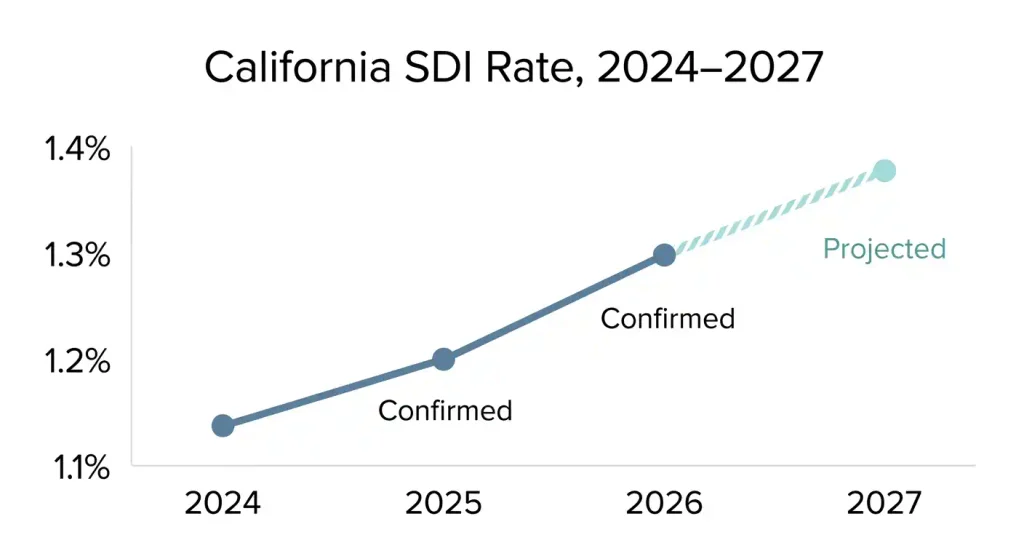
| Year | SDI Rate | Status |
|---|---|---|
| 2024 | 1.1% | Confirmed |
| 2025 | 1.2% | Confirmed |
| 2026 | 1.3% | Confirmed |
| 2027 | 1.4% | Projected |
Who Pays California SDI Tax?
California employees pay SDI. It comes out of each paycheck as a payroll deduction, usually labeled CASDI on your pay stub. Your employer does not match it, except at employers running approved voluntary plans.
Employee SDI Withholding vs. Employer Payroll Taxes
SDI is employee-paid. Employers alone cover Unemployment Insurance (UI) and the Employment Training Tax (ETT), both capped at the first $7,000 of wages. SDI has no cap. Self-employed workers, independent contractors, and business owners are not automatically covered. They can opt into EDD’s Disability Insurance Elective Coverage program for the same protection.
Which Wages Are Subject to SDI?
Regular wages, overtime, commissions, and most bonuses count as SDI wages, per EDD’s Types of Payments guidance (DE 231TP). The California EDD Determine Taxable Wages and Calculate Taxes guidance covers the same rules for employers.
How Much California SDI Tax Will You Pay in 2027?
At the projected 1.4% rate, SDI costs $14 per $1,000 of covered wages.
California SDI Tax by Annual Salary
Estimated annual cost at common California salaries, 2026 confirmed versus 2027 projected:
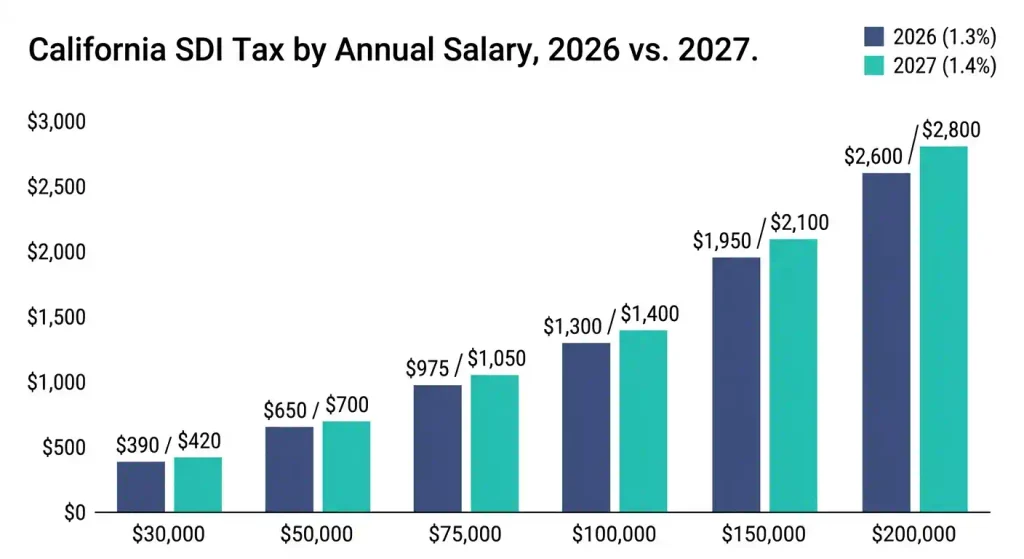
| Annual Salary | 2026 SDI (1.3%, confirmed) | 2027 SDI (1.4%, projected) |
|---|---|---|
| $30,000 | $390 | $420 |
| $50,000 | $650 | $700 |
| $75,000 | $975 | $1,050 |
| $100,000 | $1,300 | $1,400 |
| $150,000 | $1,950 | $2,100 |
| $200,000 | $2,600 | $2,800 |
These are estimates based on gross covered wages. Your exact deduction depends on employer rounding.
SDI Deductions by Pay Frequency
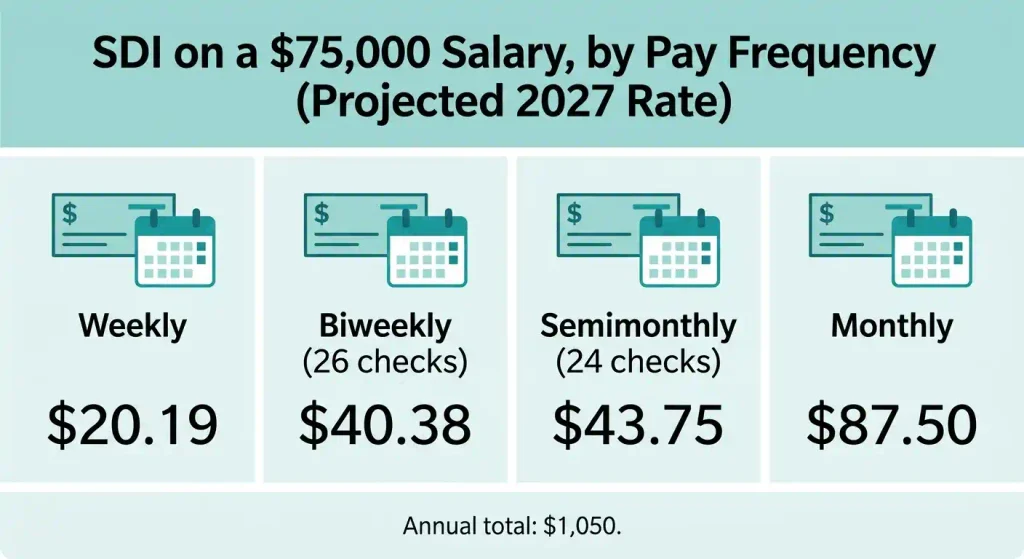
At $75,000 a year, the projected 1.4% rate equals $1,050 in SDI. Weekly, that is $20.19 per check. Biweekly (26 checks), $40.38. Semimonthly (24 checks), $43.75. Monthly, $87.50. The yearly total stays the same no matter how it is split.
How to Calculate California SDI Withholding
The formula is covered wages times the SDI rate. A $3,000 biweekly paycheck at 1.4% withholds $42. Payroll rounding may shift your W-2 total by a dollar or two, and our gross pay calculator can run the exact figure for your own paycheck.
Does California SDI Have a Wage Limit or Maximum Deduction?
No. California removed the SDI wage cap in 2024, so every dollar earned gets the deduction, with no ceiling.
Why High Earners Continue Paying SDI
Before 2024, SDI stopped once wages crossed an annual ceiling, $153,164 in 2023. Senate Bill 951 (SB 951) amended the California Unemployment Insurance Code (CUIC) to erase that ceiling starting January 1, 2024. Earning $300,000 in 2027 at the projected 1.4% rate means $4,200 in SDI for the full year, with no cap. The more you earn, the more SDI you pay.
SDI Wage Limits vs. Unemployment Insurance Wage Limits
UI and ETT stop at $7,000 in wages per year. SDI never stops, since its wage base was removed in 2024. Switching jobs no longer creates an overpayment credit, since there is no shared annual cap to track across employers.
How Could a 2027 SDI Rate Increase Affect Your Take-Home Pay?
Moving from 1.3% to 1.4% trims your paycheck by a small, predictable amount tied to your salary.
What a Change From 1.3% to 1.4% Would Mean
At $50,000, the increase costs $50 a year, about $4.17 a month. At $100,000, it is $100 a year, about $8.33 a month. At $200,000, it is $200 a year, about $16.67 a month. These are planning estimates until EDD confirms the rate.
Why Your Actual Paycheck May Look Different
SDI is one line among several: federal tax, state income tax, Social Security, and Medicare all affect take-home pay too. Raises, bonus timing, and W-4 or DE 4 changes matter more than a 0.1 point SDI shift.
How Is SDI Different From Other Payroll Taxes?
SDI funds a specific wage-replacement benefit. Other payroll taxes fund separate programs with their own rules.
SDI vs. California State Income Tax
SDI is an insurance contribution, not a general tax. State income tax funds California’s budget and scales with income. Changing your DE 4 withholding has no effect on your SDI rate.
SDI vs. Social Security, Medicare, and Unemployment Insurance
Four payroll taxes, including Social Security, carry four different rules:
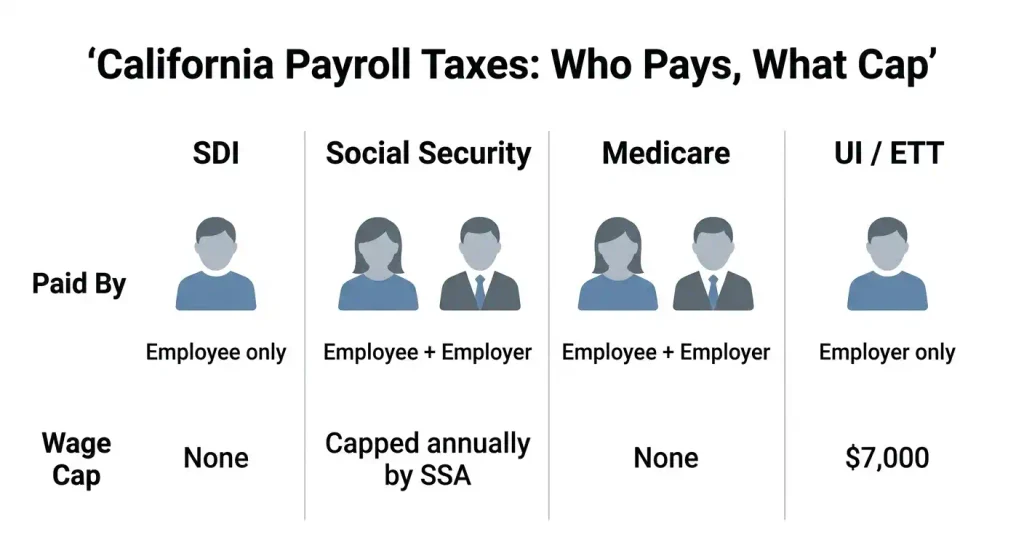
| Tax | Paid By | Wage Cap |
|---|---|---|
| SDI | Employee only | None |
| Social Security | Employee + Employer | Capped annually by SSA |
| Medicare | Employee + Employer | None |
| UI / ETT | Employer only | $7,000 |
What Benefits Does California SDI Fund?
SDI contributions fund two programs covered in our paid leave and benefits guides: Disability Insurance and Paid Family Leave.
State Disability Insurance and Paid Family Leave
Disability Insurance (DI) replaces wages during a non-work illness, injury, or pregnancy. Paid Family Leave (PFL) covers up to eight weeks of paid leave to care for a seriously ill family member or bond with a new child. Both draw from the same SDI deduction but cover different situations.
SDI Contributions vs. Disability Benefit Limits
What you pay and what you could collect are separate numbers. EDD’s forecast projects the 2027 maximum weekly benefit at $1,791, up from $1,765 in 2026, though that figure is not confirmed either. Check EDD’s current disability insurance page for confirmed amounts.
How Should Employers Prepare for the 2027 SDI Rate?
Budget around 1.4% for now, but don’t lock it into payroll settings before EDD’s official confirmation.
Verify the Official Rate Before Updating Payroll
Check EDD’s official rate page before updating your California payroll taxes for the new year. EDD mails a Notice of Contribution Rates and Statement of UI Reserve Account (DE 2088) yearly. The California Employer’s Guide (DE 44) and the Tax Rates, Wage Limits, and Value of Meals and Lodging (DE 3395) confirm the same figures. Cross-check all three before your first 2027 paycheck.
What to Do if Your SDI Deduction Looks Wrong
Check the math: covered wages times the current rate should match your stub, within rounding. If an online SDI calculator differs, it likely defaults to a projected rate like 1.4% before EDD confirms it. A projection works for personal planning, but payroll should wait for EDD’s confirmed figure. If the gap persists, contact payroll, then EDD.
Common California SDI Rate and Wage-Limit Myths
A few misunderstandings about SDI cost people money if left uncorrected.
Does SDI Stop After You Earn $7,000?
No. That cap applies to UI and ETT, not SDI. SDI continues on every paycheck all year.
Is the Forecasted 2027 Rate Already Final?
No. A fund forecast is EDD’s internal projection, not the official rate, which EDD typically publishes in December.
Does Your Employer Pay Your SDI Contribution Separately?
Generally no. Standard SDI comes entirely from your wages. The exception is a Voluntary Plan (VP), which must match or exceed SDI benefits, add at least one better benefit, and cost employees no more than SDI.
Frequently Asked Questions
What Is the Official California SDI Rate for 2027?
Not yet official. EDD’s forecast points to 1.4%, confirmed around December 2026.
Is California SDI Expected to Increase in 2027?
Yes, per EDD’s forecast: from 1.3% to 1.4%, the fourth straight annual increase.
How Much SDI Tax Will I Pay on a $100,000 Salary?
$1,300 a year at the confirmed 2026 rate of 1.3%, or $1,400 at the projected 2027 rate of 1.4%, a small slice of take-home pay on a $100k after-tax California salary.
Is There a Maximum California SDI Contribution?
No. California removed the wage cap in 2024, so there is no ceiling.
Do Bonuses and Overtime Count Toward SDI?
Yes, in most cases, per EDD’s Types of Payments guidance (DE 231TP).
Who Pays California SDI, the Employee or Employer?
The employee, except at employers running an approved Voluntary Plan.
Where Can I Verify the Final 2027 SDI Rate?
California EDD official rate publications, confirmed around December 2026.
For more California payroll and tax guides, browse our post sitemap, page sitemap, and category sitemap.

Yeasin Sorker is the founder of Paycheck Calculator California. He built this tool in 2018 after noticing that most free paycheck calculators missed California-specific rules like daily overtime and the uncapped SDI rate.
He researches California payroll tax updates regularly and keeps this calculator aligned with the latest IRS, FTB, and EDD published rates. All calculations on this site are estimates based on official 2026 government sources. For personalized tax advice, consult a qualified tax professional.