
Truck driver salary in California means the pay for heavy and tractor-trailer drivers, averaging $58,270 a year, or $28.02 an hour, per BLS data. Actual pay ranges $48,000 to $90,000+ depending on experience, freight type, and route.
That average comes from BLS wage data across California’s heavy-duty freight sector, blending entry-level, experienced, and specialized driver pay together.
Real earnings vary widely, so treat this average as a benchmark, not a guarantee.
How Much Do Truck Drivers Make in California in 2026?
The BLS figure and the job-board range above both hold up, they just measure different slices of the job, one a statewide statistical mean, the other live postings across experience levels and freight types.
California Truck Driver Salary at a Glance
California’s mean is $58,270 a year, $28.02 an hour. The more recent national release (May 2024) shows a national mean of $58,240 a year, $28.00 an hour, so California now sits about in line with the national average. This covers heavy and tractor-trailer drivers (SOC 53-3032) only, not light truck drivers (SOC 53-3033), who typically earn less. The numbers come from the U.S. Bureau of Labor Statistics’ Occupational Employment and Wage Statistics (OEWS) program, and California’s Employment Development Department (EDD) publishes similar figures through California LaborMarketInfo. For a broader look at how driver pay compares with other professions, browse our California salary guides by industry, and see our methodology for how we source and verify wage data like this. A statewide mean is not a promise, your first offer lands somewhere on a curve.
What the 25th, 50th, and 75th Percentiles Mean
National percentiles: 25th is $45,920, 75th is $63,010, top 10 percent clears $76,780. The median was updated in the newer May 2024 release to $57,440, up from $54,320. So a quarter of drivers earn less than $45,920, half earn less than roughly $57,440, one in four earns more than $63,010. New drivers usually land near the 25th percentile in year one. Do not treat the median as your starting wage.
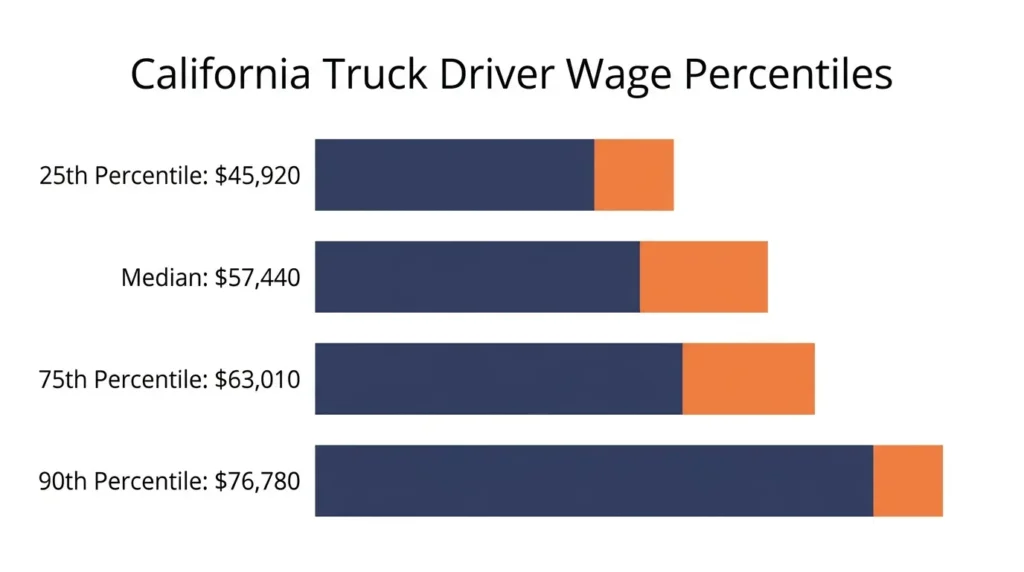
| Percentile | Annual Wage | What It Means |
|---|---|---|
| 25th | $45,920 | A quarter of drivers earn less |
| Median (50th) | $57,440 | Half earn less, half earn more |
| 75th | $63,010 | Only one in four earns more |
| 90th | $76,780 | Top-tier, experienced or specialized drivers |
Why Truck Driver Salaries Vary So Much
Experience, freight type, miles run, employer, and pay structure all move the number. ZipRecruiter’s August 2026 data shows California truck driver pay from $21,218 to $101,651, proof that experience and job type matter more than location. Job ads advertise the ceiling. Your paycheck depends on your guaranteed base.
Truck Driver Salary by Job Type in California
Local, regional, OTR, and specialized freight each pay differently and trade off against lifestyle.
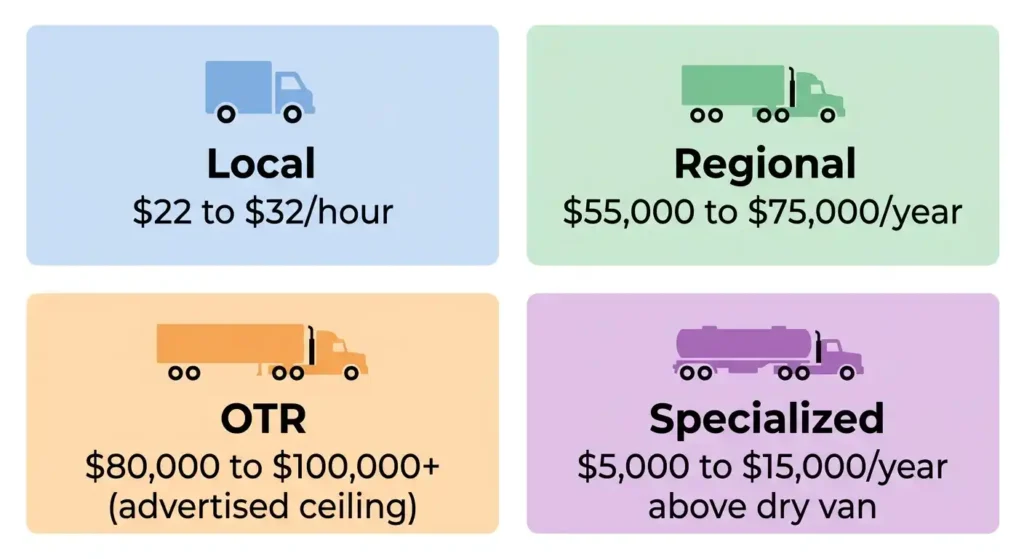
| Job Type | Typical Pay | Home Time |
|---|---|---|
| Local | $22 to $32/hour | Home most nights |
| Regional | $55,000 to $75,000/year | Home most weekends |
| OTR | $80,000 to $100,000+ (advertised ceiling) | Gone 2 to 4 weeks at a time |
| Specialized (flatbed/tanker) | $5,000 to $15,000/year above dry van | Varies by freight |
Local Truck Driver Salary
Local driving means home most nights, usually paid hourly between $22 and $32 an hour in California. You trade some earning potential for a normal schedule.
Regional Truck Driver Salary
Regional covers a few states, home most weekends, typically $55,000 to $75,000 for experienced drivers. More miles usually means more money on mileage pay.
OTR Truck Driver Salary
OTR drivers run coast to coast, gone two to four weeks at a time. Some California OTR postings claim $80,000 to $100,000+, but most OTR pay is per mile, so income depends on how many miles dispatch actually gives you. Advertised ceilings assume a perfect week, which rarely happens.
Specialized Truck Driver Pay
Tanker, flatbed, reefer, and dry van pay differently. Flatbed and tanker often pay $5,000 to $15,000 more a year than dry van, since the work is harder or needs a hazmat endorsement. Team driving can roughly double weekly miles since the truck barely stops, but pay structures vary by carrier, some split a higher combined rate, some pay each driver the standard solo rate, so confirm the split before assuming more money.
Truck Driver Salary in California by Experience Level
Experience is the biggest lever on pay. The jump from year one to year five usually beats any single job change.
Entry-Level Truck Driver Salary
Entry-level means under a year of CDL experience. Indeed’s California data shows entry-level averages of $78,103 to $82,161, though that blends in higher-paying dedicated roles. Training pay often runs $700 to $900 a week before moving to standard pay. A realistic first-year target is $45,000 to $55,000. An $80,000 first-year offer should raise questions, since that pay level usually needs experience a new driver doesn’t have yet.
Experienced Truck Driver Salary
After three to five years with a clean record, pay climbs. Salary.com’s July 2026 data puts experienced Class A drivers at $52,000 to $64,000; Glassdoor’s broader data shows $77,765 on average with bonuses and specialized routes included.
How Long It Can Take to Reach Higher-Paying Jobs
Better-paying jobs, dedicated routes, tanker work, regional runs, usually want two years of verifiable experience, some carriers want three. Endorsements can speed this up. Progression happens because a driver builds a record and asks for the better route.
Truck Driver Pay by CDL Class and Endorsement
Your CDL class sets the ceiling on what you can drive, which sets your pay range.
Class A CDL Jobs
Class A covers combination vehicles over 26,001 pounds, tractor-trailers, flatbeds, tankers. StartCDL data shows California Class A drivers at $86,000 to $98,000 in many roles, an upper-tier estimate, not a guarantee.
Class B CDL Jobs
Class B covers single vehicles over 26,001 pounds, dump trucks, box trucks. These typically pay less than Class A, often $50,000 to $60,000 a year for a local route. Compare jobs by actual duties, not license class alone.
| Class A | Class B | |
|---|---|---|
| Vehicle Type | Combination (tractor-trailer) | Single vehicle |
| Weight Threshold | Over 26,001 lbs, towed unit over 10,000 lbs | Over 26,001 lbs |
| Typical CA Pay | $86,000 to $98,000 (upper-tier roles) | $50,000 to $60,000 |
| Common Jobs | Tractor-trailers, flatbeds, tankers | Dump trucks, box trucks |
Hazmat, Tanker, and Other Endorsements
Hazmat and tanker endorsements matter most in California given fuel, chemical, and agricultural freight volume. A hazmat endorsement needs a TSA background check plus a written test; tanker adds its own exam. A doubles and triples endorsement opens multi-trailer routes, less common in California, small premium where they exist. The pay bump only happens if your employer actually has that freight available.
How California Truck Drivers Are Actually Paid
Four pay structures dominate the industry, and each rewards different things.
Hourly Pay
Hourly pay is common in local and some regional jobs. California’s daily and weekly overtime rules apply to many trucking positions, hours past 8 in a day or 40 in a week can trigger time-and-a-half, though some interstate drivers are federally exempt. A driver at $28 an hour working 45-hour weeks with eligible overtime earns about $1,470 that week versus $1,120 flat, roughly $18,000 more a year. California’s Labor Commissioner and the Division of Labor Standards Enforcement (DLSE), under the California Department of Industrial Relations, enforce the state’s Wage Orders. Wage Order 9 from the Industrial Welfare Commission covers transportation, including California meal periods and rest periods under Labor Code Section 512 and California Code of Regulations Title 8 Section 11090.
Pay by the Mile
Mileage pay runs 45 to 65 cents per mile in California postings. A driver averaging 2,200 miles a week at 55 cents grosses $1,210 a week, about $62,920 a year if that pace holds, which it rarely does every week. Run your own numbers with our annual salary calculator to see how weekly pay adds up over a full year.
Percentage, Load, and Trip Pay
Some carriers pay 25 to 35 percent of load revenue instead of a flat mileage rate, which swings with freight rates and fuel surcharges. Trip pay is a flat rate per delivery. Compare these against a straight mileage offer using average weekly settlement, not just the percentage.
Bonuses, Detention, Layover, and Extra-Stop Pay
Detention pay usually runs $15 to $25 an hour after a grace period. Layover pay covers unplanned overnight stops, extra-stop pay adds a flat fee per stop. If your job includes hand-loading or unloading, ask whether that’s paid separately. A “$90,000” ad usually blends base pay with every bonus stacked on top, and bonus pay itself gets withheld differently than regular wages, see our California bonus tax rate guide for the exact withholding math.
| Pay Structure | Typical Rate | Best For |
|---|---|---|
| Hourly | ~$22 to $32/hour | Local, predictable schedules |
| Per Mile | 45 to 65 cents/mile | OTR, regional |
| Percentage/Load | 25 to 35% of load revenue | Owner-operators, flatbed |
| Trip Pay | Flat rate per delivery | Dedicated, regional routes |
| Detention Pay | $15 to $25/hour after grace period | Supplemental, not guaranteed |
Truck Driver Salary by California Location
Location changes pay, but less than freight type or experience.
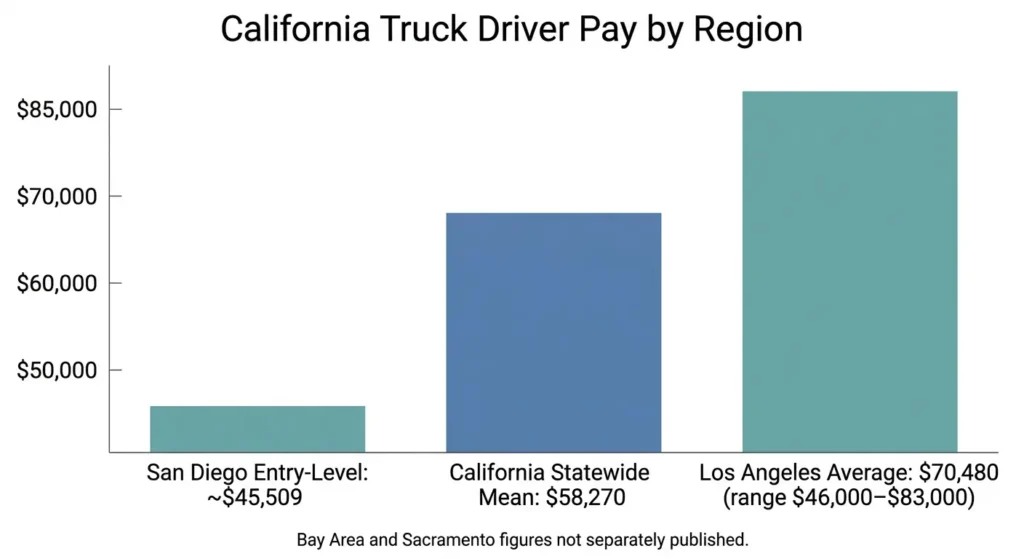
Los Angeles and Southern California
LA is a major freight corridor thanks to the ports of LA and Long Beach. Payscale data puts average LA heavy/tractor-trailer pay at $70,480, ranging $46,000 to $83,000. Port drayage is its own niche, often paid per container move. Curious what your take-home would look like in the area, try our Los Angeles paycheck calculator.
San Francisco Bay Area
The Bay Area ranks as California’s highest-paying trucking market in BLS metro data, driven by the Port of Oakland’s freight volume and tech-sector demand across San Jose and the South Bay. Higher pay needs context, Bay Area living costs run well above the state average, run your numbers through our San Francisco, Oakland, or San Jose paycheck calculator before comparing offers.
Sacramento, San Diego, and Other California Areas
Sacramento and San Diego track closer to the statewide mean; San Diego entry-level Payscale data shows early-career drivers around $45,509. Check exact take-home figures with our Sacramento and San Diego paycheck calculators. The Central Valley has strong local and regional demand despite lower posted wages. Job mix drives these differences as much as cost of living does.
How Much Is $60K, $70K, $80K, or $100K as a California Truck Driver?
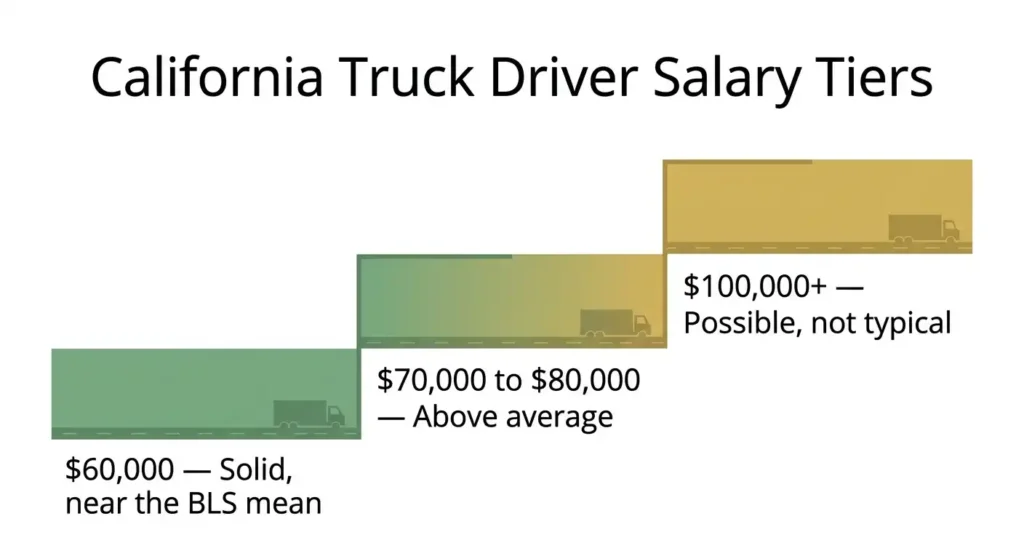
| Salary | Verdict | Typical Profile |
|---|---|---|
| $60,000 | Solid, near the BLS mean | A couple years of experience |
| $70,000 to $80,000 | Above average | Specialized freight, endorsement, or tenure |
| $100,000+ | Possible, not typical | Owner-operator or specialized/overtime-heavy role |
Is $60,000 a Good Truck Driver Salary in California?
$60,000 sits near the BLS mean, solid for a driver with a couple years of experience. After taxes, expect to keep roughly 75 to 80 percent of gross, closer to $45,000 to $48,000 in spending power.
Is $70,000 or $80,000 a Good Salary?
These sit above the statewide mean, usually tied to specialized freight, an endorsement, or tenure. They often come with less home time or more demanding freight. Before accepting $80,000, confirm the guaranteed weekly minimum, see exactly what an $80,000 salary nets after taxes in California.
Can Truck Drivers Really Make $100,000+?
Yes, but it’s not typical. It usually comes from owner-operators, specialized tanker or hazmat freight, or heavy overtime. ZipRecruiter’s 90th percentile figure for standard truck drivers is $82,406; some CDL-specific and specialized roles top $100,000. Treat six-figure ads as best-case, not standard.
Truck Driver Salary vs. Take-Home Pay in California
Gross Salary vs. Net Pay
Job postings show gross pay, not net pay. Deductions include federal tax, California state tax, Social Security, Medicare, and California SDI at 1.3 percent with no wage cap. A $58,270 earner should expect roughly 20 to 25 percent to disappear before it hits their account. Example: a driver grossing $1,120 in a week might see $230 to $260 come out total, landing take-home around $860 to $890 for that week, learn to read every line on your pay stub if the numbers don’t add up. Exact take-home depends on how you filled out your W-4.
Benefits Can Change the Value of a Trucking Job
Health insurance, retirement matching, and paid time off carry real value beyond the base salary line. Sign-on bonuses of $2,000 to $10,000 are real but one-time, not ongoing income.
How to Compare Two Trucking Offers
Start with guaranteed base or mileage rate, not the advertised max. Get realistic weekly miles or hours from current drivers, then weigh home time, benefits, and deductions. Our gross pay calculator can help you run each offer side by side. A job at 58 cents a mile with 1,800 realistic weekly miles beats 62 cents a mile with 1,400 miles, even though the rate looks worse.
Truck Driver Salary vs. Take-Home Pay in California
Gross Salary vs. Net Pay
Job postings show gross pay, not net pay. Deductions include federal tax, California state tax, Social Security, Medicare, and California SDI at 1.3 percent with no wage cap. A $58,270 earner should expect roughly 20 to 25 percent to disappear before it hits their account. Example: a driver grossing $1,120 in a week might see $230 to $260 come out total, landing take-home around $860 to $890 for that week, learn to read every line on your pay stub if the numbers don’t add up. Exact take-home depends on how you filled out your W-4.
Benefits Can Change the Value of a Trucking Job
Health insurance, retirement matching, and paid time off carry real value beyond the base salary line. Sign-on bonuses of $2,000 to $10,000 are real but one-time, not ongoing income.
How to Compare Two Trucking Offers
Start with guaranteed base or mileage rate, not the advertised max. Get realistic weekly miles or hours from current drivers, then weigh home time, benefits, and deductions. Our gross pay calculator can help you run each offer side by side. A job at 58 cents a mile with 1,800 realistic weekly miles beats 62 cents a mile with 1,400 miles, even though the rate looks worse.
Company Driver vs. Owner-Operator: Which Pays More?
Company Driver Earnings
Company drivers are employees. The carrier owns the truck and covers maintenance and insurance, lower financial risk, easier to compare across job offers.
Owner-Operator Revenue vs. Income
Owner-operator ads often quote gross revenue, sometimes $180,000 or more, before fuel, maintenance, insurance, truck payments, and permits. Example: $180,000 gross minus $60,000 fuel, $15,000 truck payment, $10,000 insurance, $15,000 maintenance and permits leaves about $80,000 in actual income. Owner-operators are independent contractors, not employees, a worker classification question governed by California Labor Code Sections 2775-2787, which set the ABC test California uses, tracing back to the Dynamex Operations West, Inc. v. Superior Court ruling. AB 5 has been actively enforced against California trucking since August 2022, upheld by a 2025 Ninth Circuit ruling, so confirm your classification before assuming your setup works like a company driver’s, misclassifying a driver can trigger serious penalties for both sides. Owner-operator income is also taxed differently, factor in self-employment tax when comparing net income against a company driver’s salary. Our 1099 vs W-2 calculator can help run that comparison directly.
Which Option Makes More Sense for a New Driver?
Company driving is the smarter starting point, you build experience and a safety record without ownership risk. Ownership can make sense once you understand the real operating costs.
What You Need to Earn a Truck Driver Salary in California
California CDL Requirements
Class A and Class B weight thresholds are covered above; California’s third class, Class C, covers vehicles carrying hazardous materials or 16+ passengers. You need a Class C license and a commercial learner’s permit (CLP) before testing for a Commercial Driver’s License (CDL). Minimum age is 18 for intrastate, 21 for interstate or hazmat, though a small number of 18 to 20 year olds drove interstate under the FMCSA’s Safe Driver Apprenticeship Pilot Program before it closed to new participants on November 7, 2025, with existing participants grandfathered until they turn 21. Check current rules with the California Department of Motor Vehicles (California DMV). Federal rules from the Federal Motor Carrier Safety Administration (FMCSA) and the Motor Carrier Safety Improvement Act apply alongside state rules. The California Department of Transportation (Caltrans) covers oversize loads and certain highway freight. Every CDL holder is listed in the Commercial Driver’s License Information System (CDLIS). New hires also go through standard onboarding, see our California new hire paperwork requirements guide for what to expect.
ELDT and Behind-the-Wheel Training
Federal Entry-Level Driver Training (ELDT) rules require FMCSA-approved training for first-time CDLs, class upgrades, or certain endorsements. California adds its own behind-the-wheel requirement. Training providers must be on the FMCSA’s Training Provider Registry. Applies to first-timers and upgraders, not renewals without a class change.
Medical, Driving Record, and Employment Requirements
Every CDL holder needs a current medical examiner’s certificate, commonly called a DOT medical card. Carriers check your motor vehicle record (MVR); DUIs or excessive tickets can disqualify you. Federal rules require pre-employment and random drug and alcohol testing, and carriers must check the FMCSA Drug and Alcohol Clearinghouse before hiring and report positive results there too. Hours-of-Service Regulations, tracked via an electronic logging device (ELD) in most trucks, also factor into hiring.
What Affects Your California Truck Driver Salary the Most?
Experience and Safety Record
Experience and a clean record are checked first by every carrier. Violations can knock you out of the better-paying routes.
Freight Type and Endorsements
Tanker, hazmat, and flatbed pay a premium for more skill or risk. Weigh the effort of an endorsement against the realistic pay bump in your market.
Route, Home Time, and Schedule
Local, dedicated, regional, and OTR trade home time for pay differently. Dedicated routes pay a bit less per mile than irregular routes but offer steadier home time.
Employer and Compensation Structure
Large carriers offer stability and benefits; smaller carriers sometimes pay a higher per-mile rate. Check for training pay conditions or contract clauses before signing.
Real California Truck Driver Salary Scenarios
See more real paycheck scenarios for other California jobs and wage levels.
Scenario 1: Brand-New Class A Driver
Six-week CDL program, hired at $850 a week during an eight-week training period, then 52 cents a mile. Year one nets roughly $46,000 to $50,000. Year two, with a clean record, $58,000 to $62,000.
Scenario 2: Experienced Local Driver
Five years in, grocery distribution route in the Inland Empire, $30 an hour, 45-hour weeks, grosses roughly $70,000 a year with overtime. Home every night.
Scenario 3: Experienced OTR Driver
Six years, dry van freight at 58 cents a mile, 2,400 miles a week, grosses $72,000 to $75,000 before detention and bonus pay, with three to four weeks away from home most months.
Scenario 4: Specialized or High-Earning Driver
Tanker driver, hazmat endorsement, eight years clean, dedicated Bay Area fuel routes, can clear $85,000 to $95,000 a year. Not a typical paycheck, it reflects years of qualification-building.
| Scenario | Experience | Pay Structure | Annual Gross |
|---|---|---|---|
| Brand-new Class A | 0 to 1 year | $850/week training, then 52 cents/mile | $46,000 to $62,000 |
| Experienced local | 5 years | $30/hour, 45-hour weeks | ~$70,000 |
| Experienced OTR | 6 years | 58 cents/mile, 2,400 mi/week | $72,000 to $75,000 |
| Specialized (tanker/hazmat) | 8 years | Dedicated Bay Area fuel routes | $85,000 to $95,000 |
How to Tell If a California Trucking Job Offer Is Actually Good
Check the Guaranteed Pay
Get the actual guaranteed hourly, weekly, mileage, or salary number in writing, separate from bonus language. Confirm the training or probationary rate and when it changes.
Calculate the Real Annual Earnings
Ask for realistic weekly miles or hours from current drivers. Leave uncertain bonuses out of your baseline. Annualize and compare honestly against the job ad.
Check the Trade-Offs Before Accepting
Verify home-time promises with current drivers, check benefit costs, and review equipment condition and physical demands before signing.
Common Myths About Truck Driver Salary in California
“Every Truck Driver Can Make $100,000”
Six-figure income is real but not typical, it needs years of experience, specialized freight, or owner-operator status.
“The Highest Cents-Per-Mile Rate Is the Best Job”
A high rate on an idle truck earns less than a moderate rate on a truck running full weeks. Unpaid time and realistic miles matter more than the headline rate.
“Owner-Operator Revenue Is Salary”
Gross business revenue is not personal income. Fuel, insurance, truck payments, and maintenance eat a large chunk first.
“A California Salary Average Is My Starting Pay”
Statewide averages blend every experience level. Entry-level pay sits well below the median.
What You Need to Earn a Truck Driver Salary in California
California CDL Requirements
Class A and Class B weight thresholds are covered above; California’s third class, Class C, covers vehicles carrying hazardous materials or 16+ passengers. You need a Class C license and a commercial learner’s permit (CLP) before testing for a Commercial Driver’s License (CDL). Minimum age is 18 for intrastate, 21 for interstate or hazmat, though a small number of 18 to 20 year olds drove interstate under the FMCSA’s Safe Driver Apprenticeship Pilot Program before it closed to new participants on November 7, 2025, with existing participants grandfathered until they turn 21. Check current rules with the California Department of Motor Vehicles (California DMV). Federal rules from the Federal Motor Carrier Safety Administration (FMCSA) and the Motor Carrier Safety Improvement Act apply alongside state rules. The California Department of Transportation (Caltrans) covers oversize loads and certain highway freight. Every CDL holder is listed in the Commercial Driver’s License Information System (CDLIS). New hires also go through standard onboarding, see our California new hire paperwork requirements guide for what to expect.
ELDT and Behind-the-Wheel Training
Federal Entry-Level Driver Training (ELDT) rules require FMCSA-approved training for first-time CDLs, class upgrades, or certain endorsements. California adds its own behind-the-wheel requirement. Training providers must be on the FMCSA’s Training Provider Registry. Applies to first-timers and upgraders, not renewals without a class change.
Medical, Driving Record, and Employment Requirements
Every CDL holder needs a current medical examiner’s certificate, commonly called a DOT medical card. Carriers check your motor vehicle record (MVR); DUIs or excessive tickets can disqualify you. Federal rules require pre-employment and random drug and alcohol testing, and carriers must check the FMCSA Drug and Alcohol Clearinghouse before hiring and report positive results there too. Hours-of-Service Regulations, tracked via an electronic logging device (ELD) in most trucks, also factor into hiring.
Is Truck Driving a Good-Paying Career in California in 2026?
When Trucking Can Be Financially Attractive
A CDL program costs a few thousand dollars and takes weeks, a fast path to above-minimum-wage pay. The BLS projects about 237,600 truck driving job openings a year on average through 2034, with employment growing roughly 4 percent over that decade. National mean pay moved from $55,990 (May 2023) to $58,240 (May 2024), a gradual increase. Compared with warehouse, delivery, or bus driving, which often post lower BLS medians, Class A trucking sits toward the higher end of jobs that don’t need a four-year degree, in the same range as fields like police officer salary California or entry-level registered nurse salary California paths that don’t require a bachelor’s degree either.
When a Higher Salary May Not Be Worth It
Chasing the highest number can mean excessive time away from home or an unpredictable schedule. Unpaid waiting time and bonus-heavy pay can leave you earning less than the posted number suggests.
What a New Driver Should Target
A stable company job with guaranteed pay, a path to route upgrades, and decent home time, even if it’s not the highest number on the board.
Frequently Asked Questions About Truck Driver Salary in California
How much does a truck driver make in California in 2026?
$58,270 a year, $28.02 an hour, based on the latest BLS state data, for heavy and tractor-trailer drivers specifically. Actual offers vary by experience, freight type, and employer.
What is the starting salary for a truck driver in California?
$45,000 to $55,000 in year one once training pay and ramp-up weeks are factored in.
Can truck drivers make $100,000 a year in California?
Yes, usually with years of experience, specialized freight, or owner-operator status. Not typical, the 90th percentile nationally is $76,780.
What type of truck driver makes the most money in California?
Specialized freight drivers, tanker and hazmat haulers, and cost-efficient owner-operators tend to earn the most. No single job type is universally highest.
Do truck drivers get paid by the hour or by the mile?
Both. Local and some regional jobs pay hourly; OTR and much of regional pays by the mile, sometimes blended with percentage or trip pay.
Is $80,000 a good salary for a truck driver in California?
Yes, well above the statewide mean, usually reflecting experience, a specialized route, or overtime.
How much does a Class A CDL driver make in California?
A wide range, roughly $52,000 (Salary.com) to $86,000+ (industry sources) depending on job type and experience.
Do truck drivers pay taxes in California?
Yes, federal tax, California state tax, Social Security, Medicare, and California SDI. Advertised salaries are gross figures; exact take-home varies by individual factors, if your check looks smaller than expected, see why your California paycheck feels low.
What to Do Next If You Want to Become a Truck Driver in California
Choose the CDL Path That Matches Your Income Goal
Class A opens higher-paying tractor-trailer work; Class B fits local delivery and construction supply. Identify endorsements, like hazmat or tanker, that match higher-paying niches.
Compare Training and Job Offers
Verify any training program is FMCSA-registered. Check contract clauses tying you to a carrier, and confirm guaranteed pay and benefits before accepting.
Use Salary Data to Set a Realistic Target
Use current California wage percentiles as your benchmark, adjust for region and job type. Once you land an offer that hits your target, get the pay structure and bonus terms in writing before day one. Our California paycheck calculator can help you check the real take-home number before you sign anything.

Yeasin Sorker is the founder of Paycheck Calculator California. He built this tool in 2018 after noticing that most free paycheck calculators missed California-specific rules like daily overtime and the uncapped SDI rate.
He researches California payroll tax updates regularly and keeps this calculator aligned with the latest IRS, FTB, and EDD published rates. All calculations on this site are estimates based on official 2026 government sources. For personalized tax advice, consult a qualified tax professional.