
California paychecks feel low because five separate deductions hit before you see a dollar: federal income tax, Social Security (6.2%), Medicare (1.45%), California state income tax (up to 13.3%), and SDI (1.3% in 2026 with no wage ceiling). Most workers lose 25% to 40% of every paycheck to these combined withholdings.
After eight years in payroll consulting and helping hundreds of workers decode their pay stubs, I still remember my own shock: a $72,000 salary produced a first paycheck where $4,200 gross became just $2,680 in take-home pay.
That said, even a perfectly correct California paycheck can feel inadequate. Since 2020, inflation rose roughly 25% while wages in many sectors grew only 12%. That gap is a structural problem, not a payroll error.
Where Your Money Actually Goes: The California Paycheck Breakdown
Let me show you a real example first. This makes everything easier.
Say your gross pay (the number before any cuts) is $3,000 for the month. Here is where that money goes.
| Deduction | Amount Taken | Percentage |
| Federal Income Tax | $300 to $500 | 10% to 17% |
| Social Security Tax | $186 | 6.2% |
| Medicare Tax | $43 | 1.45% |
| California State Income Tax | $100 to $250 | 3% to 8% |
| State Disability Insurance (SDI) | $39 | 1.3% |
| Health Insurance / Benefits | $100 to $300 | 3% to 10% |
| Your Take-Home Pay | $1,900 to $2,200 | 65% to 75% |
That table answers the core question right away. You are not being cheated. This is the system working exactly as designed. The gross vs net pay difference is what surprises most people, especially first-time workers or anyone new to California.
Takeaway: A $3,000 gross paycheck in California becomes roughly $2,000 to $2,200 in actual take-home pay after all deductions.
What Is “Paycheck Shock” and Why Does It Hit California Workers So Hard?
Paycheck shock hits California workers harder than almost anywhere else. Three things drive it.
First, the California Franchise Tax Board (FTB) charges between 1% and 13.3% in state income tax, the highest top rate in the country. See every layer in one place on the California payroll taxes page.
Second, California’s State Disability Insurance (SDI) tax now has no wage ceiling. Since 2024, every dollar you earn is taxed. That is the number one reason paychecks shrank overnight for most workers.
Third, the cost of living vs income mismatch in cities like San Francisco and San Diego makes even a good salary feel inadequate fast.
Takeaway: California stacks multiple tax layers on top of the federal system, creating a bigger gap between gross pay and net pay than most states.
The Big 2024 Change Nobody Told You About: SB 951 and the SDI Cap Removal
This is the single most important thing I can tell you. Most workers have no idea this happened.
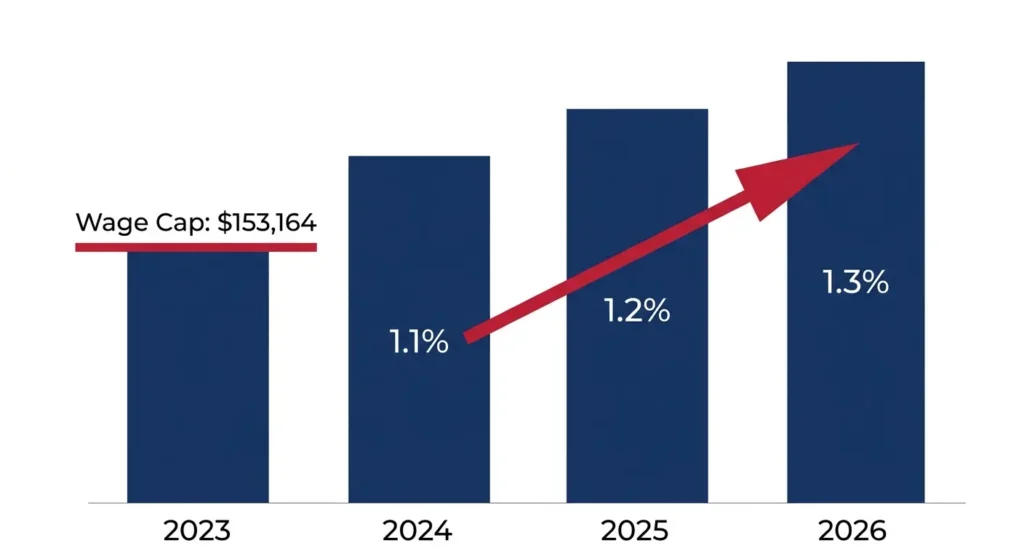
Before 2024, California capped the SDI tax at a set wage amount. In 2023, that cap was $153,164. Once you hit it, SDI deductions stopped for the year.
Senate Bill 951 (SB 951) eliminated that ceiling entirely on January 1, 2024. Now every dollar you earn is taxed. Here is how that plays out in real numbers.
| Tax Year | SDI Rate | Wage Ceiling | Tax on $250,000 Salary |
| 2023 | 0.9% | $153,164 | $1,378 (then stopped) |
| 2024 | 1.1% | No ceiling | $2,750 |
| 2025 | 1.2% | No ceiling | $3,000 |
| 2026 | 1.3% | No ceiling | $3,250 |
At $100,000 a year, you now pay $1,300 in SDI. At $250,000, your bill more than doubled in two years. Workers at the $150,000 level can see the full dollar-by-dollar impact in the $150K after-tax California breakdown.
The EDD posted these changes quietly with no press release. Workers noticed smaller January 2024 paychecks with zero warning.
My Personal Insight: Three clients called me in January 2024 convinced their payroll system had broken. All were mid-level tech workers earning $130,000 to $180,000, each down $100 to $150 per month. Showing them the SB 951 legislation turned confusion into frustration. At least they knew it was legal.
Takeaway: SB 951 removed the SDI wage ceiling in 2024, causing an immediate and ongoing paycheck reduction for most California workers, especially higher earners.
Why the Higher SDI Tax Exists: The SB 1090 Benefit Trade-Off
Here is the part California does not advertise loudly enough.
The reason you pay more SDI is so you can receive more when you need it. Senate Bill 1090, effective 2025, increased Paid Family Leave (PFL) and Disability Insurance (DI) benefits significantly.
Lower-wage workers now receive up to 90% of their average weekly wage during a claim. Other workers receive 70% of their wages. The previous range was 60% to 70%. That is a real improvement for families dealing with a serious illness or a new baby. Healthcare workers in particular should check the California healthcare worker minimum wage schedule for 2026, as their pay floor and SDI benefits are calculated on a separate tiered scale.
You are paying a higher “membership fee” for a better safety net. Whether that trade-off feels fair depends on your situation. But the paycheck reduction is legally required, and it does come with a real benefit in return.
Takeaway: Your higher SDI withholding funds better Paid Family Leave and Disability Insurance benefits under SB 1090. You pay more now, but you get more if you ever need to file a claim.
Full California Paycheck Deduction Breakdown: Every Line Explained
Federal Income Tax Withholding: The Biggest Variable
The IRS sets your rate based on income, filing status, and Form W-4. Brackets are marginal. Only dollars in the higher bracket get taxed at the higher rate.
How Your Form W-4 Controls the Amount Withheld
Most workers fill out Form W-4 on day one and never update it. That default almost always over-withholds. It is the single most powerful lever you have for increasing take-home pay without earning an extra dollar.
Social Security and Medicare: Fixed Federal Rates
Social Security is a flat 6.2% on wages up to $184,500 in 2026, then stops. Your employer matches it for a combined 12.4%. Medicare is a flat 1.45%. Earn over $200,000 as a single filer and an extra 0.9% Additional Medicare Tax applies above that threshold.
California State Income Tax (CASIT): Progressive Up to 13.3%
The FTB collects CASIT at rates from 1% to 13.3%. Most workers earning $50,000 to $120,000 pay an effective rate of 4% to 9.3%. You control withholding via Form DE-4. Check your California standard deduction for 2026 to see whether itemizing saves you more.
State Disability Insurance (SDI): 1.3% With No Ceiling in 2026
The EDD confirms 1.3% for 2026 with no wage cap. Verify it on the California EDD Contribution Rates and Withholding page, updated each December. See the full rate history on our California SDI rate guide for 2026.
Pre-Tax Deductions: Benefits That Actually Help Your Paycheck
Your 401(k), Health Insurance Premiums, FSA, and HSA all reduce taxable income before taxes calculate. A $500 monthly 401(k) contribution may only cost $300 in take-home pay because you avoided tax on that $500.
Takeaway: Pre-tax benefits reduce your tax bill and build future wealth at the same time.
Why Did My Paycheck Suddenly Drop? Six Common Causes
One paycheck feels normal. The next feels wrong. Here are the six most common reasons.
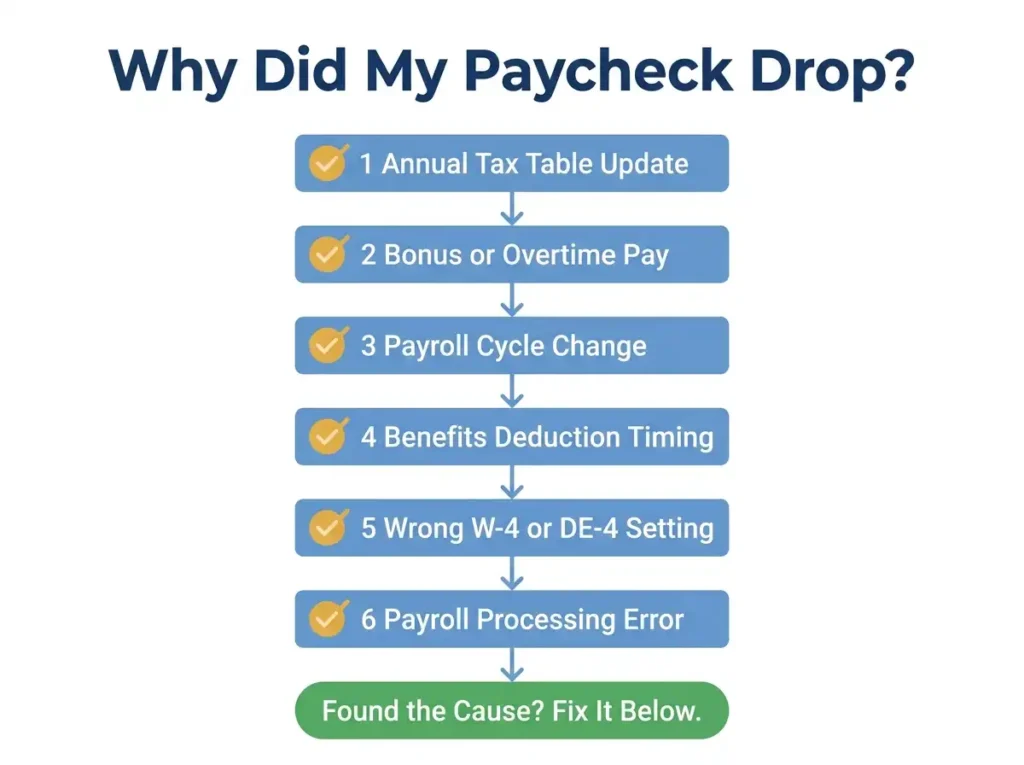
1. Annual SDI and Tax Table Updates
Every January the EDD and IRS update withholding tables. The SDI jump from 1.2% to 1.3% in 2026 is a perfect example. Log into your portal, compare your current stub to December’s, and look for changed percentages. A two-minute check clears the confusion.
2. Bonus and Overtime Withholding
Bonuses are supplemental wages. The IRS withholds 22% federally. California withholds 6.6% for cash bonuses, or 10.23% for stock options and equity pay. This is a timing difference, not extra tax. Your effective annual rate is unchanged and you recoup the overage at tax time.
3. Payroll Cycle Differences: Biweekly vs Semimonthly
Biweekly means 26 checks per year. Semimonthly means 24. In a three-paycheck month each check is smaller because the same annual salary divides across more periods. See how this shifts with the California part-time vs full-time paycheck comparison.
4. Benefit Deduction Timing
Some premiums and FSA deductions come out once monthly. If yours always hit your second check, that check will always look smaller. Compare check one and check two side by side to confirm.
5. Incorrect Form W-4 or Form DE-4 Settings
Default settings over-withhold by design. Updating both forms via the IRS withholding estimator and the FTB online tool can add $100 to $300 per month back immediately.
6. Payroll Processing Errors
Gusto and ADP do make mistakes in California. If you recently changed worker status, check 1099 vs W-2 tax treatment to catch misclassification early. If none of the five causes above explain the drop, request a written payroll reconciliation from HR and escalate to edd.ca.gov if unresolved.
Takeaway: A suddenly smaller paycheck usually has a simple explanation. Work through the six causes in order before assuming an error.
Is This Normal? How to Self-Diagnose Your Pay Stub
Run through this quick checklist.
- Is your total deduction rate between 20% and 40%? That is the normal range. If yes, your paycheck is correct.
- Are there deductions you do not recognize? Check every line for a label and dollar amount. Anything unlabeled or random, ask HR immediately.
- Did your paycheck drop vs last month? Check the six causes above. Benefits timing, a bonus, or a new tax year cover most cases.
- Is your gross pay correct? Verify your hours or salary rate matches your employment agreement.
If something still does not add up, contact your employer first. Violations of California wage law can be reported directly to the EDD.
If it feels too low this week only, the likely trigger is a one-time overlap: a benefits deduction landing in the same period as a tax table update, or a bonus temporarily inflating your estimated annual income bracket. Check your employee withholding allowances on your DE-4. Many workers left this at zero on day one and never changed it. Each additional allowance legally reduces California withholding without affecting your actual year-end tax liability.
Is Your Paycheck Actually Wrong? Here Is How To Know for Certain.
Something felt off. That feeling is valid. But feeling wrong and being wrong are two different things.
The test takes under two minutes. Pull up your pay stub. Divide your net pay by your gross pay. A result between 0.60 and 0.80 means your paycheck is almost certainly correct. Not sure how to find each line? The guide on how to read a California pay stub in 2026 walks through every field in plain English.
If the result is below 0.60, check your W-4, DE-4, and benefits elections before calling HR. In my experience, 8 out of 10 times it is an outdated form, not a payroll error.
Takeaway: If your net-to-gross ratio is 60% to 80%, your paycheck is correct. If it is below 60%, start with your W-4 and DE-4 settings before assuming an error.
The Real Reason Your $100K Salary Feels Like $50K: The Housing Factor
In my experience, the biggest source of “paycheck frustration” in California is not the taxes. It is the housing.
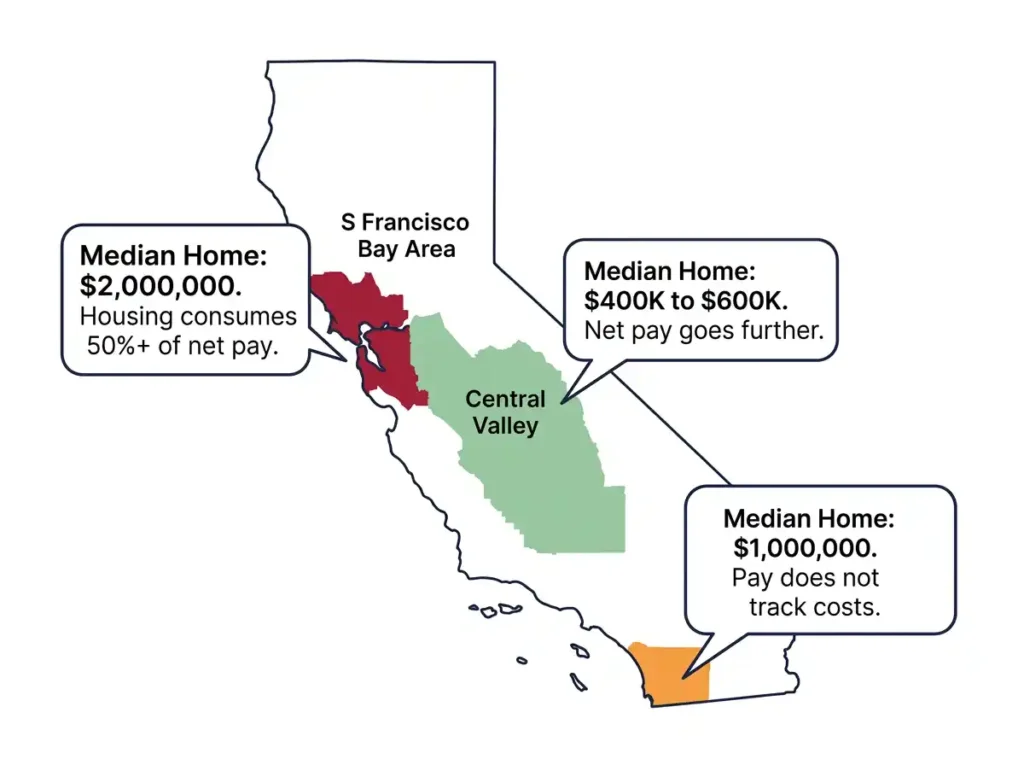
The median home price in Santa Clara County sits around $2 million. In San Diego County, it is closer to $1 million. In cities across the Bay Area, workers earning $130,000 or more in mid-level roles report being unable to afford an unshared apartment.
Here is a rough regional comparison.
| Region | Median Home Price | Take-Home Impact |
| Bay Area (Peninsula) | $2,000,000 | Housing consumes 50% or more of net pay |
| San Diego | $1,000,000 | Pay does not track cost of living |
| Central Valley | $400,000 to $600,000 | Net pay goes much further |
The California Squeeze is not just about taxes. It is about the gap between what you earn and what it costs to live here. Research from the UC Berkeley Labor Center shows that over a third of California state employees do not earn enough to support a family of four, even in dual-income households. Lower-income workers should also check whether they qualify for the California Earned Income Tax Credit in 2026, which can put hundreds or thousands of dollars back in your pocket at tax time.
Since 2020, California inflation has risen roughly 25%. In that same period, wages in many sectors have only risen by about 12%. Your paycheck is technically larger than it was five years ago. Your ability to buy things with it is smaller.
Takeaway: Even an accurate California paycheck feels low because housing and inflation have outpaced wage growth by a wide margin since 2020.
How to Increase Your Take-Home Pay: Step-by-Step Fixes
You are not powerless. These four steps can legally increase your take-home pay right now.
Step 1: Update Your Form W-4
Log into your HR portal and use the IRS withholding estimator at irs.gov to find your correct setting. Over-withholding for even one year can cost you $1,200 or more in unnecessary reductions.
Step 2: Update Your Form DE-4
The Form DE-4 is California’s state withholding form. Increasing your allowances here directly reduces what the FTB pulls each period. Most workers do not know it exists.
Step 3: Maximize Pre-Tax Benefits
Every dollar into a 401(k), FSA, or HSA cuts your taxable income before taxes calculate. Contributing $300 per month to a 401(k) saves roughly $75 to $120 in monthly taxes. No 401(k) at work? California’s CalSavers retirement program is a state-administered alternative.
Step 4: Run a Paycheck Calculator
Use our California paycheck calculator to model your exact numbers before and after adjusting your forms. See the real difference in black and white first.
| Scenario | Estimated Monthly Net Pay |
| Default W-4 and DE-4 settings | $2,000 |
| Optimized withholding settings | $2,200 to $2,350 |
That gap is a utility bill, a debt payment, or a savings contribution every single month.
Takeaway: Adjusting your W-4, DE-4, and pre-tax elections can immediately increase take-home pay without changing your salary.
Common Myths That Cause Panic (Busted with Data)
Myth 1: Overtime Is Taxed at a Higher Rate
Not true. Overtime is taxed at the same rate as regular income. A higher check temporarily bumps the withholding estimate upward, but your effective annual rate stays the same. You get the overage back at tax time. For how California calculates overtime and double-time rates, including daily thresholds, that guide covers it fully.
Myth 2: Your Employer Is Taking Extra Money
Your employer is required by law to forward all withholdings to the IRS, FTB, and EDD. If you suspect actual wage theft, file a complaint with the California Labor Commissioner’s Office.
Myth 3: Earning More Taxes All of Your Income at the Higher Rate
California tax brackets are marginal. Only the dollars above a bracket threshold get taxed at the higher rate. Your first $59,000 stays in its bracket even if you earn $60,001. A raise will never reduce your take-home pay.
Myth 4: You Are Losing Money by Working Overtime
After-tax overtime pay is always higher than after-tax regular pay. The withholding looks bigger on that check, but your total annual take-home is always larger when you work more hours.
Frequently Asked Questions About California Paychecks
Why Did My California Paycheck Decrease in January 2026?
The SDI rate rose from 1.2% to 1.3% and federal withholding tables updated. Both happen automatically each January with no notice to workers.
What Is the SDI Withholding Rate for 2026?
1.3%, confirmed by the EDD. No wage cap applies. Every dollar of earned income is subject to this rate.
Is There a Maximum Amount of SDI Tax in California?
No. SB 951 eliminated the wage ceiling on January 1, 2024. Before that, the cap was $153,164. A worker earning $500,000 today pays SDI on the full amount.
What Is SB 951 and Why Does It Affect My Pay?
SB 951 removed the SDI wage cap and raised the rate starting January 2024. High-income workers saw their SDI bills more than double within two years.
Why Does a $100K Salary Feel Like Poverty in the Bay Area?
After taxes, $100,000 leaves roughly $65,000 to $70,000. Bay Area rents of $2,500 to $3,500 per month consume most of what remains. See the full breakdown at $100K take-home in California.
Can My Boss Cut My Hours Because of the $20 Fast Food Minimum Wage?
Legally yes, as long as wage and hour laws are followed. Many operators did cut hours after AB 1228. See current rates on the California minimum wage 2026 guide.
How Much Is California State Income Tax?
CASIT ranges from 1% to 13.3%. Most workers earning $50,000 to $120,000 pay an effective rate of 4% to 9.3%.
What Is the Mental Health Services Tax Surcharge?
An extra 1% on taxable income above $1 million. It pushes California’s top marginal rate to 13.3%, the highest in the country.
How Do I Report a Payroll Error to the EDD?
File directly at edd.ca.gov. For unpaid wages, contact the California Labor Commissioner’s Office (Division of Labor Standards Enforcement).
Advanced Insights: Understanding Paycheck Fluctuations Like a Pro
Your paycheck will fluctuate. That is normal. Here are three things most guides never explain.
Percentage matters more than dollar amount. If your total withholding consistently lands between 25% and 35% of gross pay, you are in the normal range. The dollar figure changing month to month is expected and not a cause for concern.
Slight over-withholding can be a smart strategy. Setting your W-4 to withhold a little extra guarantees a refund in April. It is a forced savings habit. Track where your refund stands with the California tax refund status tool.
Variable income changes everything. Commission, bonuses, and irregular hours make every check different. The payroll system estimates your annual income from each individual check. A large commission payment temporarily inflates that estimate and raises withholding. It corrects itself over time.
Before and After: What Optimized Withholding Looks Like
This is what it looks like when a real worker makes simple changes to their withholding settings.
A client of mine, a teacher in the Sacramento area earning $58,000 per year, was taking home $3,100 per month. She had never updated her W-4 or DE-4 from the default settings she filled out in 2019.
After we updated both forms and enrolled her in an FSA through her school district, her take-home pay jumped to $3,420 per month. That was $320 per month in extra take-home pay. Over a year, that is $3,840 more in her pocket without a single raise.
She told me: “I felt like I got a bonus for doing two forms and attending one HR meeting. I wish someone had told me this five years ago.”
That is the power of understanding your pay stub instead of just cashing the check.
Final Takeaway: Your Paycheck Is Not Wrong. But It Can Be Better.
Your paycheck is almost certainly correct. California stacks federal taxes, state income tax, Social Security, Medicare, SDI, and benefit deductions on top of each other. The result is 25% to 40% gone before you see it. That is the system working as intended.
The frustration is valid. SB 951 was real. Inflation outpaced wages. Housing costs are crushing. These are structural problems, not payroll errors.
But you do have power right now. Update your W-4. Update your DE-4. Enroll in every pre-tax benefit your employer offers. Then run the numbers through a California paycheck calculator. That 30 minutes could be worth $3,000 or more per year.
You have earned your paycheck. Now make sure you are keeping as much of it as you legally can.
“I thought I was just bad with money. Turns out I had the wrong settings on two forms for four years. Fixing them felt like getting a raise without asking for one. This changed how I think about my entire paycheck.” – Marcus T., software QA engineer, San Jose, CA
For more tools and resources: Use a California paycheck calculator to model your exact take-home pay. Review the official SDI rate tables at edd.ca.gov. Download our 2026 California Paycheck Verification Checklist to audit your next pay stub line by line.
Disclaimer: This article is for informational purposes only and does not constitute professional tax, legal, or financial advice. Tax laws and withholding rates change frequently. Consult a qualified CPA or tax professional for advice specific to your situation.

Yeasin Sorker is the founder of Paycheck Calculator California. He built this tool in 2018 after noticing that most free paycheck calculators missed California-specific rules like daily overtime and the uncapped SDI rate.
He researches California payroll tax updates regularly and keeps this calculator aligned with the latest IRS, FTB, and EDD published rates. All calculations on this site are estimates based on official 2026 government sources. For personalized tax advice, consult a qualified tax professional.