
The Social Security wage base for 2027 is $192,300, the maximum yearly wages taxed at 6.2% for Social Security. Wages above it skip that tax, but Medicare tax still applies.
That $192,300 comes from the Social Security Administration (SSA) announcement of October 14, 2026, not the earlier $190,200 projection. All figures below use it.
Only earners above $184,500 pay more. As of October 15, 2026, IRS pages still list the 2026 base, so confirm with SSA.
Last updated: October 15, 2026. See our methodology for how we check our numbers.
What Is the Social Security Wage Base for 2027?
Ever notice Social Security tax missing from a late-year bonus? That is the wage base at work. Once your year-to-date wages pass it, Social Security tax stops for the rest of the year.
The 2027 Social Security Wage Base at a Glance
SSA set the 2027 wage base at $192,300, up $7,800 (about 4.2%) from $184,500 in 2026. SSA’s formal name for it is the Social Security contribution and benefit base. You’ll also see it called the “taxable maximum.” It covers only wages and net self-employment earnings, not interest, dividends, or investment gains.
Is the 2027 Wage Base Official or Still a Projection?
It is official. The Social Security Board of Trustees projected $190,200 in its Annual Report of the Board of Trustees in June, based on wage growth assumptions. The final number uses actual wage data and came in $2,100 higher. SSA announced $192,300 on October 14, 2026, along with the 3.6% cost-of-living adjustment, in its 2027 COLA fact sheet. It applies to wages paid and self-employment income earned from January 1, 2027.
2026 vs. 2027 Social Security Wage Base
The limit rose, but the tax rate did not. The most any employee pays rises by $483.60, and anyone earning under $184,500 sees no change.
2026 vs. 2027 Social Security Wage Base
| 2026 | 2027 | |
|---|---|---|
| Wage base | $184,500 | $192,300 |
| Change | n/a | +$7,800 (about 4.2%) |
| Max employee tax (6.2%) | $11,439.00 | $11,922.60 |
| Max employer match (6.2%) | $11,439.00 | $11,922.60 |
| Max self-employed Social Security tax (12.4%) | $22,878.00 | $23,845.20 |
Someone earning $200,000 pays $483.60 more in 2027, about $40 a month. A worker earning $90,000 pays $5,580 in both years. Pay between $184,500 and $192,300 sees a partial increase. At $190,000, you pay $11,780 instead of $11,439, a $341 difference. For self-employed workers, the $23,845.20 maximum applies once net earnings reach about $208,231, because only 92.35% of net earnings count.
Under Section 230 of the Social Security Act, the base rises with the National Average Wage Index (AWI) and is rounded to the nearest $300. That is why the 4.2% increase does not match the 3.6% Cost-of-Living Adjustment (COLA). The COLA follows prices, measured by the Consumer Price Index for Urban Wage Earners and Clerical Workers (CPI-W), and raises benefits. The wage base follows wages and sets what gets taxed. Here are the last five years, per SSA’s base history:
| Year | Wage base | Change | Max employee tax (6.2%) |
|---|---|---|---|
| 2023 | $160,200 | +$13,200 (about 9.0%) | $9,932.40 |
| 2024 | $168,600 | +$8,400 (about 5.2%) | $10,453.20 |
| 2025 | $176,100 | +$7,500 (about 4.4%) | $10,918.20 |
| 2026 | $184,500 | +$8,400 (about 4.8%) | $11,439.00 |
| 2027 | $192,300 | +$7,800 (about 4.2%) | $11,922.60 |
How Much Social Security Tax Will You Pay in 2027?
You pay 6.2% of wages up to $192,300, so the most is $11,922.60 a year. At $5,000 a month, expect $310 per monthly paycheck.
Employee and Employer Social Security Tax Rates
You pay 6.2% and your employer pays another 6.2%. The combined 12.4% funds Social Security, but only your half comes out of your check. Formally, this is Old-Age, Survivors, and Disability Insurance (OASDI) tax, one piece of the Federal Insurance Contributions Act (FICA) payroll tax. Medicare is the other piece. The Internal Revenue Code sets the rate, so only Congress can change it. At the maximum, you pay $11,922.60 and your employer matches it, for a combined $23,845.20. Self-employed workers pay both halves.
How the Wage Base Affects Different Salary Levels
| Annual salary | Wages taxed | Employee Social Security tax | Effective rate |
|---|---|---|---|
| $75,000 | $75,000 | $4,650.00 | 6.2% |
| $150,000 | $150,000 | $9,300.00 | 6.2% |
| $192,300 | $192,300 | $11,922.60 | 6.2% |
| $200,000 | $192,300 | $11,922.60 | about 5.96% |
A $100,000 salary means $6,200 for the year, about $238.46 per biweekly paycheck. To estimate yours, multiply expected taxable wages by 6.2%, capped at $11,922.60, or run your pay through our California paycheck calculator.
Annual salary is the number in your offer letter. Taxable wages are what Social Security counts, which can be lower than your gross pay if you pay benefits like health premiums before tax. Withholding is what comes out each payday, based on your year-to-date wages. At $200,000, the last $7,700 is free of Social Security tax, so higher earners pay a slightly lower share.
How Does the 2027 Wage Base Affect Your Paycheck?
Social Security tax comes out of every paycheck until year-to-date wages reach $192,300, then stops. Below that, your paychecks look the same all year.
When Does Social Security Withholding Stop?
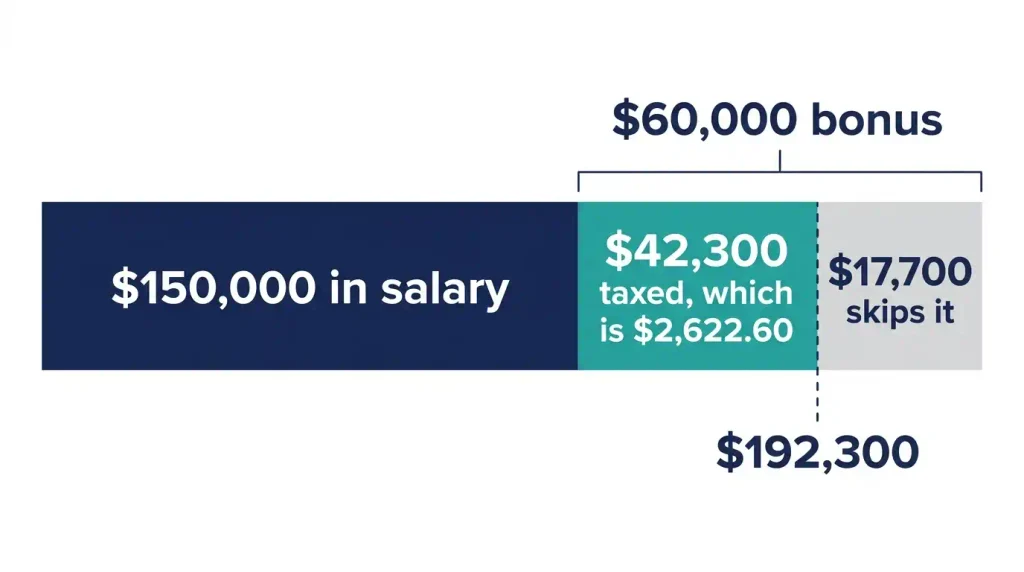
Payroll adds up your Social Security wages each paycheck, and withholding stops once the total hits $192,300. Most taxable pay counts toward that total:
- Salary and hourly pay
- Overtime, bonuses, and commissions
- Tips
- Taxable fringe benefits, like personal use of a company car
Any of these can get you to the limit sooner. Overtime still counts, even with the federal no tax on overtime deduction (up to $12,500, or $25,000 for joint filers, through 2028, per the IRS), because that deduction lowers income tax, not Social Security tax. Say you earn $150,000 in salary and a $60,000 bonus arrives in December. Only the first $42,300 of the bonus is taxed, which is $2,622.60. The other $17,700 skips it. The count resets on January 1.
How the Wage Base Affects Different Pay Schedules
Here is a $240,000 salary on each schedule.
| Pay schedule | Social Security per paycheck | Last paycheck taxed | Paychecks with no Social Security tax |
|---|---|---|---|
| Weekly (52) | $286.15 | 42nd (partial) | 10 |
| Biweekly (26) | $572.31 | 21st (partial) | 5 |
| Semimonthly (24) | $620.00 | 20th (partial) | 4 |
| Monthly (12) | $1,240.00 | 10th (partial) | 2 |
The same annual pay can mean different deductions in the same month, depending on pay schedule or when a bonus lands. The table shows estimates. Your real withholding depends on year-to-date wages, so check your pay stub. For more examples, see our paycheck scenarios.
Why Your Take-Home Pay May Still Change
When Social Security stops, you keep the 6.2% and take-home pay rises. Federal and state income tax withholding follow different rules, depend on your W-4, your California DE 4, and pay level, and are not directly changed by the new 2027 wage base.
In California, state disability insurance (SDI) has no wage cap, per the EDD, so it keeps coming out. Estimate yours with our CA SDI calculator. Benefit premiums, 401(k) deferrals, and other deductions also move net pay. Traditional 401(k) contributions lower income tax wages but not Social Security wages. For more ways to keep pay, see California tax savings planning.
If a paycheck doesn’t match your estimate, check the year-to-date Social Security wages line, then your W-4 and deductions. If tax keeps coming out after one employer has taken $11,922.60, or a final pay stub shows an unexplained deduction, ask payroll to fix it. An employer should refund its own over-withholding without waiting for tax season. If it doesn’t, file Form 843 with your W-2s.
What Happens If You Earn More Than the 2027 Wage Base?
Social Security tax stops on the extra pay, Medicare tax does not, and the extra earnings don’t raise your future benefit.
Social Security Tax vs. Medicare Tax
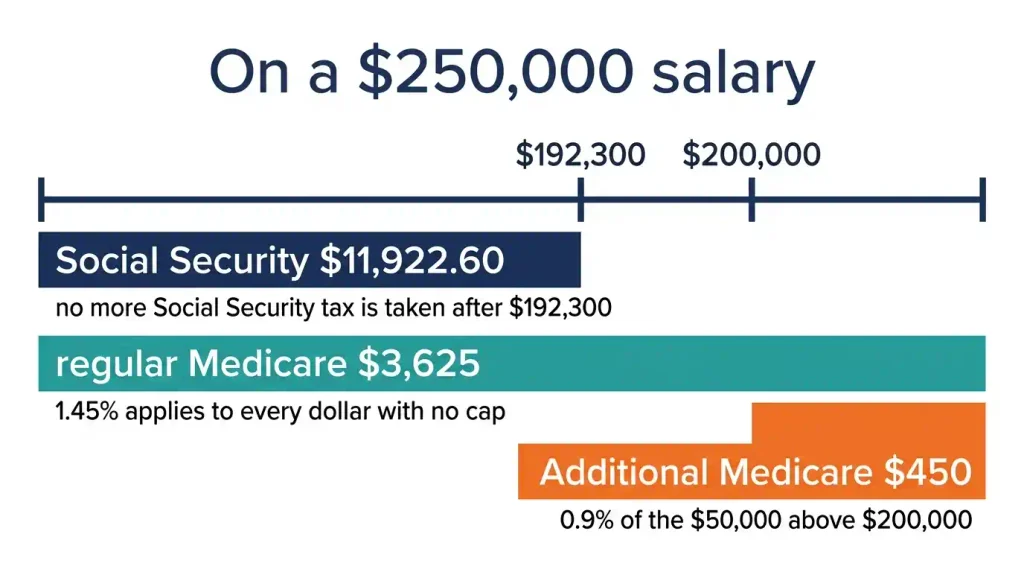
After $192,300, no more Social Security tax is taken. Medicare keeps going. The standard 1.45% employee tax, the Medicare Hospital Insurance (HI) tax, applies to every dollar with no cap. On top of that, you owe a 0.9% Additional Medicare Tax on wages above $200,000 if single or head of household, $250,000 if married filing jointly, and $125,000 if married filing separately. Your employer starts withholding it at $200,000 regardless of filing status and does not match it (IRS Topic 751). On a $250,000 salary, you’d pay $11,922.60 in Social Security, $3,625 in regular Medicare, and $450 in Additional Medicare (0.9% of the $50,000 above $200,000). You settle it on Form 8959 when you file.
Does Earning Above the Wage Base Affect Retirement Benefits?
No. Social Security counts earnings only up to the base each year. It averages your highest 35 years of indexed earnings into Average Indexed Monthly Earnings (AIME). A formula then turns that into your Primary Insurance Amount (PIA), your monthly benefit at full retirement age. If you earn $250,000 in 2027, only $192,300 counts for that year. The rest adds nothing to your benefit and is never taxed for Social Security. The same number caps both the tax (the contribution) and the earnings credited to your earnings record (the benefit).
How Does the Social Security Wage Base Work for Multiple Jobs and Self-Employment?
Each employer tracks the limit separately. Self-employment income shares one limit with your wages, so watch the total.
What If You Have Two Employers in 2027?
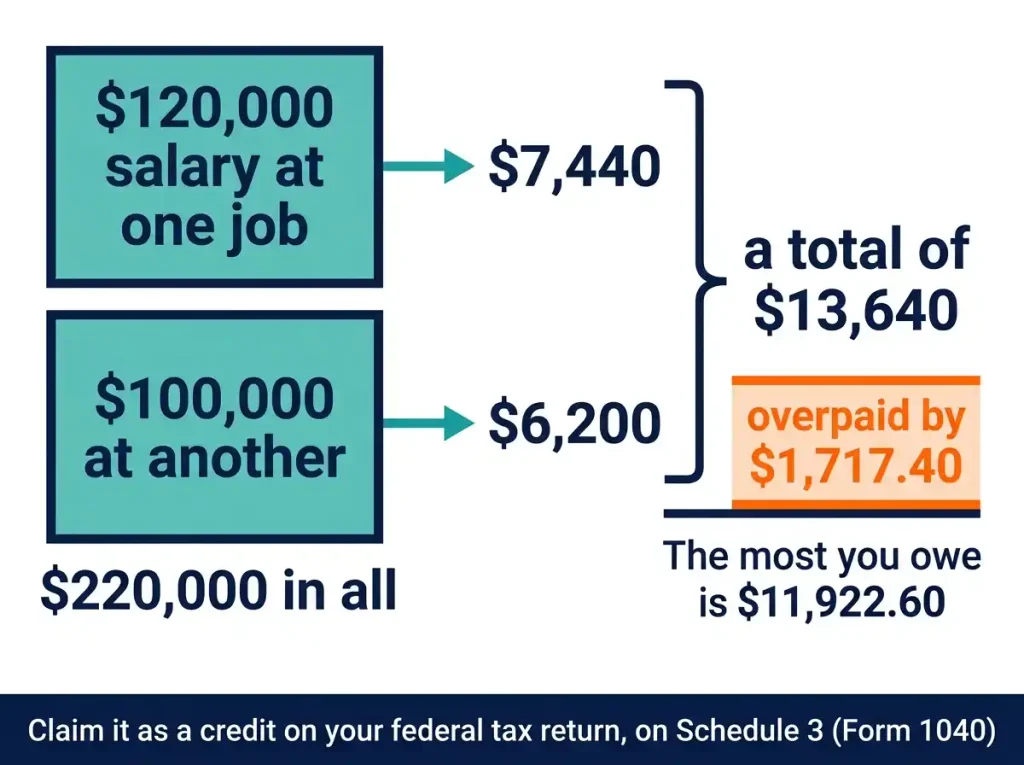
Each employer withholds as if it were your only job, and neither knows what the other paid. Say you earn a $120,000 salary at one job and $100,000 at another, $220,000 in all. Your employers withhold $7,440 and $6,200, a total of $13,640. The most you owe is $11,922.60, so you overpaid by $1,717.40. Claim it as a credit on your federal tax return, on Schedule 3 (Form 1040). If one employer alone withheld too much, ask that employer to fix it instead. If it won’t, file Form 843 with your W-2s. Changing jobs mid-year works the same way. Your new employer generally starts your count at zero, even if your old one already took tax on $150,000 of your pay.
How the Wage Base Applies to Self-Employed Workers
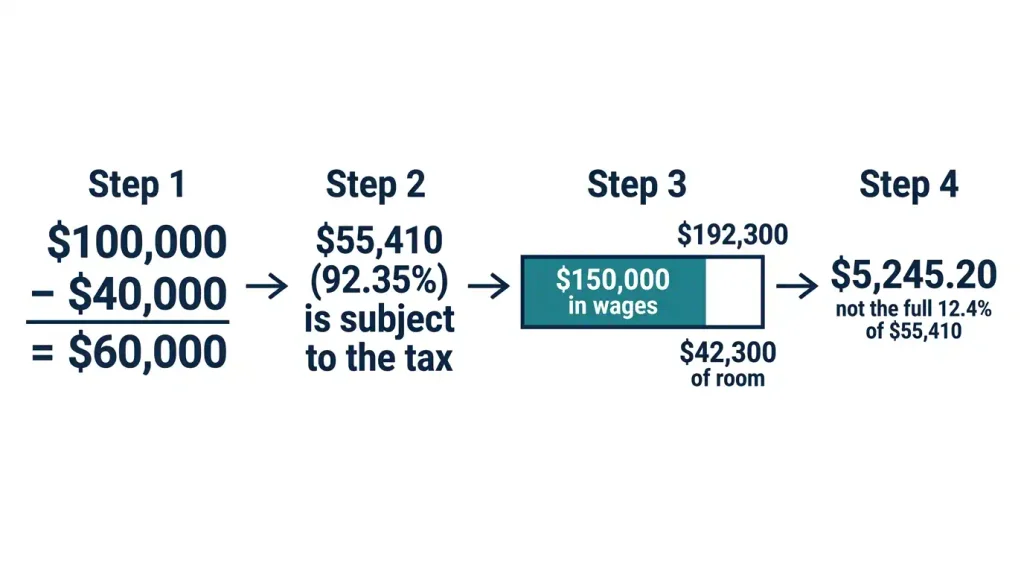
Self-employment tax is 15.3%: 12.4% Social Security and 2.9% Medicare. You owe it once net earnings reach $400. It applies to 92.35% of net earnings, meaning business revenue minus expenses, not gross revenue. Say you bring in $100,000, spend $40,000, and net $60,000. Then $55,410 (92.35%) is subject to the tax. Your W-2 wages use up the Social Security base first. If you also earned $150,000 in wages, only $42,300 of room remains under $192,300, so Social Security tax on the side income is $5,245.20, not the full 12.4% of $55,410. This applies to sole proprietors and partners, and you can deduct half of the self-employment tax when figuring income tax. S corporation owners who pay themselves a salary go through payroll instead. Independent contractors have no withholding, so they pay through quarterly estimated taxes and figure the bill on Schedule SE (Form 1040). Comparing contractor pay with a job? Try our 1099 vs. W-2 calculator.
What Payroll Teams and Employers Need to Know
For 2027, payroll systems should withhold 6.2% of each employee’s wages up to $192,300 and track year-to-date wages per employee. Withholding stops when the total hits the limit, and the last taxed paycheck is often partial. The employer matches 6.2% on the same wages, up to $11,922.60 per employee. Each employee earning above $184,500 costs the employer up to $483.60 more in matching tax in 2027. Ten employees who all earn $192,300 or more add up to $4,836. On each employee’s Form W-2, Form W-2 Box 3 Social Security wages and Form W-2 Box 4 Social Security tax withheld stop at the limit. Form W-2 Box 5 Medicare wages and tips counts every dollar, so it can run higher than Box 3. The employer’s own share is not refunded, even when an employee has two employers and claims the excess on their own return. An employer that over-withholds by mistake must correct it. The Internal Revenue Service (IRS) explains the rules in IRS Publication 15 (Circular E). Its 2027 update was not out as of mid-October 2026, so use SSA’s $192,300 until it is.
Common Social Security Wage Base Misconceptions
The wage base gets confused with other limits. Here are the three main mix-ups.
Does the Wage Base Limit All Payroll Taxes?
No. It only limits Social Security tax. Medicare has no cap, and the 0.9% Additional Medicare Tax applies above $200,000. Federal income tax is separate, uses brackets, and has no connection to the wage base. A worker earning $300,000 stops paying Social Security after $192,300 but keeps paying Medicare and income tax on every dollar.
Does the Wage Base Equal the Social Security Retirement Earnings Limit?
No, they are two different numbers for different groups. The wage base ($192,300) sets how much pay is taxed. The retirement earnings test applies only to people collecting benefits before full retirement age. In 2027, that limit is $25,560 a year, per the 2027 COLA fact sheet. SSA withholds $1 in benefits for every $2 earned above it. In the year you reach full retirement age, a higher limit applies to earnings before the month you reach it, and SSA withholds $1 for every $3 above it. Withheld benefits aren’t lost, since SSA adds them back after you reach full retirement age. Neither limit is a ceiling on what you can earn.
Does a Higher Wage Base Mean Everyone Pays More Social Security Tax?
No. The rate stays 6.2%. Only the amount of pay it applies to changes, and only for people earning above $184,500. A worker earning $100,000 pays $6,200 in both years, and the most any worker pays more in 2027 is $483.60. Earnings above the base are not subject to Social Security tax at all. Talk of raising or scrapping the cap doesn’t change 2027. Only a new law would, and SSA set $192,300 under current law.
Frequently Asked Questions About the 2027 Social Security Wage Base
Short answers to the questions people ask most.
What Is the Maximum Social Security Tax for Employees in 2027?
The maximum is $11,922.60, which is 6.2% of $192,300. Your employer matches it separately.
What Is the Social Security Wage Base for 2027 Compared With 2026?
It is $192,300 in 2027 and was $184,500 in 2026, an increase of $7,800. SSA officially announced it on October 14, 2026.
Do I Stop Paying Social Security Tax After Earning the Wage Base?
Yes, for the rest of the year with that employer. Medicare tax continues on all wages.
What Happens If Two Employers Withhold Too Much Social Security Tax?
When combined withholding passes $11,922.60, claim the excess as a credit on your federal return. If a single employer took too much, that employer should refund you. If it doesn’t, file Form 843 with your W-2s.
Do Self-Employed Workers Have a Different Social Security Wage Limit?
No. The limit is the same $192,300, but you pay 12.4% instead of 6.2%. Wages count against the limit first, then self-employment earnings.
Where Can I Verify the Official 2027 Social Security Wage Base?
Check SSA’s contribution and benefit base page or the 2027 COLA fact sheet. The Social Security Administration Office of the Chief Actuary maintains the SSA page, which includes a table of every past wage base. For employer withholding rules, see IRS Publication 15, whose 2027 update is pending. Before trusting a 2027 Social Security tax calculator, check that its Social Security wage base 2027 reads $192,300 and that it stops the tax at $11,922.60.
Key Takeaways: What the 2027 Wage Base Means for Your Paycheck
Earn under $184,500 and you won’t notice the new limit. Earn above it and you’ll pay up to $483.60 more.
The Numbers and Rules to Remember
- The 2027 wage base is $192,300, up $7,800 from $184,500.
- The employee rate is 6.2%, so the most you pay is $11,922.60, matched by your employer.
- Social Security stops at the limit, but Medicare doesn’t, and the 0.9% Additional Medicare Tax starts above $200,000.
- Employees: check year-to-date Social Security wages on your pay stub, especially with two jobs or a big bonus.
- Self-employed workers: your wages use up the base first.
- Payroll teams: update systems to $192,300 before the first January paycheck.
More on this topic: paycheck basics, payroll compliance and reporting, worker classification, paid leaves and benefits, California labor laws, and California payroll taxes.

Yeasin Sorker is the founder of Paycheck Calculator California. He built this tool in 2018 after noticing that most free paycheck calculators missed California-specific rules like daily overtime and the uncapped SDI rate.
He researches California payroll tax updates regularly and keeps this calculator aligned with the latest IRS, FTB, and EDD published rates. All calculations on this site are estimates based on official 2026 government sources. For personalized tax advice, consult a qualified tax professional.