
Your paycheck came up short again, and you can’t tell if it’s a mistake or something worse. In California, it’s often worse.
Here’s the real issue. Most workers assume nothing can be done about it. That’s not true. A 2026 state law now forces employers to pay wage judgments within 180 days, or face a penalty up to three times what they owe, with half of that going straight to the worker.
Not every shorted paycheck is theft though. A payroll slip fixed fast is different from a pattern that keeps repeating. That difference is where your case actually starts.
Think Your Employer Stole Your Wages? Start Here
Quick Answer
Wage theft is your employer keeping money that is legally yours, unpaid overtime, skipped breaks, shorted tips, or a late final paycheck. California protects every worker, full time, part time, undocumented, or gig. Immigration status and job title do not matter. If you did the work, you get paid. Most cases are recoverable, and many workers recover thousands once they know what to look for.
Is This Wage Theft? Quick Checklist
You likely have a case if your pay stub does not match hours worked, you were told to clock out and keep working, your manager rounded time down but never up, or a bounced final check left you waiting for money you already earned. If you’re still wondering why your paycheck looks smaller than expected, start there before assuming the worst. A one time payroll typo fixed within the same pay period usually is not wage theft. Pattern beats mistake. One fast correction is an error. A repeat is a system built to shortchange you.
What You Can Recover
You can recover the unpaid wages, penalties for late payment, and interest, plus attorney fees and court costs in some cases. A worker shorted $3,000 in overtime over six months could walk away with $5,000 or more once penalties and interest are added.
What Counts as Wage Theft in California?
Failure to Pay Minimum Wage
As of January 1, 2026, California’s minimum wage climbed to $16.90 an hour for every employer, regardless of size, a figure confirmed on the California Department of Industrial Relations’ minimum wage page. Piece rate, commission, or daily pay still must average out to at least $16.90 per hour worked. Deductions for uniforms, tools, or register shortages are illegal in almost every case. Paying part of your wages in unreported cash to dodge taxes is also a violation, even if you agreed to it.
Unpaid Overtime
Daily overtime
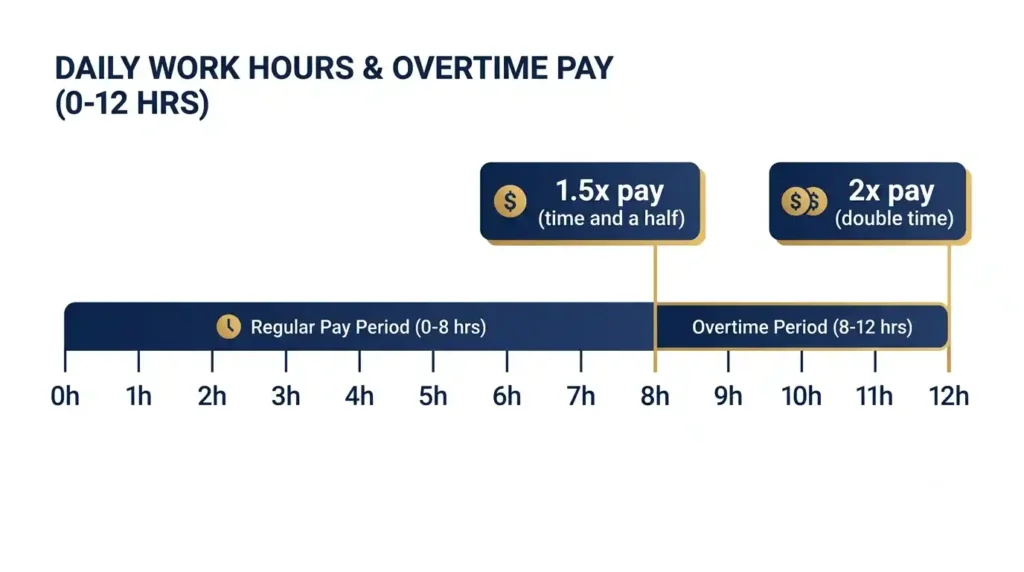
Cross 8 hours in a day and you’re owed time and a half under California’s daily overtime rules. Cross 12 hours, and it becomes double time. Employers sometimes push 9 or 10 hour shifts at straight time. No higher rate on your paycheck for those hours is a red flag.
Weekly overtime
Overtime also kicks in after 40 hours a week, even with no single day over 8. Working multiple locations for one employer or split shifts often causes this to get missed. Employers sometimes “forget” to combine hours across locations, quietly erasing overtime you earned.
Off-the-Clock Work
If your employer benefits from your labor, you get paid, period. That covers pre-shift tasks, post-shift wrap up, mandatory security checks, and opening or closing duties like counting a register. A retail worker losing 15 unpaid minutes a day to security screening loses over 60 hours a year, real money walking out the door. If you show up for a scheduled shift that gets cut short or cancelled, you may also be owed reporting time pay for showing up as scheduled.
Meal and Rest Break Violations
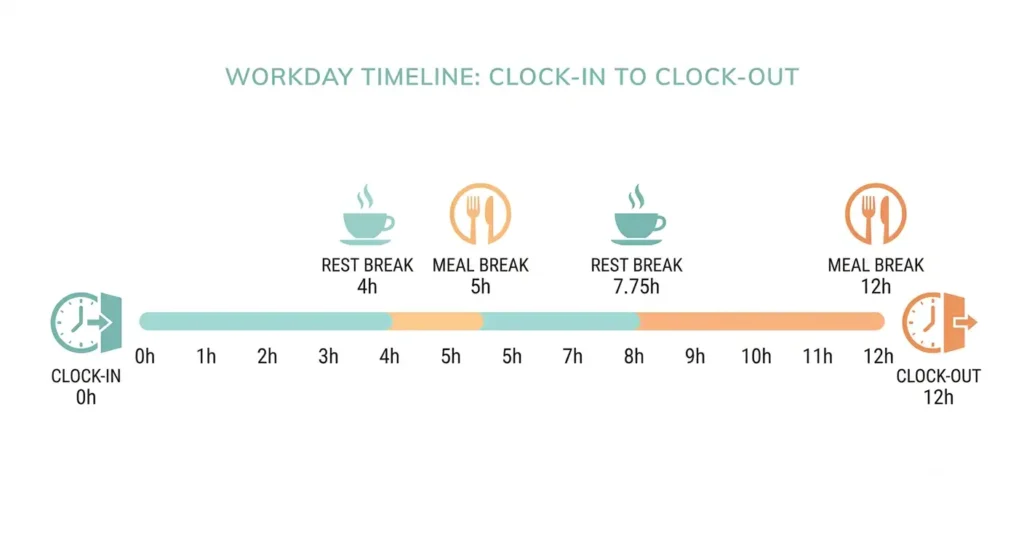
California’s meal and rest break rules require a 30 minute unpaid meal break past 5 hours, and a second past 12 hours, plus a paid 10 minute rest break per 4 hours worked. Denied or pressured-through breaks owe you one extra hour of pay per violation, per day. Miss both meal and rest break in one shift, and that’s two premium hours owed, not one.
Final Paycheck Violations
Fired or laid off, your final paycheck is due immediately. Quit with 72 hours notice, it’s due on your last day. Quit without notice, your employer has 72 hours. Miss these deadlines and waiting time penalties pile up, a full day’s wages per late day, up to 30 days.
Other Common Wage Theft
Tip theft is a manager or owner taking a cut of tips that legally belong to staff. Commission disputes arise when a closed sale goes unpaid once the relationship sours. Unused vacation must be paid out at termination, since California treats it as wages, not a gift. Employers must reimburse necessary business expenses, including mileage at 72.5 cents per mile for 2026. Piece rate workers must be paid separately for rest breaks and other nonproductive time, on top of the piece rate itself.
California Wage Theft Laws That Protect Workers
State Labor Laws
These protections live in the California Labor Code. The Wage Theft Prevention Act requires a written new hire notice covering pay rate, payday, and employer information. Industrial Welfare Commission Wage Orders, often just called IWC Wage Orders, set industry-specific rules. California Labor Code Section 510 sets daily and weekly overtime, California Labor Code Section 1194 lets you sue directly for unpaid minimum wage or overtime, and California Labor Code Section 226 covers wage statements. California Labor Code Section 201, California Labor Code Section 202, and California Labor Code Section 203 govern your final paycheck deadline and late penalty. California Labor Code Section 98 gives the Labor Commissioner authority to decide wage claims. California Labor Code Section 351 protects tips, California Labor Code Section 2802 requires expense reimbursement, California Labor Code Section 558 allows civil penalties, and California Labor Code Section 1102.5 protects you from retaliation.
Federal vs California Law
Federal law is a floor, not a ceiling. The Fair Labor Standards Act, the FLSA, sets a federal minimum wage of $7.25 an hour, enforced by the United States Department of Labor through its Wage and Hour Division, far below California’s $16.90. When state and federal law disagree, the rule that protects the worker wins, so California labor law still applies its own daily overtime rule, which federal law lacks.
Protection Against Retaliation
Your employer cannot fire you, cut hours, or punish you for asking about unpaid wages or filing a claim, win or lose. Retaliation gets its own separate complaint and damages.
How Much Money Could You Recover?
Recoverable Compensation
Core recovery covers unpaid wages, overtime at the correct rate, meal and rest break premiums, and unreimbursed expenses like mileage or required equipment.
Additional Penalties
Waiting time penalties add up to 30 days of wages on top of what’s owed. Inaccurate wage statements carry their own penalty: $50 for the first violation, $100 for each after, capped at $4,000. Interest accrues from the date wages were due, not the date you filed.
Sample Recovery Calculations
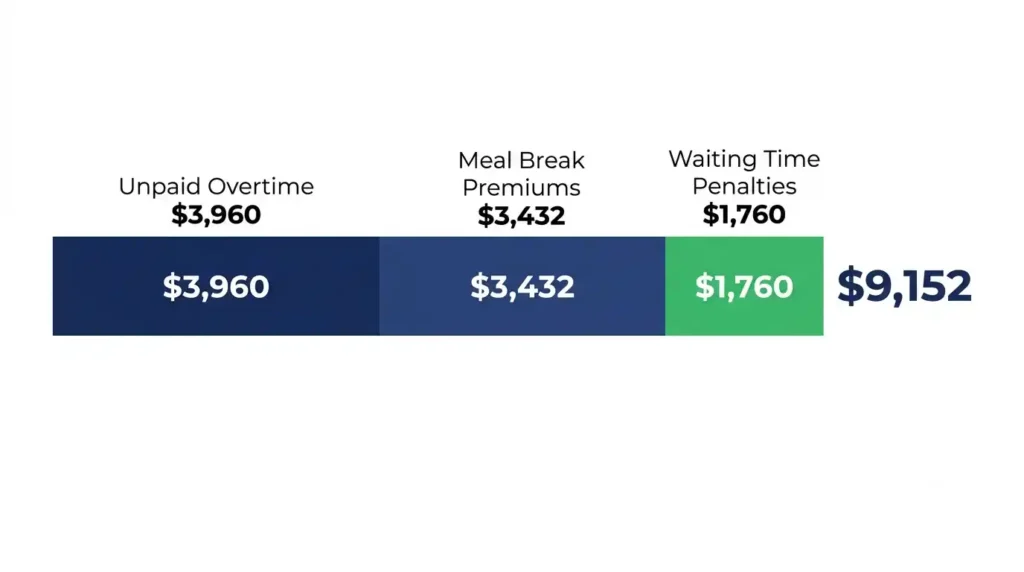
Say you worked 10 unpaid overtime hours a month for a year at $22 an hour. Time and a half is $33, so that’s $3,960 in unpaid overtime alone. Run your own numbers with a gross pay calculator to see how close your paycheck should land. Missed meal breaks three times a week for the year, at one premium hour of $22 each, add $3,432. Ten days without a final check adds 10 days of waiting time penalties, worth $1,760 at that rate. This math shows up in real DLSE claims every week.
Real Workplace Examples
Restaurant Employees
Tip pooling disputes are common when managers dip into the pool, which California law bars outright. Off-the-clock cleaning and skipped breaks during dinner rushes round out the top complaints.
Construction Workers
Unpaid travel time between sites, unpaid equipment setup, and straight time pay for hours owed overtime are the three recurring violations on job sites statewide.
Warehouse Employees
Mandatory end-of-shift security screening, unpaid pre-clock-in meetings, and time rounding that always favors the company are the classic patterns.
Healthcare Workers
Missed breaks during understaffed shifts, unpaid shift extensions for coverage, and unpaid training time are especially common, since employees often hesitate to push back with patients at stake.
Wage Claim vs Lawsuit vs PAGA
Wage Claim
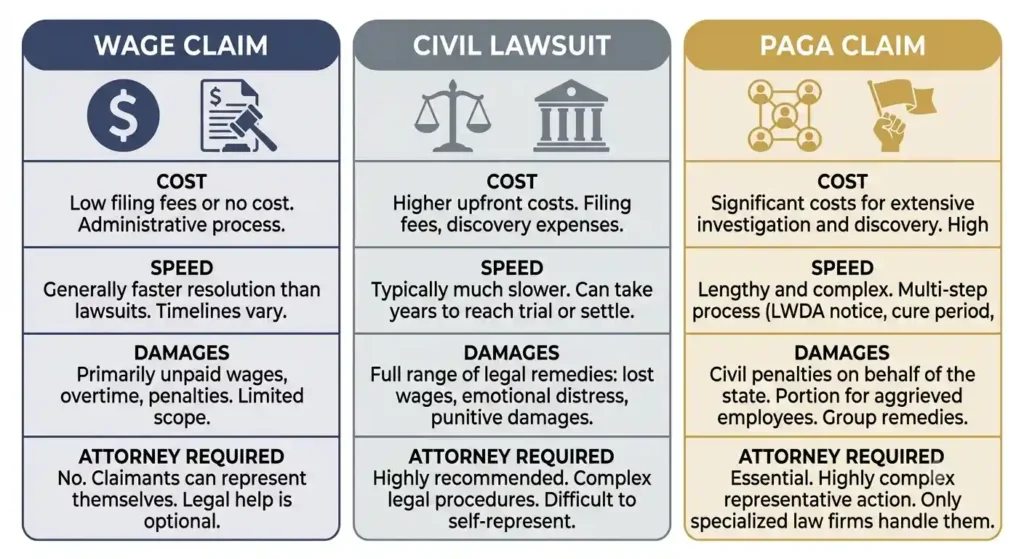
Filing with the Labor Commissioner’s Office suits straightforward violations like unpaid overtime or a late final paycheck. It’s free and needs no lawyer, but can take months and struggles with complex, multi-violation cases.
Civil Lawsuit
A lawsuit fits large amounts, stacked violations, or an ignored DLSE ruling. It can recover more, including attorney fees, but takes longer and usually needs representation.
PAGA Claims
The Private Attorneys General Act lets you sue on behalf of yourself and other affected employees, stepping into the state’s enforcement role. It fits systemic wage theft across a workplace, not an isolated incident.
Comparison Table
| Factor | Wage Claim | Civil Lawsuit | PAGA Claim |
|---|---|---|---|
| Cost | Free | Filing fees, often contingency | Filing fees, often contingency |
| Speed | Months | Longer, often a year or more | Longer, often a year or more |
| Damages | Wages, penalties, interest | Wages, penalties, interest, attorney fees | Civil penalties for all affected workers |
| Attorney required | No | Recommended | Yes |
Filing Deadlines You Shouldn’t Miss
One-Year Claims
Penalties tied to a bounced paycheck carry a one year window. Miss it, and that penalty is gone even if the underlying claim survives.
Two-Year Claims
Violations based on an oral agreement, like a verbally promised wage rate never honored, fall under a two year statute of limitations.
Three-Year Claims
Most core violations, unpaid overtime, minimum wage shortfalls, meal or rest break penalties, give you three years from the violation date to file.
Four-Year Claims
A written contract claim, or one brought under California’s Unfair Competition Law, gets a four year window, the longest available.
What Evidence Should You Collect?
Payroll Documents
Pay stubs, wage statements, and timecards are your strongest evidence, straight from your employer’s own records. Learning how to read your pay stub makes spotting these gaps much faster.
Personal Evidence
Texts about your schedule, emails on pay, photos of posted schedules, and your own hour notes all strengthen a claim when official records are thin.
If You Don’t Have Records
California requires employers to keep payroll records for at least three years. If they can’t produce them, the burden shifts toward the employer to disprove your reasonable estimate.
Gig Workers and Misclassification
Independent Contractor Issues
California uses the ABC test to separate real contractors from misclassified employees. Your employer must prove all three parts: you’re free from their control, your work falls outside their usual business, and you run an independently established business. Fail one part, and you’re legally an employee, entitled to overtime and breaks. This test came from the Dynamex Operations West, Inc. v. Superior Court ruling and was written into law by AB 5.
Employee Rights
Misclassified gig workers can pursue back pay for wages, overtime, and expense reimbursement through the same wage claim and lawsuit options as any employee. Getting your worker classification right matters here, since a 1099 vs W-2 mistake changes what you’re owed. The ongoing wage theft cases against Uber and Lyft, handled by the Labor Commissioner, show how widespread this is.
Common Myths About Wage Theft
Myth vs Reality
Being salaried doesn’t mean no overtime; that only applies if you meet strict exempt duties tests and earn at least $70,304 a year under the 2026 threshold. Undocumented workers have full legal standing regardless of immigration status. Small employers are not exempt from minimum wage or overtime. Cash payment doesn’t sidestep wage law. You don’t need an attorney for a basic wage claim, and missing records don’t sink your case since reasonable estimates backed by personal evidence still count.
Common Employer Defenses—and Whether They’re Legal
“You’re Salaried”
A salary alone doesn’t make you exempt. Exemption depends on actual job duties and a minimum salary threshold, not title or pay structure.
“Everyone Does It”
A workplace habit doesn’t override state law. Denying breaks company-wide just means bigger exposure if workers file together.
“You Never Reported Your Hours”
Employers must track your hours, not the reverse. Their recordkeeping failure is not a valid defense against your claim.
“You Agreed to It”
You cannot waive your right to minimum wage, overtime, or required breaks, even in writing. These rights exist regardless of any agreement.
Mistakes That Can Hurt Your Wage Claim
Evidence Mistakes
Waiting too long risks losing pay stubs, timecards, and clear memory of dates. Vague notes without dates or amounts weaken a claim.
Filing Mistakes
Missing a statute of limitations deadline kills a claim outright. Wrong agency or incomplete paperwork slows everything down.
Communication Mistakes
Complaining on social media can be used against you. Relying only on verbal agreements weakens your position. Signing a settlement without understanding it is one of the costliest mistakes workers make.
How to File a California Wage Claim
Before Filing
Gather every pay stub, timecard, and schedule. Estimate what you’re owed. Confirm your employer’s full legal name and address, since claims against the wrong entity get delayed.
Filing With DLSE
File online, by mail, or in person at a local California Labor Commissioner’s Office, part of the Division of Labor Standards Enforcement within California’s Department of Industrial Relations, the DIR. You’ll need your information, your employer’s information, and a description of wages owed with supporting dates. Filing is free, and deadlines depend on the violation type. For the broader compliance rules employers answer to, see our payroll compliance reporting coverage.
What Happens Next
Settlement conference
Most claims start with an informal settlement conference, where a deputy labor commissioner helps both sides reach agreement. A fair settlement usually beats months of delay.
Wage hearing
If settlement fails, the case moves to a formal hearing under oath. The Labor Commissioner issues a written decision, and either side can appeal to civil court.
Collecting After You Win
Winning is only half the fight. A 2023 California State Auditor report found the Labor Commission fully collected on just 12 percent of judgments between 2018 and 2023. That’s why the state passed SB 261, effective January 1, 2026. Employers who don’t pay a wage judgment within 180 days face a penalty of up to three times the unsatisfied amount plus interest, with half going directly to the worker.
Frequently Asked Questions
Is wage theft a crime in California?
Yes. Under AB 1003, intentional theft of more than $950 from one worker, or $2,350 total from several, can be charged as grand theft under Penal Code Section 487m.
Can undocumented workers file wage claims?
Yes. California labor law applies regardless of immigration status, and your employer cannot legally threaten you with deportation for filing.
Can I be fired for reporting wage theft?
No. Retaliation is illegal, and it gets its own separate complaint.
How long does a wage claim take?
Simple claims resolve in a few months. Complex, multi-violation cases or hearings take longer.
Do I need a lawyer?
Not for a basic DLSE wage claim. For overtime disputes, PAGA claims, or larger recoveries, a lawyer often nets more money, and many work on contingency.
What if my employer changed my timecard?
Altering timecards is illegal and strengthens your case, since it shows intent, not a mistake.
What if I was paid in cash?
You’re still owed accurate wage statements and full legal pay. Bank deposits or your own notes can help establish what you earned.
What if I already quit?
You can still file after leaving. Quitting often makes it easier to speak freely without fear of ongoing retaliation.
Can I recover attorney’s fees?
In many overtime and minimum wage lawsuits, yes, California law lets the winning employee recover reasonable attorney fees and costs.
Can multiple employees file together?
Yes. A PAGA claim or class action strengthens the case, since a pattern across many workers is harder to dismiss as an isolated mistake.
Final Action Plan
Confirm the Violation
Pull recent pay stubs and compare against hours actually worked. Identify which law applies, overtime, breaks, or a late final paycheck. Estimate roughly what you’re owed.
Prepare Your Case
Organize documents by date. Build a simple timeline. Calculate damages precisely, since a clear number makes your claim more credible.
Take the Next Step
File with the DLSE, or consult an employment attorney for larger or multi-violation cases. Track deadlines and follow up instead of assuming the system will chase it for you.

Yeasin Sorker is the founder of Paycheck Calculator California. He built this tool in 2018 after noticing that most free paycheck calculators missed California-specific rules like daily overtime and the uncapped SDI rate.
He researches California payroll tax updates regularly and keeps this calculator aligned with the latest IRS, FTB, and EDD published rates. All calculations on this site are estimates based on official 2026 government sources. For personalized tax advice, consult a qualified tax professional.