
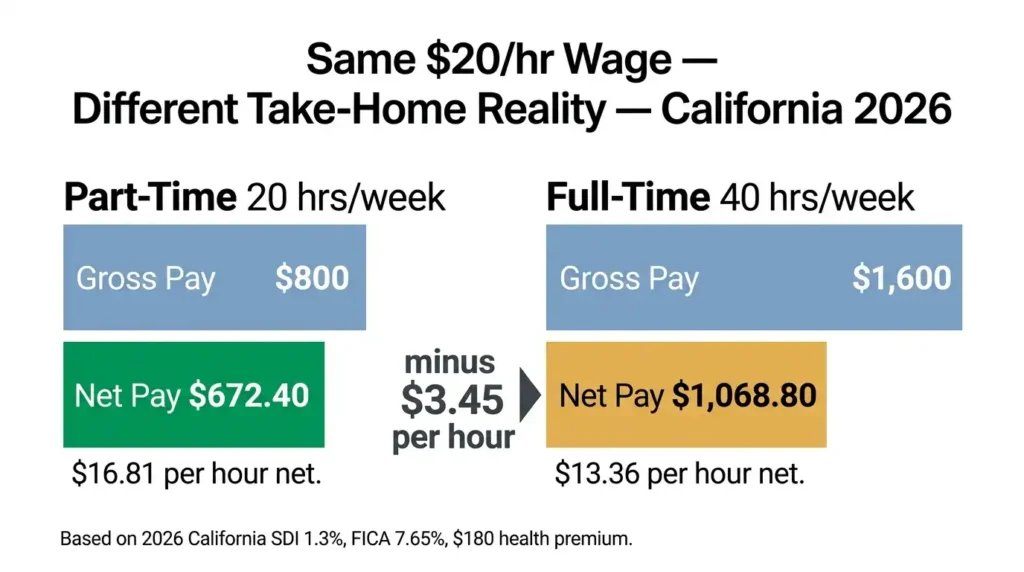
In California, a full-time worker earns more total income, but a part-time worker often keeps more money per hour worked. After taxes, deductions, and benefit costs, two workers earning the same $20 hourly rate can take home a difference of $3.45 per hour.
In 8 years of decoding California pay stubs, I have seen this gap first-hand. At the same $20 wage, my data shows a part-time worker nets $16.81 per hour while a full-time peer nets just $13.36, once California SDI at 1.3%, FICA, and health insurance premiums are subtracted.
Full-time only wins financially when you actually use its benefits. If you never tap the health plan or 401(k) match, the paycheck advantage disappears fast.
Why Your Paycheck Does Not Match Your Expectations
You do the math. You multiply your hours by your wage. Then you look at the deposit and feel confused. We have all been there.
The problem is that gross pay and net pay live in two completely different worlds. California has one of the most complex payroll systems in the country. Between the California Department of Industrial Relations (DIR), the Employment Development Department (EDD), the Franchise Tax Board (FTB), and the Internal Revenue Service (IRS), your paycheck passes through many hands before it reaches yours.
The California minimum wage 2026 sits at $16.90 per hour statewide. But fast food workers at chains with 60 or more locations now earn $20.00 per hour. Healthcare workers at large systems earn up to $24.00 per hour. West Hollywood workers have a $20.25 floor. A part-time fast food worker can out-earn a full-time entry-level office worker on a gross hourly basis. That fact changes everything about how you compare jobs.
Takeaway: Gross wage is a starting point, not a finish line. Net pay is what actually matters.
Reality Check: Common Myths That Confuse Your Paycheck
“Part-Time Pays Less Tax”
This is false. California taxes your total annual income. It does not care whether you earned that money in 20 hours or 40 hours per week. The Franchise Tax Board applies a progressive personal income tax that starts at 1.0% and climbs to 13.3%. Your tax rate depends on what you earn in a year, not how many hours your employer scheduled you.
In my experience, part-time workers who hold two jobs often pay more in taxes than a single full-time worker earning the same total income. I will explain why in the multi-job section below. It is one of the most expensive surprises I see every year.
Takeaway: Job classification does not determine your tax bracket. Total income does.
“Full-Time Always Pays More Per Dollar”
This is also false. A full-time worker earning $25 per hour may take home less per hour worked than a part-time worker earning the same rate. Why? Benefit deductions. Full-time employees often pay $300 to $800 per month in health insurance premiums. That can erase $2 to $5 of effective hourly pay before overtime even becomes a factor.
What I have found is that benefits only help you financially if you actually use them. A healthy 25-year-old paying $400 per month for a PPO plan may be losing money compared to a part-time peer who buys a cheaper HMO on the Covered California marketplace.
Takeaway: Full-time earns more total. But part-time can earn more per dollar if you do not need the benefits.
“Only Full-Time Workers Get Overtime”
This myth costs California workers real money every year. The California Labor Commissioner is very clear on this point. Overtime eligibility in California depends on hours worked, not your employment classification. Any non-exempt worker who works more than 8 hours in a single day earns 1.5x overtime pay. Work more than 12 hours in a day and you earn double time at 2.0x. The 40-hour weekly limit triggers 1.5x pay on every hour above it as well. You can see the full rules in our guide to California daily overtime rules.
The 8-hour daily limit is a uniquely Californian rule. Federal law only triggers overtime after 40 weekly hours. This matters a lot for part-time workers who pick up long shifts. A part-time employee who works one 12-hour Saturday earns 1.5x for hours 9 through 12. Their employer cannot legally call them “part-time” and skip that overtime.
Takeaway: Part-time status does not cancel overtime rights. Every non-exempt worker earns overtime protection in California.
“Part-Time Workers Do Not Get Benefits”
Wrong again. Under California sick leave accrual law, almost every worker earns 1 hour of sick leave for every 30 hours worked. A part-time worker clocking 20 hours per week still earns protected sick time. The Division of Labor Standards Enforcement (DLSE) enforces this aggressively.
What part-time workers often miss is the Affordable Care Act (ACA) 30-hour insurance threshold. If your employer has 50 or more full-time equivalent employees, they must offer health insurance to any worker averaging 30 or more hours per week. This single number shapes scheduling decisions across California every single day.
Takeaway: Part-time workers earn sick leave and may qualify for employer health insurance at 30 hours per week.
How Paychecks Actually Work: The Gross to Net Calculation
Step 1: Calculate Your Gross Pay
Gross pay is your hourly rate multiplied by hours worked. For salaried workers, it is your annual salary divided by your payroll cycle. California employers use several payroll cycles: weekly, bi-weekly, semi-monthly, or monthly. Most hourly workers receive bi-weekly pay.
For a part-time worker with variable hours, gross pay changes every period. This unpredictability is a real financial strain. I always advise part-time workers to budget on their lowest recent paycheck, not their average. Predictive scheduling laws in some California cities now require employers to post schedules in advance, which helps reduce this anxiety.
Takeaway: Gross pay is just the starting number. Every line after it reduces your take-home amount.
Step 2: Understand FICA Taxes
FICA stands for Federal Insurance Contributions Act. This covers Social Security and Medicare. Every worker pays 6.2% for Social Security and 1.45% for Medicare. Combined, FICA taxes take 7.65% of your gross pay. Both part-time and full-time workers pay this equally.
There is no exemption based on hours. A student working 10 hours per week still sees 7.65% removed for FICA before anything else. The IRS treats all wage income the same way for these purposes.
Takeaway: FICA taxes hit every worker equally at 7.65% of gross wages.
Step 3: Apply California State Income Tax
The Franchise Tax Board collects California’s personal income tax (PIT). The rates are progressive. Low earners pay 1% to 4%. Workers in the middle pay 6% to 9.3%. High earners face rates up to 13.3%. See the full California state income tax brackets for a complete breakdown by income level.
Your Form DE-4 (California’s equivalent of the federal W-4) tells your employer how much state tax to withhold. If you fill it out incorrectly, you may owe money at tax time. Our step-by-step guide on how to fill out your Form DE-4 covers every section, including the multiple jobs worksheet. I have seen workers owe $800 or more in April simply because they did not account for a second job on their DE-4.
Takeaway: California state income tax is progressive. More income means a higher marginal tax rate on each new dollar you earn.
Step 4: Subtract California SDI
CASDI withholding is unique to California. The California SDI rate for 2026 is 1.3% of gross wages. This is a mandatory deduction. It funds short-term disability benefits and California’s Paid Family Leave (PFL) program. Almost every California employee pays this.
Many workers see this line on their pay stub and wonder what it is. It is not a fine or a mistake. It is a form of insurance you are paying into. If you become unable to work due to illness or pregnancy, SDI can replace a portion of your income. The Employment Development Department (EDD) manages this program and publishes the official rate annually on the EDD Contribution Rates and Withholding page.
Takeaway: California SDI is a 1.3% mandatory deduction that funds disability and paid family leave benefits.
The Full Net Pay Formula
Here is the formula that payroll calculators use but rarely explain. For a deeper look at every component, see our full guide to California payroll taxes:
Net Pay = (Gross Wage x Hours) minus (PIT + SDI + FICA + Insurance Premiums + Retirement Contributions)
Where:
- SDI = 1.3% of gross wages
- FICA = 7.65% (6.2% Social Security + 1.45% Medicare)
- PIT = 1% to 13.3% depending on total annual income
- Insurance Premiums = $0 for many part-time workers, $200-$800 per month for full-time
- Retirement Contributions = optional but reduce taxable income
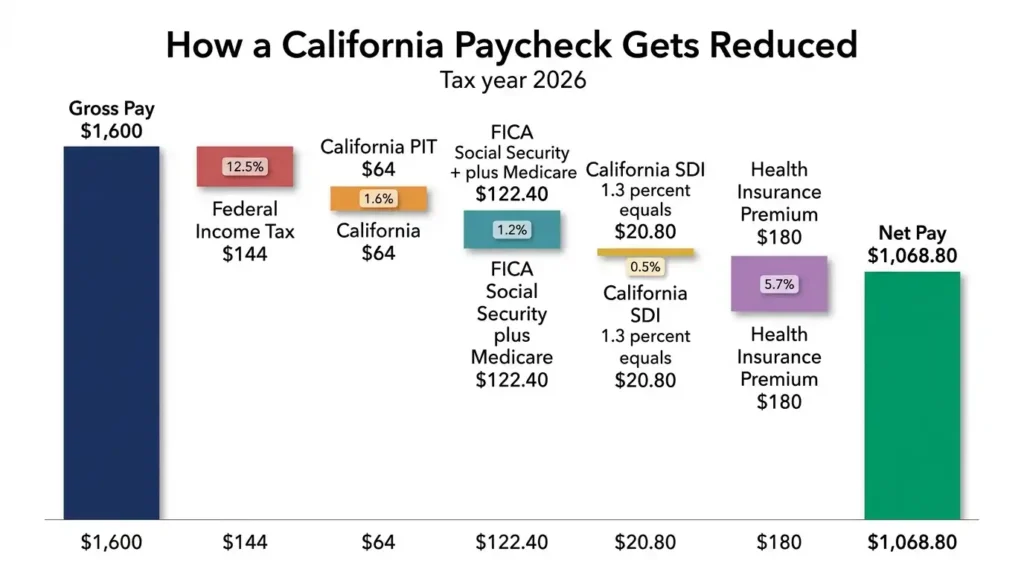
This formula is your financial compass. Print it out. Write your numbers in. Run both scenarios: part-time at 20 hours and full-time at 40 hours. The results often shock people.
Takeaway: Net pay depends on six variables, not just your hourly rate. Run the full formula before comparing job offers.
Real Pay Stub Walkthrough: Line by Line
If you want a full annotated guide alongside this section, our post on how to read your California pay stub walks through every field in detail.
The Earnings Section
Your pay stub starts with gross earnings. It lists your regular hours and your hourly rate. If you worked overtime, it shows those hours separately at the 1.5x rate. California law requires this breakdown. If your stub combines regular and overtime hours, your employer may be violating the California Labor Commissioner’s standards.
For a part-time worker earning $20 per hour at 20 hours per week on a bi-weekly cycle:
- Regular hours: 40 hours
- Gross pay: $800.00
For a full-time worker earning $20 per hour at 40 hours per week on a bi-weekly cycle:
- Regular hours: 80 hours
- Gross pay: $1,600.00
The Tax Section
After gross pay, the tax section appears. You will see federal income tax withheld. This depends on your W-4 selections. You will see California state income tax withheld. This depends on your DE-4. Then you see Social Security tax at 6.2% and Medicare tax at 1.45%. These are always present.
The year-to-date (YTD) totals column shows how much you have paid in taxes since January 1. Watch this number. It helps you predict whether you will owe or receive a refund when April comes.
The Deduction Section
This section lists your voluntary and mandatory deductions. Health insurance premiums appear here for full-time workers enrolled in a plan. A PPO might cost $350 per month while an HMO costs $180. Retirement contributions follow. A common employer 401(k) match is 50 cents per dollar you put in, up to 6% of your salary. The CalSavers retirement mandate also makes retirement saving available to workers without a 401(k) option.
The ERISA 1,000-hour rule is critical here. If you work more than 1,000 hours in a 12-month period, your employer must allow you to join their retirement plan. A 24-hour-per-week worker clocking 50 weeks hits 1,200 hours and qualifies. Many part-time workers do not know this.
The Net Pay Section
Net pay is what hits your bank account. It is the number that actually matters for your budget. Everything above it is just the math that explains how you got here.
Takeaway: Read every line on your pay stub. Each deduction is a financial decision you can sometimes control.
Side-by-Side Paycheck Comparison: Real California Example
The $20/Hour Worker Scenario in 2026
| Category | Part-Time (20 hrs/week) | Full-Time (40 hrs/week) |
| Bi-Weekly Gross Pay | $800.00 | $1,600.00 |
| Federal Income Tax (est.) | $48.00 | $144.00 |
| California State Tax (est.) | $8.00 | $64.00 |
| Social Security (6.2%) | $49.60 | $99.20 |
| Medicare (1.45%) | $11.60 | $23.20 |
| SDI (1.3%) | $10.40 | $20.80 |
| Health Insurance Premium | $0.00 | $180.00 |
| Estimated Net Pay | $672.40 | $1,068.80 |
| Effective Hourly Net Rate | $16.81/hr | $13.36/hr |
This table reveals something important. The full-time worker earns $396.40 more per bi-weekly period. But they earn $3.45 less per hour in actual take-home pay. That gap is entirely explained by the health insurance premium and the higher tax bracket.
The “Full-Time Feels More Taxed” Insight
This is not a feeling. It is math. Higher income activates higher California tax brackets. Your average tax rate might be 6%, but your marginal rate on the last dollar you earned might be 9.3%. Full-time workers are not being punished. They are experiencing progressive taxation exactly as designed.
Takeaway: Full-time workers pay more total tax AND more per dollar earned because progressive brackets activate at higher income levels.
The Multi-Job Withholding Trap: California’s Biggest Hidden Risk
This is the exclusive insight that most blogs completely miss. I consider it the single most important financial concept for any California worker holding two jobs.
When you take a second part-time job alongside a full-time position, your second employer does not know how much you already earn. Their payroll system calculates withholding as if your part-time income is your only income. It applies the lowest tax bracket to your part-time wages.
But the IRS and the FTB do not care about your employers’ ignorance. They look at your total annual income at tax time. If your full-time job already pushes you into a 22% federal bracket, every dollar from your part-time job is taxed at 22% or higher. Your part-time employer withheld at maybe 10%. The gap is what you owe in April.
How to Fix the Withholding Trap Right Now
The solution is the W-4’s “Multiple Jobs” section. Here is what to do:
- Use the IRS Tax Withholding Estimator at IRS.gov with both income sources entered.
- Get the recommended additional withholding amount.
- Write that number on Line 4(c) of your W-4 for your part-time job.
- Also complete a new Form DE-4 for California, using the “Multiple Jobs” worksheet on the back.
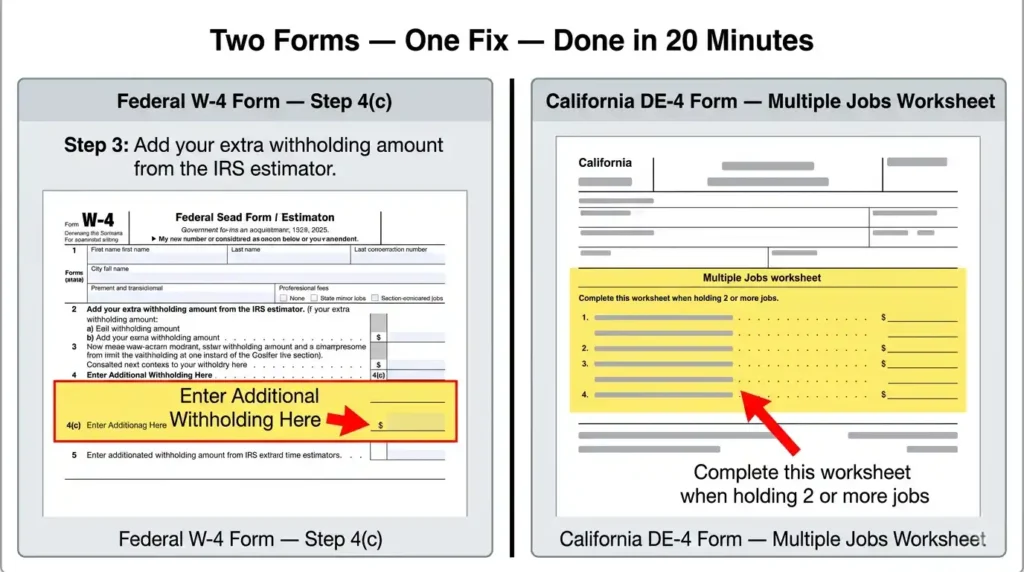
This one step prevents a $500 to $2,000 tax bill in April. I have seen Reddit posts from workers describing exactly this problem. They work two part-time jobs, each withholds a small amount, and they owe money they did not save. The fix takes 20 minutes.
Takeaway: Always update your W-4 and DE-4 when you add a second job. The Multiple Jobs section prevents surprise tax bills.
Gig Workers and 1099 Income: How It Changes Everything
Many California workers mix a W-2 part-time job with gig income from Uber, DoorDash, or freelance work. This combination creates a unique tax situation that most payroll articles completely ignore.
When you work as an independent contractor, no employer withholds taxes for you. The IRS and the Franchise Tax Board expect you to pay quarterly estimated taxes on that income yourself. If you do not, you face an underpayment penalty in addition to the taxes owed. Our full breakdown of 1099 vs W-2 in California explains the exact cost difference between both statuses.
Your gig income also interacts with your W-2 wages. If your part-time W-2 job puts you in a 12% federal bracket, your 1099 gig income gets added on top of that. Every gig dollar may be taxed at 22% or higher. Gig workers also pay both halves of FICA: the standard 7.65% and the employer-side 7.65%, for a combined self-employment tax of 15.3%.
The fix is straightforward. Use IRS Form 1040-ES to estimate your quarterly payments. A Health Savings Account (HSA) or a SEP-IRA can reduce your taxable self-employment income significantly if you qualify. The EDD also requires gig workers to assess whether they meet the California ABC test and AB5 classification criteria, which could change your entire tax picture.
Takeaway: Mixing a W-2 job with 1099 gig income creates a double tax burden. Quarterly estimated payments prevent a painful bill in April.
California Laws That Shape Your Paycheck
No Legal Definition of Part-Time or Full-Time in California
California does not have a law that defines “part-time” or “full-time” in hours. This surprises many workers. The California Department of Industrial Relations does not set a specific hour threshold that makes you one or the other. Employers set their own internal definitions.
The ACA uses 30 hours per week as the threshold for large employer insurance mandates. The federal government uses 40 hours per week as the overtime trigger. Your employer might define full-time as 32, 35, or 40 hours based on their policy. Reading your employee handbook matters.
The Strategic 29-Hour Schedule
Some employers cap part-time schedules at 29 hours per week deliberately. At 30 hours, the Affordable Care Act requires large employers to offer health insurance. At 29 hours, they do not. Employees call this the “29-hour ceiling.”
This practice is legal in most cases. But it becomes illegal when used as retaliation. If you asked about benefits and your hours dropped below 30 within two weeks of that conversation, use the “Timeline Test”: write down your schedule for the past 90 days, note the date of your concern, and take that record to the Division of Labor Standards Enforcement (DLSE) if the timing is suspicious.
Overtime Rules: Daily and Weekly Triggers
California has two overtime triggers. Federal law has one. Our guide to double time vs overtime in California covers every tier with worked examples.
- Daily overtime: Work more than 8 hours in a single workday. You earn 1.5x on hours 9 through 12.
- Daily double time: Work more than 12 hours in a single workday. You earn 2.0x on every hour beyond 12.
- 7th consecutive day: Work 7 days in a single workweek. The first 8 hours on day 7 pay at 1.5x. Hours beyond 8 on day 7 pay at 2.0x.
- Weekly overtime: Work more than 40 hours in a single workweek. You earn 1.5x on every hour above 40.
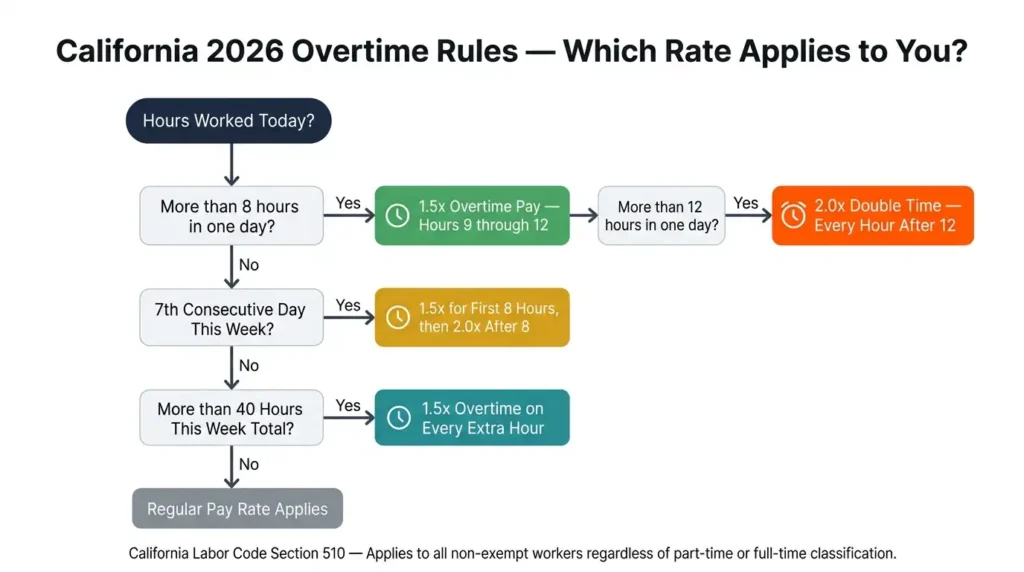
Your employment status as part-time or full-time does not affect any of these rules. They apply to all non-exempt employees.
Split Shift Premiums and Reporting Time Pay
Two California rules that most workers never hear about are split shift premiums and reporting time pay. A split shift is when you work two separate periods in one day with an unpaid break of more than one hour. California requires employers to pay an extra hour at minimum wage for any split shift. This is on top of your regular wages.
Reporting time pay applies when you show up for a scheduled shift and are sent home early. If you work less than half your scheduled shift, your employer must pay you for at least half of it, with a minimum of 2 hours and a maximum of 4 hours. These rules protect part-time workers who rely on showing up for income.
Local City Mandates That Change Your Paycheck
California cities can set rules that go beyond state law. San Francisco’s Health Care Security Ordinance (HCSO) is a strong example. It requires employers with 20 or more workers to spend a minimum amount on healthcare per hour worked for each covered employee. This applies to workers who put in at least 8 hours per week.
The City of Los Angeles raised its minimum wage to $18.42 per hour, effective July 1, 2026. West Hollywood sets it even higher at $20.25 as of January 1, 2026. These minimum wage ordinances mean your paycheck floor depends on your zip code, not just your employer. Always check your city’s specific rate before accepting an hourly offer.
Takeaway: Local city mandates in San Francisco, Los Angeles, and West Hollywood set higher pay floors than state law. Your location directly affects your paycheck.
Income vs Total Compensation: The Hidden Difference
What Part-Time Reality Looks Like
A part-time worker gets a smaller paycheck. They pay fewer deductions. They take home a higher percentage of their gross pay. But they also carry more financial risk. Their income fluctuates with scheduling. They often pay out-of-pocket for health insurance. They may not have access to a 401(k) employer match.
Accrued time off is also smaller for part-time workers. Sick leave accrues at 1 hour for every 30 hours worked. A 20-hour-per-week worker earns sick leave at half the rate of a 40-hour worker. Vacation pay, if offered, is often prorated.
What Full-Time Reality Looks Like
A full-time worker earns more total income. They pay more in taxes. But they often receive benefits that have real dollar value. Employer-paid health insurance, a 401(k) match, and paid time off are forms of compensation that never appear in your hourly rate.
Benefit vesting periods matter here. Many 401(k) employer match programs require you to stay with the company for 1 to 3 years before you “own” that match. Leaving early means leaving money behind. Part-time workers who qualify under the ERISA 1,000-hour rule face the same vesting clocks.
The Total Compensation Formula
True earnings = Cash pay + Health insurance value + Retirement match + Paid time off value + Other benefits.
A full-time worker earning $18 per hour with $400 per month in employer-paid health insurance, a $1,200 annual 401(k) match, and 10 days of paid vacation is actually earning the equivalent of about $21.50 per hour in total value. A part-time worker at $20 per hour with no benefits earns exactly $20 per hour.
The gross hourly rate comparison can be misleading. Total compensation is what actually funds your life.
Takeaway: Add up the dollar value of all benefits before comparing part-time and full-time offers. The gap often shrinks significantly.
Break-Even Analysis: When Full-Time Becomes Worth It
The Benefits Value Threshold
Full-time becomes financially superior when you actually use the benefits. Health insurance only helps you if you have medical expenses. A 401(k) match only helps you if you contribute enough to capture it. Paid time off only helps you if you take it.
The break-even point in many California scenarios is roughly $300 to $400 in monthly benefit usage. If your employer-paid health plan saves you $350 per month in insurance costs that you would otherwise pay yourself, then full-time is worth more in real terms than part-time at the same hourly rate.
Lifestyle Costs Are Real Compensation Costs
Time has value. A full-time schedule may require childcare that costs $1,200 per month. That cost directly reduces your effective compensation. A part-time worker who avoids $800 in childcare costs by working fewer hours is effectively “earning” that $800 through schedule flexibility.
Living wage metrics in California vary widely by county. A living wage for a single adult in San Francisco requires nearly $30 per hour. In Fresno, it may be around $18. These local city mandates and cost of living adjustments (COLA) shape whether any given job actually covers basic expenses.
Takeaway: Full-time pays more total. But lifestyle costs like childcare, commuting, and lost flexibility reduce the real advantage.
Sector-Specific Paychecks: The 2026 California Shift
California’s 2026 minimum wage structure is not one number. It is a tiered system that depends on your industry and city.
| Sector or Region | 2026 Hourly Rate | Monthly Gross (40 hrs/week) |
| Statewide All Employers | $16.90 | $2,929 |
| Fast Food (60+ unit chains) | $20.00 | $3,467 |
| Healthcare (Large Systems) | $24.00 | $4,160 |
| Healthcare (Safety Net) | $18.63 | $3,229 |
| West Hollywood | $20.25 | $3,510 |
| City of Los Angeles | $18.42 (from July 1, 2026) | $3,193 |
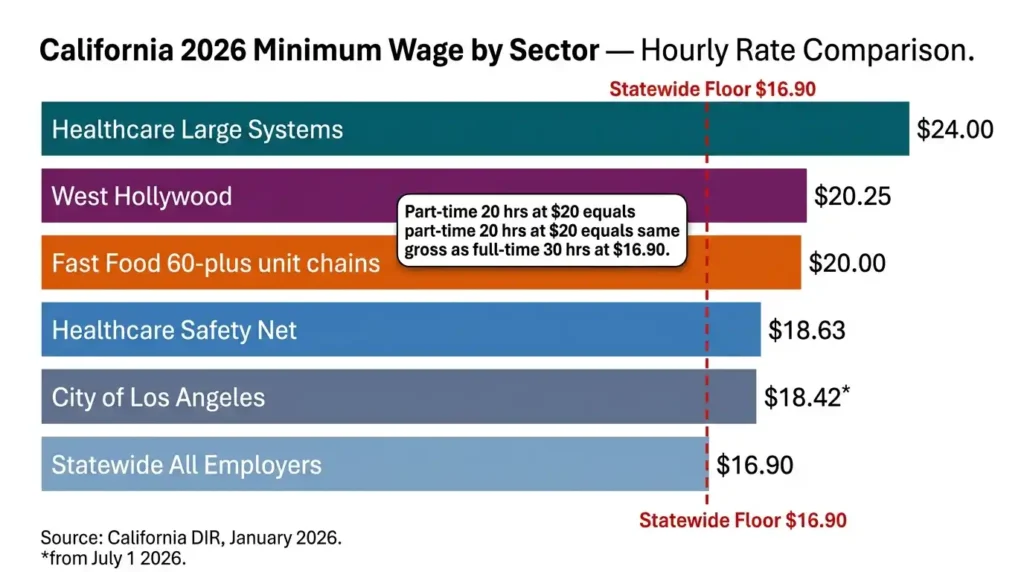
A part-time fast food worker at 20 hours per week earns $400 in gross pay per week. A full-time statewide minimum wage worker at 40 hours earns $676. The fast food part-timer earns $400 for half the hours. Their effective hourly rate advantage is massive. Healthcare workers face an additional layer of complexity covered in our guide to California healthcare worker minimum wage. This is the sectoral shift that changes how California workers evaluate job offers in 2026.
Takeaway: Your industry determines your minimum wage in California. Compare job offers using sector-specific rates, not the statewide floor.
The Exempt Employee Myth for Part-Time Workers
Many managers tell part-time workers they are “salaried exempt” to avoid paying overtime. This is often wrong. California sets the salary floor for exempt status at $70,304 per year in 2026. That is $1,352 per week without exception. A worker earning less than this amount cannot be classified as exempt from overtime regardless of their job title or duties.
Part-time workers almost never meet this salary threshold. A worker earning $35,000 annually in a so-called “manager” role is non-exempt under California law. They are owed overtime for every hour over 8 in a day and every hour over 40 in a week. If you have ever been told you are exempt and your annual pay is below $70,304, speak with the California Labor Commissioner immediately.
Takeaway: Exempt status requires a $70,304 minimum salary in 2026. Part-time workers almost never qualify and are owed overtime protection.
Step-by-Step: Calculate Your Real Paycheck
Follow these steps to find your true take-home pay for any job offer. You can also run all six steps instantly using the California Paycheck Calculator — it handles salary, hourly, 1099, and job comparison modes in one place.
Step 1: Calculate Gross Income Multiply your hourly rate by your weekly hours, then multiply by 52 for annual gross. Divide by 26 for bi-weekly pay periods. You can skip the math entirely with our gross pay calculator built specifically for California workers.
Step 2: Estimate Your Federal Tax Use the IRS tax brackets for your filing status. In 2026, single filers pay 10% on income up to $11,925, then 12% from $11,926 to $48,475, then 22% from $48,476 to $103,350. Most California hourly workers fall in the 12% to 22% range. Use the IRS Withholding Estimator for a precise figure based on your full income.
Two free tools make this faster. PaycheckCity lets you run a full California paycheck estimate in under two minutes by entering your hourly rate, pay period, and filing status. Zenefits offers a benefits cost estimator that shows you the true dollar value of employer health plans side by side. Use both before accepting any job offer.
Step 3: Estimate Your California State Tax The Franchise Tax Board tables show California PIT rates. At $20,000 annual income, your effective state rate is around 1-2%. At $40,000, it rises to about 3-4%. At $60,000, expect 5-6%.
Step 4: Subtract FICA and SDI Subtract 7.65% for FICA. Subtract 1.3% for California SDI. These apply to your gross pay directly.
Step 5: Subtract Benefit Deductions If full-time, subtract your health insurance premium. Add back the employer-paid portion as “invisible income.” Subtract any 401(k) contribution you plan to make.
Step 6: Add Benefit Dollar Value Estimate what employer benefits would cost you if you paid for them yourself. Add this to your net pay as “true compensation.” This gives you the complete picture.
Output: Your true hourly and monthly value in real dollars after everything.
Takeaway: Run this 6-step calculation before accepting or comparing any job offer. The final number often differs significantly from the advertised wage.
Scenario-Based Decision Guide
Students and Side Hustlers: Part-Time Has the Edge
If you are in school or running a side business, part-time work often wins. You keep flexibility. You avoid high deduction packages you may not need. Your tax burden stays low. Your income remains predictable enough to budget around without disrupting your main priorities.
The key is maximizing your hourly rate. A part-time fast food worker earning $20 per hour in 2026 generates the same gross income in 25 hours as a statewide minimum wage worker does in 30 hours. Choose high-paying sectors even for part-time work.
Stability Seekers: Full-Time Has the Edge
If you have dependents, a mortgage, or health conditions requiring regular care, full-time employment usually wins on total value. The health insurance alone can be worth $400 to $800 per month. The retirement match builds long-term wealth. The paid time off gives you financial protection when life gets unpredictable.
Comparing Job Offers: Use This Checklist
- What is the hourly rate for each job?
- What are the average weekly hours (not guaranteed hours)?
- What is the health insurance cost to me per month?
- Does the employer offer a 401(k) with a match? What percentage?
- How many paid sick days and vacation days per year?
- What is the commute cost in time and money per week?
- Are there shift premiums, overtime opportunities, or split shift risks?
- Does the schedule offer predictive scheduling protections?
Run the total compensation formula on both offers. The answer becomes clear.
Takeaway: Use the checklist to compare total compensation, not just wages. The better-paying job is often not the one with the higher hourly rate.
Deep-Dive FAQ: People Also Ask
Is Part-Time Taxed Differently in California?
No. California taxes income based on what you earn in a year, not how many hours you worked. A part-time worker earning $30,000 pays the same tax rate as a full-time worker earning $30,000. The difference is that full-time workers often earn more, which pushes them into higher tax brackets.
Why Do Full-Time Paychecks Feel Smaller Per Dollar?
Three reasons. Higher income activates higher tax brackets. Health insurance premiums reduce net pay by $150 to $400 per bi-weekly period. Retirement contributions, if any, reduce take-home pay further. Each of these is a financial asset or obligation, not a loss. But together they shrink the paycheck dramatically compared to gross wages.
Can Part-Time Workers Earn Overtime in California?
Yes. Every non-exempt worker in California earns 1.5x overtime pay after 8 hours in a single day and 2.0x after 12 hours. The 40-hour weekly limit also triggers 1.5x for hours beyond 40. Employment classification as part-time does not remove these rights. The California Labor Commissioner enforces this vigorously.
What Counts as Full-Time Hours in California?
California law has no set definition. Most employers define full-time as 32 to 40 hours per week. The ACA uses 30 hours as the threshold for health insurance mandates on large employers. The IRS uses 30 hours per week as the benchmark for ACA purposes as well. Your employee handbook is the best source for your specific employer’s definition.
Is Two Part-Time Jobs Better Than One Full-Time Job?
It depends on your situation. Two part-time jobs may give you schedule flexibility and variety. But they often create the multi-job withholding trap described above. They may also disqualify you from ACA employer insurance if neither job reaches 30 hours. Run the full net pay calculation for both scenarios before deciding.
How Do I Calculate Real Hourly Pay After Taxes?
Take your annual net pay (after all taxes and deductions). Divide by the number of hours you actually worked in the year. This is your true hourly value. Divide by 52 weeks for a weekly figure. This number tells you exactly what your time is worth after California and federal obligations are met.
What Is the SDI Tax Rate in California for 2026?
The CASDI withholding rate is 1.3% of gross wages for 2026. The Employment Development Department (EDD) manages this program. It funds short-term disability benefits and California’s Paid Family Leave (PFL) program. There is no wage cap on SDI contributions in 2026, unlike Social Security, which caps at $184,500 in covered wages.
Can an Employer Cap My Hours at 29 to Avoid Paying Health Insurance?
Yes, in most cases this is legal. Employers are not required to offer health insurance to workers under 30 hours if they are not considered full-time under their company policy. However, if an employer cuts your hours below 30 specifically because you asked about benefits or exercised a legal right, that could constitute illegal retaliation. Document your schedule changes carefully.
Does My Part-Time Status Affect Eligibility for CFRA?
The California Family Rights Act (CFRA) requires you to have worked for your employer for at least 12 months. You also need to have worked at least 1,250 hours in the past 12 months. That works out to about 24 hours per week. Many part-time workers do qualify. Your employer must have 5 or more employees for CFRA to apply.
What Is the 7th Consecutive Day Rule in California?
If you work 7 consecutive days in a single workweek, California law requires your employer to pay 1.5x overtime for the first 8 hours on that 7th day. Every hour beyond 8 on that 7th day earns 2.0x double time. This rule applies to all non-exempt employees regardless of their part-time or full-time status.
Are Part-Time Workers Eligible for Unemployment in California If Their Hours Are Cut?
Yes, and this surprises many people. The Employment Development Department (EDD) bases unemployment eligibility on your total wages earned in a base period, not on whether you were classified as full-time. If your hours are reduced significantly and you earn below the threshold for your situation, you may qualify for partial unemployment benefits. California calls this “partial claims.” You can work part-time and still receive a reduced UI benefit to make up the gap. Report your earnings honestly every week you claim.
Final Verdict: Which Paycheck Is Better?
Here is my honest answer after 8 years of working through this question with real people in real situations.
Full-time wins on total income and long-term financial security. The higher gross pay, the employer-paid benefits, the retirement match, and the income stability create a stronger financial foundation over time. If you need healthcare, if you have a family, or if you want to build savings consistently, full-time is usually the better path.
Part-time wins on hourly efficiency and flexibility. If you do not need employer benefits, if you are managing multiple income streams, or if your life priorities require schedule control, part-time can generate better results per hour worked. The key is choosing a high-wage sector and avoiding the multi-job withholding trap.
The Decision Matrix
| Priority | Better Choice | Why |
| Maximum total income | Full-time | Higher gross, more hours |
| Maximum per-hour value | Part-time (no benefits needed) | Fewer deductions per dollar |
| Health insurance access | Full-time at 30+ hours | ACA mandate threshold |
| Schedule flexibility | Part-time | Employer-defined flexibility |
| Retirement savings | Full-time with 401(k) match | Employer contribution doubles value |
| Tax simplicity | One full-time job | No multi-job withholding trap |
| Multiple income streams | Part-time | Allows additional roles |
The final insight I will leave you with is this: optimize for your “true hourly value,” not your wage rate. Take your annual net pay. Divide by the hours you actually work, including unpaid commute time and mandatory training. The number you get is what your time is actually worth to you. Make every job decision from that number.
A job that pays $20 per hour but costs you $400 in monthly insurance and 10 hours in weekly commute time may be worth less than a $17 per hour job close to home with employer-paid coverage.
Run the numbers. Trust the math. And remember: in California, the paycheck you see on payday is just the beginning of the story.
Takeaway: There is no universal winner. Full-time wins on total income and benefits. Part-time wins on hourly efficiency. The right choice depends entirely on your life, your health, and your financial goals.
For tools and resources mentioned in this guide:
- IRS Withholding Estimator: irs.gov/W4App
- California EDD: edd.ca.gov
- California DIR: dir.ca.gov
- Covered California: coveredca.gov
- CalSavers: calsavers.com
- California FTB Tax Calculator: ftb.ca.gov
What One Reader Said After Using This Guide
Maria from Riverside sent me a message three weeks after finding this post. She had just accepted a full-time healthcare job at $24.00 per hour. Before reading this, she was about to take a second part-time retail job without updating her W-4. She ran the numbers instead.
“I saved myself $900 in April taxes by just filling out that one form correctly. I had no idea that second job would push me into a higher bracket.”
That is exactly why this guide exists. One 20-minute fix. One form. Real money back in your pocket.

Yeasin Sorker is the founder of Paycheck Calculator California. He built this tool in 2018 after noticing that most free paycheck calculators missed California-specific rules like daily overtime and the uncapped SDI rate.
He researches California payroll tax updates regularly and keeps this calculator aligned with the latest IRS, FTB, and EDD published rates. All calculations on this site are estimates based on official 2026 government sources. For personalized tax advice, consult a qualified tax professional.